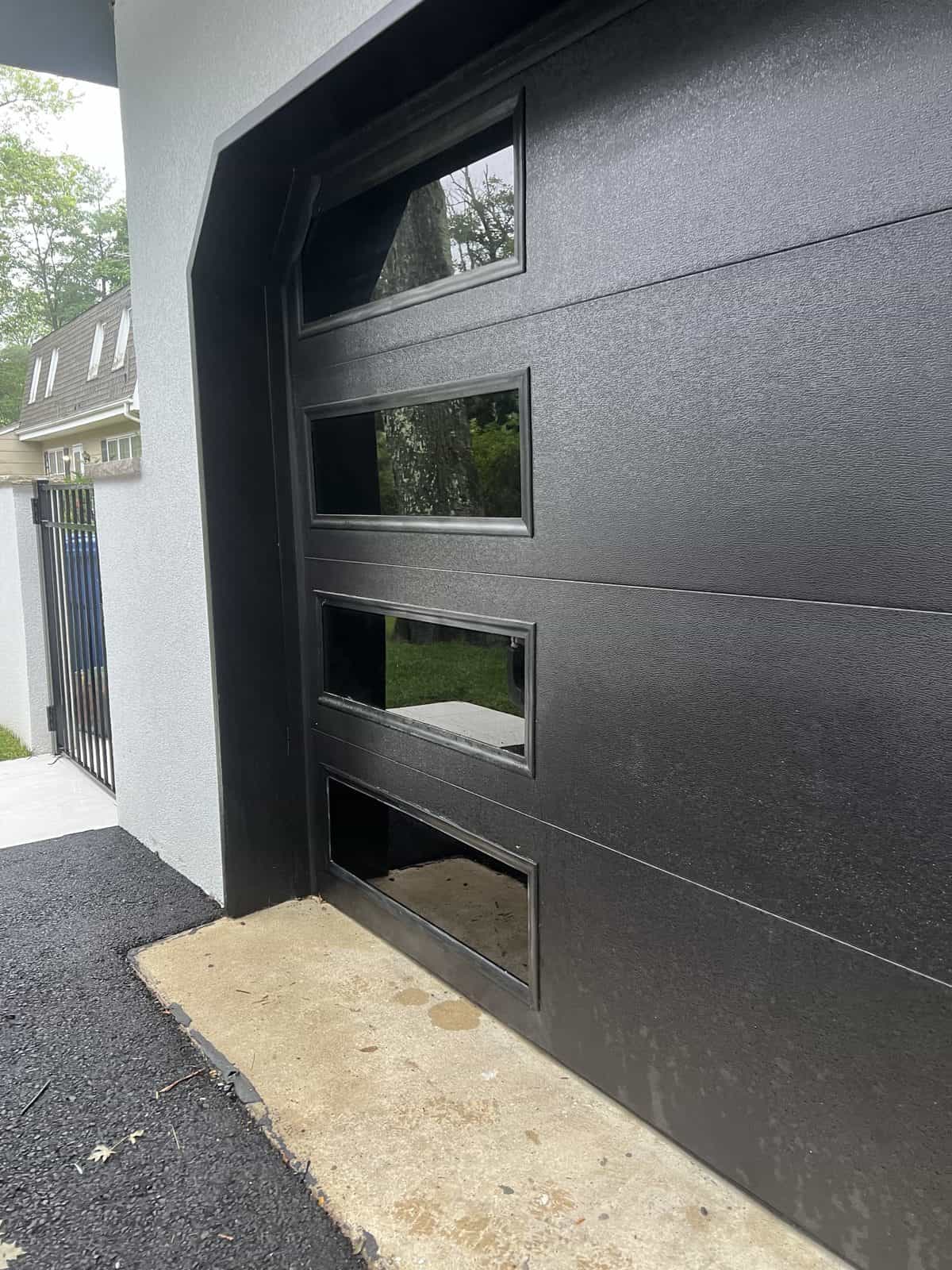
Entry & Front Door Installation
Fiberglass, steel + wood entry doors with decorative glass, sidelites + transoms — measured, quoted, and approved before any work.
Entry & Front Door Installation
Complete entry and front door replacement for NJ homes — fiberglass, steel, and wood door systems installed as prehung units with proper sill flashing, insulation, and weatherstripping built for nor'easter wind-driven rain. Because we're a glass company first, the glass side of the job — decorative lites, privacy sidelites, transoms, and safety glazing per IRC R324.4 — is spec'd and serviced in-house rather than ordered blind from a catalog. We verify egress clear-opening requirements (IRC R318) before a configuration is finalized, pull permits when the scope requires them, and coordinate the inspection. Storm doors and French doors install alongside or separately. Every project starts with a free on-site measure and a written quote you approve before anything is ordered or removed.
Your entry door is the hardest-working opening in the house. It gets opened and closed a few thousand times a year, takes wind-driven rain off every nor'easter head-on, carries the deadbolt that secures the whole envelope, and sets the first impression of the property from the curb. We install complete entry systems — fiberglass, steel, and wood doors, with or without sidelites and transoms — across all 21 New Jersey counties from our shop in Garfield. Every job starts the same way: measured on-site, quoted in writing, and approved by you before anything is ordered or removed.
What makes our door work different is that we're a glass company first. Most door installers order the glass package from a catalog and hope it shows up right; we spec, source, and service decorative lites, privacy glass, sidelites, and transoms in-house — the same glass capability behind our shower, storefront, and window work. If your existing door is sound and only the glass is wrong — a fogged half-lite, a dated oval insert, a clear sidelite where you want privacy — we can often fix the glass without replacing the door at all.
Fiberglass vs. steel vs. wood: which one for a New Jersey entry
For most NJ homes, fiberglass is the right answer — and it's what we install most. New Jersey's freeze-thaw winters and humid summers punish doors that move: wood swells and sticks in August, then shrinks and lets drafts through in January. Fiberglass doesn't absorb moisture, won't warp, rot, or rust, and modern wood-grain skins take a stain convincingly enough that from the sidewalk it reads as wood. The foam-insulated core also outperforms solid wood several times over thermally, which matters on an entry that faces the winter wind.
Steel is the value and security pick. An insulated steel door in a reinforced frame is genuinely hard to kick in, closes with a solid feel, and costs less than comparable fiberglass. The trade-offs: steel can dent, scratches need touch-up before rust starts, and on shore properties salt air will find any break in the finish. We recommend steel for side and utility entries, rental properties, and budget-driven replacements away from the coast — and we'll say so plainly at the quote if your situation points the other way.
Wood is still the right call on the housing New Jersey has a lot of — pre-war Colonials, Tudors, and Victorians in towns like Montclair, Ridgewood, and Princeton, where a fiberglass slab can read wrong on the facade. Wood needs an honest conversation about exposure: a protected entry under a portico can carry a stained mahogany door for decades, while an unprotected south-facing entry will need refinishing on a real schedule. We'll tell you which one you have before you commit.
Glass is where an entry door comes alive — and where we're strongest
Sidelites, transoms, and door lites do more for curb appeal than any other line item on an entry quote, and they're exactly the part of the job a windows-and-glass company should own. We offer clear, decorative-caming, seeded, rain, frosted, and etched-pattern glass in door inserts and sidelites, with privacy levels from fully transparent to fully obscure — so you can get daylight into a dark foyer without giving the street a view of it. Internal-blinds glass is available where you want both options in one unit.
Glass in and around doors is safety-glazing territory under the code. IRC R324.4, enforced statewide through New Jersey's Uniform Construction Code, requires tempered or laminated glass in door lites and in any fixed panel within 24 inches of the door edge with glass lower than 60 inches off the floor — which describes virtually every sidelite ever installed. Every insert and sidelite we install carries certified safety glazing, and for ground-floor entries where security is the concern we quote laminated glass, which holds together when broken instead of leaving an open hole.
Because glass is our core trade, we also handle the jobs most door companies won't touch: replacing a fogged insulated lite in an otherwise good door, swapping a builder-grade clear insert for decorative glass, or converting a clear sidelite to privacy glass. If the slab, frame, and hardware are sound, replacing just the glass is a fraction of the disruption of a full door replacement — and we'll tell you honestly which side of that line your door is on.
Egress, code, and permits: the basics NJ homeowners should know
New Jersey enforces the IRC through the Uniform Construction Code (N.J.A.C. 5:23), and the section that governs entry doors is R318: every dwelling needs at least one side-hinged egress door providing a minimum 32-inch clear width and 78-inch clear height. For most homes, that designated door is the front entry. This matters at replacement time because clear width is measured with the door open 90 degrees — and squeezing sidelites into an existing opening can shrink the door slab below the egress minimum. We check that math at the measure visit, before you fall in love with a configuration that won't pass.
R318 also covers what's underfoot: a landing or floor on each side of the egress door, with the threshold held within code height limits so the entry doesn't become a trip hazard. On permits, the answer is better than most homeowners expect: replacing a door in the same opening, without altering that opening's dimensions or framing, is ordinary maintenance under N.J.A.C. 5:23-2.7 — the rule says no permit, no inspection and no notice to the enforcing agency, and that it "shall be treated as such by every enforcing agency," so it is not a township-by-township judgment call. Storm doors are named in the same provision. Egress doors are included too, with one condition: the replacement cannot reduce the required height, width or net clear opening of what was there. The exception to watch is opening protectives in fire-resistance-rated assemblies — a rated garage-to-house door or a unit entry off a rated corridor is not ordinary maintenance. Enlarging the opening, adding sidelites or a transom, or altering framing is different work and does need a permit and inspection. We make that call at the measure visit and pull the permit when one is genuinely required.
Weatherproofing: where NJ entry doors actually fail
Most 'bad door' calls we take aren't about the slab — they're about water and air getting past it. Nor'easter rain arrives horizontally, and an entry without proper sill protection wicks water into the subfloor for years before anyone notices the rot. Every full entry install we do gets a sill pan under the threshold that catches water and drains it back out, rot-proof composite frame and brickmold options for exposed entries, and flashing tied into the housewrap shingle-fashion — the same detail discipline we apply to window installs.
The parts that wear out are the seals. Kerf-in compression weatherstripping around the perimeter, corner seal pads at the bottom corners (the number-one draft point on any entry door), an adjustable threshold cap, and a door-bottom sweep — these are what stand between your foyer and a January wind, and all of them are serviceable. If your existing door is solid but drafty, a weatherstripping-and-adjustment service call may genuinely be all you need, and we quote that option when it's the honest answer.
For older or exposed entries, a storm door adds a second thermal barrier plus screened ventilation in the shoulder seasons — our storm door installation page walks through mid-view, full-view, retractable-screen, and security models. One caution we give every customer: we don't recommend storm doors over glass primary doors on unshaded south- or west-facing entries, because heat buildup between the doors can damage the primary door's finish and stress the glass. And if what you actually want is a wide glass opening to the patio rather than a front entry, our French door and sliding glass door pages cover those systems in depth.
Our Process
- 1Free on-site measure and quoteWe measure the rough opening and slab, probe the sill and framing for rot, verify the egress clear-width math if you're considering sidelites, and flag any safety-glazing triggers. You get a written quote listing the exact door system, glass package, hardware, and scope — nothing is ordered and nothing comes off your house until you approve it.
- 2Order, permit, and prepThe door ships as a prehung unit built to your opening — slab, frame, hinges, and glass as one factory-weatherstripped system. Stocked configurations arrive quickly; custom sizes, wood species, and decorative glass packages take a few weeks. If the scope requires a permit, we pull it through the local construction office before install day.
- 3Install day and closeoutOld door out, opening cleaned up and repaired as needed, sill pan set, new unit set on shims until it sits plumb and square, fastened to the manufacturer's schedule, insulated and flashed, lockset and hardware installed, threshold and weatherstripping adjusted until the door closes with an even reveal and a tight seal. Most single-door replacements finish in a day. We haul away the old door and all debris, then walk you through operation and warranty paperwork before we leave.
Materials We Use
The Precision Difference
About Entry & Front Door Installation in NJ
Do I need a permit to replace a front door in New Jersey?+
Which is better for a NJ home — fiberglass or steel?+
Can you replace just the glass in my existing front door?+
How long does entry door installation take?+
What affects the price of a new entry door?+
Should I add a storm door to my new entry door?+
Guides on this
- Are storm doors worth it in NJ?
When a storm door is worth adding, and the sun-facing situations where we tell homeowners not to install one.
Serving All 21 New Jersey Counties
We service Atlantic County, Bergen County, Burlington County, Camden County, Cape May County, Cumberland County, Essex County, Gloucester County, Hudson County, Hunterdon County, Mercer County, Middlesex County, Monmouth County, Morris County, Ocean County, Passaic County, Salem County, Somerset County, Sussex County, Union County, Warren County. From our Garfield, NJ shop we cover the entire state, same-day in Bergen County, and elsewhere depending on the job and how booked we are that day.
Explore More
STORM DOOR INSTALLATION
Andersen + Larson + ProVia storm doors — full-view, mid-view, retractable-screen, and security options for NJ entries.
DetailsFRENCH DOOR INSTALLATION
Hinged double doors with full glass panels — traditional NJ Colonial + Tudor aesthetic for patios + room dividers.
DetailsINTERIOR & OFFICE GLASS DOORS
Interior and office glass doors built for non-standard openings.
DetailsSLIDING GLASS DOOR INSTALLATION
New sliding patio door installation — XO/OX, multi-slide and pocket systems, custom sized.
DetailsSTANDARD WINDOW INSTALLATION
Professional installation of double-hung, single-hung, and slider windows.
DetailsENERGY EFFICIENT REPLACEMENTS
Low-E and argon-filled windows that lower heating and cooling bills.
Details