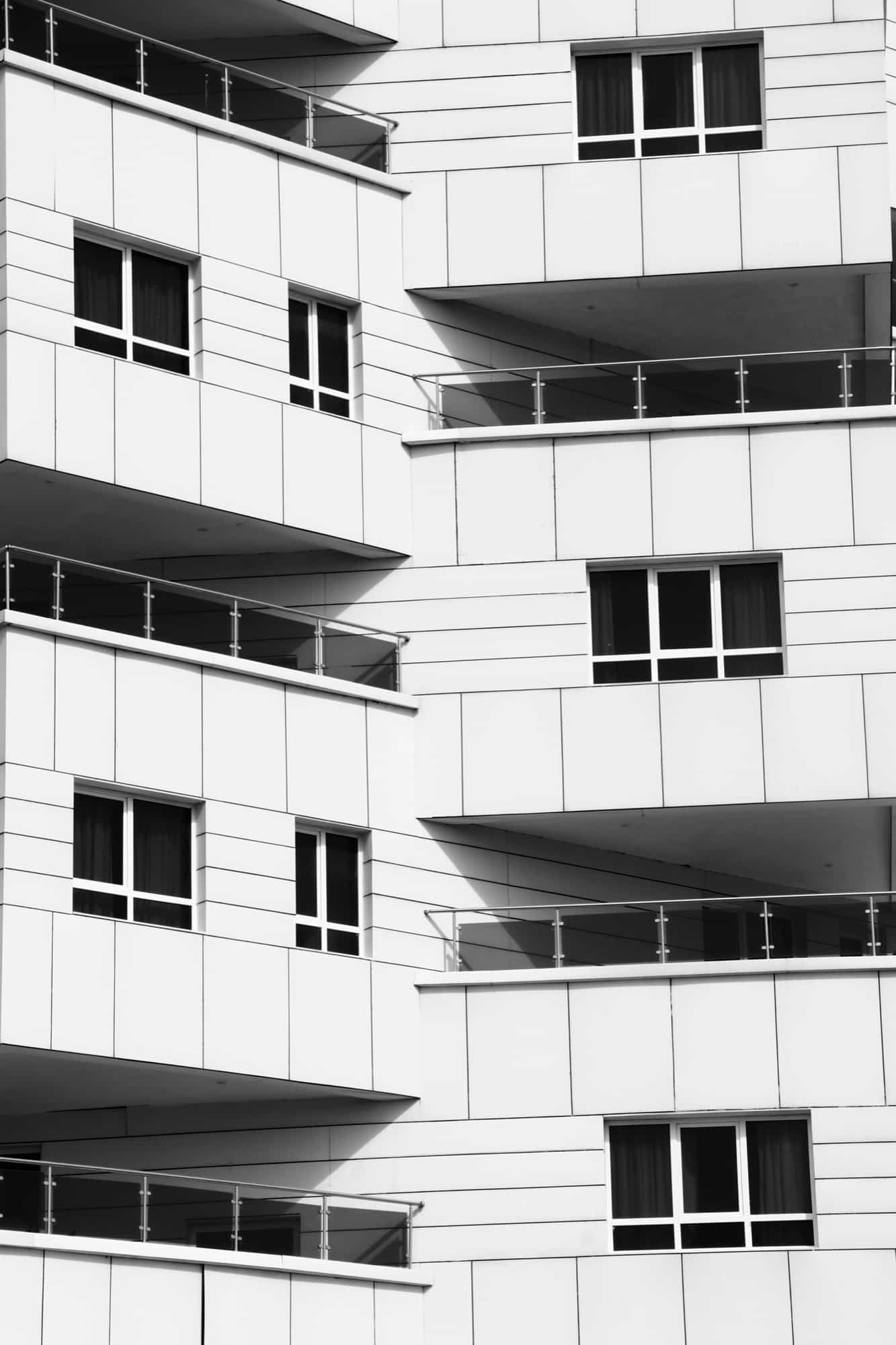
Glass Balcony Railings
Structural glass guards for balconies, terraces and mezzanines.
Glass Balcony Railings
Maximize your view and safety with our structural glass balcony systems. Built for elevated openings — residential balconies, roof terraces, and commercial mezzanines — where the glass is the guard and has to be engineered as one.
Glass balcony guards are a structural system, not a decorative element. IBC Section 2407 (adopted by New Jersey under N.J.A.C. 5:23-3.14) treats glass guards as required structural assemblies subject to load testing, redundancy requirements, and very specific glass make-up. A failure isn't a maintenance issue — it's a fall hazard with potential life-safety consequences. Every glass balcony we install is engineered, fabricated, and installed accordingly.
This page is the elevated guard specifically: balconies, roof terraces, cantilevered decks and interior mezzanines, where the walking surface is well above what is below it and the glass is the only thing between the two. We install them on multifamily high-rises in Jersey City, Hoboken, Newport and along the Hudson waterfront, on luxury single-family residential (Saddle River, Alpine, and the oceanfront in Mantoloking, Bay Head, Avalon and Stone Harbor), and on commercial mixed-use — rooftop bars and terraces, hotel exterior corridors, elevated restaurant decks. Grade-level work — backyard decks, patios, stairs and pool surrounds — is a different install with different substrate and code questions, and it lives on our glass railing systems page.
IBC 2407 and the structural requirements
IBC 2407.1 requires glass used in guards (railings, balconies, balustrades) to be either fully tempered, heat-strengthened, or laminated. Single-lite tempered is permitted only where the guard does not have a top rail OR where the glass is supported on three or more sides. For typical balcony installs — top-mounted, bottom-supported, no continuous top rail — we use laminated tempered or laminated heat-strengthened glass, two lites bonded with a structural interlayer.
The structural interlayer is critical. Standard PVB (polyvinyl butyral) softens significantly at room temperature and is generally not approved as a structural interlayer for guards without a top rail. SentryGlas Plus (ionoplast, Kuraray) and DuPont Sentinel are the two interlayers commonly approved for guard applications — they remain stiff at room temperature and hold the glass together if one lite breaks, preventing the panel from falling out of the assembly.
Load requirements: IBC 1607.8.1 requires guards to resist 50 plf (pounds per linear foot) horizontal load at the top, or 200 lbs concentrated load at any point along the top — whichever produces the larger stress. For glass guards the concentrated load typically governs. Our base case engineering: 1/2 inch laminated tempered with SentryGlas, mounted in a base shoe extrusion (CRL TAPER-LOC HD, Q-railing Easy Glass Slim) or with point-mounted standoffs.
Redundancy: if one lite breaks, the system must remain in place until repair. Laminated construction provides this — the broken lite stays bonded to the intact lite by the interlayer. Single-lite tempered installations require additional design measures (top rail tying multiple panels together, secondary support cables) to satisfy redundancy.
NJ amendments and local enforcement
New Jersey's adoption of IBC 2407 under N.J.A.C. 5:23 includes specific provisions for guard heights: 42 inches minimum measured from the walking surface, and some specific occupancies require more. The 4-inch sphere rule applies (no opening in the guard may pass a 4-inch sphere) which for glass balconies means continuous glass with no horizontal joint gaps wider than 4 inches.
Local enforcement varies by municipality. Jersey City and Hoboken building departments take a strict view on IBC 2407 — every commercial glass balcony or guard install requires engineered shop drawings stamped by an NJ-licensed PE, structural calculations, and product data sheets showing the glass make-up and hardware ratings. Bergen County suburban municipalities (Englewood Cliffs, Tenafly, Saddle River) tend to follow the same standard for high-end residential.
Shore municipalities (Avalon, Stone Harbor, Mantoloking, Long Beach Township) add wind load review. Per ASCE 7-16, basic wind speed for risk category II residential along the Atlantic coast of NJ runs 130-140 mph (3-second gust). Glass guards on oceanfront balconies see direct wind pressure and require sizing for that load — typically pushing us to 3/4 inch laminated tempered with reinforced base shoe anchorage.
Hardware finishes for coastal salt exposure
Any glass balcony east of the Garden State Parkway in the southern shore counties (Atlantic, Cape May, Ocean) or within 1-2 miles of the coast generally is treated as marine environment. Chloride aerosol attacks unprotected metal hardware aggressively — standard 304 stainless will show pitting within 18-36 months, and plated steel fails inside 12 months.
Marine spec for balcony hardware: 316L stainless throughout for any structural component. 'L' denotes low carbon, which improves corrosion resistance at welded joints. All fasteners stainless or hot-dipped galvanized. Aluminum base shoe extrusions: anodized Class I (0.7 mil minimum coating) or fluoropolymer painted (Kynar 500). We avoid powder coat on coastal aluminum — it fails at edges and chalks under UV.
Specific brands we spec for coastal: Q-railing (German manufacturer with strong marine hardware), CRL's TAPER-LOC HD with marine-grade base shoe, Trex Signature Aluminum railing with glass infill. We avoid generic imported base shoe extrusions for coastal work — the aluminum alloy and anodizing depth aren't always specified to marine grade.
Maintenance schedule for coastal glass balcony: rinse hardware with fresh water quarterly, inspect for chloride pitting annually, replace sealants at the 7-10 year mark before adhesion fails. Inland installs run on longer service intervals.
Installation methods: base shoe vs standoff vs spigot
Base shoe (continuous extrusion): aluminum or stainless channel mounted to the deck or slab, glass set into the channel with structural gaskets or wedges. CRL TAPER-LOC HD is the dominant US system; it uses tapered wedges that lock the glass in tension without through-bolts. Q-railing Easy Glass Slim is the European equivalent. Base shoe provides continuous structural support and is our default for residential and most commercial.
Standoff (point-mounted): the glass is held by individual stainless standoffs through pre-drilled holes near the top and bottom edges of each panel. Provides a more transparent look (no continuous base shoe visible), used on luxury residential and architectural commercial. More expensive (custom glass drilling, more hardware) and requires careful engineering — point loads concentrate stress at the standoff penetrations.
Spigot (post-mounted): individual stainless spigots set into the deck at regular intervals (typically 24-36 inches on center), glass panels set into the spigots. Cleaner look than base shoe but slower install. Common on hotel roof terraces and elevated outdoor dining decks.
Deck/slab attachment is where most balcony installs succeed or fail. We require structural engineering review of the deck or slab capacity to receive guard loads. For new construction, embeds are cast into the slab. For retrofit, we use through-bolts, epoxy-anchored studs, or fascia mounts depending on the deck construction. We never face-fasten a guard system to wood blocking or composite decking without engineered hardware and PE review.
Glass make-up and visual considerations
Default residential balcony glass: 1/2 inch laminated tempered with SentryGlas Plus interlayer. Two 1/4 inch tempered lites bonded with 0.060 inch ionoplast. Maximum panel size approximately 4 ft x 6 ft within standard hardware capacities.
Commercial / oceanfront / wind-exposed: 3/4 inch laminated tempered with SentryGlas. Two 5/16 inch tempered lites bonded with 0.090 inch ionoplast. Larger panel sizes possible (up to 5 ft x 8 ft on standard hardware).
Visual options: clear tempered for unobstructed views (the default on oceanfront balconies and roof terraces). Low-iron tempered (Starphire) for the highest clarity — eliminates the green tint visible at edges of standard glass. Frosted or acid-etched for privacy guards on urban balconies overlooking adjacent units. Custom patterns (gradient frit, ceramic frit pattern) for architectural feature installs.
Edge polishing: all visible edges polished to flat-polish or pencil-edge finish. Mitered corners possible on premium installs with custom fabrication. Standard practice is straight panels with 1/4 inch reveal between adjacent panels — the panels do not touch directly, which prevents lite-to-lite chipping under thermal movement.
Our Process
- 1Site survey and structural assessmentWe measure the deck or balcony, evaluate substrate (concrete slab, framed deck, composite, etc.), and confirm whether existing structure can accept guard loads. For retrofit installs we may recommend structural engineering review before quoting.
- 2Engineering and shop drawingsWe produce stamped engineered drawings showing glass spec, hardware schedule, anchorage details, and load calculations. NJ-licensed PE stamp on every commercial install and on coastal residential. Drawings submitted for permit review where required.
- 3Fabrication and lead timeStandard 1/2 inch laminated tempered with stock hardware: 4-6 weeks. Custom-shape glass or larger panel sizes: 6-10 weeks. Marine-spec hardware adds 2-3 weeks. We track production weekly and confirm install date once glass clears tempering and lamination.
- 4Substrate preparationExisting deck surface cleaned and inspected. Concrete slabs prepped for through-bolts or epoxy anchors. Wood-framed decks reinforced where necessary. Waterproofing membrane checked and patched where penetrations will occur.
- 5Hardware installBase shoe or spigots mechanically anchored per engineered detail. Anchorage verified with pull testing on a sample anchor where required. Hardware leveled and aligned across the full run before any glass is set.
- 6Glass set and final lockupGlass panels lifted into position with suction tools (every panel is heavy — 4 ft x 4 ft of 1/2 inch laminated runs around 130 lbs). Set into base shoe with wedges or gaskets, aligned plumb, and final-locked. Top cap or interlayer between panels installed per spec.
- 7Inspection and walkthroughFinal building inspection if permit required. Walkthrough with owner showing maintenance schedule (rinse with fresh water on coastal installs, sealant inspection at year 7, structural check at year 10). Photo documentation of all anchorage details retained in our files.
Materials We Use
The Precision Difference
About Glass Balcony Railings in NJ
Why does my glass balcony need laminated glass instead of just tempered?+
How tall does a glass balcony railing need to be in NJ?+
Will my glass balcony survive a coastal storm?+
Can I get a glass balcony with no visible hardware?+
How long does a glass balcony last in NJ weather?+
Do I need a permit for a glass balcony install in NJ?+
How much does a glass balcony cost in NJ?+
Glass Balcony Railings by City
Serving All 21 New Jersey Counties
We service Atlantic County, Bergen County, Burlington County, Camden County, Cape May County, Cumberland County, Essex County, Gloucester County, Hudson County, Hunterdon County, Mercer County, Middlesex County, Monmouth County, Morris County, Ocean County, Passaic County, Salem County, Somerset County, Sussex County, Union County, Warren County. From our Garfield, NJ shop we cover the entire state, same-day in Bergen County, and elsewhere depending on the job and how booked we are that day.