Roof Repair & Replacement in Hawthorne, NJ
In Hawthorne nobody reviews your shingle, and three Borough offices regulate everything around it: the municipal C&D dumpster is rationed at 2,000 pounds a permit, the Zoning Officer decides whether a container may stand on your lot, and the zoning chapter measures rooftop solar off the finished roof surface. Tear-offs, leak tracing, flashing, gutters. NJHIC #13VH13970900.
Most New Jersey towns leave construction debris to the contractor and a transfer station. Hawthorne runs its own, and § 425-6B opens it to residents of the Borough and their contractors — which sounds, to an owner pricing a re-roof, like the Borough will take the roof. Read the rest of the sentence: “No more than 2,000 pounds, or four cubic yards, of construction or demolition waste shall be deposited at the C & D dumpster under one C & D permit.” One ton, against a tear-off that runs several. Four cubic yards, against a container that holds ten or twenty. § 425-6A puts roofing materials on that list already.
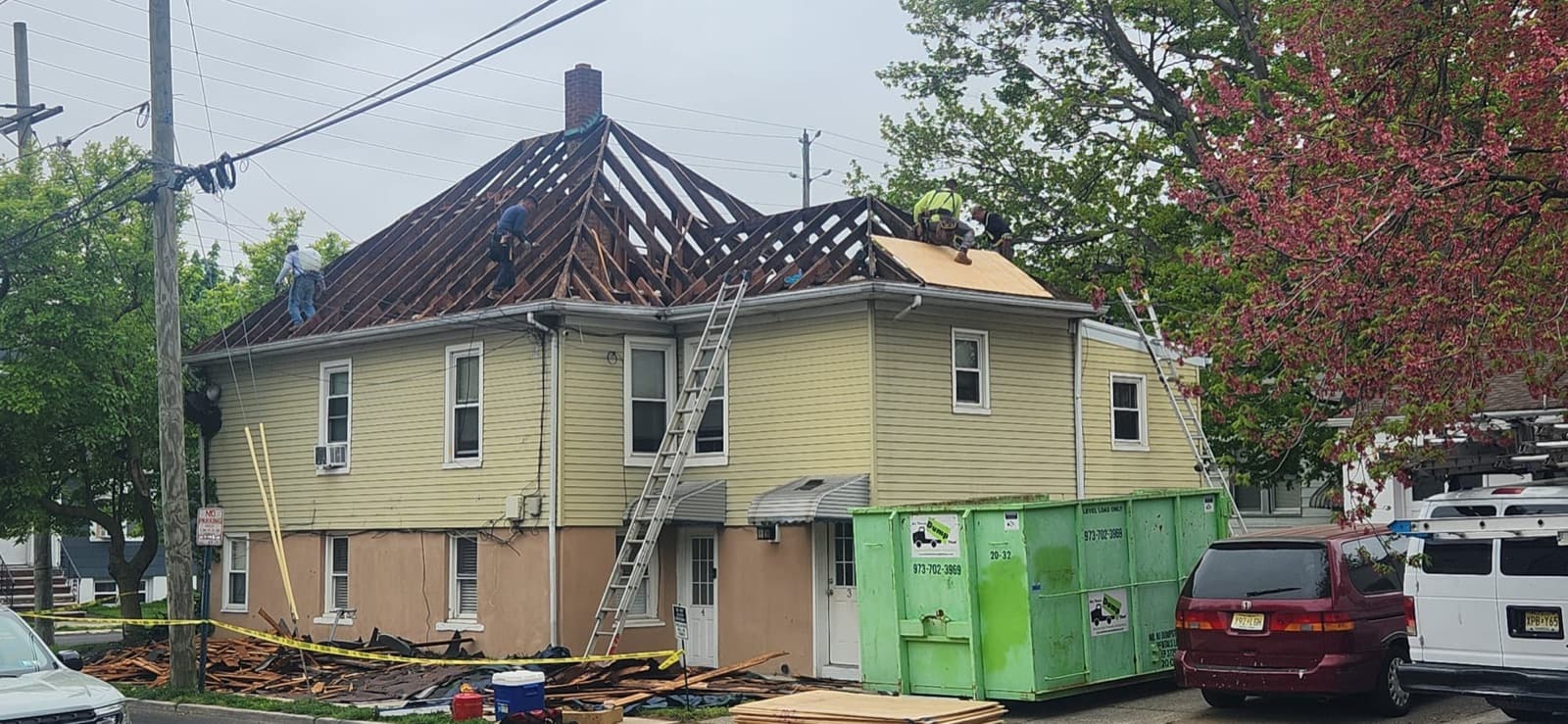
So the debris stays on your property, where three Borough offices have something to say about it: the Zoning Officer decides whether a container may sit on the lot, the Construction Official has to authorize it, and the Building Code Official decides at the counter whether the job earns a solid-waste surcharge. The zoning chapter then uses the finished roof surface as a measuring line for anything mounted on it. Our shop is at 163 Midland Ave, Unit B in Garfield: leak tracing, tear-off and re-roof, flashing, gutters, 24/7 emergencies.
- roofing in Passaic County — Hawthorne is a Passaic County borough — the county-wide page covers the towns around it and how we run work across the county.
- roof replacement — What a full tear-off and re-roof actually involves once the container question is settled.
- roof leak repair — Tracing a leak to its entry point before anyone talks about replacing a roof.
- flat and low-slope roofing — The low-slope roofs where the 12-inch solar standoff rules out tilted racking — membrane systems, drainage and detail work.
- chimney repair — Chimneys sit in the same 18-inch projection exception as roof overhangs, and a chimney rebuild or a new liner other than a liquid-applied lining is the kind of work that pulls a permit.
- gutter installation — The eave and rake band the array has to stop short of is the same band the gutter line lives in.
Three offices decide where a Hawthorne tear-off may sit
Start with the front yard, where a roofer wants the box. For more than 24 hours, § 540-142B(1) bars from the front yard of any lot commercial vehicles bearing signs or advertisements, boats and campers, and any container, box, object or thing larger than 50 cubic feet. Fifty cubic feet is about a large chest freezer. The smallest roll-off in normal use runs roughly 270 cubic feet, a twenty-yard box closer to 540. The container is over the line several times over, the clock is a day, not the length of the job, and the lettered truck is caught by the same sentence.
§ 540-145 then permits storage containers on residential property only in conjunction with renovation or reconstruction of a single-family dwelling, only where that work is performed under an active construction permit, only if the Construction Official authorizes the container, and only with a zoning permit from the Zoning Officer. The permit predicate is the trap. Under N.J.A.C. 5:23-2.7(c)1x, replacing the roof covering — the covering only — on a detached one- or two-family dwelling is ordinary maintenance and pulls no construction permit; under 5:23-2.7(b)4, structural work is never ordinary maintenance. The ordinary Hawthorne re-roof is the job least able to meet the condition this section is built on.
Where a container is allowed, § 540-145B is blunt: “No more than one storage container shall be permitted on the residential property at any one time. The storage container shall not be larger than 20 feet by eight feet. The storage container shall not be mounted on wheels.” One box rules out staging new bundles in one while filling another with tear-off. The wheels clause draws a line the trade does not, and the text does not say which side a wheeled roll-off lands on — settle that with the Zoning Officer before trucks are scheduled.
In Hawthorne the finished roof surface is a datum, not just a surface
§ 540-141D reads: “If attached, the solar energy device(s) and associated equipment shall not be more than 12 inches higher than the finished roof to which it is mounted. In no instance shall any part of the device extend beyond the edge of the roof.” A zoning ordinance measuring off your shingles makes this a roofing question before it is a solar one.
Three things follow. A low-slope roof cannot carry a tilted array on ballasted racking the usual way, since tilt racks routinely stand well over a foot proud of the deck. When an array comes off for a tear-off and goes back, the roof it returns to may not be the height it left — a second layer, a thicker assembly — and the 12 inches is measured from wherever the finished surface now sits. The edge rule is an eave and rake detail: the array stops short of the drip edge, where starter course, flashing and gutter line have to stay serviceable.
The setback rule points at the roof too. § 540-128D: “Unless otherwise permitted per § 540-116, no part of any building shall extend beyond the foundation into any required yard, except the following, which shall not extend more than 18 inches beyond the foundation into any required yard:” — and the three exceptions listed under it are roof overhangs, bay or bow windows, and chimneys.
Monthly payment options
We work with Hearth, which shops several lenders on a single application. See your personalized options in minutes — checking does not affect your credit score, and there is no commitment.
- Loan amounts up to $250,000
- Funding in as little as 1–3 days
- No prepayment penalties
- No home equity required
Financing is provided by Hearth's lending partners, not by Precision Windows & Roofing. Rates and terms depend on your credit and the lender making the offer, and all financing is subject to credit approval.
Common questions
Does anyone in Hawthorne review the color or material of my shingles?
We read the Borough's published codebook, masthead through 05-07-2025, and found nothing that does. Chapter 45 creates an Assessor, a Clerk, a Municipal Court, an Environmental Commission, a Board of Health, a Shade Tree Commission and a Library Board of Trustees — and no Historic Preservation Commission. Chapter 540's twenty-five articles carry no historic district, no architectural review board, and no design article that reaches the exterior of an existing house — its design standards apply to subdivisions and site plans.
Does a roofer have to register with the Borough of Hawthorne?
We found no contractors chapter in the code. We found no contractors chapter in the code. The closest thing, Ch. 287, reaches commercial landscapers and commercial tree service providers, and § 287-3 exempts anyone holding a State Contractors' Registration Act number. Hawthorne registers the man who takes the tree down, not the man who roofs the house it fell on. State registration applies to us regardless: NJHIC #13VH13970900, GAF certified, fully insured.
Could the permit cost more than the fee schedule says?
It can. Under § 425-6D, at issuance of every Uniform Construction Code building permit the Building Code Official determines whether, in his or her opinion, more than 200 pounds or half a cubic yard of construction or demolition waste will likely result — and if so a surcharge is added to the permit fee. Half a cubic yard is nothing; a roofing job that reaches a permit clears it.
The tear-off finds rotted decking. What changes?
The job stops being ordinary maintenance. Structural work is never ordinary maintenance under N.J.A.C. 5:23-2.7(b)4, so replacing structural decking or a rafter moves you onto a construction permit — the same permit § 425-6D's waste determination attaches to, and the permit § 540-145 wants to see before a container is authorized.
Explore
Get your free roofing quote
Free, no-obligation on-site assessment anywhere in New Jersey — and we answer the phone 24/7.