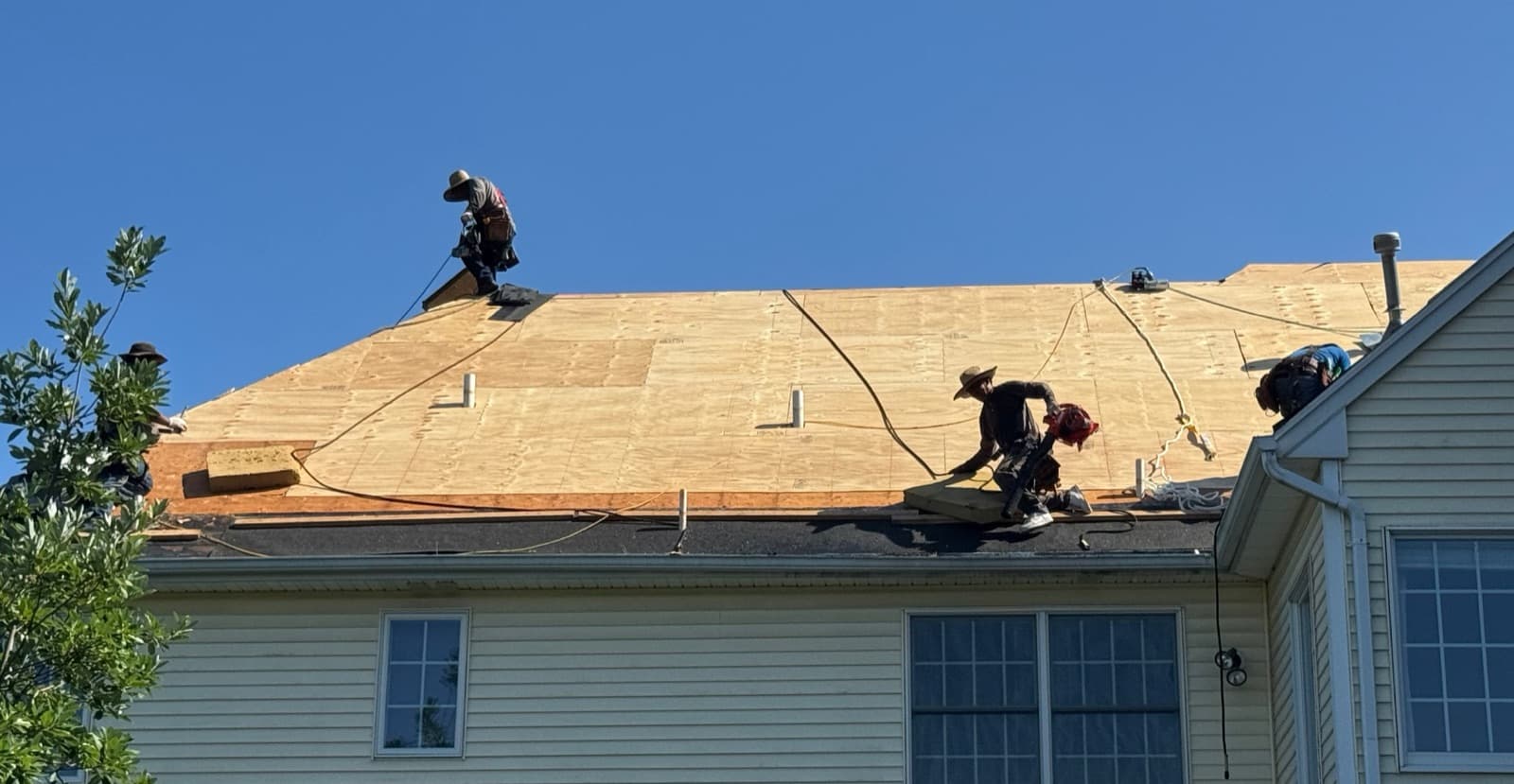
Roof Repair in Ridgewood, NJ
On a Ridgewood store, office or house of worship the gutters can need a permit before work starts while the roof covering does not: a commercial re-roof pulls a construction permit that absorbs the zoning review, but gutter and leader work is ordinary maintenance statewide, so § 190-97B(3)(b)[2] leaves it alone on the Zoning Officer's desk. NJHIC #13VH13970900.
Ridgewood keeps a written list of the improvements that require a zoning permit, and the roofing trade is on it. Section 190-97B(3)(b)[2] names “Modification of the exterior improvements of a building, including, but not limited to, roofing, siding, doors and windows, decorative trim and molding, drain gutters and leaders, and change of paint color.” That list governs an exterior improvement “involving a nonresidential use”; the residential branch above it names nothing the roofing trade does. So on a Ridgewood store, office, church or school, some of what a roofer does is filed with the Zoning Officer.
Precision Windows & Roofing runs out of Garfield: NJHIC #13VH13970900, GAF certified, insured, with a ten-year workmanship warranty that transfers with the house. This is old stock — ACS 2020–2024 five-year estimates, table B25034, put 6,838 of Ridgewood's 9,191 housing units before 1960, 74.4%, and 3,481 of those in 1939 or earlier. (201) 275-9185 reaches us at any hour, though what a crew may lawfully run here on a Sunday is the second half of this page.
- gutter installation — Seamless gutter and leader work — trough sizing, 3x4 outlets, and hidden hangers set every 24 inches — the item Ridgewood's zoning list names right alongside roofing.
- commercial roofing — Nonresidential buildings that stay open through the work — phasing, the permit route, and a written scope a property manager or trustee can take to a meeting.
- roof replacement — Tear-off method, decking, underlayment, flashing and the eave membrane — the construction detail of a full re-roof, written once instead of on each town page.
- roof inspection — A hands-on look at shingles, flashing and valleys with a written report at the end — pre-purchase, post-storm, or before anyone prices a repair.
- roof repair in Fair Lawn — A Bergen County borough run from the same Garfield shop: postwar capes, ranches and splits, and a permit question that turns on which desk the job lands on.
- roofing in Bergen County — The rest of our Bergen County coverage — which towns we run, where the crews come from and how a job here gets scheduled.
On a nonresidential building the gutters need a zoning permit the roof does not
Read the chapeau before the list. The zoning permit is required “unless a building permit, certificate of occupancy, sign permit or historic preservation permit is required for the improvement, in which case issuance of said permits shall negate the necessity for issuance of a zoning permit.” Also exempt outright: “minor repairs to existing improvements or replacement of conforming improvements with identical conforming improvements.”
The covering itself comes straight back off that desk. N.J.A.C. 5:23-2.7(c)1x, the ordinary-maintenance item for a roof covering, reaches detached one- and two-family dwellings only — so a nonresidential covering replacement is permitted construction work every time, and a required construction permit negates the zoning permit by the chapeau's own terms. The item beside roofing behaves differently: 5:23-2.7(c)1xvi, gutters and leaders, carries no building-type limit, so no construction permit arrives to displace anything. Nonresidential gutters and leaders that are neither a minor repair nor an identical conforming replacement go to the Zoning Officer, who has 10 business days under § 190-97B(6).
Where a permit does exist, § 190-97E adds a step at the far end. Amended 11-8-2023 by Ord. No. 3973, it defines “exterior site improvements” to include “roofing” by name, and E(7) provides that they “shall not be deemed to be completed until an as-built survey showing the post-development conditions has been provided to the Zoning Officer and Village Engineer.” It reaches only work authorized by a permit — so a commercial re-roof is inside it, and the ordinary detached one- or two-family covering replacement never is. Settle who files the survey before work starts.
- Whether it is a nonresidential use at all — § 190-97B(3)(a), the residential branch, does not name roofing
- Whether a construction permit is required, which under § 190-97A(5) carries the zoning review inside it
- Whether the gutters going back up are identical conforming replacements, exempt under § 190-97B(3)(b)
The crew's week comes from the power-tools chapter, and Saturday ends at 1:00 p.m.
Ridgewood's noise chapter sets no hours. Chapter 201 runs two sections: a prohibition on “unreasonable and unnecessary loud or disturbing noise,” a direction at § 201-1C to “apply the standards and principles of common-law nuisance,” and a ban on train whistles. No schedule, no decibel table — which is not the same as no exposure, since a nuisance standard is decided after the fact. The calendar sits in Chapter 222 instead.
Section 222-1, headed “Commercial use,” covers power tools, manual tools, motorized construction equipment and landscaping and yard maintenance equipment “in all residential zones or within 200 feet of a residential property line when such use is conducted on a commercial or industrial property.” Weekdays run 8:00 a.m. to 6:00 p.m. Saturday is permitted “between the hours of 9:00 a.m. and 1:00 p.m. only.” Sunday is prohibited outright, as are eleven named federal holidays.
Read the chapeau's geography before planning around the schedule: it reaches residential zones, and commercial or industrial property within 200 feet of a residential property line. A roof deep inside a commercial district is not obviously within it, and that is a question for the Village. Where it does apply, compressors, nail guns and saws sit squarely inside the description, so we book Ridgewood work as weekday work and treat Saturday as four hours of dry-in. The chapter's single exception, § 222-2, is machinery used to remove ice and snow; beyond it, § 222-1B lets the Village Manager allow prohibited use “in the case of an emergency and on Sundays.”
Monthly payment options
We work with Hearth, which shops several lenders on a single application. See your personalized options in minutes — checking does not affect your credit score, and there is no commitment.
- Loan amounts up to $250,000
- Funding in as little as 1–3 days
- No prepayment penalties
- No home equity required
Financing is provided by Hearth's lending partners, not by Precision Windows & Roofing. Rates and terms depend on your credit and the lender making the offer, and all financing is subject to credit approval.
Common questions
Does a re-roof in Ridgewood need a permit?
Ask it twice, because there are two desks — three inside the historic district. On a detached one- or two-family house, N.J.A.C. 5:23-2.7(c)1x calls a covering replacement ordinary maintenance, so no construction permit, and § 190-97B(3)(a), the residential half of the village's list, does not name roofing. That holds until the deck opens, because 5:23-2.7(b)4 puts work affecting structural or fire safety outside ordinary maintenance. On a nonresidential building § 190-97A(5) folds the zoning permit into the building permit. On a designated historic site, or inside the Village Center Historic District, § 190-97D adds a preservation permit, and its roofing carve-out at D(2)(b)[3] removes only the Commission's report.
We only need gutters and leaders replaced on a commercial building. Is that really a zoning matter?
It can be. Section 190-97B(3)(b)[2] lists “drain gutters and leaders” among the improvements requiring a zoning permit on a nonresidential use, and 5:23-2.7(c)1xvi makes that work ordinary maintenance with no building-type limit — so on a hanger-and-trough replacement touching nothing structural, no construction permit arrives to negate the zoning permit. Reach structural or fire safety and 5:23-2.7(b)4 takes it out of ordinary maintenance, and § 190-97A(5) then carries the zoning review inside the construction permit. The escape in the same subsection stands either way: minor repairs, or identical conforming replacement.
A storm opened our roof on a Sunday. Will you come out?
We answer the phone at any hour and we will come and look. Hear the local rule rather than be sold around it: § 222-1A(3) prohibits commercial use of power tools, manual tools and motorized construction equipment entirely on Sunday, and § 222-1A(4) does the same on the eleven named federal holidays. Whether a tarp set by hand is “commercial use” of manual tools is a question for the Village, and § 222-1B routes it to the Village Manager.
Where does the roll-off go, and can staging stand at the curb?
Two permits, two offices. Chapter 133 splits the container permit — Police for a public area, Buildings and Inspections for private property — and § 133-5A bars a container from a public area in a residential zone unless the Police find there is not sufficient room on the owner's own property. Section 133-4E then invalidates the permit and requires the container removed after any cessation of work beyond 15 calendar days. Staging is Chapter 249: § 249-15 makes it unlawful to erect staging on a street or sidewalk without a permit in writing from the Director of Building and Inspections.
Explore
Get your free roofing quote
Free, no-obligation on-site assessment anywhere in New Jersey — and we answer the phone 24/7.