Roofing, Gutters & Siding in Middlesex County, NJ
New Jersey wrote cohort logic into its own enforcement rule: find a townhouse fire-separation violation in one unit of a development, and the construction official must see that every similar unit is inspected. A Middlesex roof reads the same way, because this county built development by development — same builder, same year, the same detail failing in the same place. Same-day roofing service across all 25 municipalities, depending on the job and how booked we are that day. NJHIC #13VH13970900.
Most roofing advice is written for a house. Middlesex asks to be read a development at a time, and that framing is the state's. N.J.A.C. 5:23-2.35 provides that where violations of certain listed Code provisions are found in a residential structure in a development after a certificate of occupancy has issued, the construction official “shall issue such notices and orders as may be necessary to ensure that all units within the development that might have similar violations are inspected…” On that list by name: “Section R302.2, Townhouses (Fire-Resistant Construction)” — the section governing the fire separation a townhouse roof deck dies into.
It fits the county's single biggest decade of building. ACS 2020–2024 five-year estimates, table B25034, put 50,910 of Middlesex's 317,979 housing units — 16.01%, more than any other decade — in the 1980s, and 82,705, 26.01%, across the 1980s and 1990s together. The postwar 1950s and 1960s together are larger still at 95,725 units, so this is not a county built only one way; what the 1980s wave added was tract development at scale, and inside individual municipalities it dominates — Plainsboro raised 56.56% of its housing in those two decades, South Brunswick 49.12%, Edison 33.83%. Middlesex is not a townhouse county by share: table B25024 puts 35,162 units, 11.06%, in the “1, attached” bucket, eighth among New Jersey's 21 counties. What matters is when that stock went up, and what the code then let a builder lay over it.
Precision Windows & Roofing works this county out of Garfield — insured, GAF Certified, NJHIC #13VH13970900, ten-year transferable workmanship warranty. Same-day roofing service across Middlesex depending on the job and how booked we are that day, and 24/7 emergency response, with every roof measured before it is priced. (201) 275-9185.
- roof repair in Parlin — The one Middlesex address on this site with its own page, and it answers a question the county cannot: ZIP 08859 sits in two governments, so which construction office holds your file gets settled before we quote.
- how flashing is actually repaired — The metal at every junction, written out once — and why on a party-wall roof it also has to stay clear of the four feet either side of the common wall.
- what a free inspection covers — Hands-on and written up. On a townhouse the one question it has to answer is whether the common wall carries a real parapet or a treated band of deck.
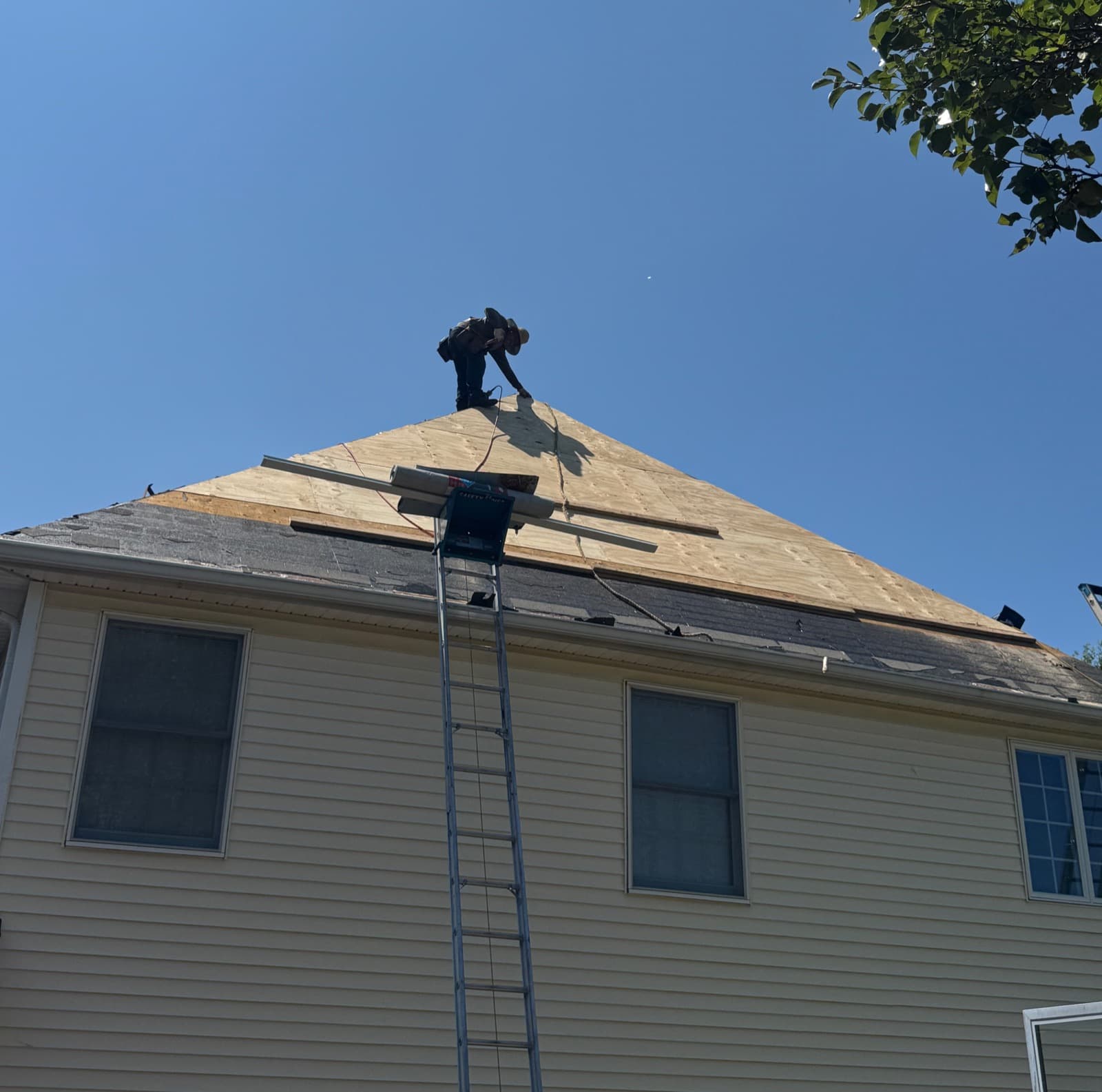
- how a full replacement runs — Tear-off, deck, underlayment, flashing and ventilation. Worth reading here because on a townhouse the deck work is filed and inspected whatever the covering was.
The state's own rule stops counting houses here and starts counting developments
The provision does not treat a townhouse as a house that happens to touch another. It treats the development as the unit under inspection, on the reasoning that units raised together by one builder to one detail carry one defect. None of that is a homeowner remedy — it is a duty on a construction official, limited to the listed provisions and to structures in a development — and it runs on a clock: under N.J.S.A. 2A:14-1.1 no notice of violation may go to the developer or any contractor more than ten years after the certificate of occupancy. On the county's 1980s and 1990s rows, that window shut long ago.
What survives is the survey logic. On a synchronised street the roofs age out within the same few years and the same junction fails unit after unit, so what we find on one unit tells us where to look on the next. It is not evidence for an adjuster: cohort reasoning tells a crew where to look first and decides nothing about your policy.
The four feet of deck on either side of a townhouse party wall
New Jersey's one- and two-family dwelling subcode is the 2024 International Residential Code, adopted at N.J.A.C. 5:23-3.21, and we confirm which provisions govern a given building with its construction office. Under R302.2.4 a townhouse common wall ordinarily carries a parapet through the roof. The exception releases the builder where the covering is at least Class C and either “the roof decking or sheathing is of noncombustible materials or fire-retardant-treated wood for a distance of 4 feet (1219 mm) on each side of the wall or walls…” or Type X gypsum board sits directly beneath the deck over that width — and it closes by keeping roof openings and penetrations outside those four feet. So on a great many townhouse roofs the fire separation is not a visible wall. It is a band of deck.
The USDA Forest Products Laboratory reports that between 1985 and 1995 roughly 750,000 multifamily housing units nationally had roofing problems from fire-retardant-treated plywood sheathing failure, caused by excessive exposure to solar radiation — and that FRT plywood's major use was exactly this, sheathing at party-separation walls in townhouses and condominiums in place of a fire-rated parapet, a substitution the model BOCA code provided for in 1979. At worst the wood had darkened, gone brash and brittle, and crumbled after three to eight years in service. Two limits: that is a national figure over a decade, not a Middlesex count, and FPL is equally clear the incidence was low against the volume of treated material in use.
So the four feet either side of a common wall is the first thing we open on a row. Whether your building used that exception or carries a real parapet is settled on the roof and with the construction office. Three consequences follow:
- Deck replaced inside that band does not go back as ordinary CDX — R302.2.4 calls for noncombustible material or FRT wood meeting Sections R802.1.5 and R803.2.1.2.
- No new vent, stack or skylight goes within four feet of the common wall, so ventilation is relocated deliberately rather than cut where convenient.
- Replacing deck is structural work, permitted and inspected whatever the building is; FPL puts dark, absorbent coverings behind the solar heat that drives deck temperature and blocked intake and exit vents behind the moisture that compounds it — so shingle colour and attic airflow are both deck-life questions here.
Roof leaking right now? We answer 24/7.
The county's newest large stock is the cohort now coming due
Monroe Township is where the cohort story is still young. Table B25034 puts 9,311 of its 22,419 housing units, 41.53%, in 2000 through 2019, while table B25024 gives it 5,817 single-family attached units — 25.95% of its stock, and more than any other municipality in the county, ahead of Edison's 4,430.
These are first roofs, not third ones. The shingle field is rarely what fails; the trouble is the one detail the builder repeated down the row — the same low plane dying into the same taller wall, the same step and kick-out assembly behind the same siding. It is also the only stock on this page young enough for the ten-year window after a certificate of occupancy to be open at all — and even there only for units certified from 2016 on, since Monroe's 2000s units are already past it. That is reason enough to find the CO date and photograph the condition now.
The pre-war boroughs and cities, where this page's own logic gives the wrong answer
In Middlesex's pre-war municipalities the housing was never a cohort. Table B25034 puts 31.00% of Perth Amboy's stock before 1940, 25.85% of New Brunswick's, 38.42% of South Amboy's, 29.79% of Dunellen's and 27.43% of Highland Park's; table B25024 puts 4,378 Perth Amboy units, 22.32%, in the “2” bucket, and finds only 21.41% of New Brunswick's units single-family detached. Those are housing units rather than buildings — the table has no three-family bucket and cannot sort a two-unit structure into detached and attached.
On these addresses the neighbour's roof predicts nothing, and the reason is procedural rather than architectural. These houses were permitted one at a time, by different builders, under codes decades apart, so there is no development to survey and nothing the enforcement rule in the first section would ever reach. The shortcut that section buys us does not exist here, so the survey takes longer and is done from the attic as well as the slope, address by address.
Roof leaking right now? We answer 24/7.
Across 309 square miles, and the one thing the code does not ask of Middlesex
Middlesex County is 309.252 square miles across exactly 25 municipalities, and we cover all 25 — roof repair and replacement, gutters, and siding — with same-day roofing service depending on the job and how booked we are that day, and 24/7 emergency response. All of it dispatches from one shop in Garfield: no branch, no yard and no crew stationed in the county, and no arrival time attached to the day.
One requirement New Jersey does not put on this county is the eave ice barrier. Middlesex is not Sussex: DCA Bulletin 07-3 confines the requirement to areas where the average daily January temperature is 25°F or less, and names the qualifying area — “For the State of New Jersey, this area is Sussex County.” Self-adhered membrane goes on at our eaves and valleys regardless, carried past the interior face of the exterior wall, and the quote calls it our specification. A bid calling it code here has a checkable fact wrong.
Credentials as held: NJHIC #13VH13970900, workers' compensation on our crews, and GAF Certified — the tier that registers GAF's System Plus Limited Warranty and nothing beyond it, since Silver Pledge and Golden Pledge belong to contractor levels we do not hold. Owens Corning and CertainTeed supply us; they do not certify us.
What affects the cost
| Whether the roof is one of a row or a one-off | On a synchronised development the units share one assembly, so the survey has fewer unknowns to settle. Older pre-war borough and city stock is read one house at a time and carries more allowances. |
|---|---|
| What the deck turns out to be at a party wall | Within four feet of a common wall the sheathing is a specified material with its own order and its own lead time, not a sheet pulled off the truck. We carry that band as a named line with a quantity that can move, and we photograph what comes off before anything goes back. |
| How the row's units differ from one another | End units carry a gable and an exposed wall the interior units do not, so on the same row the end pair is a different scope from the middle. We price the row's positions separately rather than dividing one number by the number of doors. |
| Where ventilation is allowed to go | On a roof leaning on the parapet exception, penetrations stay clear of the common wall, so intake and exhaust have to be planned into the layout instead of placed where the run is shortest. |
| Whether the covering has to carry a fire rating | The parapet exception at R302.2.4 only holds while the covering keeps a Class C rating or better, so on a townhouse relying on it the shingle is chosen against that rating rather than against price alone, and the rating is written on the quote by product name. |
| Who controls the ground the work stages on | On a development the parking, the common drive and the lawn a container would sit on are frequently not the homeowner's alone, so the staging plan has to be agreed with whoever holds them before a date is offered. On a detached lot that conversation does not exist. |
We don't bundle a mystery number — you get a firm, free on-site quote, approved before any work starts.
Monthly payment options
We work with Hearth, which shops several lenders on a single application. See your personalized options in minutes — checking does not affect your credit score, and there is no commitment.
- Loan amounts up to $250,000
- Funding in as little as 1–3 days
- No prepayment penalties
- No home equity required
Financing is provided by Hearth's lending partners, not by Precision Windows & Roofing. Rates and terms depend on your credit and the lender making the offer, and all financing is subject to credit approval.
Common questions
Do you actually cover Middlesex County, and how quickly?
All 25 municipalities, with same-day roofing service depending on the job and how booked we are that day, and 24/7 emergency response — but no clock on the arrival. Everything dispatches from the Garfield shop; there is no Middlesex branch, yard or stationed crew, and a guaranteed arrival window across 309 square miles would be a promise about traffic rather than about roofing. Ring (201) 275-9185.
My neighbour's townhouse just had roof decking replaced. Does that mean mine is bad?
It means yours is worth opening and looking at — a different thing. Units in one development were built by one builder in one season to one detail, so a defect found in one is fair reason to check the rest — the reasoning inside N.J.A.C. 5:23-2.35, which puts a duty on a construction official to see that similar units in a development are inspected. It is not a diagnosis of your roof.
We are a whole row and want the same roof done at once. Can you do that?
Yes, and on a synchronised row it is the sensible way to do it — one mobilisation, one staging plan, one order, and the party-wall band opened continuously rather than four feet at a time under four separate contracts. Each owner still signs their own written contract for their own unit and every unit is measured on its own; we do not quote a row as a single roof. Where the units are not all ready together we sequence them and hold the specification so the later ones match the first.
Does a Middlesex re-roof need a permit?
On a townhouse, yes. N.J.A.C. 5:23-2.7(c)1x makes covering-only replacement ordinary maintenance solely on a detached one- or two-family dwelling, and a townhouse is not detached. Separately, once we replace deck rather than covering, the work is structural and permitted whatever the building is. We settle it with the construction office before a date is set.
Explore
More in Middlesex County
Get your free roofing quote
Free, no-obligation on-site assessment, quoted line by line before anything is booked. We cover all 25 Middlesex municipalities same-day depending on the job and how booked we are that day, and answer emergencies around the clock.