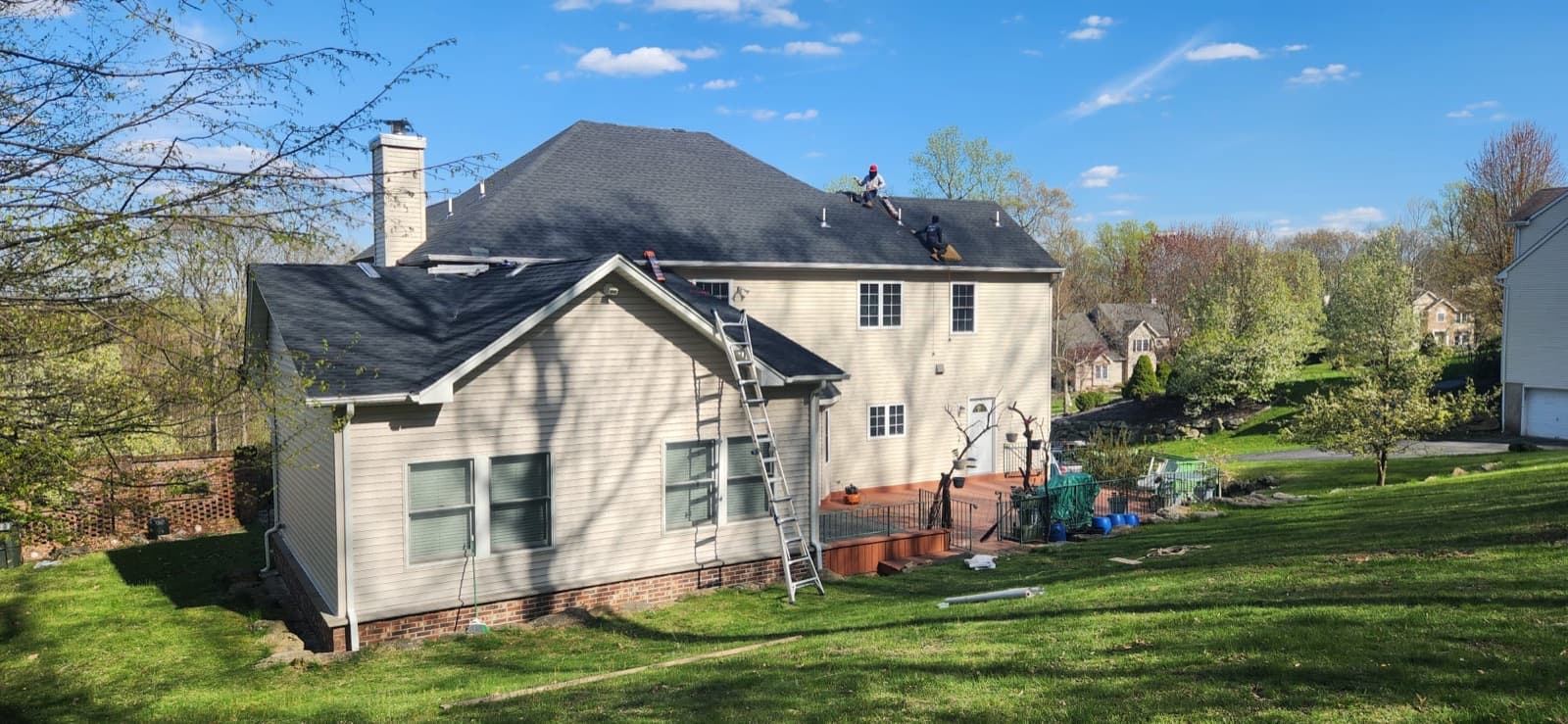
Roof Repair & Replacement in Woodland Park, NJ
Woodland Park is not a detached-house town. Under a third of its housing sits in a stand-alone single-family house, and roughly 45% of the borough's stock falls outside the state rule that lets an owner re-roof with no permit at all. Townhouse and association re-roofs, hillside split-levels where an upper plane empties onto a lower one, and a maintenance plan built for a borough that is a third county parkland. Our trucks run out of Garfield. NJHIC #13VH13970900.
Three names can be correct for one Woodland Park house, which matters the moment you go looking for its history. The borough was incorporated as West Paterson on March 25, 1914, and stayed West Paterson for ninety-five years; a referendum in November 2008 carried 2,136 to 2,111 — twenty-five votes — and the Borough of Woodland Park existed from January 1, 2009. Mail adds the third layer: ZIP 07424 is shared with Little Falls, and Little Falls, Woodland Park and West Paterson are all accepted city names on it. Insurance claims, manufacturer warranty registrations and any permit ever pulled are filed against an address, and here the address has been written three ways.
The second thing to know is that this is not a detached-house town, whatever the drive up McBride Avenue suggests. The borough's zoning ordinance carries separate districts for garden apartments, townhouses, planned residential, age-restricted adult residential and inclusionary multi-family development. The census agrees: of roughly 5,534 housing units, about 1,636 are detached single-family houses — under a third. Around 881 are attached single-family, roughly 1,411 sit in two-unit buildings and about 1,600 more in buildings of three units or larger. Of the borough's 5,165 occupied units, 35% are rented rather than owned. On a great many Woodland Park roofs the person who can authorize the work is a board.
Either way the first step is the same: call (201) 275-9185. The run from our Garfield shop is short enough that a roof left open, water coming through a ceiling, or a storm that came through an hour ago brings a truck out the same day, at whatever hour it happens. Anything less urgent we get eyes on quickly and then schedule against the forecast, because flashing bedded in the wet does not stay bedded. NJHIC #13VH13970900.
- Roof leak repair — In a townhouse row the leak and the stain frequently sit in different units, which is how a repair turns into an argument about whose roof it is. Tracing it first settles that.
- Emergency roof repair — A roof left open over an attached unit is everyone's emergency at once. We dispatch around the clock from Garfield, down Route 46.
- Roof flashing repair — The hillside split-level detail this borough is full of: an upper plane emptying onto a lower one, and a roof running into a two-storey wall beside it.
- Roof maintenance plans — The scheduled version — inspection, clearing and small repairs on a calendar — which is what a board managing shared roof area actually needs to budget against.
- Roofing in Passaic County — The rest of our Passaic County work, and the permit line that roughly 45% of Woodland Park's housing stock sits on the far side of.
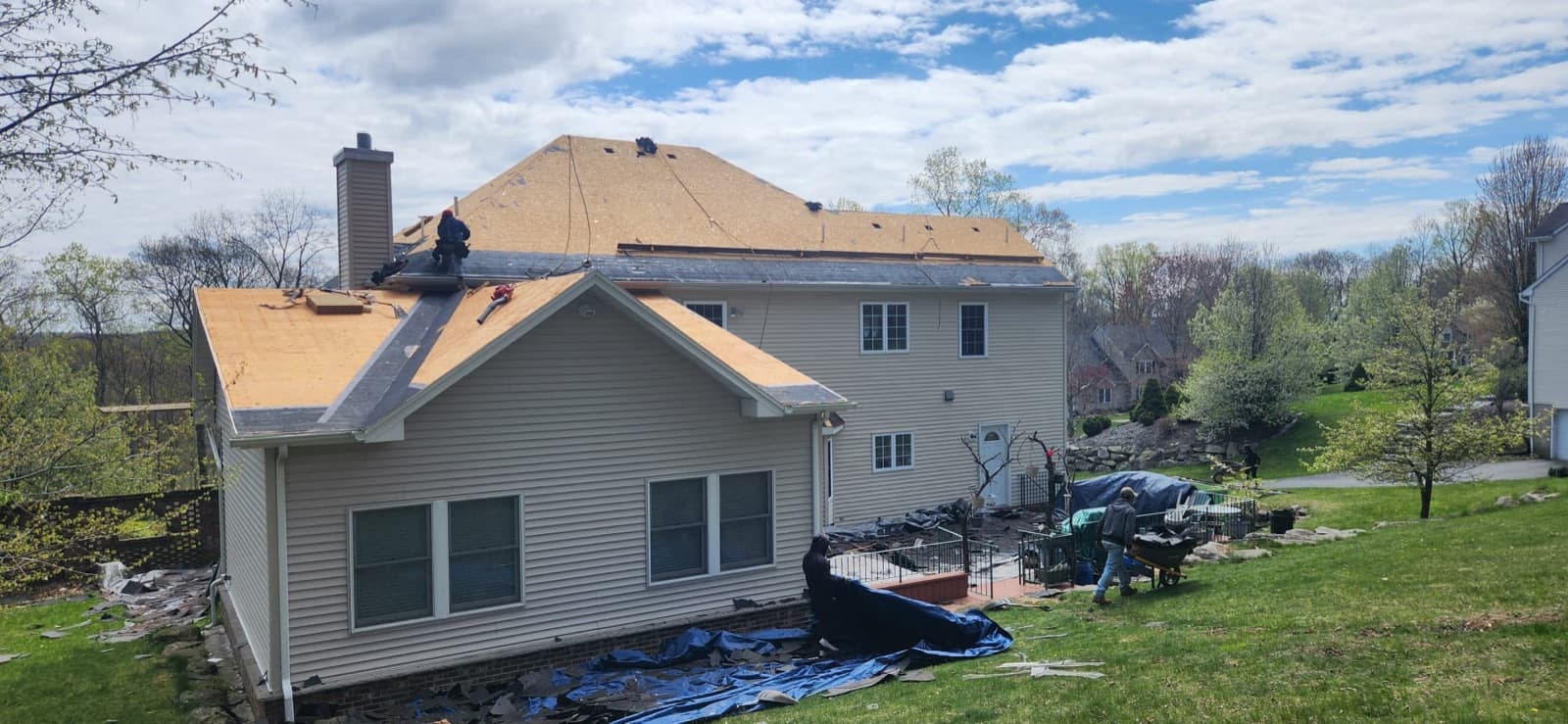
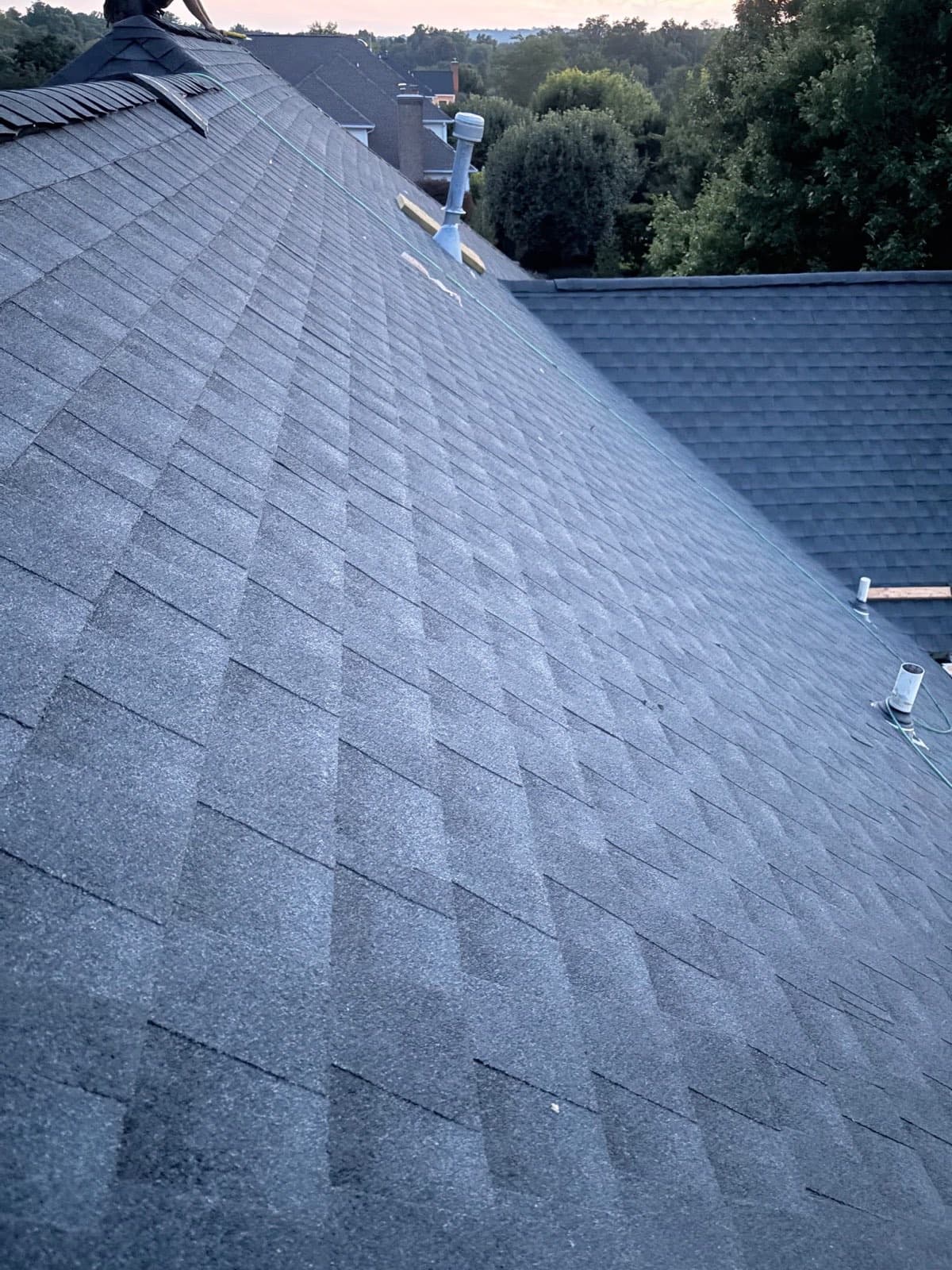
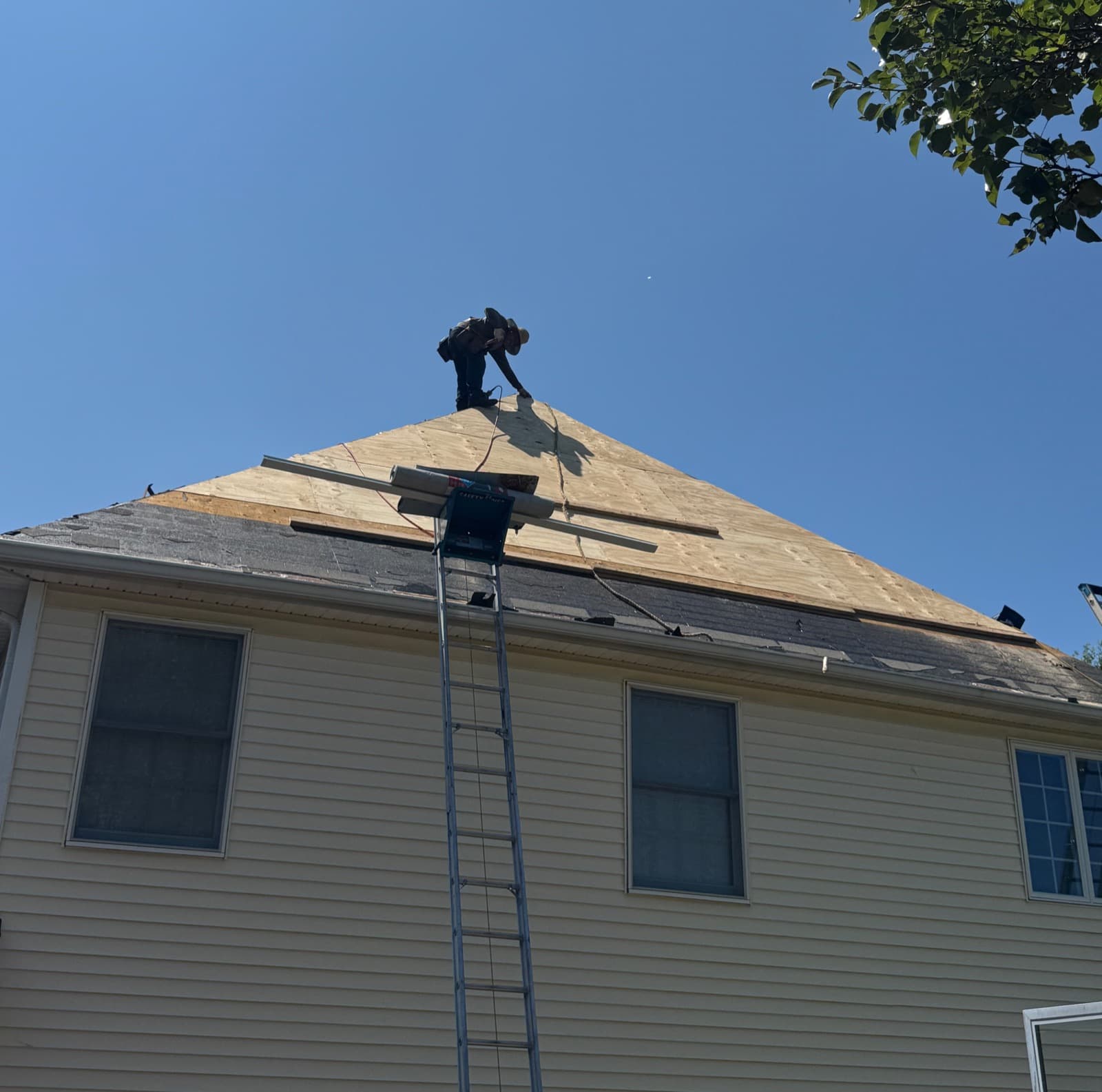
Recent work in New Jersey
In much of Woodland Park the roof is not yours alone
The reason a suburban owner can usually re-roof without telling anybody is one line of state code, and it is narrower than the version that gets repeated. N.J.A.C. 5:23-2.7 puts a re-cover in the ordinary-maintenance bucket, but only for a dwelling that stands on its own and houses one or two families. Set that wording against this borough's census and the split is unusually stark. The 881 attached single-family units and the roughly 1,600 in buildings of three or more fall outside it — about 2,487 units, near 45% of the housing stock, before anyone asks whether a given two-family is freestanding. And it protects the covering only: replace rotted decking or touch a rafter on any building in New Jersey and the job is permitted and inspected. Answering that for a particular address is a question for the Construction Official at the Municipal Building, 5 Brophy Lane, and it is worth having the answer before you collect bids rather than after.
Where the roof is an association's, the paperwork changes more than the roofing does. What sets the scope is the master deed, not the shingle line — one continuous roof plane on a townhouse row can sit above four separately owned units — so that gets read first, because a number quoted to one owner is otherwise a number for a roof that owner does not control. Boards can reasonably ask for four things, and we put all four in writing: a per-building condition report with photographs, so members can see why the order is the order; insurance certificates issued in the association's and the managing agent's registered legal names, since a certificate made out to a trading name is the one that gets rejected at the worst possible moment; a building-by-building calendar rather than a season; and a standing rule that nothing is left open overnight — a roof opened in the morning is closed before the crew leaves.
The roofing itself is ordinary and we run all of it: full tear-off and a new architectural asphalt covering; leak tracing on buildings where the entry point and the ceiling stain belong to different units; chimney step and counter-flashing; low-slope membrane on the flat rear sections and garage roofs this stock is full of; seamless gutter, soffit and fascia.
The borough has put in writing what its next roofs must look like
Most towns regulate height and setback and stop. Woodland Park's zoning goes as far as naming what a roof has to do. Ordinance 24-05, adopted March 6, 2024, created the Residence "I" Inclusionary Multi-Family Residential District at § 22-22, and its architectural standards read like a roofer's punch list. Buildings shall avoid long, monotonous, uninterrupted walls or roof planes. Roofline offsets, which the ordinance says include dormers and gables, shall be provided to relieve the effect of a single, long roof, at a maximum spacing of 40 feet. Gable and hipped roofs shall be used to the greatest extent possible, both providing overhanging eaves on all sides extending a minimum of one foot beyond the building wall. Flat roofs are allowed only where every visibly exposed wall carries an articulated cornice. The newer Residence "J" district at § 22-27, added February 4, 2026 by Ordinance 26-03, repeats the offset rule at a looser 80 feet and carries no eave or roof-form language at all.
Those standards govern new development in two districts. They are not retroactive to the house you already own, and the reason to read them anyway is that they tell you how to read a bid. A roof obliged to break every forty feet is not a quantity of squares; it is a specified count of ridge, hip, valley and roof-to-wall run, and each of those is priced by the linear foot rather than by the square. So the lines worth comparing across two proposals are linear feet of valley metal, linear feet of step flashing, linear feet of ridge, and the number of sidewall diverters — IRC R903.2.1 makes that last one mandatory wherever the design puts an eave into a wall, whether or not the proposal bothers to itemize it. The one-foot minimum overhang is a drainage specification wearing architectural clothes: it fixes how far off the wall the water lands, and it leaves enough soffit depth for intake ventilation that genuinely takes air in.
Roof leaking right now? We answer 24/7.
On a 15% grade the upper roof empties onto the lower one
Woodland Park runs uphill. The basalt of the First Watchung Ridge cuts through the eastern side of the borough — the 2012 Master Plan calls the slopes there very steep — and the Borough Council found the grade real enough to legislate: Ordinance 23-06, adopted April 19, 2023, defines a steep slope here as slopes 15% or greater from the horizontal plane. That grade shaped what got built on it. The 1960s are the borough's largest housing cohort, roughly 1,224 units, with about 912 more from the 1950s, and on falling ground the standard answer of those two decades was the split-level and the garage-under ranch.
What those houses produce is a roof delivered in two or three stages instead of one, and the trouble with it is arithmetic before it is workmanship. An upper plane sheds its whole area onto a lower plane that may be a quarter the size, so a few feet of the lower roof and a few feet of its gutter end up handling water collected from well above them. Left to discharge as an open sheet, it lands on one narrow band of the lower covering every time it rains, and that band wears out years ahead of the plane around it — which is why a hillside roof so often fails in a stripe rather than all over. The fix is to stop the transfer being a sheet: catch the upper plane and take it down in a leader, past the lower roof rather than onto it. So the question worth asking on these addresses is not how the shingles look but where the upper roof is putting its water, and that is answered standing on the lower plane looking up. The grade decides access too: on lots with no level ground beside the house a hoist has one workable position, and the tear-off gets sequenced around it.
There is no street-dumpster permit here — the container goes on your property
Plenty of North Jersey towns sell a permit to set a roll-off at the curb. Woodland Park sells nothing of the kind. Section 5-20.1 of the borough code says no person shall obstruct any streets, rights-of-way and sidewalks of the borough by parking, leaving or placing thereon any type of dumpster, and that leaving one on borough-owned property is unlawful without the Borough Administrator's written consent. The exceptions at 5-20.2 cover loading and unloading, and refuse receptacles lawfully placed for collection — expressly excluding portable garbage dumpsters. There is no application to file, because there is nothing to apply for.
So placement is part of the plan rather than an afterthought: the driveway, and on the hillside blocks a driveway with a pitch and a turning radius worth measuring before a delivery is booked. On association ground it is a board approval, not our decision. Any proposal you are comparing should state in writing where the container will stand and on whose property.
Roof leaking right now? We answer 24/7.
Most of your tree problem belongs to Passaic County
The eastern side of this borough is not built on. Garret Mountain Reservation and Rifle Camp Park — both Passaic County parks, both carrying Woodland Park addresses, on Mountain Avenue and Rifle Camp Road — take the whole mountain flank, and the borough's master plan puts county and municipal parkland at 632.5 acres of a 3.1-square-mile town: a third of its total land area. Houses on Rifle Camp Road, Overmount Avenue and the streets below them back onto continuous county forest. That is a permanent condition rather than a landscaping choice — oak and hickory litter every autumn, planes facing the woods that dry slowly, limb strike in any real wind — and a limb reaching over your ridge from inside a county park is county property, so the call goes to Passaic County Parks rather than to a tree service you hire.
On your own side of the line the borough tightened its rules recently, and the threshold is low. Chapter 27 was amended in its entirety on September 6, 2023 by Ordinance 23-18. Section 27-6 requires a tree removal permit for any tree of a caliper of four inches or greater measured four and a half feet above the ground. Section 27-17 then limits what a permit may be issued for at all: a tree that is dead or poses a safety hazard, one inside the footprint of a proposed building, one within fifteen feet of any building, or one standing in the way of a driveway, walkway, utility line or accessory structure — plus two that only reach development work: a tree between the curb lines of a proposed roadway approved under the subdivision ordinance, and one specifically permitted for removal in an approved site plan. A healthy oak twenty feet off the house, shading half the roof, meets none of those tests.
So the working assumption on this side of town is that the canopy outlives the roof and the roof gets specified around the canopy. The woods-facing planes get their own inspection interval instead of being lumped in with the sunny side. The shingle gets chosen for permanent shade, where staining shows up early and is cosmetic rather than structural. Valleys and gutters go on a calendar, because backing onto county forest makes the debris annual and predictable rather than occasional. We will photograph the limb scouring granules off your ridge; whether it can lawfully come down is a separate question, and here the answer is often no.
Why one side of your roof still holds snow a week later
Two things build ice on a Woodland Park roof, and neither of them is the county's January average. The first is aspect. A house at the forest edge holds snowpack on the plane facing the reservation for days after the street side has cleared, and that difference across a single roof — one side running, the other still frozen at the eave — is what grows a dam. The second is the hillside geometry from two sections up: an upper roof melting in afternoon sun, emptying onto a lower plane whose eave sits over an unheated garage, where it refreezes on a surface that never warmed up.
About the membrane, since every estimate in this market mentions it. The state hangs its eave ice-barrier requirement on one number, a January mean of 25°F, and DCA Bulletin 07-3 resolves that to Sussex County. Passaic is not in it. We run the membrane here anyway, and it belongs on your contract as its own line precisely because no inspector will ever ask for it. But be clear on what it buys: it limits what a dam costs you, it does not stop one forming. Stopping one forming is a ventilation question — air in low, air out high, and the leaks out of the ceiling below sealed — which is why an inspection worth paying for on these streets goes into the attic and up over the garage ceiling, not only onto the roof.
Monthly payment options
We work with Hearth, which shops several lenders on a single application. See your personalized options in minutes — checking does not affect your credit score, and there is no commitment.
- Loan amounts up to $250,000
- Funding in as little as 1–3 days
- No prepayment penalties
- No home equity required
Financing is provided by Hearth's lending partners, not by Precision Windows & Roofing. Rates and terms depend on your credit and the lender making the offer, and all financing is subject to credit approval.
Common questions
My deed says West Paterson and my mail says Little Falls. Which is my town?
Woodland Park, and only Woodland Park. The borough was West Paterson from its 1914 incorporation until the November 2008 referendum took effect on January 1, 2009, and the authority over anything on your roof is the Woodland Park Construction Official at the Municipal Building, 5 Brophy Lane, whatever the deed says. Where the three names matter is history: past claims and manufacturer warranty registrations are filed by address, and 07424 is shared with Little Falls, so one house's records can sit under three labels. One caution in the other direction — being told there is no permit on file for previous roof work proves nothing either way on a detached one- or two-family here, because that re-roof never needed a permit to begin with.
I own a townhouse. Is the roof mine, and does it need a permit?
Two questions, two documents. Responsibility comes from your association's master deed — on an attached row the roof is very often a common element even though the ceiling below is plainly yours, so the association contracts the work and you pay through it. The permit comes from state law: N.J.A.C. 5:23-2.7 exempts only freestanding one- and two-family houses, an attached row house is neither, and so the work is permitted and inspected. Replacing decking or touching framing pulls a permit on any building in New Jersey.
Can the roll-off go at the curb? There is no room on my property.
Not at the curb, and no permit exists that changes that — which surprises people who have re-roofed elsewhere in North Jersey. Section 5-20.1 makes it an offense to obstruct a borough street, right-of-way or sidewalk by parking, leaving or placing a dumpster there; the exceptions at 5-20.2 expressly exclude portable garbage dumpsters; and leaving one on borough-owned land takes the Borough Administrator's written consent. So the container goes on the property, usually the driveway, and on the hillside blocks we check the pitch and the turning room before booking a delivery. In an association, placement needs the board's approval and we get that in writing. Where a property genuinely cannot take a container, the alternative is loading straight onto a truck across the working day, which we price as its own line.
Can our association re-roof one building at a time?
Usually yes, and across a campus of similar buildings phasing is often the better plan — it spreads cost across budget years and lets the board see one finished roof before committing to the rest. Two conditions. The order should come from inspecting every building rather than from assuming that a shared construction date means a shared condition; on this side of the borough a building sitting under canopy ages differently from the one across the parking court. And because the schedule crosses years, the product line, the color and the accessory system belong in the contract now — shingle lines get discontinued, and a board that agreed to "the same as building one" in a phone call finds out in year three what that was worth.
One side of my roof still has snow a week after the other side cleared. Should I worry?
It is worth looking at, and on the streets backing onto Garret Mountain Reservation and Rifle Camp Park it is common rather than odd. The plane facing the woods sits in shade the sunny side never sees, so it holds snowpack days longer, and a roof running on one side while frozen at the eave on the other is the setup for an ice dam and for a valley that never dries out. We look at the attic before the roof — whether the soffits are taking air in, whether insulation is packed over them, whether the ridge is exhausting — and then at the shaded plane itself for granule loss, staining and packed debris.
Explore
Get your free roofing quote
Free, no-obligation on-site assessment anywhere in New Jersey — and we answer the phone 24/7.