Roof Repair in Middletown Township, Monmouth County NJ
Pull the federal flood map at the two ends of this township and it does not answer once: Port Monmouth returns Zone AE, base flood 13 feet NAVD88; Navesink returns Zone X, minimal hazard. Which of those two roofs you own decides the metal we specify and the order we inspect in.
Middletown Township covers 40.95 square miles of land — third of Monmouth County's 53 municipalities, behind Howell and Upper Freehold — plus 17.77 square miles of water. Inside that one town line the federal flood map gives two different answers. The zones and the base flood elevation below are FEMA's own, pulled at the sections' published internal points: zone AE with a 13-foot base flood at Port Monmouth, zone X and minimal hazard at Navesink and Lincroft. USGS elevations read roughly 3 feet at Port Monmouth, 8 at Belford, 93 at Navesink and 60 at Lincroft. All of these are point queries at section centroids, not at your address, and the map that governs your house is the one your floodplain manager pulls for your lot.
We work out of 163 Midland Ave, Unit B in Garfield. NJHIC #13VH13970900, insured, GAF Certified — which registers the System Plus Limited Warranty: non-prorated, ten to fifty years depending on the system, tear-off included. Our workmanship warranty is ten years and transferable. We cover Middletown Township same-day depending on the job and how booked we are that day, and answer emergencies around the clock. What the survey settles here before anything is quoted is which of the township's two flood zones your address sits in, because that decides the metal. (201) 275-9185.
- Chimney cap & crown metal — Where we set out galvanized against 304 against 316 — the molybdenum-bearing grade specified where chlorides sit in the air.
- Metal roofing — Coated steel against aluminum: steel for inland North Jersey, aluminum saved for genuinely salt-exposed properties. A bayshore block is that case.
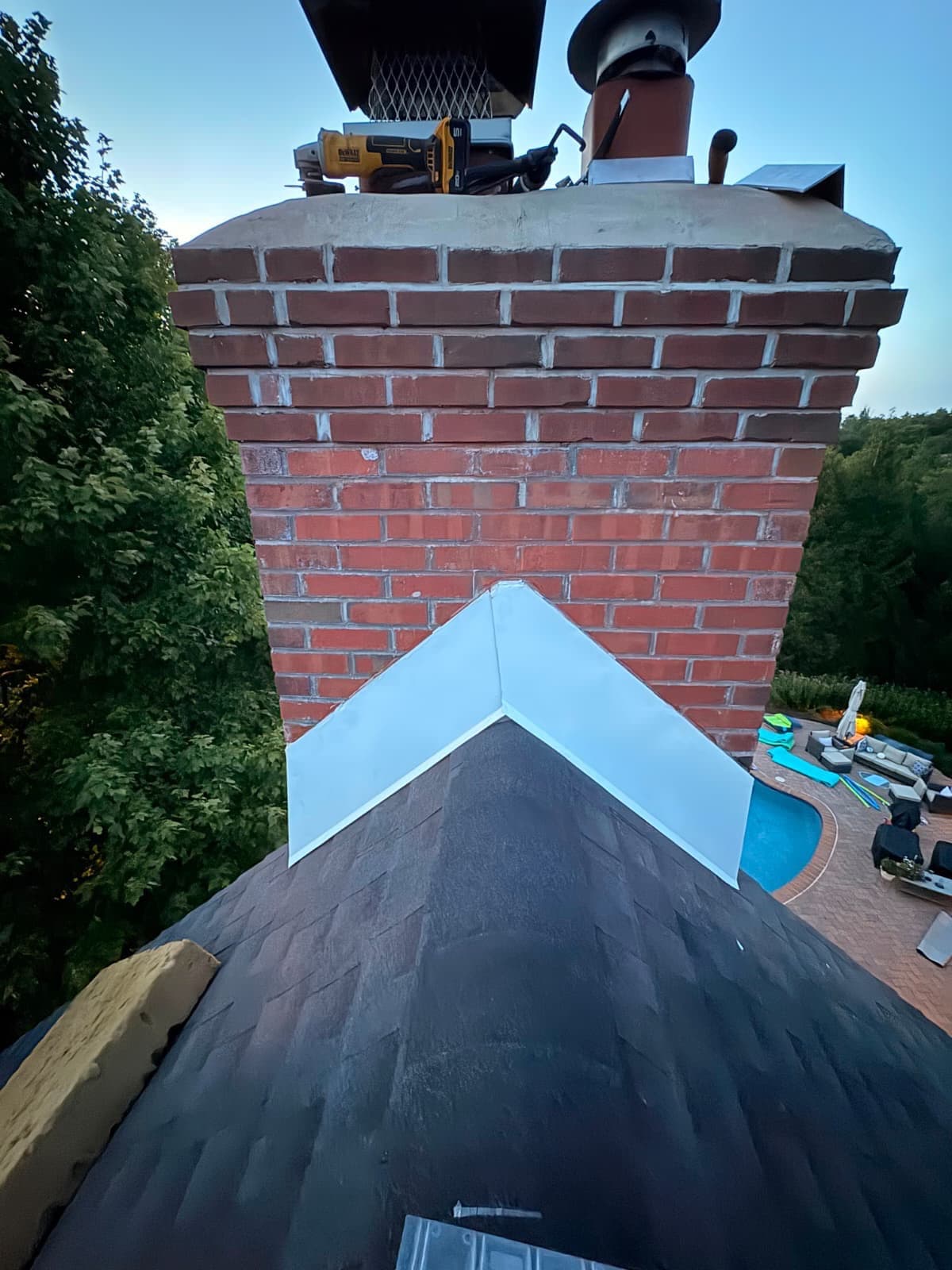
- Flashing and metal details — Step, counter, apron, valley and drip edge — the line items a bayshore address should spend on ahead of the shingle.
- The page that works the floodplain question — The shipped page that argues this properly: a borough whose flood chapter names roofing outright and folds its cost into a substantial-improvement determination.
- What the survey covers — What the visit itself covers: we climb it, we get into the attic, and you get photographs and a written summary, free and with no obligation.
- roof repair in Little Ferry — The Bergen borough that measures building height up from the base flood elevation plus a foot, so the flood map, not the lawn, is where a dormer or a raised ridge starts.
Three feet at Port Monmouth, ninety-three at Navesink — one town line, one construction office, two different roofs
Same covering at both ends of the township; what changes is the metal and the order we look in. FEMA's coastal corrosion bulletin gives the mechanism — “Salt spray from breaking waves and onshore winds significantly accelerates the rate of corrosion of metal connectors and fasteners.” It also gives a distance line: airborne salt is greatest near breaking waves and declines rapidly across the first 300 to 3,000 feet landward of the shoreline. That band takes in waterfront Belford and Port Monmouth; Lincroft is outside it. The limit belongs in the same breath: the bulletin covers light-gauge connectors and fasteners, not coverings or flashing. We cite the physics, not a rule binding your roof.
The counter-intuitive finding is the useful one: "portions of buildings exposed to rain may undergo lower corrosion rates than sheltered areas…" Read that as an instruction. The open field gets rinsed; step flashing under a sidewall, counter-flashing in a mortar joint, the pan inside a cricket and fasteners under an overhang do not. The exposure is not our claim: the Army Corps writes that "Port Monmouth located in Middletown Township, Monmouth County, New Jersey, has been under construction since 2013 after the devastation of Hurricane Sandy…" and is "slated to be complete by end year 2028."
- On a bayfront block the water-facing slope, its flashing and gutter line get read first
- Sheltered details before open field: behind counter-flashing, inside a cricket, under an overhang
- The township's CRS Class 7 discounts NFIP flood premiums; a wind-damaged roof is paid by your homeowners policy
Sixteen roofing pages are aimed at this township, all of them written somewhere else, and we are not going to pretend ours wasn't
We read sixteen roofing pages aimed at this township and found, across all sixteen, no citation of any legal authority — no N.J.A.C., no N.J.S.A., no IRC section, no ordinance. What they offer instead is nearness, some of it invented. One tells homeowners here to get a roofer's licence number and "verify them with the local licensing board." New Jersey has no local licensing board and no roofing trade licence; the state issues a Home Improvement Contractor registration through Consumer Affairs. That page prints its own registration number under the word licence. Ours is 13VH13970900.
A second page's Middletown Township content offers “our Wayne-based team,” North Jersey weather, and streets that are in Passaic County. A third, the strongest here, calls the township “the second-largest municipality in New Jersey by area”; the Census Gazetteer puts it at 40.95 square miles of land, third in its own county behind Howell and Upper Freehold, and the state's largest is Hamilton Township in Atlantic County at 110.9. Forty-one square miles also makes the Lincroft-to-Belford drive a scheduling variable. Plenty of roofers nearer than us publish round-the-clock coverage; so do we, and the difference is not the phone number but what gets pulled before the quote. What travels fifty miles is the map pulled before we quote, metal specified against what it shows, and a registration you can check.
Monthly payment options
We work with Hearth, which shops several lenders on a single application. See your personalized options in minutes — checking does not affect your credit score, and there is no commitment.
- Loan amounts up to $250,000
- Funding in as little as 1–3 days
- No prepayment penalties
- No home equity required
Financing is provided by Hearth's lending partners, not by Precision Windows & Roofing. Rates and terms depend on your credit and the lender making the offer, and all financing is subject to credit approval.
Common questions
Do I need a permit to re-roof my house in Middletown Township?
N.J.A.C. 5:23-2.7(c)1x treats roof covering replacement as ordinary maintenance, and the exemption turns on the word detached. ACS 2020–2024 table B25024 counts 25,652 housing units in Middletown Township and 19,907 in one-unit detached structures, reaching roughly four addresses in five. The 2,224 attached units and the 3,141 in buildings of three units or more sit outside it outright; the 331 two-unit estimate could fall either way, because the table records units and not whether the building is detached. Under 5:23-2.7(b)4 structural work is never ordinary maintenance — replace decking or a rafter and it is permitted work. Locally the Township's permit page cites Ord. No. 2022-3346 § 103.10, requiring a Floodplain Encroachment Permit for substantial improvement or other development in a regulated flood zone. Substantial improvement is a cost-to-value ratio rather than a category of work, so a covering-only re-roof will not normally reach it — but bundled into a bigger renovation its cost can count. On a bayshore address we ask the Municipal Floodplain Manager before we book the date.
Are you actually in Middletown Township, and can you come out today?
Not based here — our shop is at 163 Midland Ave, Unit B in Garfield — but yes, we cover the township same-day depending on the job and how booked we are that day, and answer emergencies around the clock. What we will not do is quote you an arrival time on a page. Ring and we will say what we can get down and when, and if water is coming through the ceiling now, say that first.
My house is in Belford or Port Monmouth. Should I pay for different metal than my sister in Lincroft?
Yes, with the limit attached. FEMA's coastal corrosion bulletin puts airborne salt at its greatest near breaking waves and declining rapidly across the first 300 to 3,000 feet landward of the shoreline, and reports tests in which rain-sheltered details corroded faster than the surfaces rain can rinse. On a waterfront block that makes flashing, fasteners, drip edge and valley metal the line items worth upgrading, and the sheltered details the first we check. The limit: that bulletin's scope is light-gauge connectors and fasteners, not roof coverings or flashing systems — a mechanism we apply, not a requirement anyone can cite at you.
My house is in Navesink or Lincroft, up off the water. Does any of this apply to me?
Mostly not, which is half the point. The query returning Zone AE at Port Monmouth returns Zone X, area of minimal flood hazard, at both Navesink and Lincroft, where the USGS surface reads roughly ninety-three feet at Navesink and sixty at Lincroft against three at Port Monmouth. One thing does apply up here: Navesink is one of five designated historic districts, with Chapel Hill, Locust, Monmouth Hills and Middletown Village, and the Township maintains a Landmarks Commission with a Certificate of Appropriateness application. Its historic preservation page states no trigger and says nothing about roofs, so we will not tell you review is required — but if your roof is visible from the street and you are changing colour or material, confirm with the Commission before you order.
Explore
Get your free roofing quote
Free, no-obligation on-site assessment, quoted line by line before anything is booked. We cover Middletown Township same-day depending on the job and how booked we are that day, and answer emergencies around the clock.