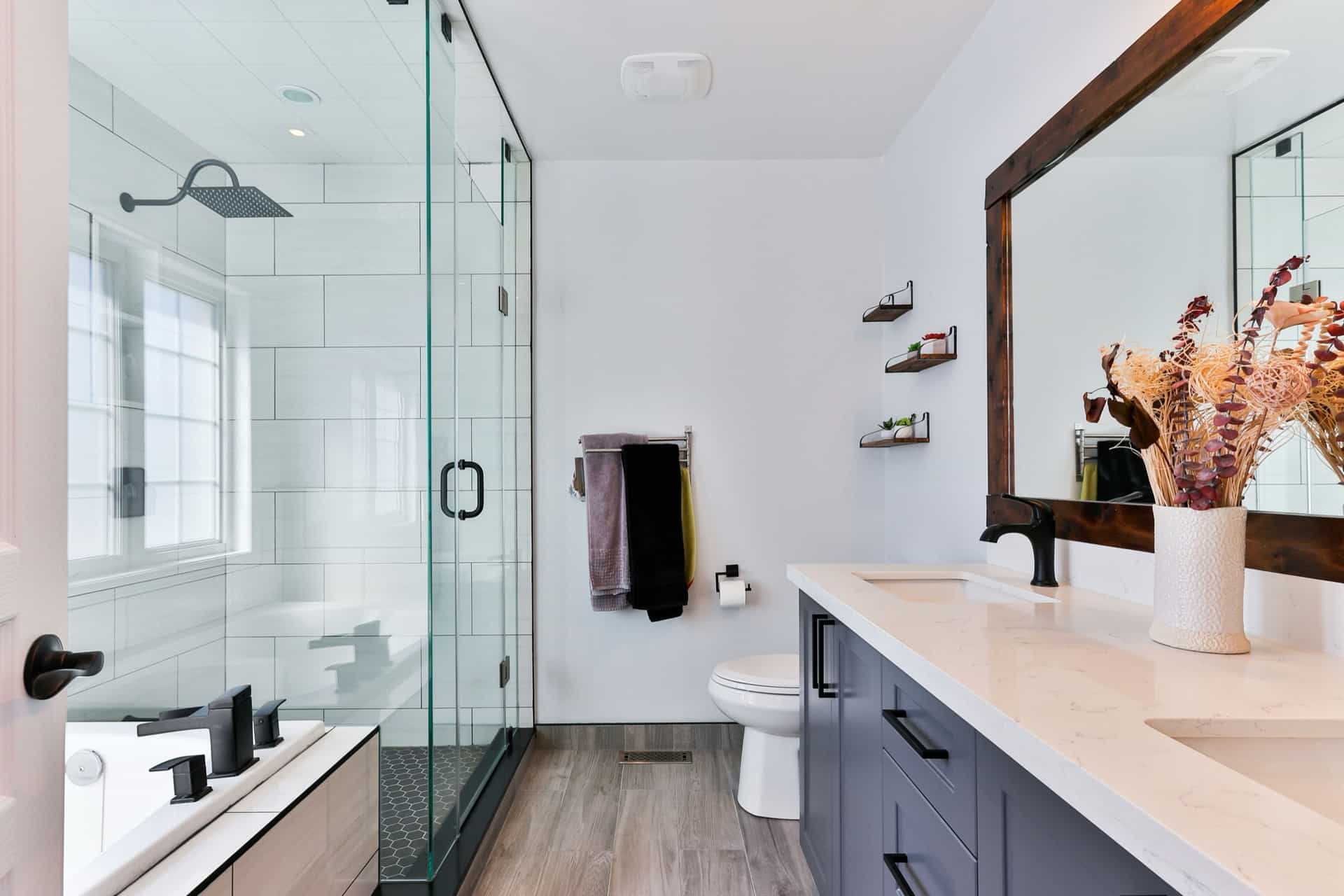
Custom Glass Showers
Frameless, semi-frameless and sliding doors for the shower opening you already have.
Custom Glass Showers
Frameless, semi-frameless and sliding shower doors measured to the opening your bathroom already has. We size the glass thickness to the door, spec the hinges to whatever is actually behind your tile, and fit the sweeps and seals that keep the water inside the shower — the three things that decide whether a door still hangs straight and stays dry in year ten. Building the shower itself — steam, curbless, or a multi-panel European layout — is our custom shower enclosures page.
A frameless glass shower is two pieces of engineering pretending to be one piece of glass. The hinges, clips, and headers carry the load; the glass thickness controls the deflection; the U-channel and sweeps control the water; and the substrate behind the tile dictates how anchors actually hold. Get any of those wrong and the door sags within a year, leaks onto the bathroom floor, or shatters the day you bump it with a vacuum cleaner. We've installed thousands of these across NJ — primary bathrooms in Bergen and Morris county new builds, condo renovations in Hoboken and Jersey City, hotel suites in Atlantic City — and the difference between a shower that lasts twenty years and one that fails in three is almost always in the spec, not the glass.
This page is the door and the fixed panel that partners it: a shower opening that already exists, or one the tile contractor is building to a normal curb-and-alcove layout, getting glass that fits it. Everything below is about that scope — thickness, hinges, seals, and the substrate the hardware has to anchor into. If the shower itself is the project rather than the glass in it — a sealed steam room, a curbless zero-threshold walk-in, a multi-panel European or neo-angle layout where the panels are carrying each other — that is a different engineering problem and it lives on our custom shower enclosures page.
New Jersey's adoption of IRC R324.4 requires tempered or laminated safety glazing in every shower and tub enclosure, full stop. We don't install annealed glass in showers under any circumstance — even if a homeowner asks. We do install 1/4", 3/8", and 1/2" tempered configurations depending on the door size, weight, and aesthetic; and we'll walk through the hinge style, hardware finish, and water-management approach during the measure visit, not after we've ordered.
Glass thickness: 3/8" vs 1/2" and when each applies
3/8" (10mm) tempered glass is the default for frameless shower doors up to about 30" wide and 80" tall. It's stiff enough to resist visible deflection when you open and close the door, light enough that two-person crews can handle install without lifting equipment, and meets the load and impact requirements of the major hinge manufacturers (CRL, Frameless Hardware Company, Coastal Industries) for residential applications.
1/2" (12mm) tempered is required for doors wider than 30", for doors taller than 84", for any door with a full-height single hinge configuration, and for steam showers where the door is sealed top and bottom. It's also our default for high-end primary bath jobs where the homeowner wants the visual weight of thicker glass — the difference at the edge view is significant. A 1/2" door at 36"x84" weighs roughly 110 lbs of glass alone, and the hinge spec changes accordingly.
We never recommend 5/16" (8mm) glass for residential frameless showers despite some discount fabricators offering it. The deflection is visible after the first year, the edge stress concentration at the hinge holes is higher, and the hardware compatibility is poor.
Low-iron Starphire glass is the upgrade option — about 20% pricier than standard clear, but it eliminates the green tint at the edges and through-thickness. Worth it on showers where the homeowner sees a lot of the glass edge (curbless doorless walk-ins, oversized fixed panels).
Hinge and hardware selection
Wall-mount glass-to-wall hinges: the standard configuration for in-line shower doors with the hinge attached to the bathroom wall (not to a return glass panel). The hinge anchors carry the entire door weight in shear — substrate matters enormously. Tile over solid backing (cement board, Schluter-Kerdi, Wedi) holds anchors well; tile over drywall does not, and we won't install glass-to-wall hinges into drywall substrate without first sistering structural blocking inside the wall.
Glass-to-glass hinges: used when the door hangs off a fixed return panel rather than the wall. Avoids the substrate issue entirely. Common in neo-angle and 90-degree configurations. We spec CRL's Geneva series or Frameless Hardware Company's M-series for residential, both rated for doors up to 110 lbs.
Pivot hinges (top and bottom pivot pins): the cleanest visual look — no visible hinge body. Limited to doors up to ~30" wide and ~75 lbs. Requires precise sill and header alignment because the pivot pins are unforgiving of out-of-plumb conditions.
Finish: brushed nickel and matte black are the current high-volume finishes in NJ. Polished chrome remains specified on traditional designs. Champagne bronze and brushed gold are growing in primary bath remodels. We stock all five finishes from CRL.
Water containment: where most frameless showers fail
Frameless doesn't mean unsealed. Every shower door we install gets a polycarbonate or vinyl door sweep at the bottom (drag seal), a magnetic strike jamb at the latch side when meeting a fixed panel, and a polycarbonate side seal at the hinge side to bridge the 3/16" gap between door and wall. Without these, water sheets out of the shower onto the bathroom floor — the #1 reason homeowners call us back on installs other contractors did.
Where a door meets a curbless or low-threshold floor, containment stops being the sweep's job alone and becomes a function of the shower floor slope (1/4" per foot toward the drain, minimum) and where the fixed panel sits relative to the spray. We measure the wet zone — typically a 24" radius from the showerhead at standing height — and place the fixed panel to keep the spray inside it. Multi-head and rain-head configurations need taller and wider containment. Doorless walk-ins, where there is no door at all and the panel layout is the entire water strategy, are scoped on our custom shower enclosures page.
Door clearance: a frameless door needs 3/16" to 1/4" clearance under the door to operate over a curb or threshold without binding. The door sweep bridges that gap. On a curbless install we drop the door to 3/8"-1/2" above the tile so the sweep makes consistent contact with the slope.
NJ code and tempered-glass requirements
IRC R324.4.5 mandates safety glazing for any pane in a shower or tub enclosure where the bottom edge is less than 60" above the standing surface. In practice that's every shower enclosure pane we install — fixed panels, doors, transoms, return walls. All tempered or laminated, all marked with the manufacturer's permanent etched designation per CPSC 16 CFR 1201 Category II.
Tempered glass cannot be cut or drilled after fabrication. Every hole for hinges, clips, knobs, and towel bars has to be fabricated before tempering. That means precise hardware layout at the measure visit — once the glass is tempered, mistakes mean re-fabrication and 7-10 day delay. We do CAD layouts on every frameless job and confirm hole locations with the homeowner before sending to fab.
For multifamily and hotel applications in NJ, IBC Section 2406 imposes additional safety glazing requirements on access aisles and pedestrian areas — relevant when shower enclosures border egress paths in studios and lofts.
Our Process
- 1Design consultationOn-site visit to assess shower geometry, substrate condition, plumbing locations, and aesthetic direction. We discuss glass thickness, hinge style, hardware finish, and water-management approach. Curbless and steam-shower upgrades scoped at this visit.
- 2Precision measureLaser measurement of every panel: heights at three points, widths at three points, plumb deviation, level of the curb or floor, square at corners. CAD layout produced same-day showing every hole location, glass edge type (polished, beveled, ground), and hardware position.
- 3Approval and orderHomeowner reviews and signs off on the CAD. Glass is ordered with the fabricator — typical lead time 7-14 business days for 3/8" clear, 10-21 days for 1/2" or low-iron Starphire. Hardware is ordered concurrently from CRL or FHC.
- 4Installation dayTwo-person crew, typically 4-6 hours for a standard 60"x36" enclosure with door and fixed panel. Substrate verification first (we anchor into solid backing or sister blocking), hardware mounted, glass set with installer suction cups, panels plumbed and squared, seals and sweeps installed last. Silicone cure-out time before water exposure: 24 hours.
- 5WalkthroughOperation check on the door swing, latch engagement, magnet alignment. Hardware care instructions for the homeowner (avoid harsh cleaners on brushed finishes). Care guide on glass cleaning to preserve any optional coatings. Lifetime workmanship warranty paperwork.
Materials We Use
The Precision Difference
About Custom Glass Showers in NJ
Is 3/8" or 1/2" glass better for my shower?+
Will the door leak water onto the bathroom floor?+
Can I drill into my tempered glass after installation to add a towel hook?+
What's the lead time on a frameless shower in NJ?+
Does a curb or a curbless floor change the door I can hang?+
Will the glass shatter on its own?+
Do you handle the tile and substrate prep too?+
What's the difference between frameless, semi-frameless, and framed shower doors?+
How do I keep my glass shower door from getting cloudy or spotted?+
Custom Glass Showers by City
Serving All 21 New Jersey Counties
We service Atlantic County, Bergen County, Burlington County, Camden County, Cape May County, Cumberland County, Essex County, Gloucester County, Hudson County, Hunterdon County, Mercer County, Middlesex County, Monmouth County, Morris County, Ocean County, Passaic County, Salem County, Somerset County, Sussex County, Union County, Warren County. From our Garfield, NJ shop we cover the entire state, same-day in Bergen County, and elsewhere depending on the job and how booked we are that day.
Explore More
CUSTOM SHOWER ENCLOSURES
The whole shower built in glass — steam, curbless and multi-panel enclosures.
DetailsINTERIOR & OFFICE GLASS DOORS
Interior and office glass doors built for non-standard openings.
DetailsGLASS INSTALLATION
Full-service glass installation across New Jersey — residential, commercial, and architectural. Cut, tempered, laminated, and insulated glass installed to NJ Uniform Construction Code.
DetailsSTANDARD WINDOW INSTALLATION
Professional installation of double-hung, single-hung, and slider windows.
Details