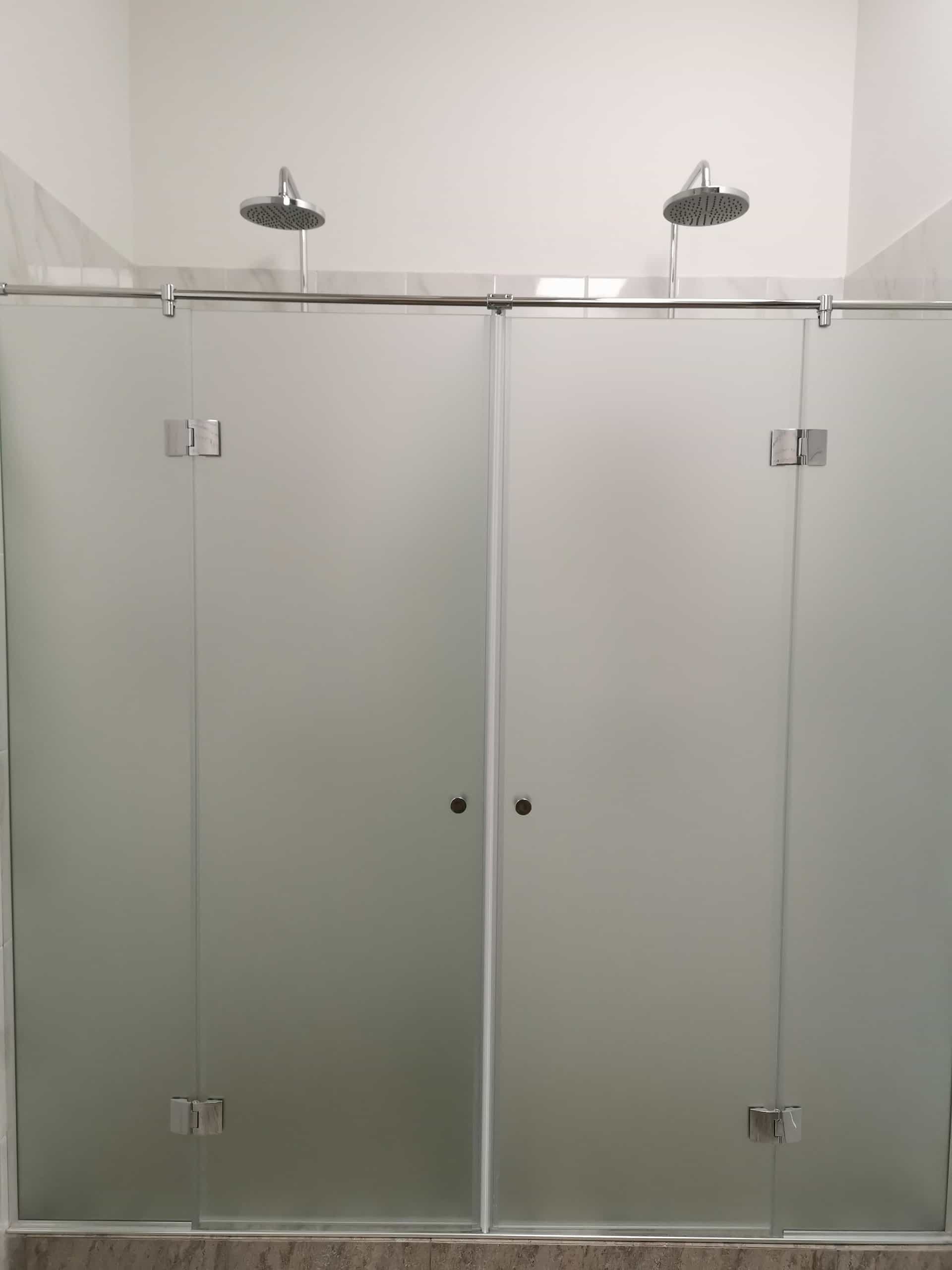
Custom Shower Enclosures
The whole shower built in glass — steam, curbless and multi-panel enclosures.
Custom Shower Enclosures
Custom shower enclosures for the jobs where the whole wet area is the project, not just the door: sealed steam enclosures with transoms and vapor-tight headers, curbless zero-threshold walk-ins, and multi-panel European layouts with neo-angle and multi-corner returns. Every panel is laid out in CAD from a field measure and custom-fabricated in heavy tempered glass, with hardware specified to survive the humidity it will live in. Replacing the door in a shower opening you already have is our glass showers page.
Custom shower enclosures are where the residential glass trade meets cabinetmaking precision. Neo-angle returns, multi-corner Euro configurations, steam-shower seals, curbless transitions, integrated benches, niches that intersect glass panels — none of these are catalog items. Every one is a CAD-engineered, field-measured, custom-fabricated piece of glass with bespoke hardware. We've built these for primary baths in Saddle River, contemporary new construction in Short Hills, Hoboken and Jersey City lofts where the entire bathroom is one continuous wet zone, and shore homes from Mantoloking to Avalon where salt air requires marine-grade hardware on every fitting.
What separates a custom shower from a standard frameless door-and-panel is engineering responsibility. When the homeowner wants a 96" tall, 60" wide, three-panel European walk-in with a single fixed pivot door, the installer has to know how the panels carry their own weight, how the structural silicone joints transfer load, how the substrate behind the tile is going to handle eight 110-lb glass panels, and how a steam shower's 100% humidity environment is going to attack every metal fitting over the next twenty years. That's the work we do.
Steam showers: a different engineering problem
A steam shower is a fully enclosed, top-to-bottom sealed wet room operating at near-100% humidity and temperatures up to 118°F. The glass needs to extend to within 6" of the ceiling, the door needs to seal at the top with a transom or flipper panel, and the enclosure needs a slight inward ceiling slope (1/2" per foot minimum) to channel condensate back toward the floor rather than dripping on the bather.
Hardware in steam showers takes more abuse than in any other residential glass application. Standard residential hinges and brackets will pit and corrode within three to five years. We spec 316 stainless steel hardware (not 304) for every steam shower — the molybdenum content in 316 resists the chloride attack that develops in repeated high-humidity cycling. CRL's Pinnacle stainless line and FHC's Stainless Series both qualify; we won't substitute lesser-grade hardware even when a homeowner pushes back on cost.
Glass thickness for steam: 1/2" tempered minimum on door panels because of the transom seal weight loading and the door height (typically 84-90"). Low-iron Starphire is strongly recommended because steam condensate on standard green-tinted glass shows mineral spotting more aggressively.
The steam generator's vapor outlet placement matters for glass: we coordinate with the plumber to ensure the steam head is not directly aimed at glass-to-glass joints, which can degrade silicone seals over years of thermal shock.
Curbless and zero-threshold designs
Curbless showers are now the dominant primary-bath design in NJ new construction and high-end remodels. The continuous tile floor reads as more open and spacious, satisfies accessibility requirements (ADA-compliant zero-threshold), and eliminates the trip hazard of a 4-6" curb. The engineering tradeoff is water containment — without a curb to define the wet zone, the glass enclosure and the floor slope have to do all the work.
Floor slope to drain: minimum 1/4" per foot per industry standard. We measure the existing slope on the tile contractor's mortar bed before scheduling the glass and won't proceed if the slope is insufficient — water that doesn't drain will pond, migrate under the glass, and end up on the bathroom floor regardless of how the glass is sealed.
Glass-to-floor detail: 3/8" to 1/2" gap with a polycarbonate sweep that flexes to follow the floor slope. We do not silicone the glass to the floor on curbless because thermal movement will crack the silicone and create a permanent leak path; the sweep is the dynamic seal.
Linear drain placement: at the entry edge of the shower (parallel to the door opening) is the contemporary preference and works well; at the back wall is the traditional placement. Either works for water management as long as the slope is correct and the glass is positioned to contain the spray pattern.
EnduroShield and protective coatings
Every glass shower develops hard-water spotting and soap scum buildup over time. EnduroShield is a fluoropolymer surface coating applied to the glass before installation that bonds at the molecular level and creates a hydrophobic surface — water sheets off rather than beading, and mineral deposits don't adhere. Ten-year manufacturer warranty on residential applications.
The coating is priced by the square foot of glass, so it scales with the size of the enclosure — a real line item, not a rounding error, but small next to replacing glass that hard water has etched past cleaning. We apply EnduroShield in our shop before delivery so the coating is uniform and uncontaminated by site dust, and we quote it as its own line so you can take it or leave it.
Alternative coatings (Showerguard, Diamon-Fusion) are similar in performance and price. We default to EnduroShield because it's the longest-standing product and the warranty service is reliable.
Maintenance: any coated shower glass should be squeegeed after each use to extend the coating life. The coating is not a permanent fix — it delays mineral buildup but doesn't eliminate it forever. Most coated showers we install need recoat or replacement at 8-12 years; uncoated glass shows visible degradation at 2-4 years.
European multi-panel and pivot configurations
Euro-style frameless walk-in showers are the high-design configuration: three to five glass panels meeting at 90° or 135° corners, structural-silicone glass-to-glass joints with no vertical metal posts, and a single pivot or sliding door. The visual is a continuous wall of glass. The engineering is precise CAD layout, perfect glass fabrication tolerances (+/- 1/16"), and silicone joints that have to carry load.
Structural silicone joints between glass panels use Dow 995 or equivalent high-modulus silicone with a minimum 3/8" bead width and full-height application. The joint carries both gravity load (each panel's weight transfers to adjacent panels) and shear load (door operation forces transmit through the panel system). We don't substitute lesser silicones on these joints — failure mode is sudden and catastrophic.
Top channel vs no top channel: a continuous U-channel at the ceiling line increases panel stability and is required on door-panel configurations over 90" tall. For purely fixed-panel configurations under 84" tall we can omit the top channel for a cleaner aesthetic, but the bottom U-channel and structural silicone joints have to do more work and the glass thickness goes up to 1/2" minimum.
Bench and niche coordination: when a stone bench or tile-lined niche intersects a glass panel, we cut and fabricate the glass around the obstruction with a notch or step. Every notch increases stress concentration and requires heat-soak treatment on the tempered panel. We coordinate the bench and niche locations with the tile contractor before glass fabrication.
Our Process
- 1Concept designOn-site walkthrough with the homeowner and (often) interior designer or architect. We discuss enclosure shape, panel configuration, door style (pivot, swing, sliding), hardware finish, glass spec (thickness, clear vs low-iron, coatings), and special features (steam, integrated bench, niches, transom).
- 2Field measure and CADAfter the tile substrate is set (not before — substrate variations of 1/4" can ruin a custom glass layout), we laser-measure every panel location, every hardware position, and every intersection with adjacent surfaces. CAD layout delivered within 3-5 days.
- 3Homeowner reviewCAD review with the homeowner to confirm every dimension, every hardware location, and every aesthetic choice. Changes accommodated before fabrication — once glass is fabricated, changes mean re-fabrication.
- 4FabricationGlass cut, edged, drilled, and tempered to spec. Heat-soak treatment on overhead, load-bearing, and large-panel jobs. EnduroShield coating applied in-shop if specified. Hardware ordered and inspected on receipt. Total fabrication: 14-28 business days for standard custom; 4-6 weeks for complex multi-panel or Euro-style.
- 5InstallationTwo- to three-person crew depending on panel count and weight. Substrate verification, hardware mount, panels set with suction cups and shoring, structural silicone application on glass-to-glass joints (24-hour cure), seals and sweeps last. Total time on site: 6-12 hours for typical custom enclosure; multi-day for full bath wet rooms.
- 6Cure and walkthroughStructural silicone joints cure for 24-48 hours before water exposure. Walkthrough with homeowner once cured: hardware operation, door swing, seal contact. Care guide for coated glass and high-end hardware finishes. Lifetime workmanship warranty + glass and coating manufacturer warranties.
Materials We Use
The Precision Difference
About Custom Shower Enclosures in NJ
What makes a steam shower different from a regular shower enclosure?+
Can you build a glass enclosure for a curbless walk-in shower?+
Is EnduroShield coating worth the cost?+
How long does a custom shower take from design to installation?+
What's the difference between regular and Euro-style multi-panel?+
Can I have a niche or bench that interrupts the glass panel?+
Do you work with my interior designer or architect?+
Custom Shower Enclosures by City
Serving All 21 New Jersey Counties
We service Atlantic County, Bergen County, Burlington County, Camden County, Cape May County, Cumberland County, Essex County, Gloucester County, Hudson County, Hunterdon County, Mercer County, Middlesex County, Monmouth County, Morris County, Ocean County, Passaic County, Salem County, Somerset County, Sussex County, Union County, Warren County. From our Garfield, NJ shop we cover the entire state, same-day in Bergen County, and elsewhere depending on the job and how booked we are that day.
Explore More
CUSTOM GLASS SHOWERS
Frameless, semi-frameless and sliding doors for the shower opening you already have.
DetailsGLASS INSTALLATION
Full-service glass installation across New Jersey — residential, commercial, and architectural. Cut, tempered, laminated, and insulated glass installed to NJ Uniform Construction Code.
DetailsINTERIOR & OFFICE GLASS DOORS
Interior and office glass doors built for non-standard openings.
DetailsSTANDARD WINDOW INSTALLATION
Professional installation of double-hung, single-hung, and slider windows.
Details