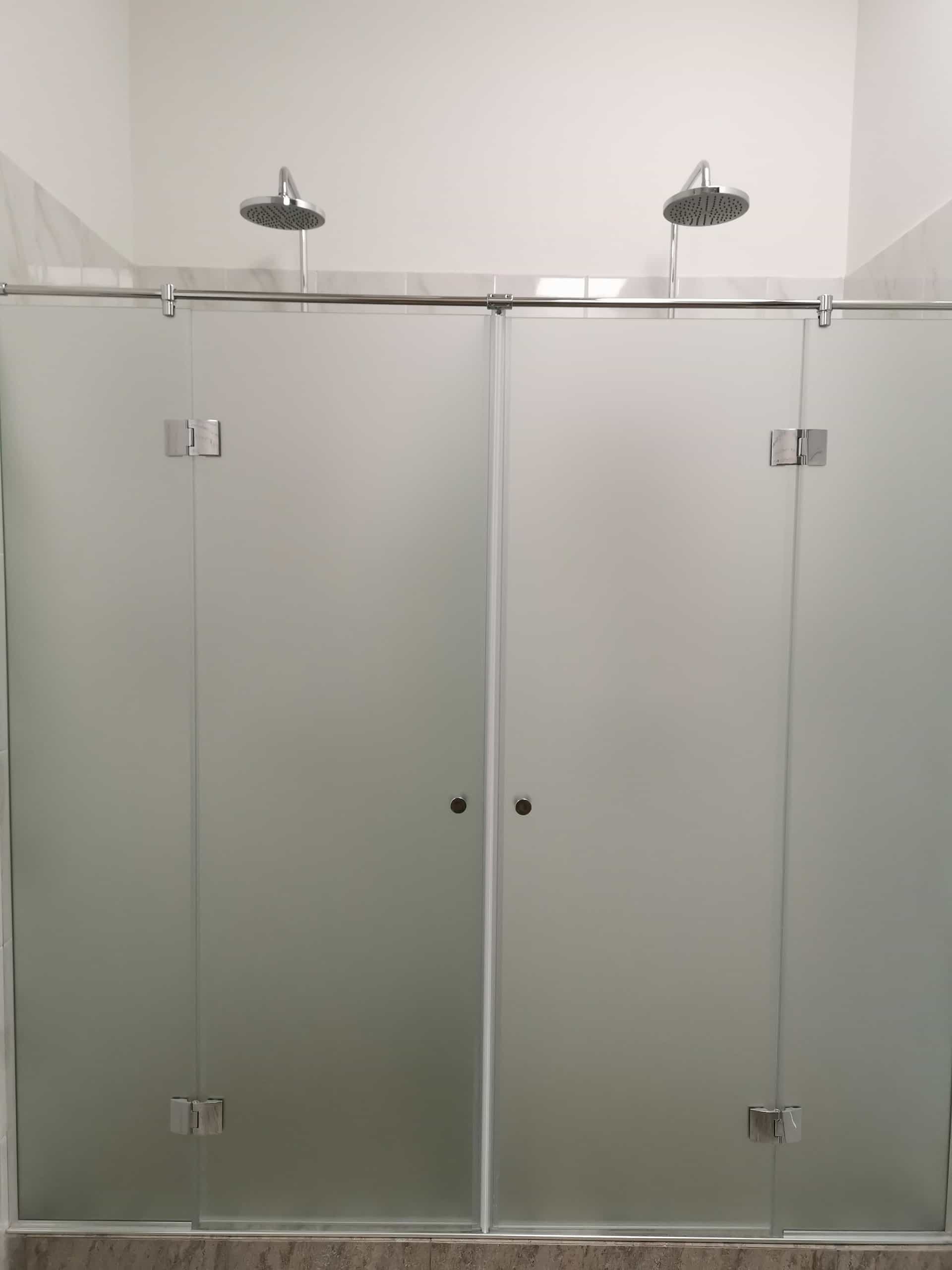
Frosted & Etched Glass
Acid-etched and sandblasted privacy glass.
Frosted & Etched Glass
Achieve privacy without losing light. Acid-etched and sandblasted glass solutions for bathrooms, offices, and doors.
Frosted glass spans four genuinely different processes that look similar from across a room but behave very differently up close: acid-etched, sandblasted, fired-on ceramic frit, and applied film. Each has its own cost, durability, fingerprint resistance, and ability to carry a custom pattern or logo. The wrong process specified for a high-touch environment — say, a sandblasted shower door in a humid bath — gives you a smudged mess within a year. The right process gives you 20 years of clean privacy. We do all four in-house or through trusted shop partners, and we'll tell you which one your project actually needs.
Our shop fabricates acid-etched and sandblasted glass up to 84" x 130". For ceramic frit and large architectural panels we work with regional glass benders and fritting shops in NJ and eastern PA. For logo work, we vector-cut masks on a 64" plotter and either sandblast or etch — turnaround 5-10 business days for stock thicknesses, 2-3 weeks for tempered or laminated.
Drop it at the Garfield counter, or we come to you
Our shop is at 163 Midland Ave in Garfield and the counter is walk-in. If the piece comes out of the opening — a bathroom sash, a cabinet lite, a pantry-door panel, a sidelight — bring it in with the pattern or the logo you want and we mask, etch or blast it here. Simple privacy frosting on a stock-size lite is straightforward counter work; masked logo and pattern jobs go on the plotter first. You get the price before we touch the glass, and you are not paying for a truck and a crew to stand in your hallway.
The jobs we run most are not exotic. Office-partition and conference-room glass with the company mark etched into it, up and down the Hackensack and Paramus corridor. Storefront lites on Route 17 and Route 4 where the tenant wants the window branded without covering it in vinyl. And bathroom privacy retrofits — a homeowner with a clear bath window facing a neighbor, where swapping the glass for etched costs a fraction of moving or replacing the window. For anything fixed in place, or anything over about 60 inches, we measure and install on site.
The four frosting processes and where each one wins
Acid-etched glass: glass surface chemically etched with hydrofluoric acid (or proprietary blends) to micro-pit the surface uniformly. Result: smooth-to-touch finish with even, soft frost — no granular feel. Premium product: Bendheim Satin, Guardian Satin Deco, Walker Glass Acuity. Best for high-touch surfaces (shower doors, partitions, table tops) because the smooth surface doesn't trap fingerprints as aggressively as sandblast. Premium price, premium aesthetic — the standard for high-end commercial and residential frosted glass in NJ.
Sandblasted glass: abrasive media (aluminum oxide, garnet) blasted at the glass surface through a vinyl or rubber mask. Result: granular, rougher texture that scatters light heavily. Best for one-off custom artwork, logos, decorative patterns where you want texture you can feel. Downside: the rough surface holds fingerprints and water spots aggressively. We finish high-touch sandblasted work with a fluoropolymer sealer (similar to Diamon-Fusion or Enduroshield) that fills the micropits and dramatically reduces marking — extra step, but mandatory on bathroom and kitchen applications.
Ceramic frit: ground ceramic enamel applied to glass surface as a paint, then fired in the tempering oven at 1150°F to permanently bond to the glass. Result: permanent opaque or translucent pattern that cannot be scratched off, cannot be peeled, and is resistant to chemicals, UV, and abrasion. Best for commercial spandrels, exterior architectural glass, and any application requiring 30+ year durability. Custom patterns require shop-fabricated screens — minimum order makes it economical only for runs of 4+ identical panels.
Applied frosted film (3M Fasara, LLumar Decorative, Solyx): adhesive-backed polyester film with frosted or patterned surface applied to existing glass. Best for retrofit privacy on existing windows where replacing the glass is too disruptive — conference rooms, bathroom windows, glass doors. Downside: 10-15 year service life, can be scratched or peeled, and shows seams on large lites. We use film when the budget or schedule won't allow replacement; we recommend etched or fritted glass for permanent work.
Fingerprint-resistant grades and why they matter
Standard acid-etched and sandblasted glass shows fingerprints — the micropits trap skin oils. On the back of a partition or wall application, that's not a problem. On a high-touch surface (shower door pull side, conference room handle side, retail display front face) fingerprint visibility becomes the dominant aesthetic issue within a month of installation.
Premium acid-etched products in their highest grade ('Bendheim Satin' top tier, Walker Glass Acuity grade A) are engineered with controlled etch depth and micro-pit geometry that reduces oil retention. They cost more than standard etched but maintain a clean appearance with a quarter of the cleaning frequency.
For projects where fingerprint resistance is critical — high-traffic commercial bathrooms, retail glass doors, hospitality conference rooms — we spec acid-etched as the base, then apply a fluoropolymer nanocoating (Diamon-Fusion ProShield, Enduroshield, ClearShield Pro) that further fills the surface and gives 10+ years of easy-clean performance. Total cost is 2× standard sandblast but maintenance cost over the install life is a fraction.
Sandblasted glass should not be specified for high-touch surfaces unless the client specifically wants the rougher tactile finish and accepts the cleaning burden. We document this in writing in every quote that includes sandblast for a high-touch application.
Custom logo and pattern etching
Vector logos and patterns are plotted on 4-mil vinyl mask material on our 64" Roland plotter. The mask is weeded (negative space removed), applied to clean glass, then either acid-etched or sandblasted depending on the design.
Acid-etched logos are sharper and finer — we can hold detail down to 1/16" linework. Best for fine-line logos, typographic elements, and detailed iconography. Wedding monograms, law firm logos, restaurant branding, hospital seals.
Sandblasted logos are deeper and bolder — best for chunkier brand marks, signage where the texture itself is part of the design, and any installation where the customer wants the etched detail to read from across a large room.
We design or take vector files (AI, EPS, PDF, SVG). Bitmap files (JPG, PNG) have to be re-traced before fabrication. Minimum etched logo size on standard glass: roughly 6" wide for readable corporate branding. Storefront branding scales up to 96" wide on a single lite.
Pricing scales with mask complexity and glass size — a single shop-cut logo on a 30" x 80" door is a different scope from running 200 identical etched panels for a retail rollout. We quote both as fixed-price line items.
Where frosted glass goes wrong
Shower doors in sandblasted finish without protective coating. Six months in, the granular surface is a permanent map of every hand-touch and water droplet. The fix is either re-coating with fluoropolymer (works if caught early) or replacement with acid-etched glass.
Exterior storefront frosted film over single-pane glass on a hot west-facing elevation. Thermal stress from differential heating of film vs glass causes either film bubbling or, worse, glass thermal-shock cracking. Solution: spec etched or fritted glass instead of film for any exterior commercial application.
Conference room partitions etched on the room-side surface. Cleaning crews use ammonia-based glass cleaners that fail to remove fingerprints from the etched side and eventually leave a permanent haze. Solution: etch on the corridor side (room side is smooth glass that takes any cleaner), or use partitioning glass etched on both sides.
Logo etching specified at 1/8" linework on a sandblast process — the texture overwhelms the line and the logo blurs into noise. Solution: acid-etch any line-art finer than 1/4".
Our Process
- 1Consultation and process selectionWe review the application, traffic level, cleaning regime, aesthetic goal, and budget. Output: written recommendation of acid-etch, sandblast, ceramic frit, or applied film with cost comparison.
- 2Design and mockupFor logo or custom pattern work, our shop designer prepares the vector file and a printed-to-scale mockup. We send the proof and don't proceed until the client signs off in writing.
- 3FabricationGlass cut to size, edges seamed or polished, mask applied, etched or blasted in our shop or partner facility. For tempered work, mask and process happen before tempering — once tempered, glass cannot be modified. Standard turnaround 5-10 business days; tempered 10-15.
- 4Quality control and coatingEvery etched or blasted panel is inspected for uniform finish, mask bleed, and edge condition. Where specified, fluoropolymer nanocoating is applied in a controlled-humidity environment and cured per manufacturer protocol.
- 5Installation and care handoffGlass installed using the appropriate hardware for the application (shower, partition, door, fixed window). Client receives a printed care sheet specifying approved cleaners and cleaning frequency to preserve appearance.
Materials We Use
The Precision Difference
About Frosted & Etched Glass in NJ
What's the difference between acid-etched and sandblasted frosted glass?+
Will my frosted shower door show fingerprints and water spots?+
Can you etch our company logo into frosted glass?+
Is frosted glass code-required to be tempered?+
How long does frosted film last vs etched glass?+
Can you frost just part of a window for privacy without full coverage?+
What's the right frosted glass for a hospital or lab?+
Serving All 21 New Jersey Counties
We service Atlantic County, Bergen County, Burlington County, Camden County, Cape May County, Cumberland County, Essex County, Gloucester County, Hudson County, Hunterdon County, Mercer County, Middlesex County, Monmouth County, Morris County, Ocean County, Passaic County, Salem County, Somerset County, Sussex County, Union County, Warren County. From our Garfield, NJ shop we cover the entire state, same-day in Bergen County, and elsewhere depending on the job and how booked we are that day.
Explore More
INTERIOR & OFFICE GLASS DOORS
Interior and office glass doors built for non-standard openings.
DetailsCUSTOM SHOWER ENCLOSURES
The whole shower built in glass — steam, curbless and multi-panel enclosures.
DetailsWINDOW TINTING & UV PROTECTION FILM
Window tinting and UV film — block 99% of harmful UV rays without replacing the glass.
DetailsSTANDARD WINDOW INSTALLATION
Professional installation of double-hung, single-hung, and slider windows.
Details