Roof Repair & Replacement in Rutherford, NJ
About four miles south of the Garfield shop. Repair and leak tracing, full tear-off and re-roof, sidewall and chimney flashing, gutters and leaders — with the downtown zoning review settled before any material is ordered. NJHIC #13VH13970900. Around the clock for an open roof.
The rule that decides how much say you have over your own roof in Rutherford is not in the building code, and it is not in a preservation ordinance. It sits in the zoning ordinance, and it turns on what the building is used for. Zoning § 131-7E carries a subsection headed "Roof, chimney, and other elements." It speaks to roof shape, to the roofing material where the roof can be seen from the street, and to what a chimney may be built of — and it binds every building inside the Rutherford Business District that is used, in whole or in part, for a nonresidential purpose. On Park Avenue that is nearly all of them. Three streets off it, none.
That split is the whole page. On the residential blocks nobody reviews your shingle, your color, your ridge line or your chimney cap; the borough has no mechanism to do it with. In a downtown building with a shop below and flats above, once exterior work goes to the Zoning Officer the covering is measured against what was there in form, shape, size, color and texture where that is practicable, and the drawings go in seven copies. Same borough, same roofer, same week. Opposite answers, and the thing that separates them is a line about use rather than a line on a map of old houses.
There is a third answer in the low West End, where the borough's floodplain chapter reaches a re-roof that the construction code expressly released. That one has nothing to do with appearance. It exists to keep the arithmetic honest, and the section that names roofing outright is quoted below with the ordinance that adopted it.
(201) 275-9185 reaches us directly. A roof that weather has opened, or a ceiling actively taking water, brings us out at any hour — Rutherford is about four miles from the shop, so that is a short run rather than a dispatch across the county. Work that can wait is diagnosed within days, then booked to a dry window — flashing bedded into a wet roof does not stay bedded. The estimate is written, it is free, and the numbers come off measurements taken on the roof itself. NJHIC #13VH13970900.
- Roof flashing repair — Sidewall base flashing, step and counter-flashing into a raked mortar joint, valley metal — the junction under a hip end, and the detail a downtown masonry chimney leaves you no way around.
- Commercial roofing — The Park Avenue side of this page: buildings that lost the state's ordinary-maintenance exemption and picked up a zoning design review in the same move.
- Roof leak repair — On a median-1945 housing stock the water is rarely entering directly above the stain. This is the page on tracing it back to the junction it is genuinely coming through.
- Emergency roof repair — An open roof, right now. About four miles from the shop, answered around the clock.
- Roof repair in Saddle River — A Bergen borough that regulates roofs the conventional way — through a designated district and a certificate of appropriateness — which is the mechanism Rutherford never built.
- Roofing in Bergen County — Our home county from the other end — the Bergen towns where a re-roof is nobody's business but yours, next to the ones where a zoning officer sees the drawings first.
Recent work in New Jersey
Rutherford's roof rule is in the zoning ordinance, and it names chimneys too
Subsection (5)(g) of § 131-7E is headed "Roof, chimney, and other elements," and it is short enough to read in full. The original roof shape shall be maintained where practicable and if reasonable. If the roof is visible from street level, roofing materials that match the original in form, shape, size, color and texture shall be used where practicable and if reasonable. Parapets, bays, towers, turrets, gables and dormers and the like shall be preserved, restored and maintained on the same standard. Satellite dishes, antennas and mechanical equipment shall not be visible to pedestrian or vehicular traffic from the street, except where allowable by local ordinance or federal law. And chimneys shall remain the original material where practicable and if reasonable — metal flue and cinderblock chimneys are prohibited unless the same can be reasonably camouflaged to match the color of the existing building.
Read the qualifier honestly, because it is attached to nearly every clause in the section. "Where practicable and if reasonable" is not permission to ignore the standard; it is the reviewer's room to accept that a pressed-metal cornice profile from 1900 is no longer manufactured. What it does mean in practice is that matching the original gets argued rather than assumed, and the ordinance tells you how it expects the argument to be made. Section 131-7E(4)(a) is written around facade work, but it is the checklist this office runs on: scaled drawings showing all proposed materials, colors and finishes, photographs of the property and of the buildings next to it, and — when available — historic photographs or drawings supporting the change. On a roof that is a low bar to clear with the right documentation in hand, and an awkward one to clear from a brochure alone.
The chimney clause is the one that changes actual roofing work, and it is the clause nobody expects. Wrapping a failing masonry stack in a metal chase is the cheap answer everywhere else in North Jersey and it is off the table here unless it can be camouflaged to the building's color. So on a downtown building the flue stays masonry, and the roofing has to be priced around that: the stack rebuilt above the roofline where it has gone, step pieces tied in as each course goes down, and the counter-flashing set into a joint raked out above them. That is a mason's afternoon sitting inside a roofer's day, and it belongs on the estimate as its own line rather than buried in a square-foot number.
The standard follows the use, and Rutherford's own zoning puts apartments inside its reach
Scope is set by § 131-7E(1)(a): the section applies to all buildings in the Rutherford Business District, specifically designated in Schedule A, "that are or become used, whether all or in part, for nonresidential use," with public buildings carved out. Age is not mentioned. Neither is architectural significance, nor any register. A 1970s infill building in the District is in; a Queen Anne on Ridge Road is out. Two cautions on the boundary. Schedule A is on file in the Borough Clerk's office rather than printed in the code, so whether a given address is inside the District is a question for the Borough, not something you can settle from a screen. And Subsection E is introduced as a supplement to the B-3 bulk table, so if your building sits in another District inside the boundary, ask the Zoning Officer to confirm the section reaches it.
The phrase carrying the weight is "whether all or in part." Rutherford's own zoning is what makes it bite, because of how downtown apartments came to exist. Under § 131-7D(6), residential apartments are a permitted conditional use in the B-1, B-3 and B-3/SH Districts only where the ground floor is primarily devoted to a permitted nonresidential use — defined as no less than 80% of the gross ground-floor area — with the nonresidential shopfront running at least 80% of the building's front facade width, no units at all on the ground floor or in the basement, and the whole facade conforming to the Downtown Facade Design Guidelines. An apartment approved under that conditional use therefore sits over a nonresidential ground floor by design. That building is used in part for a nonresidential purpose, and the roof over the tenants is inside § 131-7E. A building in the District that is wholly residential — an older one predating the standard — is not, which is one more reason the Zoning Officer settles this for a specific address rather than a website.
Two clauses turn the standard on. Section 131-7E(1)(c) bars the issuance of a construction permit for signage, exterior construction and/or exterior alteration or renovation for any District building used in whole or in part for nonresidential purposes without review and approval of plans by the Zoning Officer. Section 131-7E(3)(a) runs independently of any permit: any improvement or change to a building's facade, signage, lighting or appearance of the streetscape within the District is subject to review and approval under the section. Neither reaches a house, for the reason that governs everything here — a dwelling is not a nonresidential use.
The two rulebooks then land on the same buildings from opposite directions, which is the part worth understanding before you collect bids. The state releases most re-roofs from permitting, but N.J.A.C. 5:23-2.7 reaches detached one- and two-family dwellings only. A store with flats above it is neither, so that re-roof is permitted work — and a construction permit is exactly what § 131-7E(1)(c) will not let the Borough issue until the Zoning Officer has looked at the plans. Lose the exemption, gain the design review. They are not two separate hurdles so much as one consequence of the same fact about the building.
The process is ordinary but it has a clock in it. Seven copies go to the Zoning Officer and get referred to the Streetscape Committee — nine members, at least two with training or experience in building design, four drawn from the business community with at least one from the West End, meeting at least once a month and advisory to the Zoning Officer rather than deciding anything itself. Applications filed after a monthly meeting wait for the next one. The Zoning Officer issues a decision within 10 days of the completed review, and an appeal runs 20 days under N.J.S.A. 40:55D-72. The honest open question is whether swapping a covering for its equal counts as "exterior alteration" under (1)(c) at all; that call belongs to the Zoning Officer and not to us, which is precisely why we ask before material is ordered rather than after a pallet is sitting on the sidewalk.
Roof leaking right now? We answer 24/7.
Nothing reviews the shingle on a Rutherford house — and the near-miss is downtown
Away from the District the answer is short. Rutherford's borough code carries no historic preservation chapter at all — no landmarks ordinance, no locally designated historic district, and consequently no certificate of appropriateness for anything, anywhere in the borough. Color, profile, architectural or three-tab, ridge vent or none — on a house every one of those is yours.
The near-miss is worth raising because you may find it and misread it. The state Historic Preservation Office's Bergen County inventory does carry a "Rutherford Down Town Historic District," described as running between Erie and Pierrepont avenues, on a SHPO Opinion dated 12/2/1999. An opinion of eligibility is the office's professional view that a district could qualify if somebody nominated it. It is not a listing, and there is no local ordinance for it to attach to. So on those same few blocks the thing owners brace for carries no legal force at all, while the zoning clause nobody mentions carries all of it.
The individually registered properties are individual. The same inventory carries National Register dates for six buildings: the William Carlos Williams House at 9 Ridge Road, 1973; the Kip Homestead at 12 Meadow Road and the Yereance-Berry House at 91 Crane Avenue, both 1983; the railroad station at Station Square, 1984; Iviswold on Montross Avenue, 2004; and the Woman's Club of Rutherford Clubhouse at 201 Fairview Avenue, 2017. (A seventh Rutherford listing, the World War I Monument of 2013, is a monument rather than a building.) Register status is recognition, plus a route into certain grant and tax programs. On a privately owned house being recovered with the owner's own money, it has no say in the covering.
What applies to a house is the construction code and nothing else — the exemption described above, which reaches the covering and stops at the decking. Those structural filings go to the Building Department at Borough Hall, 176 Park Avenue, under NJHIC #13VH13970900. Census Bureau American Community Survey estimates for 2020 through 2024 put 4,061 of Rutherford's 7,129 housing units in detached single-family houses against a median build year of 1945 — so the exemption reaches most addresses in the borough, and misses the downtown ones entirely.
In the flood hazard area a second official reviews the re-roof the code let go
On December 8, 2025 the Council adopted Ordinance No. 3732-25, and Rutherford's floodplain chapter has read differently ever since. Section 37-5 is headed "Ordinary building maintenance and minor work," and it names our trade in the list: improvements defined as ordinary building maintenance and minor work by the Uniform Construction Code — including non-structural replacement-in-kind of windows, doors, cabinets, plumbing fixtures, decks, walls, partitions, new flooring materials, roofing and the rest — shall be evaluated by the Floodplain Administrator through the floodplain development permit to ensure compliance with the substantial damage and substantial improvement section, § 37-26, of the chapter. Section 37-13 says who that administrator is in one line: the Borough Engineer is designated the Floodplain Administrator.
The purpose is not to approve your shingle. Section 37-26 directs the Floodplain Administrator, in coordination with the Construction Official, to determine and include the costs of all ordinary maintenance and minor work performed in the regulated floodplain on top of the costs of the improvements the Construction Official already tracks, when calculating substantial damage and substantial improvement — and to evaluate flood-related damage across a ten-year period to test for repetitive loss. The chapter's own definitions set the threshold: substantial improvement is work whose cost equals or exceeds 50% of the market value of the structure before the start of construction. A re-roof down there matters because § 37-26B makes the Floodplain Administrator fold the cost of ordinary maintenance and minor work into that calculation alongside the permitted work, so a re-roof can help push a later project over the 50% line that triggers the flood-resistant construction requirements of the building code.
The chapter is unusually candid about where its definition came from. It describes ordinary maintenance and minor work as the types of work excluded from construction permitting under N.J.A.C. 5:23 in the March 5, 2018 New Jersey Register — roofing, siding, interior finishes, cabinets, fixtures and piping and the rest — and then says some of them must still be counted in floodplain determinations under 44 CFR 59.1. It also excludes improvements to historic structures from that determination. So the state exemption and the flood review are not in conflict: the first says nobody has to inspect the work, the second says somebody still has to record it. Practically, we settle it with the Borough Engineer's office before a tear-off date is agreed, and we ask for the determination in writing, because the useful version of that answer is the one you still have in year eight.
One borough-wide rule belongs beside it, because it governs the other end of the same water. Chapter 94, adopted April 15, 1986 by Ordinance No. 2433-86, provides at § 94-4 that no person shall make connection on roof downspouts, foundation drains, areaway drains or other sources of surface runoff or groundwater to a building sewer or drain which in turn is connected directly or indirectly to a public sanitary sewer, unless approved by the municipality for the purpose of disposal of polluted surface drainage; § 94-6 binds every user to the Passaic Valley Sewerage Commission's rules on top of that. On housing framed around 1945 the relevant fact is that such a connection frequently predates the ordinance and is sitting underground — the leader that vanishes into a cast-iron elbow at grade and has not been thought about since. We do not excavate and we will not guess at a buried line, but where each leader currently discharges is something to establish before new gutter is hung on the assumption that the old arrangement was fine.
Roof leaking right now? We answer 24/7.
The hip line and the eave: the two details that give a re-roof away
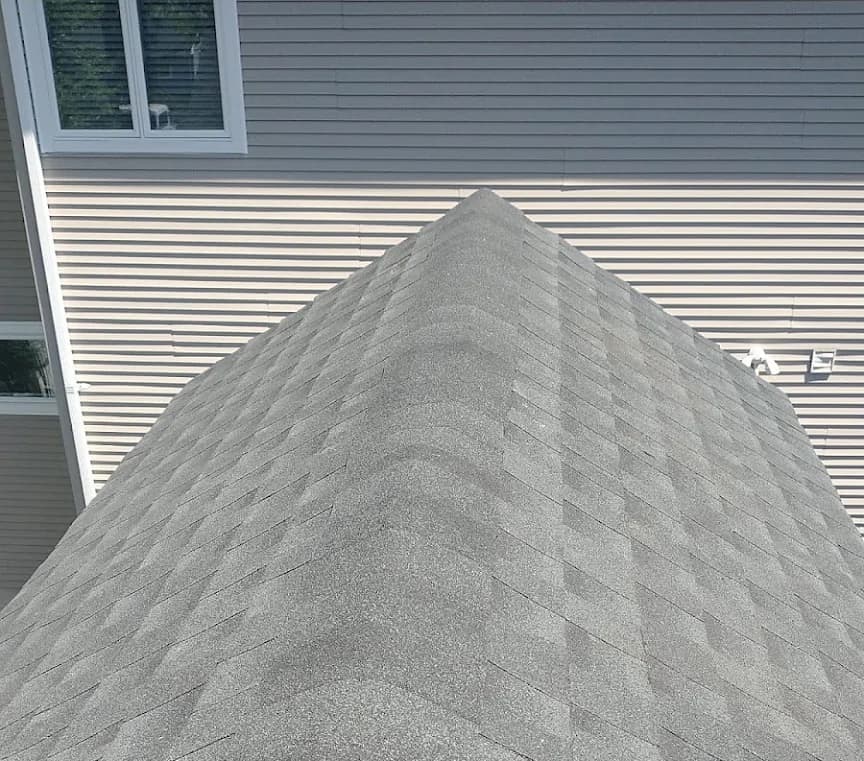
The Rutherford job at the top of this page is a hip end, and a hip is where craftsmanship is hardest to fake. There is no gable to hide behind: two planes climb to one peak, every course has to be cut to the hip line and the cap run dead straight over it, and a wandering line is legible from the sidewalk for the next twenty-five years. It is slower than a gable and it is the frame where a rushed crew shows itself.
The junction inside that same frame is what decides how long the roof lasts. The lower plane runs out into the side wall of the storey above, so every drop shed off that wall arrives at the joint. What decides the joint is sequence: the metal goes in as the field is laid, tied up through the courses, rather than set on top of finished shingles and sealed afterwards. Water behind wall cladding runs a long way from where it got in, so this is where we start when a stain appears below a second-storey wall and the shingles overhead look untouched.
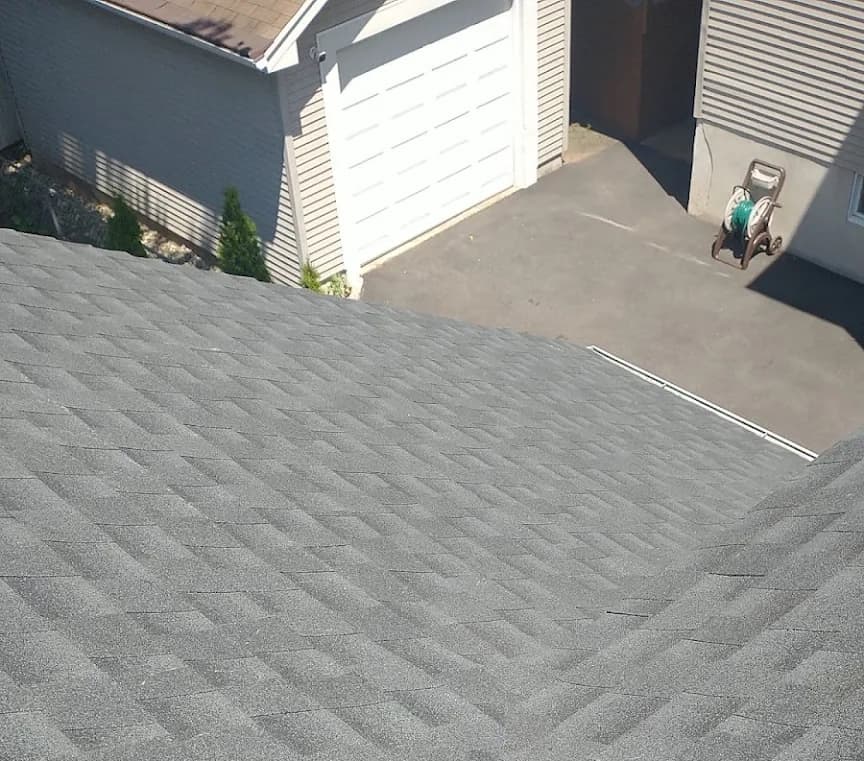
At the far end of that same roof, down the slope over the driveway, the detail to read is the white line along the bottom edge: new drip edge. It is required on a re-roof, it is close to free, and it is quietly among the easiest items to lose when a bid is being sharpened — which makes the eave the best place to inspect a contractor's finished work before you sign with them, because you can read it from the sidewalk without a ladder. Leave it out and run-off wicks back under the first course and rots the deck edge and the fascia from behind, unseen, until the hangers have nothing sound left to bite into.
Monthly payment options
We work with Hearth, which shops several lenders on a single application. See your personalized options in minutes — checking does not affect your credit score, and there is no commitment.
- Loan amounts up to $250,000
- Funding in as little as 1–3 days
- No prepayment penalties
- No home equity required
Financing is provided by Hearth's lending partners, not by Precision Windows & Roofing. Rates and terms depend on your credit and the lender making the offer, and all financing is subject to credit approval.
Common questions
I own a Park Avenue building with a shop below and apartments above. What does the Zoning Officer actually want to see for a re-roof?
Plan for a submission rather than a phone call: seven copies, filed under § 131-7E(3)(b), carrying the § 131-7E(4)(a) package the section above sets out, plus anything further the Zoning Officer determines is necessary. Two practical points nobody tells you. Keep a physical sample of whatever comes off the roof — proving a match in form, size, color and texture is far easier with the old tile or slate in hand than out of a swatch book. And file early in the month: the Streetscape Committee meets monthly, so an application landing just after a meeting waits for the next one, which is four weeks added to your tear-off date before anyone has read a word of it.
My house is three streets off Park Avenue. Does anyone review my shingle?
No. There is no historic preservation commission, no landmark designation ordinance and no design review that reaches a dwelling — the borough's zoning design standards apply only to buildings in the Business District used at least partly for a nonresidential purpose. The one question that can change the answer is not what your house looks like but what it is used for, so if part of a building in the District has become a shop, an office or a studio, that is worth resolving with the Zoning Officer before ordering material. On an ordinary house the only trail your re-roof leaves is the manufacturer's warranty registration, which is worth completing on the day the job finishes rather than from memory two years later.
There is a "Rutherford Down Town Historic District" listed online. Does that affect my building?
Not on a privately funded roof. It is an eligibility opinion, and an eligibility opinion does its work inside projects that carry federal or state funding, licensing or permits — there an agency has to weigh the effect on properties the state considers eligible. A landlord or homeowner paying for a new roof out of their own pocket is in none of that. Nor is there a local ordinance for the opinion to attach to; the borough never adopted one. What genuinely governs a roof on those blocks is the zoning section above, and it turns on the building's use rather than on any historic status.
My downtown chimney is failing. Can I wrap it in a metal chase the way my neighbor did?
Not as of right — the section quoted above prohibits metal flue and cinderblock chimneys unless they can be camouflaged to the building's color. That last clause is an opening rather than a loophole, and whether it has been met gets decided the way everything else in the section gets decided: by the Zoning Officer, on the Streetscape Committee's recommendation, off the drawings you file. So a submission that actually shows the camouflage — the finish, the color it is matched to, the neighboring buildings it will be read against — is the one with a chance; a chase drawn as a bare metal box is not. Outside the Business District none of this applies and a chase is an ordinary repair. Inside it, budget on the assumption that the stack stays masonry, which is a mason on site as well as a roofer.
Can the floodplain chapter stop me re-roofing my West End house?
It is not a veto. Chapter 37 does not judge your shingle, your color or your contractor; it makes the Borough Engineer record the work and its cost so that substantial-improvement and substantial-damage arithmetic on the building stays accurate. What it can do is change the answer to a later question, because the cost of work that needed no permit still counts toward the 50% test the next project has to clear. So the thing to get out of the process is paper: get the Engineer's determination on paper and file it with the deed. Owners who have been through two claims in a decade should read § 37-26 closely, because the repetitive-loss test looks back across ten years rather than at one event.
Where is my downspout allowed to discharge?
Onto your own ground, clear of the foundation. The section above quotes what § 94-4 actually bars, and discharging above grade on your own lot is not in it. The complication on Rutherford's older stock is inherited rather than chosen: a leader ending in an old iron fitting at grade may well be tied into something laid decades before 1986, and nobody can tell from above ground. So on a specific house the answer arrives as a photograph rather than a promise — we record where each one terminates and flag on the estimate any that vanish into the ground.
Is an eave ice-and-water membrane required by New Jersey code?
No New Jersey rule puts a membrane at your eaves in Bergen County; our roof flashing repair page carries the citation chain. What matters in Rutherford is the condition rather than the code: on a median-1945 stock a finished third floor or a converted attic warms the underside of the deck while the eave beyond it stays frozen, and that is the profile we spec it for — labelled on the estimate as our specification, so nobody is left thinking an inspector demanded it. Be clear about what it buys, too. Airflow from eave intake to ridge exhaust is what stops a dam forming. The membrane only limits the damage once one has.
My house has its original slate. Can it be covered with asphalt?
No, and that answer is not ours — IRC R908.4 does not permit a new roof covering to be installed over an existing slate roof. Anyone offering it is proposing something the code forbids, which tells you enough about the rest of the estimate. Slate turns up on Rutherford's oldest blocks, and it is usually worth assessing before replacing: individual cracked and slipped slates get swapped and the flashings rebuilt, which is a completely different job from a shingle repair and a completely different skill. Our crew hand-nails slate in house rather than subbing it out, so we can tell you honestly whether yours has years left or whether it is time for a full strip and a new covering.
How quickly can you get to Rutherford in an emergency?
Within the hour in most conditions, at any time of day or night — the shop is in Garfield, and this is a short run. What happens first is stabilization, not repair: locate where water is entering, get it covered and mechanically fastened so the covering survives the wind that usually comes with the weather that opened the roof, and get the inside protected. Diagnosis and a written scope follow in daylight. We would rather tarp a roof at 2 a.m. and quote it properly on Tuesday than sell you a permanent repair made in the dark and in the rain.
Explore
Get your free roofing quote
Free, no-obligation on-site assessment anywhere in New Jersey — and we answer the phone 24/7.