Roof Age and Homeowners Insurance in New Jersey
New Jersey regulates a non-renewal the way it regulates a contract: a notice window with a hard floor, a stated factual basis, a policy provision that lets you demand the carrier's written underwriting guideline, and a Commissioner who can order a policy reinstated when the process was botched. Here is how those levers work — and where a roofer's written condition report fits. Free inspection across New Jersey.
Nothing leaked. No storm took a shingle off. You have not filed a claim in years. And there is still a letter on the kitchen table saying your homeowners policy will not be renewed — or an email from your agent asking for proof of roof condition, with a deadline on it. That is not a claim problem, and almost none of the claim advice online applies to it. It runs under a different chapter of New Jersey regulation, on a clock that started the day the notice was mailed.
The chapter is N.J.A.C. 11:1-20, and it is written for you more than most homeowners realize. It sets a notice window with a hard floor. It requires the carrier to state the factual basis it relies on, not just a category. It puts a sentence in every homeowners policy in the state entitling you to be shown, in writing, the underwriting guideline the company used. And it gives the Commissioner power to put a policy back when the process was wrong. None of that guarantees a renewal. All of it moves the argument off a form letter and onto documents you can read.
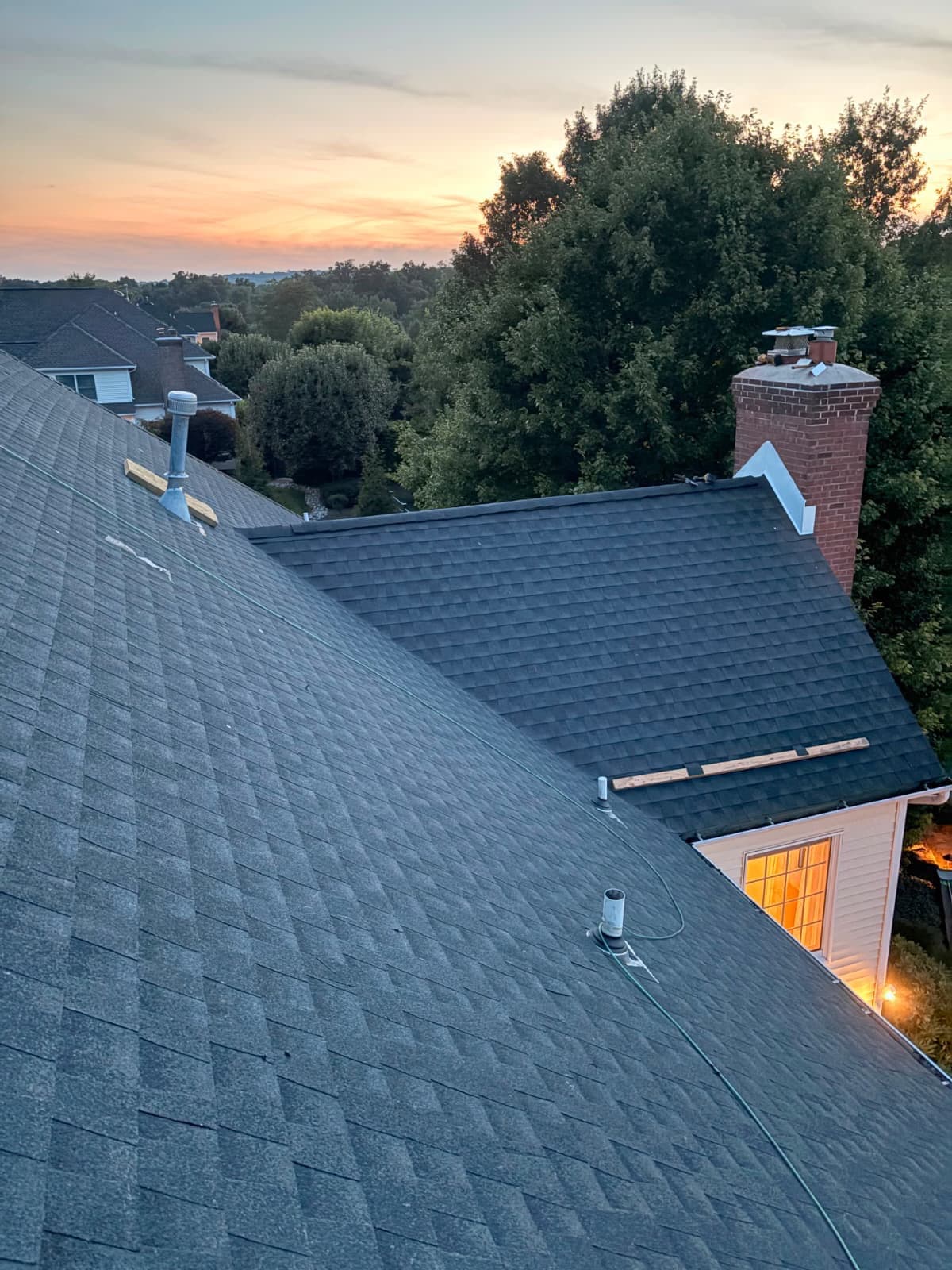
Our part is narrow and we keep it there. We get on the roof and into the attic and hand you a dated, photographed, written condition report signed by a registered New Jersey contractor — the thing an underwriter asked for and an overhead image cannot supply. If the covering is finished, the report says so and we will quote the replacement. What we will not do is tell you what your carrier is going to decide. Free inspection across New Jersey, from our shop in Garfield. NJHIC #13VH13970900.
- Roof inspection — The free on-site inspection and written report you send back when an underwriter asks for proof of condition.
- Storm damage & insurance claims — Everything after a claim exists — the covered-event argument, adjusters, deadlines, deductibles and how a settlement gets paid.
- Roof replacement — What a full tear-off and re-roof involves when replacement is the carrier's stated condition.
- Roof replacement cost — The market ranges and the variables behind them, kept off this page on purpose.
- Roof maintenance — Keeping the next condition review from turning into the next letter.
Count the days before you answer the letter
Homeowners policies are expressly inside this subchapter: N.J.A.C. 11:1-20.1(b) provides that it "shall also apply to all policies of homeowners insurance as defined at N.J.A.C. 11:2-42.2." From there, 11:1-20.2(a) bars non-renewal at expiration unless a valid written notice has been mailed or delivered, and (b) sets the window — "no notice of nonrenewal shall be valid unless it is mailed or delivered by the insurer to the insured not more than 120 days nor less than 30 days prior to the expiration of the policy." The Department of Banking and Insurance restates the floor in plain English in its consumer guide, Insuring Your Home: the company "must provide you with written notice explaining the reason for nonrenewal at least 30 days before the expiration date of your policy."
The reason requirement is where most of these letters are thin. Subsection (g): "No nonrenewal or cancellation shall be valid unless the notice contains the standard or reason upon which the termination is premised and specifies in detail the factual basis upon which the insurer relies." Roof condition is a standard. Overhead imagery dated the fourth of March showing granule loss across the south slope is a factual basis. If your letter is closer to the first than the second, asking in writing for the specific facts is the appropriate first move — and the postmark matters too, because under (i) the notice is valid only if sent by certified mail, or by first class mail where the insurer obtained a date-stamped proof of mailing showing your name and address and retained a duplicate copy. Keep the envelope.
Then there is the subsection nobody quotes. Under 11:1-20.2(j), where an insurer fails to send a notice of non-renewal as the subchapter requires — or fails to give the renewal notice required by (c) — "the insured shall be entitled to continue the expiring policy at the same terms and premium until such time as the insurer shall send appropriate notice of termination or renewal under this subchapter." Count from the day it was mailed to your expiration date before you do anything else.
- Written notice, mailed or delivered, or the non-renewal is not valid — 11:1-20.2(a)
- Not more than 120 days nor less than 30 days before expiration — 11:1-20.2(b)
- The same 120-to-30-day window covers the renewal premium amount and "any change in contract terms" — 11:1-20.2(c)
- The standard or reason, plus the factual basis, specified in detail — 11:1-20.2(g)
- A boldface statement telling you that you may complain to DOBI — 11:1-20.2(h)
- Certified mail, or first class with a date-stamped proof of mailing the insurer keeps — 11:1-20.2(i)
- Botch the notice and you are entitled to continue the expiring policy at the same terms and premium — 11:1-20.2(j)
The sentence in your policy that makes them show you the rule
N.J.A.C. 11:1-20.3(a) requires all homeowners policy forms to contain a provision setting forth this statement: "Pursuant to New Jersey law, this policy cannot be cancelled or nonrenewed for any underwriting reason or guideline which is arbitrary, capricious or unfairly discriminatory or without adequate prior notice to the insured. The underwriting reasons or guidelines that an insurer can use to cancel or nonrenew this policy are maintained by the insurer in writing and will be furnished to the insured and/or the insured's lawful representative upon written request." The rule adds that this language "is mandatory and, notwithstanding any other law to the contrary, need not be submitted to the Department for approval" — so it is in your policy whether the company drafted it or not, and 11:1-20.9 forbids any policy provision inconsistent with the subchapter.
Almost nobody uses it. The reflex instead is to go searching for the age at which carriers drop roofs, which is a wasted afternoon: no such threshold exists in New Jersey law and no state agency publishes one. Write to the insurer instead, not only to the agent, quote the provision, and ask for the guidelines relied on. What comes back converts an argument about your roof into an argument about a written rule — its wording, its effective date, and whether the facts stated in your notice actually satisfy it. That is a materially better position than answering a form letter with an opinion, and it costs a stamp.
Roof leaking right now? We answer 24/7.
A roof-age cutoff is not one of the thirteen approved guidelines
N.J.A.C. 11:1-20.4(b) sets out thirteen guidelines "approved for use by insurers," and (c) states that "only the specific language of the underwriting guidelines as set forth in (b) above is deemed to be approved by the Commissioner for use in the cancellation and nonrenewal of policies which are subject to the provisions of this subchapter." Read all thirteen and none of them is roof age. They run to non-payment, moral hazard, misrepresentation at the time of acceptance, increased hazard, breach of contractual duties, lack of cooperation on loss control, fraud, insurer capacity, changes in statutory or case law, reinsurance, code violations, failure to supply underwriting information, and agency termination.
That is not the end of it, and any page telling you the list is closed has misread the rule. Subsection (d) provides that "in addition to the approved guidelines set forth in (b) above, an insurer may use other guidelines for cancellation or nonrenewal provided such guidelines are not arbitrary, capricious or unfairly discriminatory." A roof-age or roof-condition rule lives there — as an other guideline, carrying exactly one test, the same test subsection (a) states as a flat prohibition: "No insurer may cancel or nonrenew a policy based upon underwriting guidelines which are arbitrary, capricious or unfairly discriminatory." That is the frame to read the carrier's written guideline in, and it is why getting hold of the wording matters more than knowing anyone's threshold.
Two timing rules come with it. Under (g), "only those guidelines which are in effect at the inception date of the original policy or any subsequent renewal of that policy, as applicable, may be utilized by the insurer to cancel or nonrenew during that policy period," and (h) confirms that a modified guideline "only may be applied to policies issued or renewed subsequent to the effective date of such modification." So when the rule took effect is a fair and specific question. And under (e), any guideline premised on adverse loss experience "shall be limited in application to nonrenewals only and shall specifically identify the type of loss experience which supports and justifies the nonrenewal action" — a vague gesture at your history does not satisfy that.
- (b)3 — "Material misrepresentation or nondisclosure to the company of a material fact at the time of acceptance of the risk," which is about your application, not about anything said later
- (b)4 — "Increased hazard or material change in the risk assumed which could not have been reasonably contemplated by the parties at the time of assumption of the risk"
- (b)5 — "Substantial breaches of contractual duties, conditions or warranties that materially affect the nature and/or insurability of the risk"
- (b)11 — "Failure by the insured to comply with any Federal, State or local fire, health, safety, building or construction regulation, law or ordinance with respect to an insured risk which substantially increases any hazard insured against within 60 days of written notification of a violation of any such law, regulation or ordinance"
- (b)12 — "Failure by the insured to provide reasonable and necessary underwriting information to the company upon written request therefor and a reasonable opportunity to respond"
- (c) approves only that exact wording; (d) permits other guidelines so long as they are not arbitrary, capricious or unfairly discriminatory
"Replace the roof or we won't renew" — what the statute permits, and when it applies
There is a statute directly on this, and the regulator has written it into the rule itself. N.J.A.C. 11:1-20.4(e)2 carries N.J.S.A. 17:36-5.20a across almost word for word — the regulation adds a "Pursuant to" prefix and reads "this paragraph" where the statute reads "this section." Quoting the regulation: no insurer authorized to do business in this State "shall cancel or non-renew an insurance policy covering an owner occupied one-to-four family dwelling solely because of claims or losses due to weather-related damage or a third-party criminal act committed by someone who is not a resident of the insured dwelling, unless the claim or loss identifies or confirms an increase in hazard, a material change in the risk assumed or a breach of contractual duties, conditions or warranties that materially affect the nature or the insurability of the risk." Three qualifiers do the work, and the first one decides whether this statute is yours at all: there has to have been a weather-related claim or loss — or a third-party criminal act — in the picture. The other two are owner occupied one-to-four family, and solely. If your notice cites nothing but roof age and your file holds no claim, 17:36-5.20a is not the provision that governs you; 11:1-20.4(a) and (d), the arbitrary-capricious test, is.
Where a weather-related claim is in the file, read on, because the second sentence is the one governing the demand sitting in your inbox: "However, this paragraph shall not be construed to prohibit an insurer from offering to continue coverage on different terms and conditions if the insured fails to reduce the risk of additional or future claims or losses, either by effecting necessary repairs or taking other remedial action." That is the footing for replacement-as-a-condition-of-coverage. In that claim context, New Jersey plainly contemplates a carrier conditioning what it will offer on repairs being made. What the sentence does not do is promise you anything in return — it permits an offer on different terms and requires no offer at all. So get the condition in writing before you sign a roofing contract: what work, what proof, from whom, by what date.
And do not try to solve a roof-age problem by filing a claim. Whether a loss is a covered sudden event or uncovered wear is the whole of a storm claim, and our storm damage and insurance claim page walks that argument through properly; the point here is only that a roof the carrier has already flagged for age is the worst possible place to start it, because the file already holds the company's own contrary finding. Knowingly presenting a statement in support of a claim containing false or misleading information material to that claim violates the New Jersey Insurance Fraud Prevention Act, N.J.S.A. 17:33A-4(a)(1) — an entirely different order of trouble from a letter about roof age.
Roof leaking right now? We answer 24/7.
The renewal that keeps you insured and moves the roof to ACV
Non-renewal is the loud outcome. The quiet one is a renewal you accept without reading, in which the roof covering has been moved from replacement cost to actual cash value. DOBI's consumer guide defines both plainly: "Actual Cash Value (ACV) means the value of the item as it is now, considering its age and condition. Replacement cost is the amount it would take to repair or replace with materials of like kind and quality at today's prices."
On a roof the gap between those two numbers is large and it widens every year, because the depreciation is measured against the covering's age. A replacement-cost (RCV) policy settles a covered roof loss in two parts, and how that sequence runs is on our storm damage and insurance claim page; what a roof-surfacing ACV endorsement does is remove the second part, so a wind or hail loss to the covering is settled at the depreciated value of a roof that is however many years old and the difference comes out of your pocket. Some carriers use a scheduled payment table keyed to roof age rather than a flat switch, which produces the same result on a gradient. These mechanics are set by your policy form, not by statute, which is exactly why the form is the thing to read.
Look at the declarations page and the list of endorsements attached to it, not the policy jacket. Read for roof surfacing, actual cash value, windstorm or hail losses to roof surfacing, and scheduled roof surfaces. If one of them is there and was not there last year, it arrived at a renewal — and 11:1-20.2(c) required written notice of the renewal premium "and any change in contract terms" not more than 120 days nor less than 30 days before the premium due date, stating clearly what happens if you do not pay by that date.
Overhead imagery, and the inspection nobody actually performed
Many of these letters do not begin with a person. They begin with a portfolio review — aerial or satellite imagery scored against an underwriting rule, with flagged addresses kicked out to an underwriter or an agent. Nothing about that is unlawful, and nothing about it means anyone climbed your roof. Be precise about what an overhead image resolves: the covering, so streaking, granule loss, patched or mismatched sections, tarps, missing tabs, moss, a slope gone a different color than its neighbor. It does not resolve the decking, the underlayment, the flashing at your chimney and sidewalls, or the underside of the sheathing — which is most of what decides whether a roof has service life left in it.
New Jersey regulates the machinery behind the flag, though not in a way that hands you a personal remedy. DOBI Bulletin No. 25-03, issued February 11, 2025 by Commissioner Justin Zimmerman to all insurers authorized or admitted in New Jersey, reminds them that "decisions or actions impacting consumers that are made or supported by advanced analytical and computational technologies, including Artificial Intelligence ('AI') Systems ... must comply with all applicable insurance laws and regulations," including those addressing unfair trade practices and unfair discrimination. That is insurer-facing governance, not a consumer right: it does not entitle you to the photograph, and any page saying it does is overselling. What it confirms is that market conduct actions "are separate from, but may result from, individual complaints made by consumers asserting illegal practices by insurers."
What follows a flag is usually a request for documentation or a carrier-ordered inspection, with a deadline attached, and that request is the point at which the outcome is still movable. Answering it matters legally, because 11:1-20.4(b)12 makes failure to provide reasonable and necessary underwriting information "to the company upon written request therefor and a reasonable opportunity to respond" an approved ground on its own. Read both halves — the request has to be written, and you have to be given a reasonable opportunity — then answer it. Silence turns a dispute about roof condition, which you might win, into a dispute about non-response, which you will not.
What makes a report usable to an underwriter is specificity and provenance, not adjectives. It should carry the inspection date and the property address, the covering type and the observed age indicators, a slope-by-slope condition read, dated photographs tied to each individual finding, and a stated remaining service life with the basis for that number — signed by a registered New Jersey home improvement contractor, with the NJHIC number on it. What gets walked and opened up to produce those findings is set out on our roof inspection page. A one-line assurance on a letterhead is not evidence, and an underwriter will treat it that way.
Roof leaking right now? We answer 24/7.
Complaint, reinstatement, and the market of last resort
Your notice is required to tell you where to complain. N.J.A.C. 11:1-20.2(h) requires every notice of non-renewal or cancellation, except one for non-payment of premium, to contain a statement "clearly and prominently set out in boldface type or other manner that draws the reader's attention" advising you that you may file a written complaint with the New Jersey Department of Banking and Insurance, Office of Consumer Protection Services, PO Box 471, Trenton, New Jersey 08625-0471, and advising you to contact the Department immediately if you wish to do so. If that statement is not on your letter, that is a defect in the notice and it is worth raising. The working channels are 609-292-7272 or 800-446-7467 and the complaint form at nj.gov/dobi/consumer.htm; the Department's guide gives Consumer Assistance, PO Box 329, Trenton, NJ 08625-0329, for a complaint in writing.
Here is the part almost no homeowner is told. Under N.J.A.C. 11:1-20.11(b), as an alternative or in addition to monetary penalties, the Commissioner "may require immediate reinstatement without lapse of any policy that has been cancelled or nonrenewed in violation of the provisions of this subchapter." It has an edge on it: (b)1 bars any reinstatement ordered "more than one year after the effective date of the nonrenewal or cancellation," tolled during Departmental proceedings and any judicial review, and (b)2 says plainly that nothing in it creates "any right or cause of action on behalf of any insured to enforce the penalties." So the remedy is real, only the Commissioner can order it, and it expires — which is a reason to complain in the first weeks rather than after you have replaced the policy and moved on.
Be realistic about the scope, in the Department's own words: "we cannot act as a substitute for a court or making determinations on questions of fact, but we can contact the insurance company or agent and determine if they are acting in accordance with the terms of your policy as well as New Jersey insurance laws and regulations." DOBI polices process — the window, the factual basis, the guideline, the boldface statement. It is not going to overrule an underwriter's view that a twenty-three-year-old roof is twenty-three years old.
So shop it from the day the notice arrives, and give an independent agent the whole file, roof report included. The Department's guidance is direct: "If your policy is going to be cancelled or nonrenewed, your agent may be able to help you obtain replacement coverage. It is important to act quickly so you do not face a lapse in coverage." A lapse is worse than the non-renewal — your mortgage servicer will force-place, and the gap becomes a question on every application afterwards. If the admitted and surplus markets both decline, the residual market is the New Jersey Insurance Underwriting Association, the FAIR Plan, and DOBI's advice on it is blunt: "Consider the FAIR Plan only if you cannot obtain insurance from any other source."
Our own boundary, stated plainly: we are roofing contractors — not insurance producers, public adjusters or attorneys. DOBI polices the process, a public adjuster or a coverage attorney is who to call when a dispute has moved past process, and we handle the roof and the paper that describes it. Anyone promising that a new roof guarantees a renewal is making a sales claim, not a statement about insurance. Precision Windows & Roofing, Garfield — NJHIC #13VH13970900, (201) 275-9185.
Monthly payment options
We work with Hearth, which shops several lenders on a single application. See your personalized options in minutes — checking does not affect your credit score, and there is no commitment.
- Loan amounts up to $250,000
- Funding in as little as 1–3 days
- No prepayment penalties
- No home equity required
Financing is provided by Hearth's lending partners, not by Precision Windows & Roofing. Rates and terms depend on your credit and the lender making the offer, and all financing is subject to credit approval.
Common questions
My non-renewal notice was mailed 21 days before the policy expires. Does that matter?
It matters, and note which date the clock runs on: the mailing date, not the day it reached you — which is why the envelope is worth keeping. Twenty-one days is inside the 30-day floor, and the consequence is the continuation right described above. The rules most homeowners have never seen are the mid-term ones, which sit in the same section. Under 11:1-20.2(d) a cancellation for anything other than non-payment or moral hazard runs on the same 120-to-30-day clock. Under (e) a cancellation for non-payment needs at least 10 days' notice stating the amount due and the due date, and is ineffective if you pay before the date in the notice.
How do I actually ask for the underwriting guideline, and what should I ask for?
By letter to the company rather than an email to the agent, and keep proof of sending. Name your policy number and the notice you received, cite the mandatory provision at N.J.A.C. 11:1-20.3(a), and ask for three specific things: the guideline actually applied to your policy, the version of it that was in force on your inception or applicable renewal date, and the facts the company says satisfy it. That third item is the one almost nobody requests, and it is the one that turns a form letter into something answerable — it forces the carrier to connect its own written rule to your roof.
Is there an age at which New Jersey insurers stop covering a roof?
The answer differs company to company, which is exactly why demanding the guideline beats any figure you will read online. What DOBI does tell you is where age fits. Its consumer guide lists "the age and condition of your home" among the factors that affect what a homeowners policy costs, alongside location, the cost to rebuild, construction type, your claim history and the coverages you choose — and it is the claim-history entry, not the age entry, where the Department mentions insurability at all. The guide frames age as a price effect — premiums "are often higher for older homes or homes in need of updating" — not as a line past which nobody writes.
I only called my agent to ask whether something would be covered. Does that count against me?
Not as a claim. N.J.A.C. 11:1-20.4(e)1 states that pursuant to N.J.S.A. 17:29B-4.1, "no inquiry by an insured for information regarding the insured's homeowners' insurance policy, or coverage for a particular loss under that policy, shall be categorized as a claim for purposes of determining adverse loss experience." If a non-renewal or a loss-history summary appears to be counting your questions as claims, that is a specific and citable objection. It is also a reason not to be afraid of putting a direct coverage question to your carrier in writing.
My policy is only a couple of months old. Do the same rules apply?
Not all of them, and this is the exception worth knowing before you buy a house. DOBI's guide states that when a new policy first takes effect the insurer may cancel coverage any time within the first 60 days for any reason not otherwise prohibited by law, with the cancellation effective no sooner than 10 days after written notice. The demand right tracks that: N.J.A.C. 11:1-20.3(a) says the mandatory policy provision "shall not apply to any policy that has been in effect for less than 60 days at the time notice of cancellation is mailed or delivered, unless the policy is a renewal policy." Against a brand-new policy, then, a written condition report does more for you than the regulation does.
They said they will renew if I replace the roof. Does a new roof guarantee it?
No — and be careful with any contractor who says otherwise. Nothing in New Jersey law obliges a carrier to renew because work was done; where the statute speaks to repair conditions at all it permits an offer on different terms and requires no offer, which is why the four items above have to be pinned down in writing before you sign a roofing contract. Two things to add to that list. Ask whether the offer comes back on the same terms or different ones, because a renewal that keeps you insured while quietly moving the roof to actual cash value is still a change you have to catch. And ask, in the same letter, what happens if the work is completed on schedule and no offer follows.
Should I file a claim to get an old roof replaced before the policy ends?
No. It does not answer the letter — where a carrier has set a condition, the condition is repair, not a claim payment — and a denial lands in your loss history at the precise moment you are about to shop the policy to other companies. Genuine, dated storm damage is a different matter on entirely separate footing, and it does not belong folded into a roof-age file.
Nobody will write it. What does the FAIR Plan actually cover?
The New Jersey Insurance Underwriting Association, known as the FAIR Plan, is the state's residual market for owners who have been unsuccessful at obtaining coverage in the admitted or surplus lines markets. Per DOBI, it insures homes, mobile homes, rental units, most commercial buildings and business property, and provides basic property coverage such as fire, lightning, wind and smoke — but the basic policy does not provide theft or personal liability coverage, though optional theft coverage is available as an endorsement. You may apply directly or through any licensed agent or producer: PO Box 32609, Newark, NJ 07102, 973-622-3838, njiua.org. Treat it as a floor, not a substitute for a standard homeowners policy.
Will you inspect a roof just for this, and will you tell me if it really is finished?
Yes to both, and there is no charge either way. If the covering has life left in it, that is what the report says, and we are content to have talked ourselves out of a job — an inflated finding is worth nothing to an underwriter anyway. If it is finished, the replacement is quoted separately and line-itemed on its own merits, never priced against what an insurer might pay.
Explore
Get your free roofing quote
Free, no-obligation on-site assessment anywhere in New Jersey — and we answer the phone 24/7.