Roofing, Gutters & Siding in Bergen County, NJ
Bergen is home base. Our shop sits inside the county, in Garfield, so across all 70 towns — Hackensack, Teaneck, Ridgewood, Fort Lee, Paramus, Mahwah — an emergency is a same-day drive and everything else gets on the calendar fast. Roof replacement, leak and flashing repair, gutters, and siding, built to North Jersey code and quoted line-item. NJ-registered.
Want a range for your own house? Our Instant Roof Estimate finds your roof on New Jersey's aerial photos.
Get my Instant Roof EstimateBergen County is our backyard. The shop is in Garfield, on the county's southern edge, which is why an emergency here gets a truck the same day rather than a promise — Hackensack, Lodi, and Fair Lawn are minutes away, and the far corners of the county, Mahwah in the northwest or the Northern Valley up by the state line, sit on the same day's route. This is the market we know street by street, and the one where a storm call at 7 a.m. gets a tarp on before lunch. Planned work — a diagnosed leak, a repair, a re-roof — is booked for weather that lets it be done properly rather than squeezed in the same afternoon.
There is no single 'Bergen roof,' which is the whole point of this page. The county is really four housing worlds stacked into 233 square miles, and each one fails in its own way. The dense inner ring — Hackensack, Garfield, Bogota, Wallington, older Teaneck and Fort Lee — is pre-war and early-postwar housing sitting on wood plank sheathing, where leaks start at tired flashing long before the field of shingles gives out. The postwar Cape Cod and split-level belt through Bergenfield, Dumont, New Milford, and Paramus went up fast in the 1950s and is now cycling through its second or third roof. Northwest Bergen — Franklin Lakes, Wyckoff, Ridgewood, Saddle River — runs to big multi-plane colonials with more valleys, dormers, and penetrations than a simple roof has any business having. And along the Hudson, the Fort Lee–Edgewater–Cliffside Park high-rise corridor is heavy on flat and low-slope membrane work, while the Meadowlands lowlands below it flood. We diagnose by the neighborhood, because the neighborhood usually tells us what broke.
Whatever your roof is doing, start with a phone call: (201) 275-9185. We diagnose over the phone, quote free on-site, and put nothing in writing that isn't measured on your actual roof. An active leak with weather coming gets priority dispatch anywhere in the county — Bergen has taken enough water in the last decade that we treat that as an emergency, not an appointment.
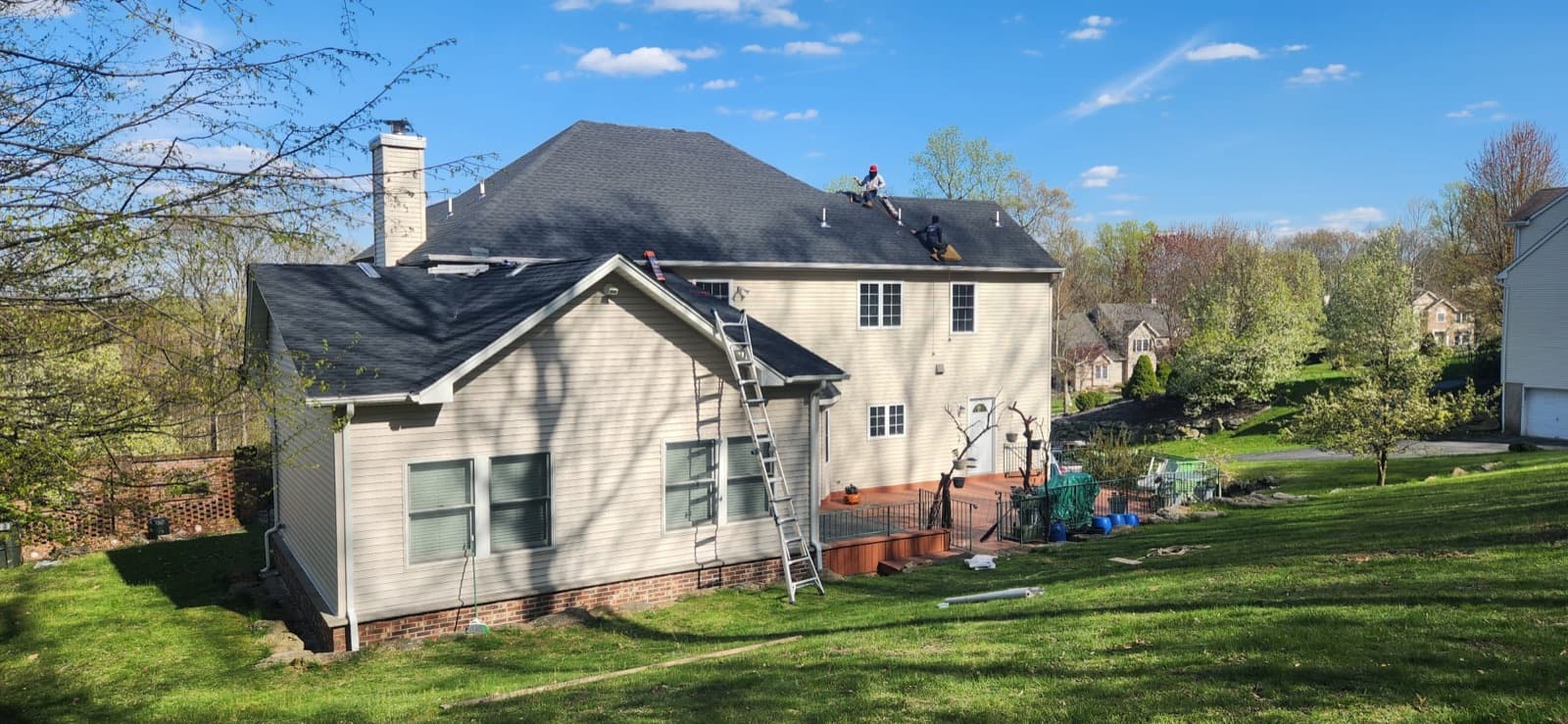
Recent work in New Jersey
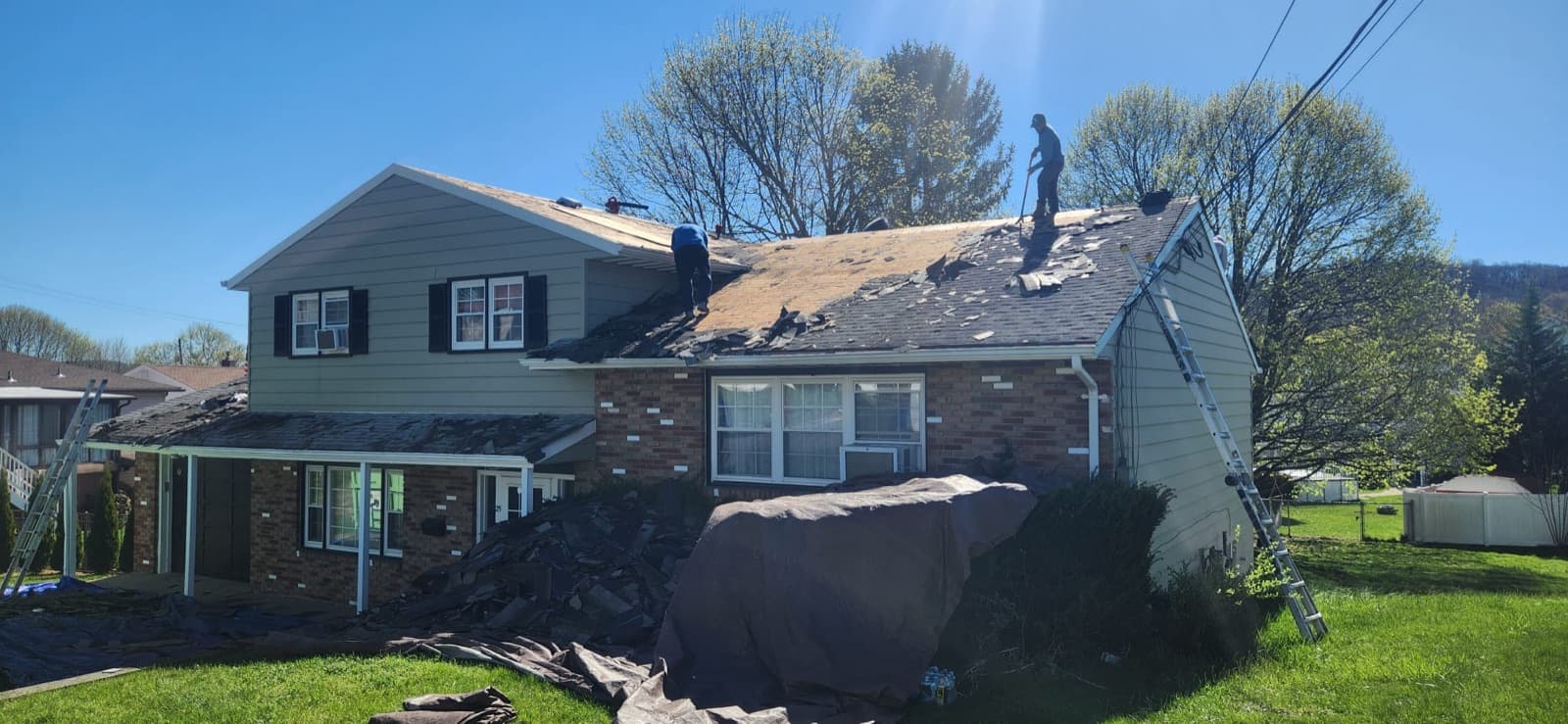
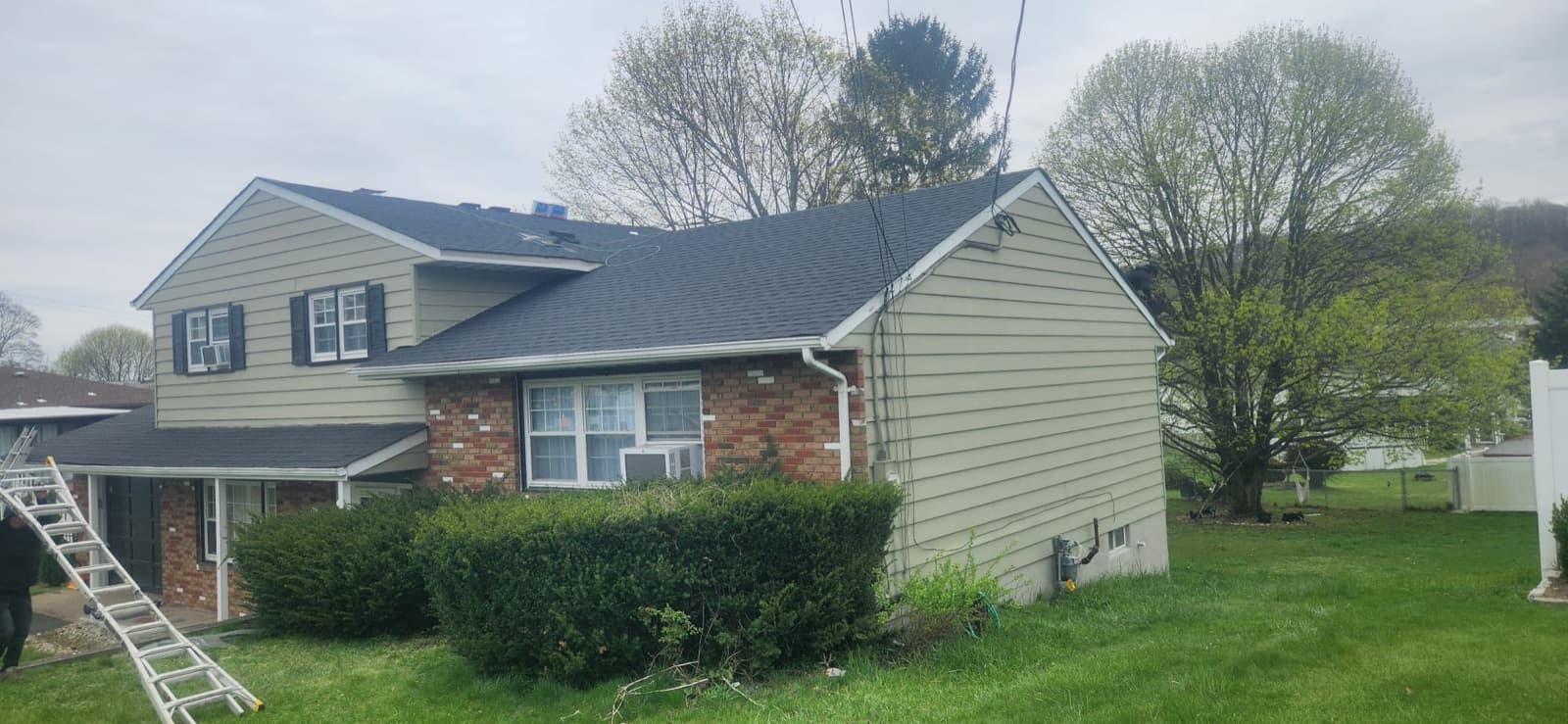
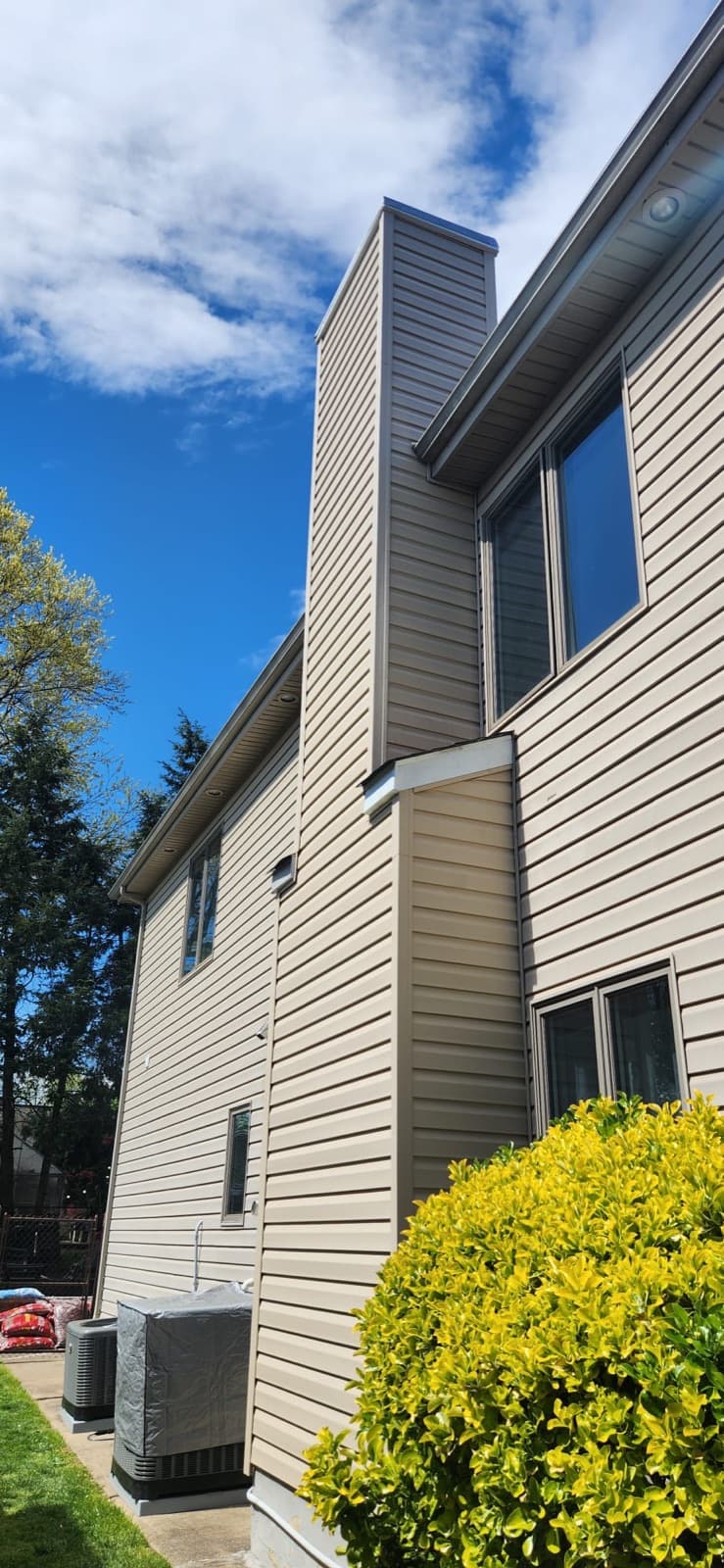
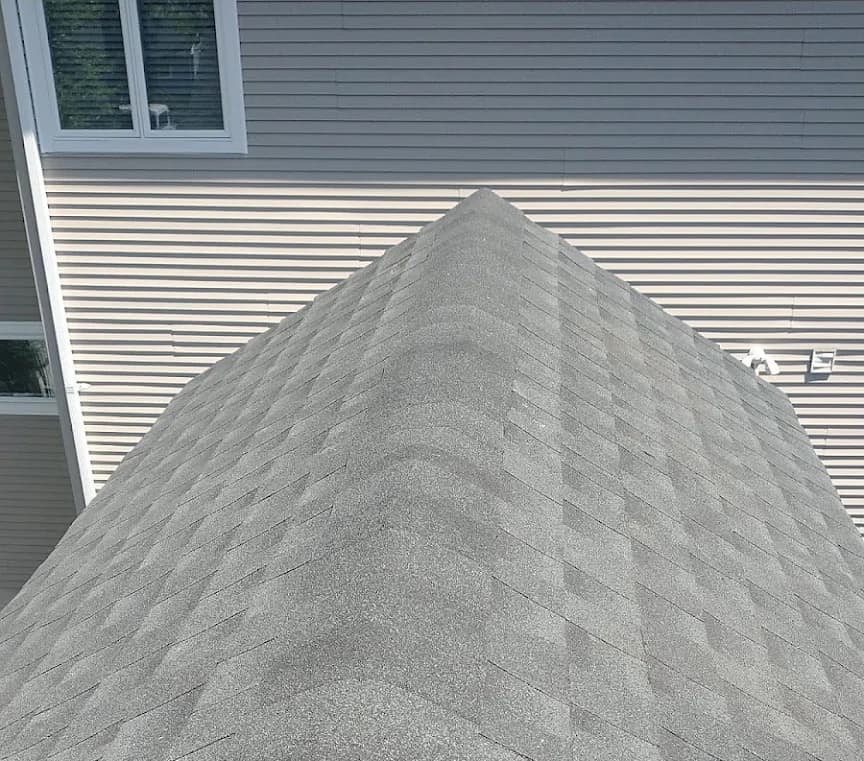
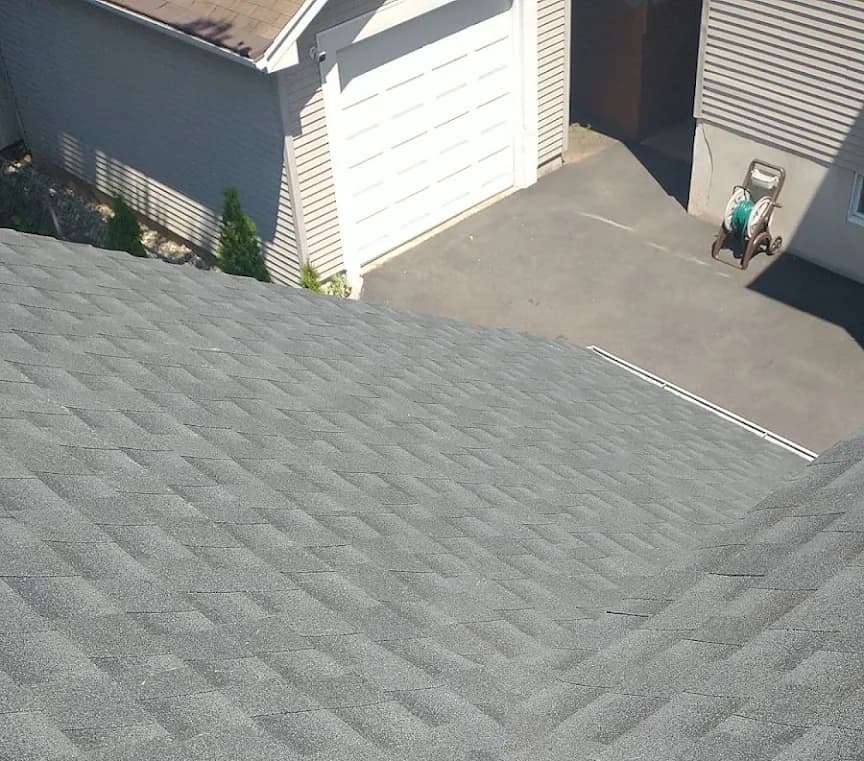
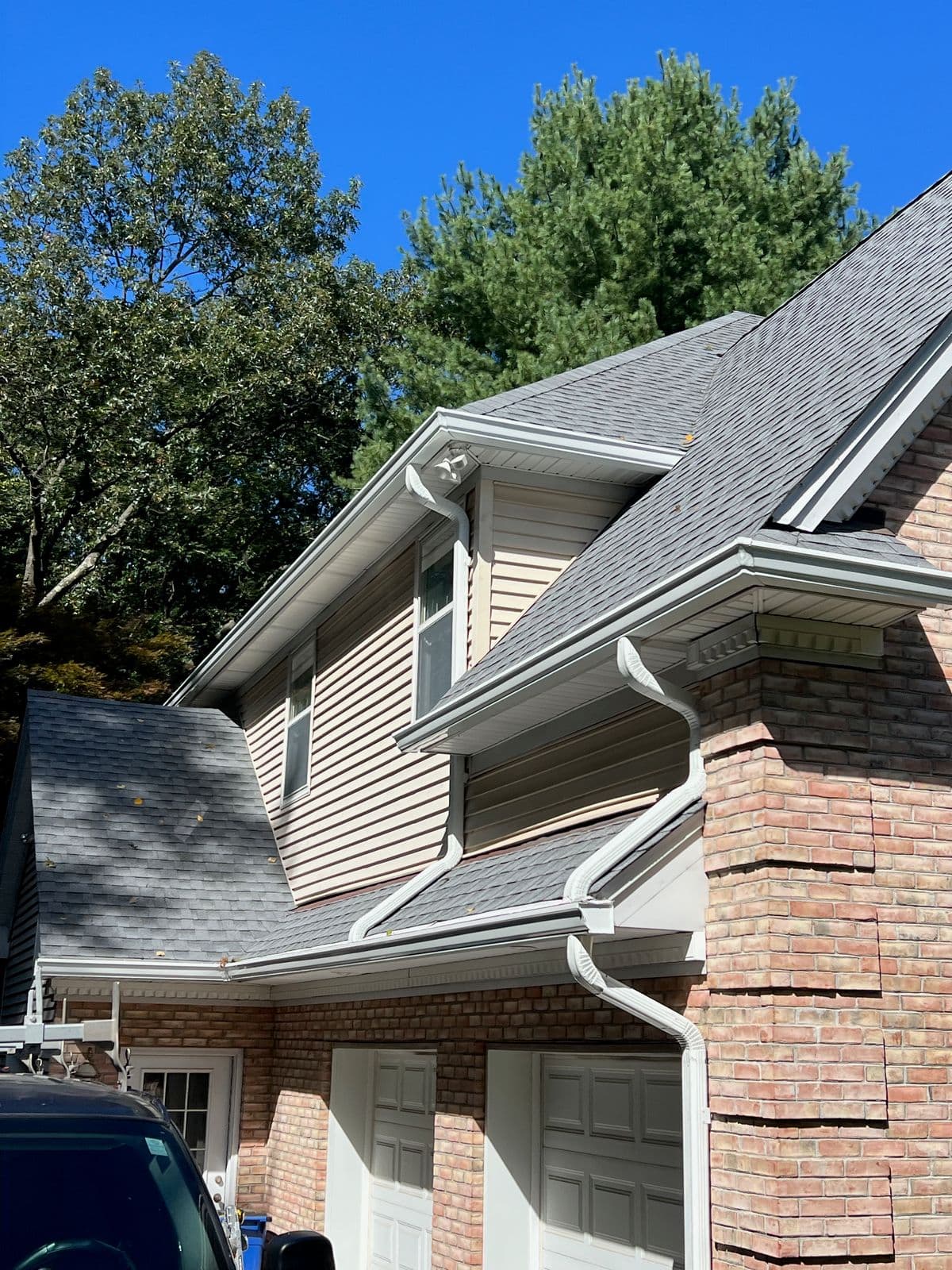
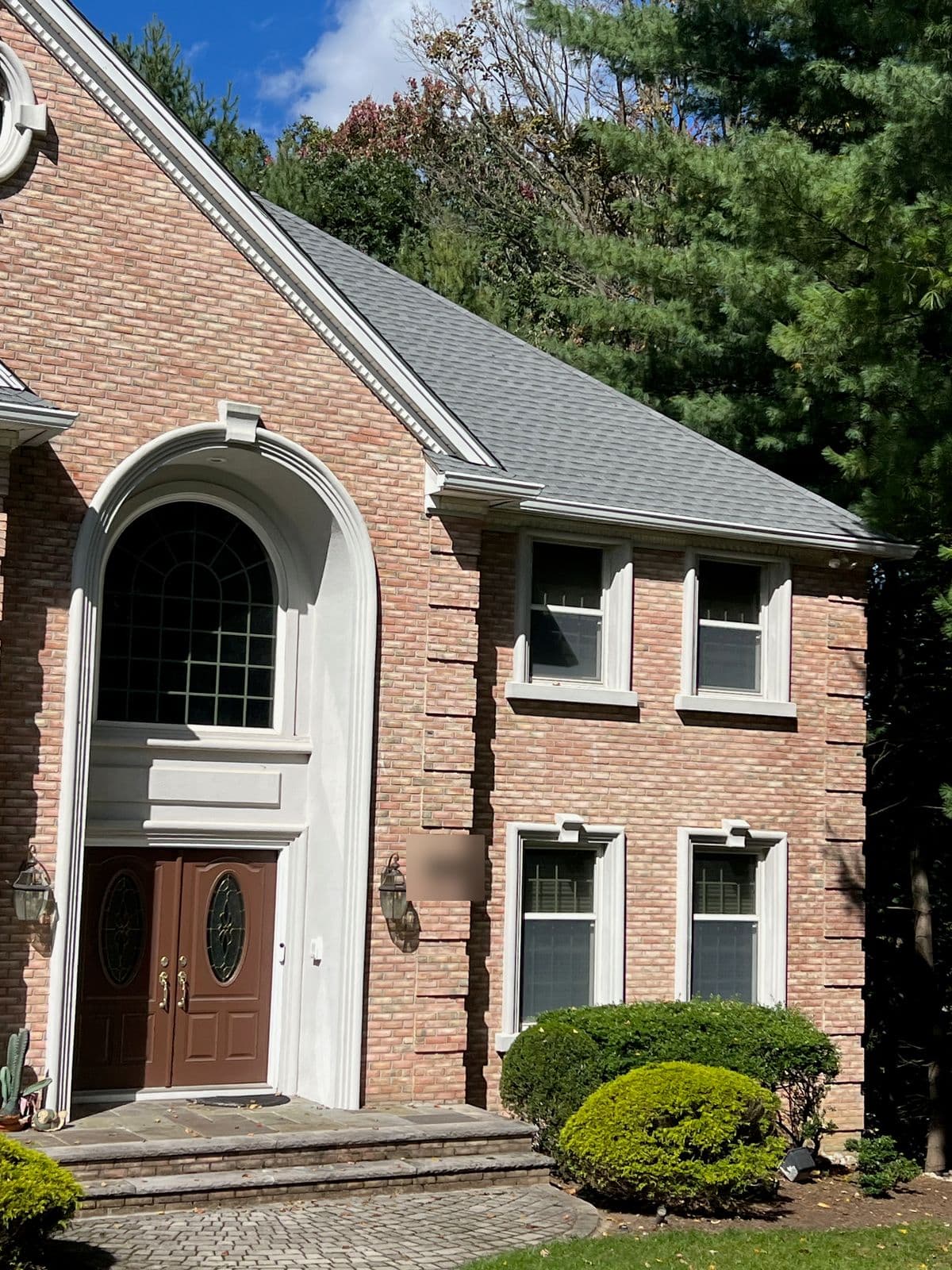
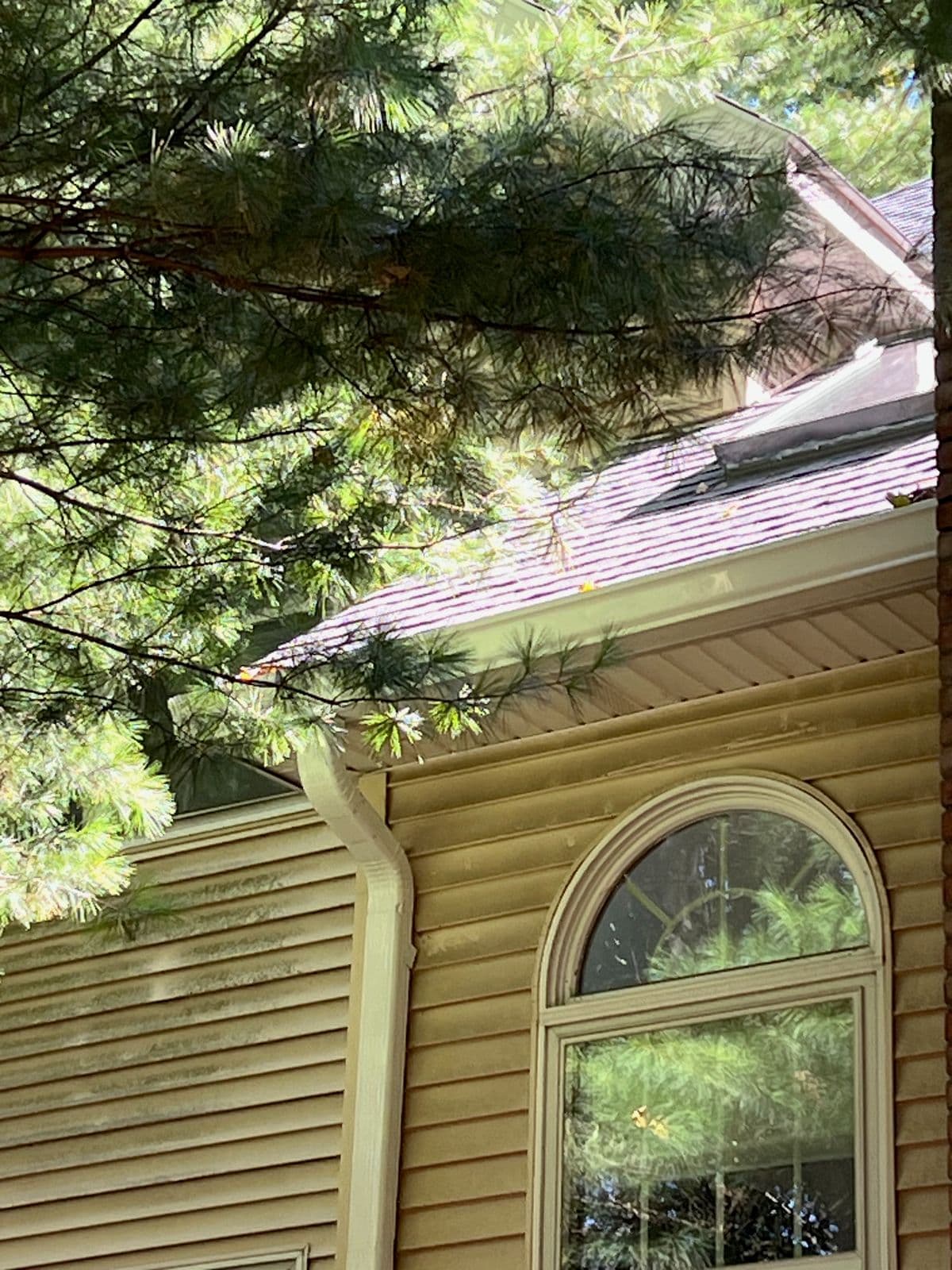
Repair, replacement, gutters, and siding — handled together
A Bergen homeowner rarely has just one problem. By the time water shows up on a ceiling, it has usually run past failed flashing, overflowed a gutter that was undersized to begin with, and started on the siding or fascia below. Running the full exterior in-house means we fix the cause and everything it touched under one contract and one accountable crew — not a roofer, a gutter guy, and a siding sub each blaming the other two.
That's the practical case for calling one number for the roofline. Here's what falls under it across Bergen:
- Roof repair — targeted fixes for wind-lifted shingles, cracked vent boots, popped nails, and worn flashing, so one failed detail doesn't turn into a rotted deck.
- Roof replacement — full tear-off and re-roof in architectural, designer, or 3-tab shingle, built to IRC-2021 with new underlayment, drip edge, and flashing, plus the eave ice barrier we spec as standard.
- Roof leak repair — source-tracing an active leak to the flashing or penetration it's genuinely coming from, our sharpest skill.
- Gutters & downspouts — seamless aluminum built to handle Bergen's cloudbursts and the oak-and-maple litter that clogs an undersized run, keeping roof water off the fascia and out of the basement.
- Siding — vinyl, insulated, and fiber-cement, plus the wall flashing and house-wrap details that keep water out where the roof meets the wall.
- Storm & flood response — emergency tarping, inspection, and honest insurance documentation after wind or one of the county's now-routine flood events.
Why the pre-war inner ring leaks — and where chimneys fit in
Walk the tight blocks of Hackensack, Garfield, Lodi, or the older sections of Teaneck and Fort Lee and you're looking at housing from the 1920s through the 1950s: solid but aging, and almost all of it built on wood plank decking rather than the plywood that became standard decades later. Roofs like these seldom leak through the shingle field, which is engineered to shed water. They leak at the interruptions — the chimney, the valleys, the step flashing along a dormer or wall, the plumbing-vent boots — and on a home this old that flashing has usually been caulked over, tarred, or roofed past more than once.
Chimneys are the worst offender in this housing, because Bergen's older homes almost all have one, and the original counter-flashing rusts or works loose from the mortar joint decades before the roof itself is spent. On a 1920s Hackensack or Bogota two-family that joint has usually been tarred over two or three times already, each patch buying a season before it lets go again. We strip that history off, re-let the counter-flashing into the joint, tie fresh step flashing into the brick courses, and rebuild the detail so it sheds water for the life of the roof. And when we open a leak and find the plank sheathing under it soft, we replace the wood rather than shingle over rot — the one point where a Bergen re-roof can cross from covering into structure, and into permit territory.
Roof leaking right now? We answer 24/7.
The Meadowlands, the rivers, and roofs that have to shed fast
No county in New Jersey has a more complicated relationship with water than Bergen. The low Meadowlands towns — Moonachie, Little Ferry, Carlstadt, and South Hackensack — sit barely above the Hackensack River, and they have paid for it: Superstorm Sandy pushed a tidal surge that put more than five feet of water into Moonachie and Little Ferry in under an hour in 2012, and the remnants of Ida dropped record rain across the county in 2021, sending the Hackensack, Saddle, and Passaic rivers over their banks and flooding Lodi, Hackensack, and Little Ferry all at once. Along the higher blocks the damage is wind — creased and lifted shingles, torn ridge caps, flashing peeled back by a gust off the ridge.
That reality shapes how we build and inspect here. A roof over a flood-prone lot has to shed hard rain fast and drain clean, which puts the gutters and downspouts on equal footing with the shingles — undersized or clogged runoff is what backs water up under the eaves in a Bergen storm. After a wind or hail event we do a full inspection and photograph what we find, whether or not it becomes a claim. When it is a claim, we document the damage the way an adjuster needs to see it and meet them on-site — but we won't promise your claim gets approved or tell you we can make the carrier pay. That's their call, driven by your policy and the cause of loss; ours is to give everyone an accurate picture. Be wary of any Bergen roofer who guarantees an approval.
Drainage and walls, sized for Bergen's rain and trees
Gutters get treated as an afterthought until the winter they aren't. On the tree-lined suburban streets — Ridgewood, Glen Rock, Fair Lawn's Radburn section, the Northern Valley towns of Tenafly, Cresskill, and Demarest — half-round and undersized gutters clog under oak and maple litter and then overflow onto the fascia and foundation. We fabricate seamless aluminum to the roof's actual drainage area, hang it on a pitch that moves water fast, and add guards and downspouts that shut the leaf load out and dump runoff well clear of the basement wall. On a flat or complex Bergen roof, that drainage plan is as much a part of the job as the covering.
Siding is the other half of the envelope, and the two problems travel together: water that beat a bad roof-to-wall flashing shows up as swollen sheathing and buckled siding a course or two down. We install vinyl, insulated, and fiber-cement siding, and we get the details right where they actually fail — the step and kick-out flashing where a roof plane dies into a wall, the house-wrap laps, the window and door head-flashing. On the county's bigger colonials and the mixed-material fronts common up in Wyckoff and Franklin Lakes, that's where a cheap siding job leaks and a correct one doesn't.
Roof leaking right now? We answer 24/7.
One county, every roof type — and the snow line to match
Bergen's replacement work runs the full range because its buildings do. Along the Hudson, the Fort Lee, Edgewater, and Cliffside Park corridor is thick with high-rise and mid-rise buildings roofed in low-slope and flat membrane — work that lives or dies on the membrane seams, the drains, and coordinating access through a managed building rather than on shingle choice. Ten miles west and up, the big colonials and splits of Ridgewood, Ho-Ho-Kus, Upper Saddle River, and Allendale are steep, multi-plane roofs where every added valley, dormer, and skylight is one more flashing detail to get right. Some of that older northwest stock — the Ridgewood and Ho-Ho-Kus Victorians and Tudors — is still under slate or cedar, which is a different trade again: hand-nailed, salvaged where the stone is sound, and flashed in soldered copper rather than caulked.
Elevation changes the roof too. Northwest Bergen climbs into the Ramapo foothills — Bald Mountain in Mahwah is the county's high point at 1,164 feet — and the higher, wooded towns of Mahwah, Ramsey, Franklin Lakes, and Oakland simply see more snow and harder freeze-thaw than the valley floor. That contrast is the thing that really defines roofing this county: the northwest needs ice-dam protection the low southern towns rarely call for, because up there meltwater refreezes at a cold eave and drives back under the shingles. So a correct hill-town roof carries an ice-and-water membrane well past the wall line at the eaves and enough eave-to-ridge airflow to hold the deck cold — details a Hackensack roof down on the valley floor can often do without. That membrane is not required anywhere in Bergen County — New Jersey mandates it only in Sussex — so we spec it on the hill-town roofs we build.
What affects the cost
| Which Bergen 'roof world' you're in | A flat membrane high-rise on the Fort Lee waterfront, a steep multi-plane Ridgewood colonial, and a pre-war Hackensack two-family are three different scopes of labor and material. |
|---|---|
| Plank decking on older homes | Pre-1960 stock through Hackensack, Garfield, Lodi, and Bogota often hides soft wood plank sheathing that only shows at tear-off — replacing it adds material and can pull a permit. |
| Roof complexity and penetrations | The county's larger colonials carry more valleys, dormers, chimneys, and skylights; each is a separate flashing detail and more skilled hours than a simple gable. |
| Flood exposure and drainage | In the Meadowlands lowlands and along the rivers, correct gutter sizing, downspout runoff, and low-slope detailing carry more weight in the job than on a high-and-dry lot. |
| Access and staging | Tight inner-ring lots, gated northwest estates, and managed Hudson-corridor buildings each change how a crew stages and protects the work. |
| Ice barrier and ventilation | The higher, colder northwest — Mahwah, Ramsey, Franklin Lakes — needs a full ice-and-water shield and balanced attic ventilation to stop ice dams the valley floor rarely sees. |
We don't bundle a mystery number — you get a firm, free on-site quote, approved before any work starts.
Monthly payment options
We work with Hearth, which shops several lenders on a single application. See your personalized options in minutes — checking does not affect your credit score, and there is no commitment.
- Loan amounts up to $250,000
- Funding in as little as 1–3 days
- No prepayment penalties
- No home equity required
Financing is provided by Hearth's lending partners, not by Precision Windows & Roofing. Rates and terms depend on your credit and the lender making the offer, and all financing is subject to credit approval.
Common questions
Do you really cover all of Bergen County same-day?
For emergencies, yes, and Bergen is where that's most true — our shop is in Garfield, inside the county, so Hackensack, Teaneck, Fair Lawn, Paramus, and the southern towns are minutes away, and Mahwah, Ramsey, or the Northern Valley sit on the same day's route. A roof that is open, water coming into the house, or storm damage anywhere in the county's 70 towns gets dispatched around the clock. A leak that isn't an emergency gets looked at within a few days and the repair scheduled for a dry roof, because that's the only way flashing and shingles go back correctly; full replacements and siding run on scheduled dates.
Do I need a permit to replace my roof in a Bergen County town?
Usually not, if it's only the covering on a DETACHED one- or two-family home — N.J.A.C. 5:23-2.7(c)1x carries that word, so an attached or three-family building never enters. Bergen's 70 towns each run their own building department, but on this classification they are not free agents: 5:23-2.7(c) says these items "shall be treated as such by every enforcing agency." The exemption is for the covering alone. The moment we replace rotted plank decking or touch framing — common on the older Hackensack, Garfield, and Lodi housing — a permit is required. We check which side of those limits your roof falls on and pull it under our state registration when one applies.
My older Bergen home leaks but the shingles look fine — how?
That's the norm in the county's pre-war stock, not the exception. The shingle field sheds water fine; leaks come from the flashing around the chimney, valleys, wall joints, and vent boots — and on a 1920s-to-50s Hackensack or Teaneck home that flashing has usually been caulked or tarred over more than once. We trace the water to its real entry point and rebuild the detail properly instead of chasing the stain.
My home is in a flood zone or took water in Ida or Sandy — can you still help with the roof?
Yes. A roof and gutters can't stop river or surge flooding, but on flood-prone lots in Moonachie, Little Ferry, Carlstadt, and the riverfront blocks they matter more, not less — fast, clean drainage keeps a hard Bergen rain from backing up under the eaves. After a storm we inspect and photograph wind and water damage for your records, and we document honestly for an insurance claim without ever promising the carrier's decision.
Do you work on Fort Lee or Edgewater high-rise and condo roofs?
Yes. The Hudson corridor — Fort Lee, Edgewater, Cliffside Park — carries a heavy concentration of mid- and high-rise buildings roofed in low-slope and flat membrane, which is a different craft from shingles: it's about the membrane seams, the drains, and coordinating access and staging through a managed building. We handle that work and the paperwork that comes with an HOA or building manager.
Are you registered and insured?
Yes. We're a registered New Jersey Home Improvement Contractor, HIC reg.# 13VH13970900 — which by law requires at least $500,000 in commercial general liability coverage from a New Jersey-authorized carrier, plus we carry workers' compensation for our crews. Any home-improvement job of $500 or more also has to be in writing in New Jersey, so you get a line-item contract, and our certificate of insurance before work starts.
Explore
Roof repair by town in Bergen County
- Carlstadt Roof Repair
- East Rutherford Roof Repair
- Elmwood Park Roof Repair
- Emerson Roof Repair
- Fair Lawn Roof Repair
- Garfield Roof Repair
- Hackensack Roof Repair
- Hasbrouck Heights Roof Repair
- Little Ferry Roof Repair
- Lodi Roof Repair
- Lyndhurst Roof Repair
- Maywood Roof Repair
- Ridgefield Park Roof Repair
- Ridgewood Roof Repair
- Rochelle Park Roof Repair
- Rutherford Roof Repair
- Saddle Brook Roof Repair
- Saddle River Roof Repair
- South Hackensack Roof Repair
- Teaneck Roof Repair
- Wallington Roof Repair
- Wood-Ridge Roof Repair
- Bergen County
Get your free roofing quote
Free, no-obligation on-site assessment anywhere in New Jersey — and we answer the phone 24/7.