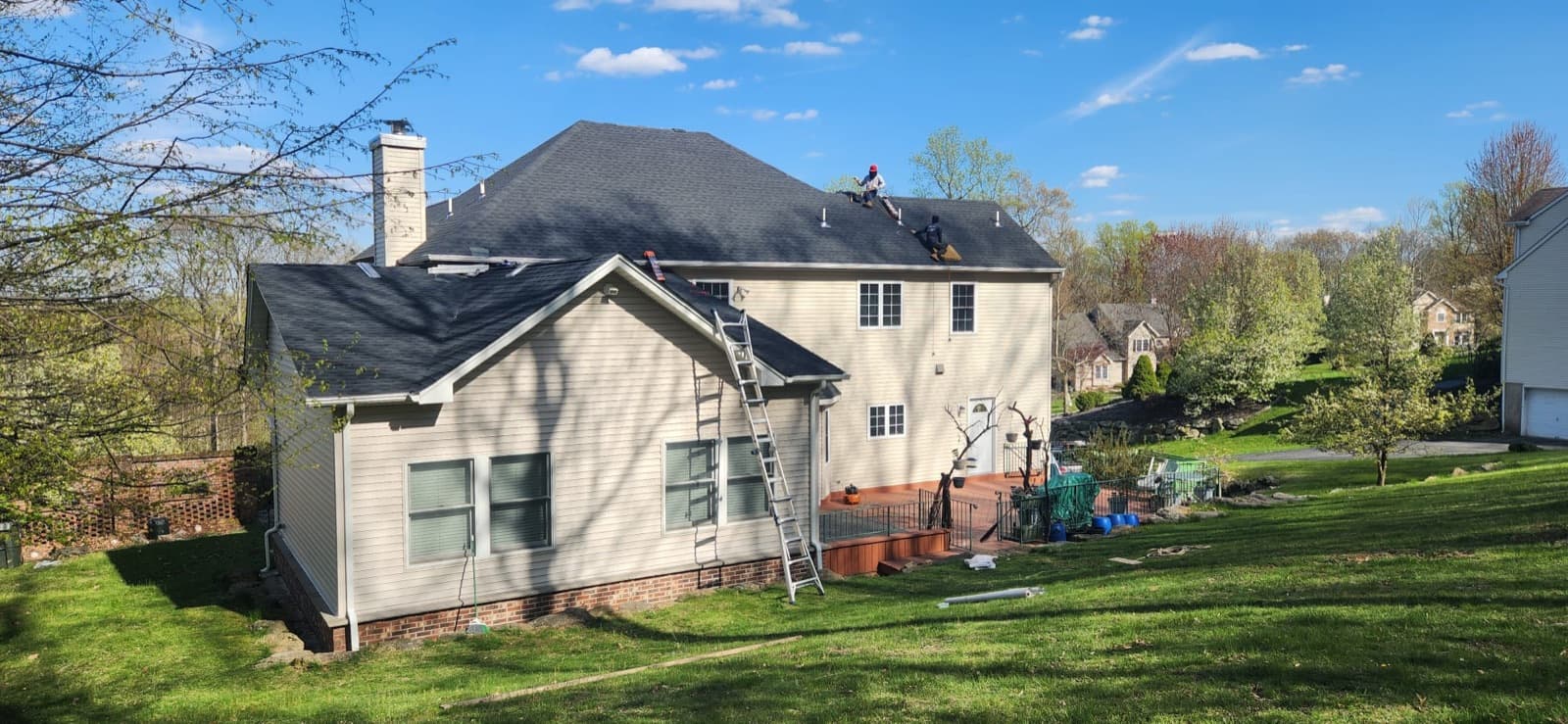
Chimney Flashing Leak Repair in North NJ
A leak around the chimney is almost never the brick — it is the flashing at the roof-to-chimney joint. We fix it the way it lasts: counter-flashing cut into the mortar and step flashing woven into the courses, not a smear of tar. Free on-site diagnosis across New Jersey. NJ-registered.
Of every specific place a roof can leak, "chimney" is the one North Jersey homeowners search for most — and for good reason. A masonry chimney is a hole cut clean through the roof plane, so it is one of the most common places for water to get in. But the leak is almost never the brick, the crown, or the chimney "being old." It is the flashing — the metal joint where the roof meets the masonry. This is the exact problem Precision was built on: before roofs, our work was water intrusion at windows and glass, flashing an opening so a driving nor'easter cannot push rain past it. The principle that keeps a window dry is identical to the one that keeps a chimney dry — every upper layer laps over the top edge of the layer below it, so gravity carries water out and down, never behind.
So chimney flashing is squarely our lane, and we run it out of our Garfield shop across New Jersey, registered under HIC reg.# 13VH13970900. Flashing work is a dry-roof job — reglets have to be cut and the metal woven into the courses — so we get out to diagnose it quickly and then set the repair for weather it can be done properly in. This page walks through how the flashing is supposed to work, the specific ways it fails, the repair that actually lasts — cut into the mortar, not caulked over — and why so many re-roofers leave the flashing leaking on an otherwise brand-new roof. If water is showing up near your chimney, call (201) 275-9185; we trace it to the real entry point and quote the fix free, on-site.
Recent work in New Jersey
Why leaks find the chimney first
A roof's open field of shingles rarely leaks — it is engineered to shed water and it is uninterrupted. Trouble starts where something pokes through, and a chimney is the biggest interruption on most roofs: water sheeting down the slope hits its uphill face and has to be routed around it, wind drives rain against all four sides, and snow piles on the high side and melts slowly right at the joint. The flashing handles all of that, so when we open a leak "at the chimney" it is the flashing that has failed far more often than the brick or crown. A chimney leak also loves to fool you — water rides the decking before it drops, so the stain often surfaces on a ceiling several feet downhill. The wet spot is a clue, not the location.
How to tell it is the chimney flashing
A flashing leak rarely fixes itself, and it shows up as small, easy-to-dismiss signs long before a ceiling comes down. What points at the chimney, inside and out:
- A brown or rust-colored ceiling stain, or bubbling paint, near the chimney chase — often a few feet to the low side of it.
- A musty smell, damp attic insulation, and dark water tracks on the decking and rafters around the chimney penetration.
- "Shiny" nails in the attic — fasteners that have condensed moisture and started to rust, a classic sign of a chronically wet cavity.
- Rust streaks running down the brick from the flashing line, or a black tar patch visible from the ground — someone "fixed" it the wrong way.
- White, chalky efflorescence and flaking, crumbling brick (spalling), and a drip that appears only in wind-driven rain or snowmelt — the signature of a flashing leak, not a field leak.
Roof leaking right now? We answer 24/7.
Two overlapping layers, not one
Done right, chimney flashing is not one piece of metal — it is two overlapping layers, and that is the key to understanding why the cheap version leaks.
- Step (base) flashing — some masons call the pieces "soakers" — is a set of individual L-shaped tabs, each interwoven with a single course of shingles up both sides of the chimney. Each tab hands water off to the shingle below it, stepping down the slope, so it can never be a single bent strip.
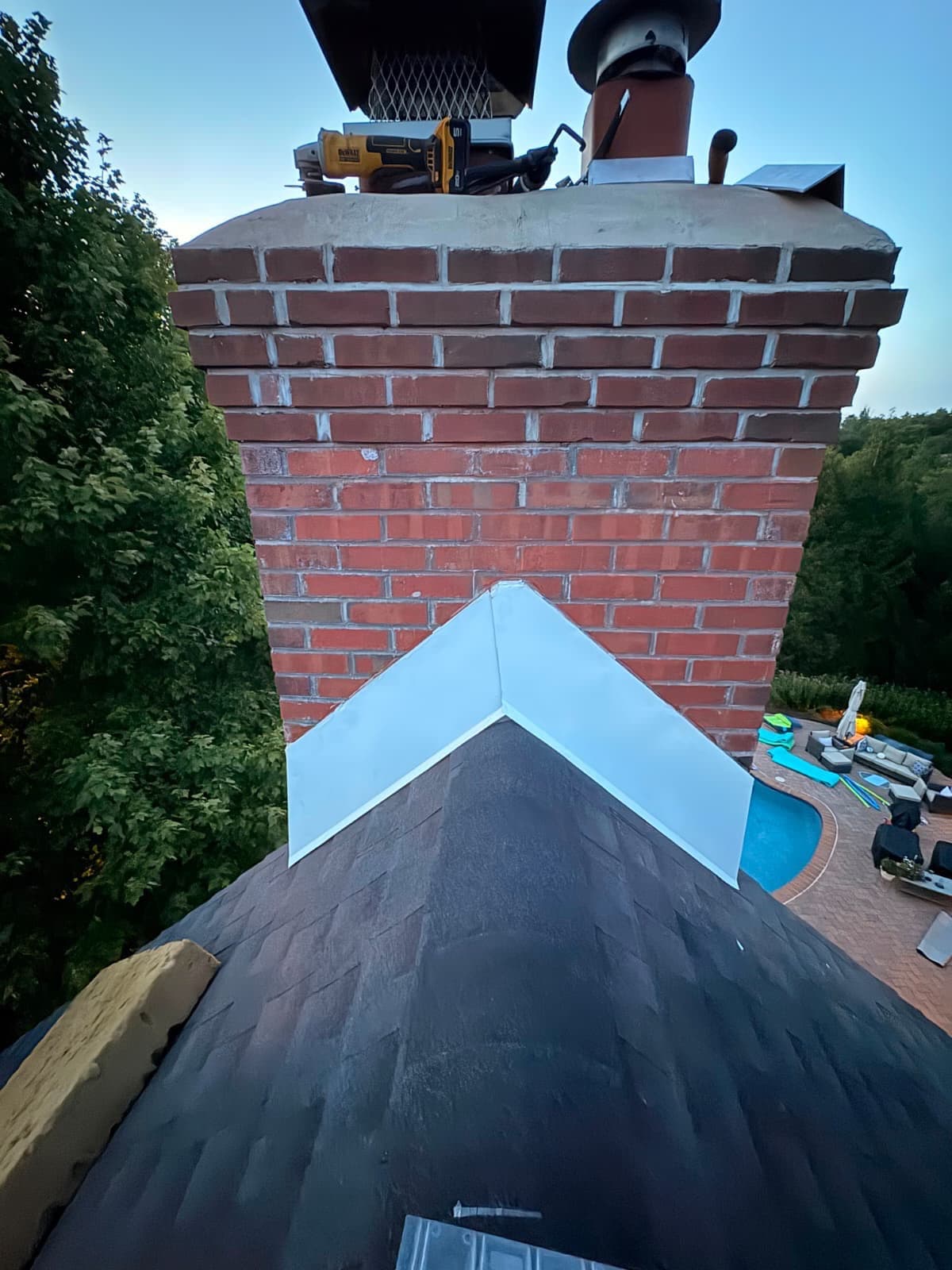
- Counter-flashing (cap flashing) is a second layer that covers the top edge of the step flashing and tucks into the chimney's mortar joints, shielding the step flashing's vertical legs so wind-driven water cannot get behind them.
- The overlap is the whole point: the counter-flashing laps over the step flashing exactly the way an upper shingle laps a lower one, or the way head flashing laps a window. Reverse that lap or leave a layer out, and you have built a funnel instead of a shield.
Caulk buys a few years; a reglet buys decades
Here is the shortcut behind most chimney leaks we see. Instead of cutting the counter-flashing into the mortar, the installer surface-mounts it flat to the brick and relies on a bead of caulk or roofing tar as the actual seal. It looks fine on day one, but caulk and tar are sacrificial: under North Jersey UV and the constant expansion of sun-baked metal, a surface seal typically breaks down in three to five years, and then the leak is back. Black tar patches smeared over a chimney are not a repair — they are a countdown, and sealant alone can never make up for counter-flashing that was never embedded.
The repair that lasts does the opposite. The counter-flashing is set into a reglet — a saw kerf cut into the mortar joint, on the order of an inch deep — then folded down into the groove, locked in, and sealed. Now the seal is mechanical, not adhesive: even when the sealant ages, the metal is physically captured in the masonry and water still cannot get behind it. Wherever we can we use a two-piece counter-flashing, so the piece buried in the mortar and the piece lapping the step flashing are separate. Because the roof and the chimney expand at different rates through a New Jersey year, letting the two move independently keeps the joint from tearing open — and lets the flashing be un-nested later to replace shingles without ripping the masonry apart.
Roof leaking right now? We answer 24/7.
The cricket most wide chimneys are missing
Look at the uphill face of a chimney after a rain and you often see the real problem: water and leaves piling against the brick with nowhere to go. On a wide chimney that flat back becomes a dam that traps water right at the most vulnerable joint, and it eventually works under the flashing. The fix is a cricket — also called a saddle — a small peaked, sloped structure on the high side that splits water and sheds it around both sides of the chimney instead of letting it pond. It is not optional on larger chimneys, and New Jersey's adopted 2024 IRC says so twice. R1003.20, in the masonry-chimney chapter, requires a cricket wherever a chimney's dimension parallel to the ridgeline is greater than 30 inches and the chimney does not intersect the ridgeline. R903.2.2, in the roof-assemblies chapter, puts the same 30-inch threshold on anything that comes through a roof: a cricket or saddle on the ridge side of any chimney or penetration more than 30 inches wide, measured perpendicular to the slope — the same measurement, stated the other way round. (That section carries one exception, for unit skylights installed per R324.6 and flashed to the manufacturer's instructions. Chimneys have no such exception.) The cricket-to-chimney joint then has to be flashed and counter-flashed with the same care as the main joint. Plenty of wide masonry chimneys on North Jersey colonials never got the cricket they were supposed to have, and the uphill flashing has been losing that fight ever since.
The crown, the mortar, and North Jersey's freeze-thaw
Flashing is the number-one path, not the only one, and an honest diagnosis checks the rest of the chimney because more than one can leak at once. The crown — the sloped mortar or concrete cap on top — is supposed to shed water and overhang the brick with a drip edge; when it cracks, water pours straight down inside. Mortar joints recede and crumble with age, opening dozens of small entry points that need repointing, and saturated brick faces spall, flaking and breaking apart.
North Jersey winters drive all of it. Our freeze-thaw climate pushes the temperature across 32 degrees and back over and over through a single winter — sometimes within one day. Water soaked into porous mortar or brick freezes, expands, and pries the masonry apart from the inside — cracking crowns, opening joints, spalling brick, and loosening flashing seals. And one myth worth killing: a chimney cap — the screen-and-lid on top of the flue — does nothing for any of this. It keeps rain, animals, and downdrafts out of the flue opening; it does not protect failed flashing, a cracked crown, or porous brick, which are separate water paths that each need their own repair.
Roof leaking right now? We answer 24/7.
Why re-roofers skip the flashing
One of the most frustrating calls we get is the homeowner who just paid for a brand-new roof and still has a wet ceiling by the chimney. The reason is almost always the flashing. Rebuilding it correctly takes extra time and a little masonry skill — cutting reglets, forming two-piece counter-flashing, framing a cricket — so to win the bid on price, plenty of roofers leave it out: they bend the old flashing back down and tar over it, or shingle up to the chimney and caulk the gap. The estimate looks cheaper because a real detail is missing from it.
The trap is that tearing off the old roof loosens even flashing that was sound, so "reused" flashing that looked fine on install day starts leaking as the new roof settles — the classic new-roof-same-leak. We do not reuse chimney flashing; on a re-roof we rebuild it and show it as its own line so you can see it is actually there. And on a leak call we trace the water to its true source first — flashing, crown, mortar, or a combination — because caulking the nearest stain is exactly how a chimney leak comes back a third time. If the surrounding masonry needs repointing or a rebuilt crown before the flashing can seat, we will say so up front.
What affects the cost
| Chimney width and whether a cricket is required | A chimney over 30 inches wide across the slope needs a code-required cricket on the high side — carpentry plus extra flashing, not just a strip of metal. |
|---|---|
| Masonry condition | Cracked crowns, recessed joints that need repointing, or spalled brick often have to be repaired first so the new counter-flashing has sound mortar to seat into. |
| Reglet cut-in vs. a surface patch | Sawing kerfs into the mortar and forming two-piece counter-flashing is skilled labor — more than a caulk-and-go patch, and it lasts many times longer. |
| Pitch, height, and access | A steep or multi-story roof, and a tall chimney standing well above the ridge, add staging, access, and fall-protection time to the same repair. |
| Existing water damage | If the leak has already rotted decking or soaked framing around the chimney, that has to be cut out and replaced before the flashing goes back. |
We don't bundle a mystery number — you get a firm, free on-site quote, approved before any work starts.
Monthly payment options
We work with Hearth, which shops several lenders on a single application. See your personalized options in minutes — checking does not affect your credit score, and there is no commitment.
- Loan amounts up to $250,000
- Funding in as little as 1–3 days
- No prepayment penalties
- No home equity required
Financing is provided by Hearth's lending partners, not by Precision Windows & Roofing. Rates and terms depend on your credit and the lender making the offer, and all financing is subject to credit approval.
Common questions
Is my chimney leak the brick or the flashing?
Almost always the flashing. The chimney is a hole cut through the roof, and the metal joint where the roof meets the masonry is what keeps that seam watertight. When we open up a chimney leak, a flashing failure is the culprit far more often than the brick, the crown, or the chimney simply being old. The masonry can leak too — a cracked crown or crumbling mortar joints — which is why we check all of it, but the flashing is the number-one path by a wide margin.
My chimney was caulked and it is leaking again. Why?
Because caulk and tar are a temporary seal, not real flashing. When counter-flashing is surface-mounted to the brick and sealed with caulk or a smear of roofing tar, that seal typically breaks down in three to five years under North Jersey sun and temperature swings — and you are right back where you started. A patch on top of a patch just resets the same short clock. The lasting fix cuts the counter-flashing into the mortar joint so the seal is mechanical, not dependent on a sealant guaranteed to age out.
Do I need a cricket or saddle behind my chimney?
If your chimney is more than about 30 inches wide measured across the slope (parallel to the ridge) and does not sit on the peak, then yes — New Jersey's code (2024 IRC, R1003.20) requires one. A cricket is a small sloped structure on the uphill side that splits water and debris around the chimney instead of letting it pond against the back. Many wide chimneys on North Jersey homes never got one, and that trapped water is exactly what works its way under the flashing. The cricket itself also has to be flashed and counter-flashed properly.
I just got a whole new roof — how is the chimney still leaking?
This is one of the most common calls we get, and the answer is almost always that the flashing was reused instead of replaced. Redoing chimney flashing correctly takes extra time and masonry work, so some roofers leave it off the estimate to come in cheaper — bending the old flashing back down and tarring over it, or shingling up to the chimney and caulking. Tearing off the old roof loosens even sound flashing, so it starts leaking as the new roof settles. We never reuse chimney flashing; we rebuild it and show it on the quote as its own line.
How do I know it is the flashing and not the crown or the brick?
Often you cannot tell from the ground, and sometimes it is more than one at once — which is why we trace it rather than guess. Flashing leaks tend to appear with wind-driven rain or snowmelt and leave stains and rust tracks near the chimney in the attic; a cracked crown leaks straight down the flue; saturated mortar and spalling brick show white efflorescence and crumbling faces outside. We read those signs, follow the water in the attic, and inspect the whole chimney before quoting, so you fix the actual source instead of the nearest symptom.
Does a chimney cap stop leaks?
No — and it is a common mix-up. The cap is the screen-and-lid on top of the flue opening; it keeps rain, animals, and downdrafts out of the chimney's interior, which is worth having. But it does nothing for a flashing leak, a cracked crown, or porous brick, because those are separate water paths on the outside of the chimney. If water is staining a ceiling near the chimney, a new cap will not fix it — the flashing or the masonry is where to look.
Explore
Get your free roofing quote
Free, no-obligation on-site assessment anywhere in New Jersey — and we answer the phone 24/7.