Roof Storm Damage & Insurance Claim Documentation in North NJ
Wind, hail, or a fallen limb hits your roof and suddenly you're filing a claim you've never filed before. We inspect, document the damage, and stand on the roof with your adjuster — honestly, with no promises about what your carrier decides. Same-day service is standard in Bergen County; elsewhere it depends on the job and how booked we are that day.
A storm rolls through North Jersey, and afterward you spot missing shingles on the windward slope or a fresh brown stain spreading across a bedroom ceiling. Now you are staring down an insurance claim you have never filed before, on a deadline you did not know you had. This page is the honest walkthrough: how to tell real storm damage from ordinary wear, how the New Jersey claim process actually runs, what your policy covers and what it does not, and where a roofer can genuinely help — without pretending to control an outcome only your carrier controls.
Here is the one promise we will make and the one we never will. We will inspect your roof, document the damage properly, and, if you want us there, be on the roof when your adjuster visits to show what we documented. We will not promise to get your claim approved or to make your insurance pay — no roofer honestly can, and anyone who does is telling you something about how they operate. The carrier decides. Our job is to make sure the damage is on the record and the repair is done right.
Our edge is where we came from. Precision started in windows and glass, tracing water intrusion to its exact entry point — a failed flashing joint, a lifted shingle course, a nail pop — long before we ever quoted a full re-roof. That leak-first diagnostic is the same skill that separates a covered storm event from a slow, uncovered leak, and it is why our storm inspections photograph the source of the water, not just the stain on your ceiling. We dispatch same-day in Bergen County, and elsewhere depending on the job and how booked we are that day, from our Garfield shop at 163 Midland Ave, registered under HIC reg.# 13VH13970900.
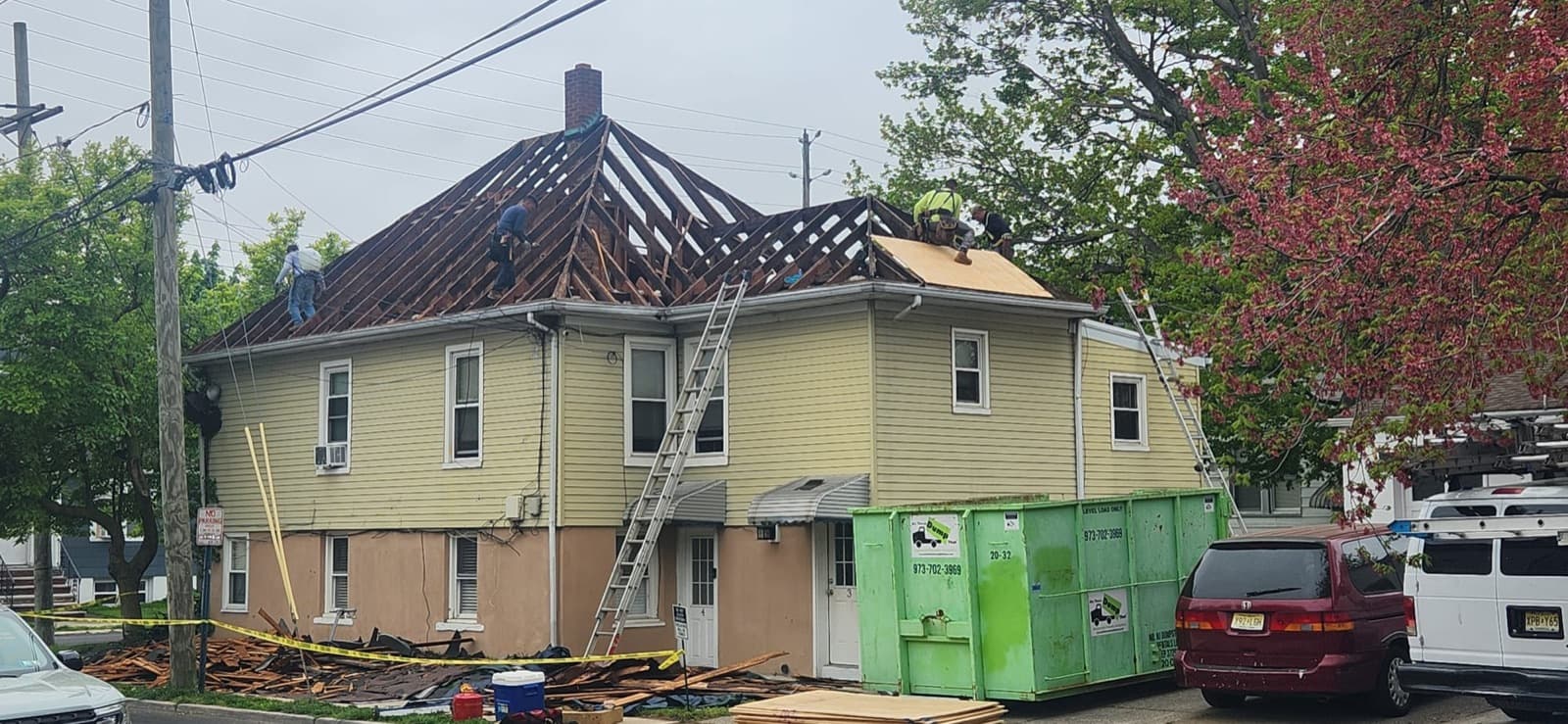
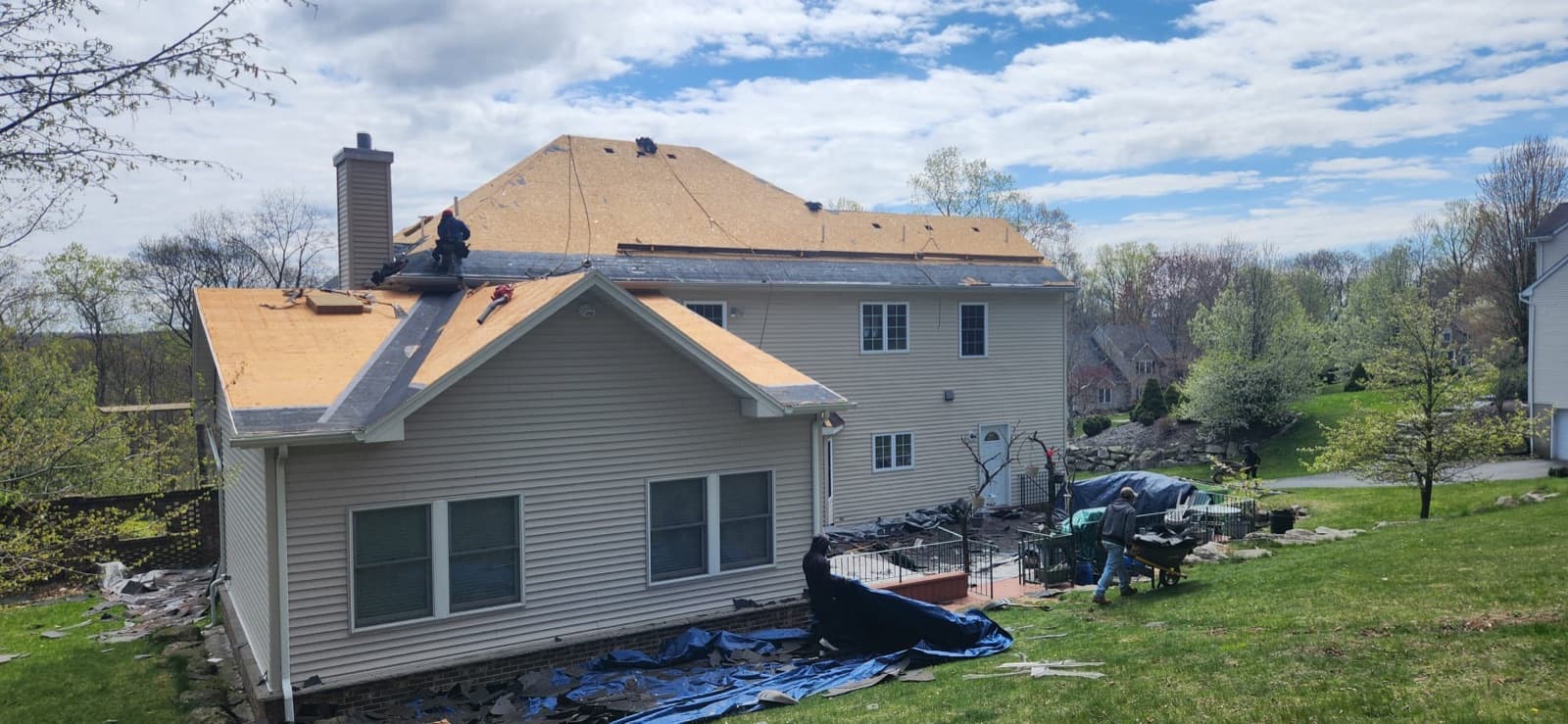
Recent work in New Jersey
Wind, hail, and tree damage — what it actually looks like
Wind is the headline peril in North Jersey. On an asphalt roof it shows up as shingles torn off in patches or entire rows, exposing the underlayment or bare deck underneath, plus shingles that are curled, lifted, or creased where the adhesive seal strip has broken but the shingle has not yet blown clear. The damage concentrates at the corners, the ridge, the rakes, and the windward slope — and lifted or bent step- and counter-flashing at walls and chimneys is very often where the actual leak begins, even when the field of the roof looks intact.
Hail is subtler and gets missed constantly. You are looking for bruises: soft, round spots where the granules have been knocked off and the asphalt mat beneath is exposed, and for a sudden pile of granules washed into the gutters and sitting at the downspout splash blocks. A roof can look perfect from the driveway and still have an entire slope of hail bruising that has quietly destroyed the shingle's water-shedding surface — which is exactly the kind of thing an adjuster and a roofer need to find together, up close.
Tree and limb strikes are the obvious case: a limb falling on the roof is a covered sudden event, and it leaves impact punctures, cracked decking, and crushed shingles that are hard to argue about. The trap is the near-miss — a glancing branch that lifts a course of shingles or knocks flashing loose without leaving a hole. That damage is real, it will leak, and it needs to be documented before it gets dismissed as pre-existing.
- Missing or torn shingles in patches or full rows, exposing underlayment or deck
- Curled, lifted, or creased shingles where the adhesive seal has broken
- Hail bruises — round dents with granules knocked off and mat exposed
- A surge of granules in gutters and at downspout splash blocks
- Lifted, bent, or displaced flashing at walls, chimneys, and valleys
- Interior signs: fresh ceiling or wall water stains and damp attic sheathing
Sudden storm event vs. pre-existing wear — the line every claim turns on
New Jersey homeowners policies are built to cover sudden, accidental perils: wind, hail, lightning, fire, and a tree or limb falling on the roof. They are generally not built to cover gradual wear, age-related deterioration, or damage that traces back to deferred maintenance. That distinction is not fine print — it is the entire ballgame.
Almost every denied roof claim comes down to a single argument: was this a sudden covered event, or pre-existing wear that the storm merely revealed? A 22-year-old roof at the natural end of its service life is a hard claim to win. A 9-year-old roof with a fresh row of shingles peeled off after a named windstorm is a clear one. The adjuster's default instinct, when the evidence is thin, is to attribute damage to age — because that is the outcome the policy does not have to pay for.
This is precisely why the storm date matters and why documentation captured close to that date matters so much. Contemporaneous, date-stamped photos establish the sudden-event timeline before anyone can pin the damage on wear. And it is why we give you a straight answer on the inspection: if what we see is wear, not storm, we will tell you — because filing a claim that gets denied for wear puts a denial on your record for no benefit.
Roof leaking right now? We answer 24/7.
The NJ roof-claim process, in the order that actually helps you
The sequence matters more than most homeowners realize. Calling your insurer first, before anyone has actually looked at the roof, means you file blind and let the adjuster set the entire narrative. A better order puts real information in your hands first, then reports promptly. Here is the process we walk North Jersey homeowners through:
- 1. Document safely from the ground first — dated wide and close-up photos and video of every slope you can see. Never climb a storm-damaged roof yourself.
- 2. Have a state-registered roofer inspect and produce a written damage report before you call the insurer, so you file knowing exactly what is up there.
- 3. Report promptly, with your policy number in hand. Policies require 'prompt' notice — commonly within a few days — and a late report is itself grounds for denial.
- 4. Be present for the adjuster. If your contractor attends, its role is to show the damage it documented and explain its own written estimate; the Scope of Loss is between you and your insurer, or a licensed public adjuster or attorney you hire.
- 5. Review the adjuster's Scope of Loss and estimate line by line before you agree to anything.
- 6. Complete the work and submit the final invoice and proof to release the withheld recoverable depreciation.
What we photograph, and why we stand on the roof with your adjuster
Adjusters work heavily from photographs, so the file has to be complete or the damage effectively does not exist. That means wide-angle shots of every roof slope, close-ups of each damaged area — torn and creased shingles, hail bruises, lifted flashing — the granules collected in the gutters, and the piece homeowners almost always skip: the interior evidence. Ceiling and wall water stains and attic moisture on the sheathing tie the roof damage to actual water entry, and everything gets date-stamped as close to the storm as possible.
This is where our background pays off directly. Because we came up through window and glass water-intrusion work, tracing a leak back to its true entry point is a diagnostic we have run for years — a failed flashing joint at a chimney, a wind-lifted shingle course, a popped nail working a hole. We photograph the point where water is getting in, not just the brown circle it left on your ceiling, which is exactly the evidence that connects a stain to a covered storm.
When your adjuster arrives, we can be on the roof to show the damage we documented and explain our own estimate — that is not adversarial, and it is not negotiation. We do not argue scope or settlement on your behalf, and we do not promise this changes your carrier's decision; the claim stays with you, or with a licensed public adjuster or attorney you hire.
Roof leaking right now? We answer 24/7.
Deductibles, ACV vs. RCV, and why the check arrives in two parts
Two things about the money catch homeowners off guard. The first is the deductible. Many homeowners assume a modest flat deductible, but a large share of New Jersey policies carry a separate percentage-based wind/hail deductible — often 1% to 5% of your dwelling coverage rather than a fixed amount. Because that number scales with your home's insured value, it can climb well past a flat deductible, sometimes high enough that a smaller storm repair is genuinely not worth filing. Read your declarations page before you file, not after.
The second is that the payment usually comes in two pieces. On a replacement-cost (RCV) policy, the carrier first issues an actual-cash-value (ACV) check for the depreciated value, then releases the withheld 'recoverable depreciation' as a second check only after the work is completed and the final invoice is submitted. An ACV-only policy is a different animal — it pays the depreciated value and never reimburses full replacement, so far more comes out of your pocket. That single line on your declarations page is worth checking before a storm ever hits.
This is where our pricing transparency matters most. We quote the actual repair on its own merits — free, on-site, and line-itemed — never 'whatever your insurance pays.' You see the real number, hold it up against your Scope of Loss and your deductible, and decide with full information instead of a bundled figure reverse-engineered from your claim check.
What New Jersey law requires of your insurer
New Jersey regulates how insurers handle claims under N.J.A.C. 11:2-17.7, and the deadlines are concrete. Your insurer must commence its investigation within 10 working days of being notified of the claim. It must settle a first-party property claim within 30 calendar days of receiving a properly executed proof of loss once liability and the amount of loss are established, and it must advise you of acceptance or denial within a reasonable time for full investigation after that proof of loss. And it must pay any amount finally agreed in settlement within 10 working days of that agreement. If your carrier goes quiet, those timelines are your leverage.
Do not sit on a disputed claim assuming you have unlimited time. Breach-of-contract suits against an insurer in New Jersey generally run six years from a wrongful denial — but many homeowner policies contain a shortened one-year suit-limitation clause that runs from the date of loss. Under New Jersey law that contractual period is tolled while the insurer is still investigating, until it formally declines liability, but treating a dragging dispute as something you can revisit years later is a real mistake.
One honest boundary: we are roofers, not public adjusters or attorneys. If a claim goes truly sideways — a denial you believe is wrong, or a settlement far below the real scope — a licensed public adjuster or an insurance-coverage attorney is who to call. Our job is documenting the damage accurately and doing the repair right, and we will tell you plainly when the situation has moved past what a roofer should be handling.
Roof leaking right now? We answer 24/7.
Storm chasers: the trucks that show up the day after
After every major North Jersey storm, out-of-town crews canvass the hardest-hit blocks door to door. Some are legitimate. But the warning signs of a storm chaser are remarkably consistent, and knowing them protects both your wallet and your roof for the decades it has to keep water out.
The single biggest red flag is an offer to 'waive' or 'eat' your deductible. That is not a discount or a favor. New Jersey has no statute naming the practice, so be precise about why it is a warning: the deductible is a fixed obligation under your policy, and the only way a contractor absorbs it and still gets paid is by presenting the carrier a price that is not the price. Knowingly presenting a statement in support of a claim containing false or misleading information material to that claim violates the New Jersey Insurance Fraud Prevention Act, N.J.S.A. 17:33A-4(a)(1). The other classic tells are high-pressure door-knocking, a demand that you sign a contract or an assignment-of-benefits form before anyone has even inspected the roof, and a large upfront deposit collected before work begins.
Protect yourself with two simple checks. First, verify a valid New Jersey Home Improvement Contractor (HIC) registration — every legitimate roofer working on your home is required to carry one. Second, ask whether the company will still exist in six months to honor the workmanship warranty; a roof failure two winters from now is worthless if the truck that installed it has left the state. We are local, based at 163 Midland Ave in Garfield, registered under HIC reg.# 13VH13970900, and we will still be here when your roof needs us.
- An offer to waive, cover, or 'eat' your deductible — a fraud signal: no New Jersey statute or rule names the practice, but it only works by billing your carrier a price that is not the price, which N.J.S.A. 17:33A-4 and 2C:21-4.6 reach
- Pressure to sign a contract or assignment-of-benefits form before any inspection
- A large deposit demanded upfront, before work starts
- Out-of-state plates, no verifiable NJ HIC registration, and no local address
- Promises that they will 'get your claim approved' or 'make insurance pay'
What affects the cost
| Repair vs. full replacement | A few storm-damaged slopes repair for far less than a whole re-roof; widespread wind or hail damage across every slope pushes the scope toward full replacement. |
|---|---|
| Hidden decking damage | Cracked or rotted sheathing found under torn shingles adds material and labor — and unlike a like-for-like re-cover, decking work triggers a NJ building permit. |
| Code-required upgrades | A full re-roof brings the assembly up to current NJ code — drip edge, correct underlayment, balanced attic ventilation — and carries the eave ice barrier we spec as standard; a partial patch carries none of it. |
| Your deductible | What you actually pay is the repair cost minus your deductible, and a percentage wind/hail deductible (1–5% of dwelling coverage) can dwarf a flat one. |
| ACV vs. RCV policy | A replacement-cost policy releases withheld depreciation after the work is done; an ACV-only policy never pays full replacement, so more comes out of pocket. |
| Shingle matching | A discontinued or weathered shingle can force a larger repair area — or a slope-by-slope replacement — to keep the roof uniform and watertight. |
| Interior & water damage | Stopping the leak is only part of the scope; stained drywall, wet insulation, and flashing repairs at walls and chimneys all factor into the total. |
We don't bundle a mystery number — you get a firm, free on-site quote, approved before any work starts.
Monthly payment options
We work with Hearth, which shops several lenders on a single application. See your personalized options in minutes — checking does not affect your credit score, and there is no commitment.
- Loan amounts up to $250,000
- Funding in as little as 1–3 days
- No prepayment penalties
- No home equity required
Financing is provided by Hearth's lending partners, not by Precision Windows & Roofing. Rates and terms depend on your credit and the lender making the offer, and all financing is subject to credit approval.
Common questions
Will my homeowners insurance cover my storm-damaged roof?
It depends on the cause, and no honest roofer can promise you a yes. NJ policies generally cover sudden, accidental perils — wind, hail, lightning, fire, and a tree or limb falling on the roof — but generally not gradual wear, age, or deferred maintenance. Almost every denied claim turns on 'sudden covered event' versus 'pre-existing wear.' We inspect, tell you straight which side of that line your roof is on, and document the damage so the sudden-event timeline is on the record. The carrier still makes the final call.
Do you guarantee you'll get my claim approved?
No, and we would be careful with any roofer who does. We are not public adjusters or attorneys, and no contractor controls what your carrier decides. What we can honestly do is inspect the roof, produce clear date-stamped documentation of the damage, and, if you want us there, be on the roof when your adjuster visits to show what we documented. The approval decision is your insurer's alone — anyone promising otherwise is telling you how they operate, not how claims actually work.
How soon after a storm should I report the claim?
Promptly. New Jersey policies require 'prompt' notice — commonly within a few days — and a late report can itself be grounds for denial. The order that helps you most is to document from the ground first, get a state-registered roofer's written inspection, then report with your policy number in hand so you file knowing exactly what is on the roof. Once you notify them, your insurer has to commence its investigation within 10 working days under N.J.A.C. 11:2-17.7.
A contractor offered to waive my deductible. Is that OK?
Walk away. No New Jersey statute names the practice, so be precise about why it is a warning: the deductible is a fixed obligation under your policy, and the only way a contractor absorbs it and still gets paid is by presenting the carrier a price that is not the price — which is what the Insurance Fraud Prevention Act, N.J.S.A. 17:33A-4(a)(1), reaches. An offer to 'eat' or 'waive' it tells you how that company operates. A legitimate NJ roofer carries a valid Home Improvement Contractor registration and expects you to pay your deductible exactly as your policy requires.
Do I have to use the roofer my insurance company recommends?
No. In New Jersey you choose your own contractor. Your carrier may suggest a preferred vendor, but the decision is yours, and you have every right to a written, line-itemed estimate you can hold up against the adjuster's Scope of Loss before any work begins. That comparison is exactly where our free, on-site, line-itemed quote is meant to help.
Explore
Get your free roofing quote
Storm response is dispatched same-day in Bergen County, and elsewhere depending on the job and how booked we are that day. Free, documented on-site assessment — no promises about what your carrier decides.