Roof Leak Repair in North NJ — Traced, Then Fixed for Good
Most leaks aren't emergencies — they're a stain that showed up after the last storm. We trace the water back to the detail that actually failed, then rebuild that detail so the leak is finished instead of paused. Free on-site diagnosis across New Jersey. NJ-registered.
A roof leak is a forensic problem before it is a repair problem. Water finds the lowest path it can, runs along the underside of the sheathing, down a rafter or a nail shank, and drips into the house feet from where it actually got in. That single fact is why so many leaks get 'fixed' twice and come back a third time — somebody repaired the stain instead of the source. This page is the other approach: find the detail that actually failed, then rebuild that detail so the leak is finished rather than paused.
Precision built its name stopping water at the hardest place to stop it: the glass line. Flashing, glazing seals, drip edges, weep paths — the water-management details that keep a window dry are the same ones that keep a roof dry, just at a bigger scale and a longer reach. A roof leak is that same forensic problem, and it is squarely in our lane. HIC reg.# 13VH13970900, fully insured.
Most of the leaks we get called for across New Jersey are not emergencies. They're a ceiling ring that appeared after the last nor'easter, a drip that only shows in driving rain from one direction, a damp rafter somebody noticed while pulling boxes out of the attic. Those are the leaks this page is for: diagnosed properly, quoted free on-site, and repaired on a dry roof where the work can actually be done right. If water is coming into the house right now or the roof is physically open, that's triage rather than repair — start on our emergency roof repair page, then come back here for the permanent fix.
- Emergency roof repair — Water coming into the house right now, or the roof physically open — that's triage before repair.
- How to find a roof leak — Read the signs yourself first: where leaks actually start and why the stain is never under the source.
- Chimney flashing leak repair — Water showing up near the chimney — counter-flashing cut into the mortar, and the cricket a wide chimney is required to have.
- Skylight leak repair — Leaks at a skylight curb or flashing kit, and when the unit itself is what failed.
- Storm damage & insurance claims — When the cause was a covered event and the damage needs documenting the way an adjuster reads it.
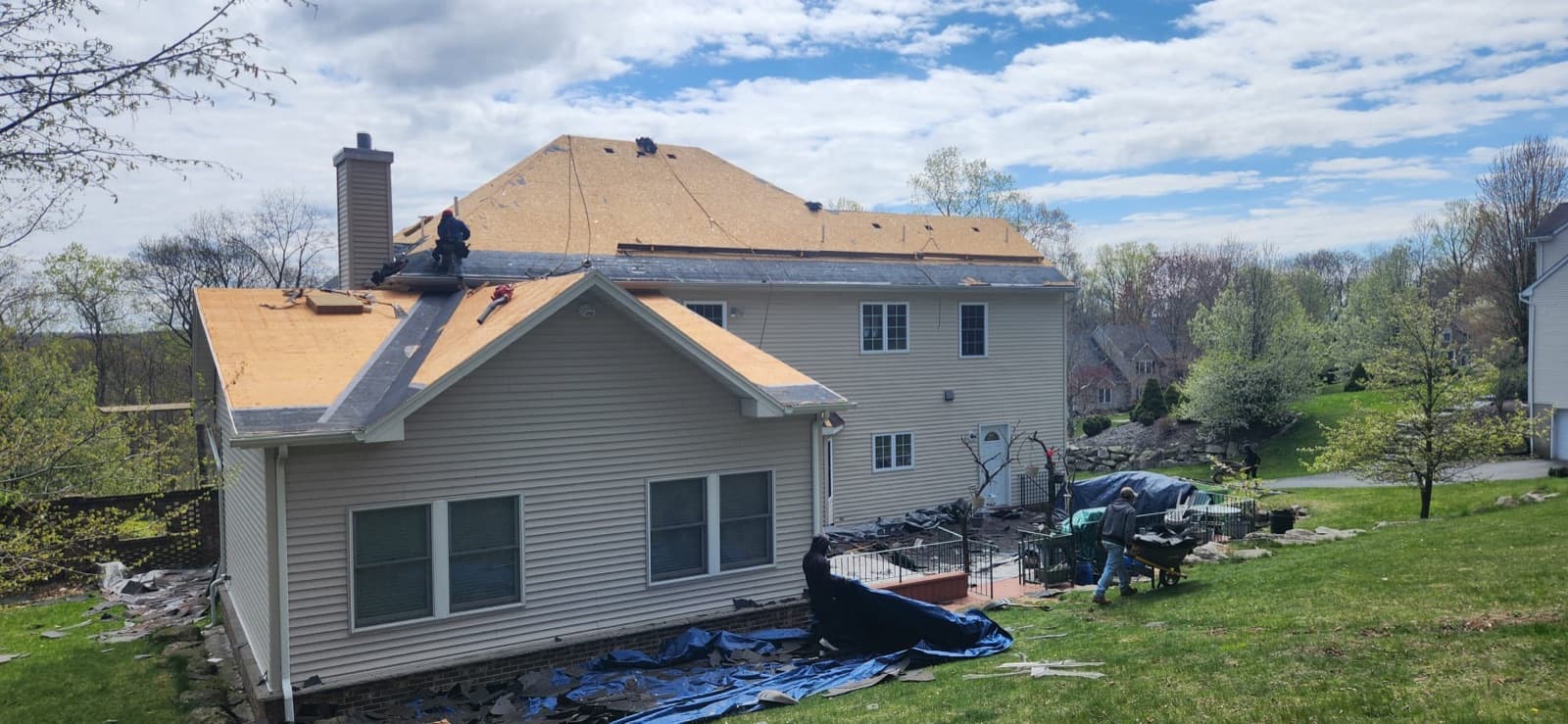
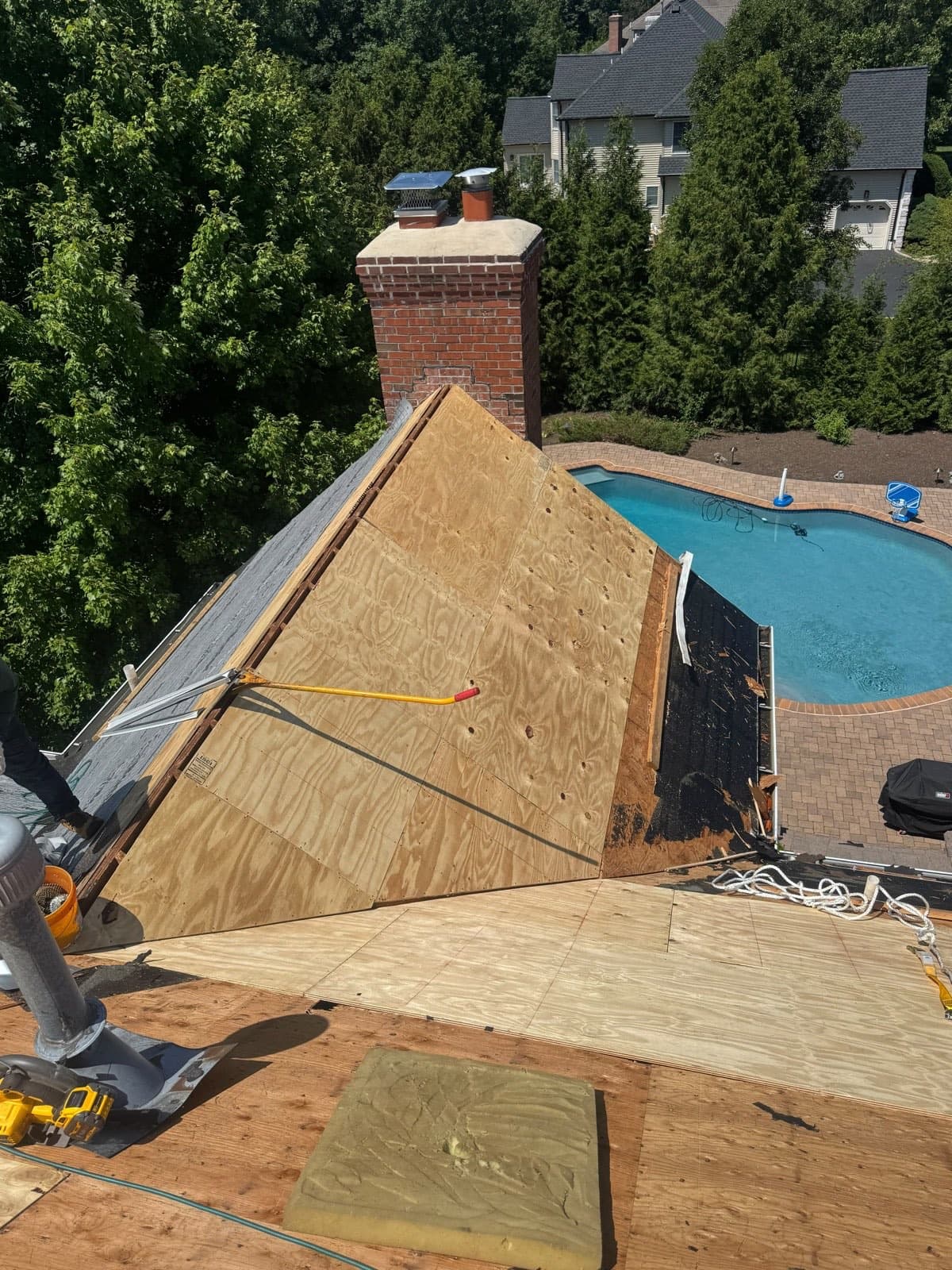
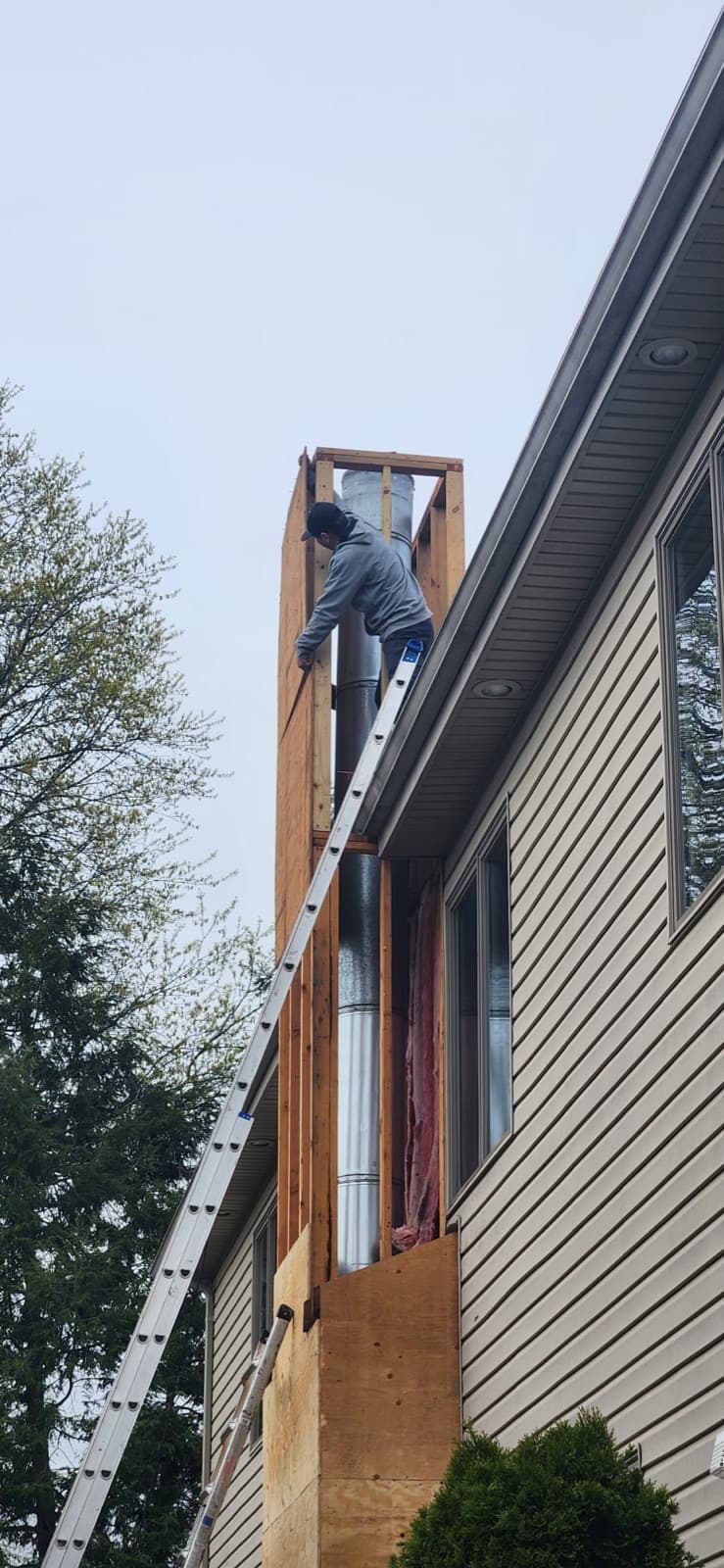
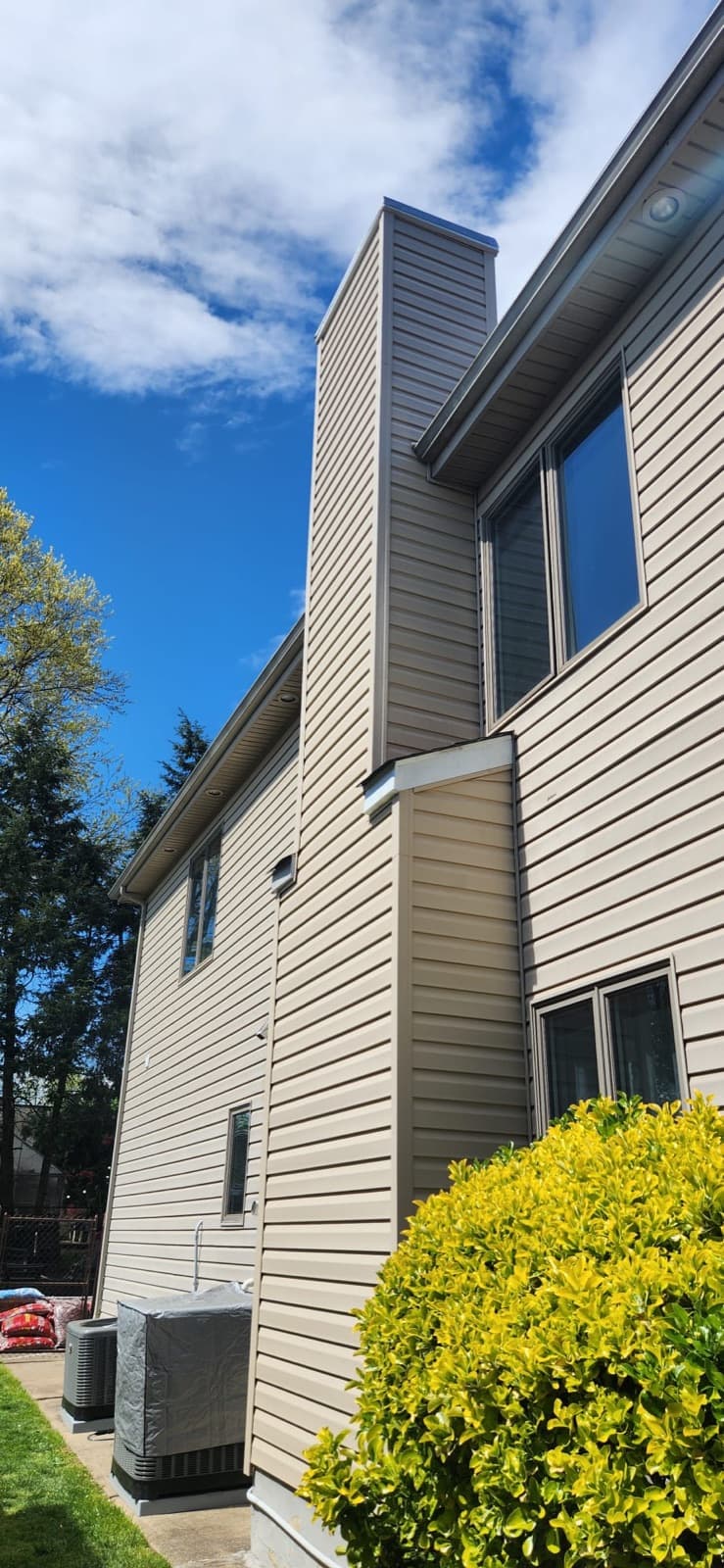
Recent work in New Jersey
Why the stain is never where the leak is
The number-one reason a leak gets 'fixed' twice and comes back a third time is that someone repaired the stain instead of the source. Water almost never drips straight down from its entry point. It travels — across the top of the sheathing, along a rafter, down a nail — until it hits something that finally lets it fall. A stain over the kitchen can start at a chimney ten feet uphill.
So we trace it, we don't guess. That means reading the interior clues (stain shape, rust trails on nails, where the drywall has gone soft), getting into the attic with a light to follow the water's actual path back uphill, and inspecting every penetration and transition on the roof surface. When a leak is intermittent or hidden, we run a controlled water test — isolating one plane, one flashing, one skylight at a time — until we reproduce it and know exactly where it's getting in before we touch a shingle. If you'd rather read the signs yourself first, our guide to finding a roof leak walks through what to look for.
Where North NJ roofs actually leak
Contrary to how most people picture it, the shingle field in the middle of a roof rarely leaks. Water gets in at the transitions and penetrations — the seams, edges, and holes where the roof meets something else. On the roofs we open up across Bergen and Passaic, the same handful of culprits come up again and again.
- Flashing failure — the metal that sheds water at walls, chimneys, valleys, and vents; when it's missing, corroded, or installed wrong, it leaks. The most common serious leak we find.
- Chimney leaks — almost always the flashing, not the masonry: failed step flashing tucked under the shingles, or counter flashing where it meets the brick.
- Roof valleys — the channel where two roof planes meet carries runoff from both at once, so failed valley flashing leaks fast after heavy rain or snowmelt.
- Skylights — usually the flashing kit, the glazing seal around the glass, or condensation mistaken for a leak; rarely a skylight that's simply 'bad.'
- Nail pops — a backed-out fastener lifts the shingle and lets water run down the nail shank, leaving a rust trail that points right at the source.
- Ice dams — a North NJ winter classic: escaping attic heat melts roof snow that refreezes at the cold eave, forcing meltwater back up under the shingles.
- Pipe boots — the rubber collars around plumbing vents dry out and split within a decade, a small, cheap failure that leaks like a much bigger one.
- Drip edge — code-required metal at the eaves and rakes; missing or undersized, water wraps back onto the fascia and rots the roof edge from outside in.
Roof leaking right now? We answer 24/7.
A leak that isn't an emergency still can't wait a season
A slow leak does its damage quietly, which is exactly what makes it expensive. Soaked insulation loses its R-value and stops drying on its own. Drywall wicks moisture upward and sags. Sheathing and rafters begin to rot, and in a warm cavity mold can establish in as little as 24 to 48 hours. The ceiling stain you can see is usually the smallest part of a wet space you can't — and every rain cycle between now and the repair adds to it.
There's an insurance reason not to sit on a known leak, too. A homeowners policy carries a duty to mitigate — to take reasonable steps to prevent further damage once you know about it. Letting a leak you already know about run through another month of storms can weaken a claim later. Getting it diagnosed and repaired protects both the house and your coverage.
Flashing: where our window expertise pays off
Step flashing is installed one piece at a time, each L-shaped tab woven under a single course of shingles so water stepping down a wall is always handed off to the shingle below it. It's fussy, it's easy to shortcut, and shortcutting it is why so many wall and chimney leaks exist: a roofer face-nails it, or skips it and runs a bead of caulk instead, and the caulk fails in a few seasons.
Doing it right is exactly the water-management work we've done at the glass line for years — layering, lapping, and sealing so water is always directed out and down, never trapped or reversed. Skylights sit right in our wheelhouse for the same reason: the failure is almost always the flashing or the glazing seal around the glass — both of which we handle every day — not a skylight that has to be torn out.
Roof leaking right now? We answer 24/7.
When it's triage instead of a repair — and where that lives
Some leaks aren't a repair call at all, at least not tonight. If the roof is physically open with more weather coming, if water is reaching a light fixture, or if a ceiling has gone soft and started to sag, the first job isn't fixing the roof — it's stopping the loss: get the opening properly covered, contain the water inside, and photograph everything before a tarp hides the evidence. That's a different scope with a different order of operations, and we run it around the clock. It's laid out step by step on our emergency roof repair page.
Keeping the two jobs separate is the point. An emergency covering is a bridge, not a fix — it buys weeks, not seasons — and a permanent repair forced through in a downpour at eleven at night is a repair that fails in the spring. Secure the house first; then the actual repair happens on a dry deck in workable temperatures, where flashing can be woven into the courses properly and the shingles will seal. Everything else on this page is that second job.
Documentation for a storm-damage claim
If your leak traces to a sudden, covered event — wind, hail, a fallen limb — it may be an insurance claim rather than an out-of-pocket repair. Because your policy expects you to mitigate further damage, carriers generally reimburse reasonable emergency tarping when you keep the receipts, so hold on to them.
Here's the honest version: we don't get insurers to pay, and we won't promise a claim will be approved — that decision belongs to the carrier and the adjuster. What we do is document the damage and our own work so your claim file is accurate: dated photos of the damage before and after we secure it, a clear identification of the source, and an itemized scope of the repair. Thorough documentation is what a fair adjustment is built on. For the full process, see our storm-damage and insurance-claim page.
Roof leaking right now? We answer 24/7.
What a leak repair actually costs
A leak is not an automatic new roof. Most of the time it's a targeted repair — a pipe boot, a length of flashing, a rebuilt valley — and that's what we quote: the repair that fixes the leak, diagnosed and priced on-site for free before any work starts. We show you the failure we found so you can see exactly what you're paying for.
When a leak genuinely is the last straw on a roof that's already at the end of its life, we'll show you that math too — repair versus replacement, side by side — and let you make the call with real numbers instead of a sales pitch. Here's what moves the price on a leak repair:
What affects the cost
| Source of the leak | A single nail pop or a split pipe boot is a quick fix; step-and-counter flashing at a chimney or a fully rebuilt valley is more material and more labor. |
|---|---|
| Roof pitch & access | Steep, high, or multi-story roofs need more staging and fall protection, which adds time to the same repair. |
| Hidden interior damage | If water has already rotted sheathing or decking, that has to be cut out and replaced before the surface goes back — cost beyond the roof itself. |
| How hard the leak is to find | A split pipe boot is a five-minute diagnosis. An intermittent leak that only shows in wind-driven rain from one direction can take a controlled water test, one plane at a time, before anyone knows what there is to quote. |
| Permit triggers | A like-for-like patch usually needs no permit, but structural work — new decking or rafters — needs a construction permit under a state rule that reads the same in every Bergen and Passaic town. |
We don't bundle a mystery number — you get a firm, free on-site quote, approved before any work starts.
Monthly payment options
We work with Hearth, which shops several lenders on a single application. See your personalized options in minutes — checking does not affect your credit score, and there is no commitment.
- Loan amounts up to $250,000
- Funding in as little as 1–3 days
- No prepayment penalties
- No home equity required
Financing is provided by Hearth's lending partners, not by Precision Windows & Roofing. Rates and terms depend on your credit and the lender making the offer, and all financing is subject to credit approval.
Common questions
How soon can you look at a leak that isn't an emergency?
Usually within a few days anywhere in New Jersey, dispatched from our Garfield shop, and we schedule the diagnosis for the conditions that help — a dry roof to inspect and open up, or deliberately wet weather when we need to watch the leak actually run. If your roof is open or water is coming in right now, that's an emergency call instead and we treat it as one; our emergency roof repair page covers what happens then.
There's just one small stain on my ceiling — is it really a big deal?
The stain is the smallest part of the problem. Water enters somewhere else and travels to that spot, so a single visible mark often sits below a much larger wet area in the cavity — soaked insulation, damp sheathing, framing that's started to rot. The right move is to find the entry point now, before another storm turns a stain into a torn-out ceiling.
Can the repair be done while it's still raining?
The permanent repair, no — and be wary of anyone who says otherwise. Flashing has to be woven into dry courses, and asphalt shingles need a dry, workable deck to seal properly; work forced through in a downpour comes apart by spring. Stopping the water doesn't have to wait, though. That's emergency mitigation — a properly anchored covering, installed the same day in Bergen County, and elsewhere depending on the job and how booked we are that day — and it's a separate scope covered on our emergency roof repair page. Secure first, repair right after.
Will my insurance cover a roof leak?
It depends on the cause. Sudden damage from a covered event — wind, hail, a fallen limb — is generally claimable; a leak from age, wear, or deferred maintenance usually isn't. We document the source and the damage with dated photos and an itemized scope so your adjuster has what they need. We can't promise any claim will be approved — that's the carrier's decision — but we make it as easy as possible to say yes to.
Do I need a whole new roof, or can the leak just be repaired?
Most leaks are a targeted repair, not a replacement — flashing, a valley, a pipe boot, a run of nail pops. We only raise replacement when the roof is genuinely at end of life and leaks are becoming a pattern, and even then we show you the repair-versus-replace math and let you decide. A leak by itself is not a reason to replace a sound roof.
What causes most roof leaks in North NJ?
Flashing failures at transitions and penetrations — walls, chimneys, valleys, skylights, and vents — are the most common serious source year-round. In winter, ice dams take over: heat escaping into the attic melts roof snow that refreezes at the cold eave, and the backed-up water forces its way under the shingles. Both are water-management problems, which is exactly our specialty.
How do you find a leak you can't actually see?
By tracing water, not chasing stains. We read the interior signs, follow the path back uphill from inside the attic with a light, and inspect every penetration and flashing on the roof. When a leak is intermittent, we run a controlled water test — wetting one area at a time — until we reproduce it and can pinpoint the exact entry point before any repair begins.
Explore
Get your free roofing quote
Free, no-obligation on-site assessment anywhere in New Jersey — and we answer the phone 24/7.