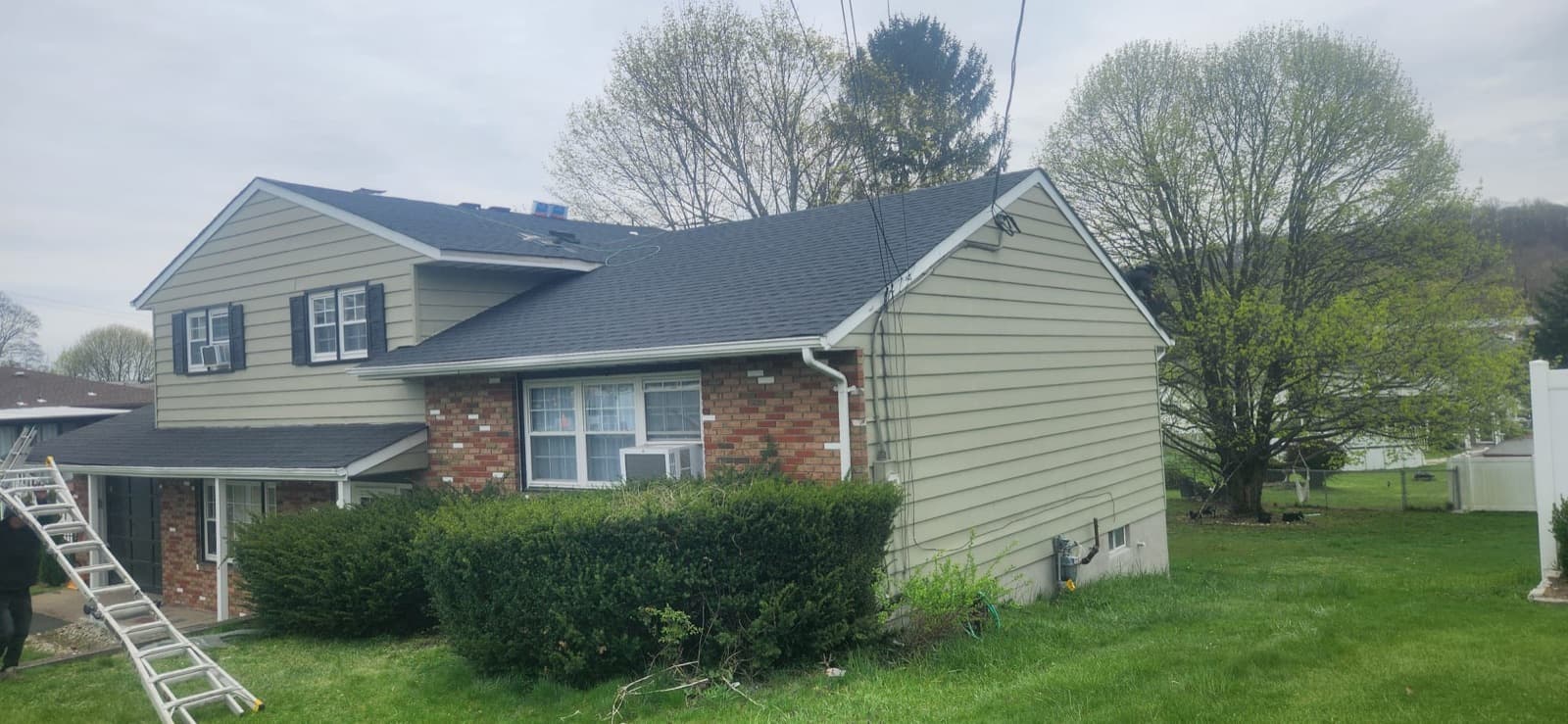
Seamless Gutter Installation in North NJ
Custom-formed aluminum gutters, cut to the exact length of every roof run right on your driveway — no leak-prone mid-run seams. Right-sized 5- or 6-inch K-style, tied into your drip edge and fascia so water actually ends up in the gutter. Same-day service is standard in Bergen County; elsewhere it depends on the job and how booked we are that day.
Most contractors treat gutters as an afterthought — a length of metal bolted to the edge of the roof once the real work is done. We come at them from the opposite direction. Precision built its name on water intrusion: finding where water slips past a window seal, behind a flashing, or into a wall, and stopping it. Gutters are the same problem at roof scale. Sized wrong, seamed poorly, or disconnected from the roof edge, they don't just overflow in a storm — they steer water behind the fascia and into the soffit, which is exactly the rot we spend our days chasing on the glass side of the business.
So we don't sell gutters by the foot and drive off. We roll-form seamless aluminum on-site — one continuous run per roof line, cut to the inch on the truck — size it to the roof area that actually drains into it, and integrate it with your drip edge and fascia as a single water-management detail instead of three loosely related parts. Same-day service is standard in Bergen County; elsewhere it depends on the job and how booked we are that day.
This page walks through how we spec a system: seamless versus sectional, the 5-inch-vs-6-inch sizing math, downspouts and gauge, the roof-edge integration nobody else bundles, guards worth having in a North Jersey winter, and what actually drives the price.
Where sectional gutters fail — and why seamless doesn't
A seamless gutter is one continuous piece of aluminum coil, fed through a portable roll-forming machine parked at your house and cut to the exact length of each roof run. That eliminates the mid-run joints that stock, store-bought sectional gutters depend on — and joints are where sectional systems fail. A typical 150-foot sectional run carries roughly 15 joint connections, every one of them sealed with caulk that UV, thermal cycling, and constant water flow break down. Most start weeping within five to seven years, and a weeping joint is water going somewhere it shouldn't.
A seamless system on that same house has only about four to six connection points total — the inside and outside corners and the downspout outlets — so the leak-prone surface area is a fraction of what a sectional run exposes. That difference shows up in lifespan: seamless aluminum typically runs 20 to 30 years against 15 to 20 for sectional. Fewer seams isn't a marketing line; it's the whole reason the system lasts.
5-inch or 6-inch K-style — measured, not guessed
K-style is the standard residential profile in New Jersey — flat back against the fascia, a decorative front that reads like crown molding, and far more water capacity than a comparable half-round. The real decision is width. A 5-inch K-style gutter holds roughly 1.2 gallons of water per foot; a 6-inch holds about 2 gallons per foot — on the order of 60 to 70 percent more capacity. That gap decides whether your gutters keep up in a summer downpour or sheet over the front edge.
We don't default to 5-inch to shave a few dollars. We look at the roof area draining into each individual run. Smaller, lower-pitch planes are fine on 5-inch. Large planes — roughly 1,400 square feet or more feeding one run — steep pitches that fire water at the gutter, metal roofs, and heavy-rain exposures get 6-inch. On a lot of North Jersey colonials and split-levels the front runs undersize and the rear over-serves; we size run by run rather than wrapping the whole house in one width.
Roof leaking right now? We answer 24/7.
Downspouts, gauge, and hangers — the parts nobody quotes
A gutter is only as good as its outlet. Oversize the trough and pinch the downspout and you've just moved the bottleneck. We pair 6-inch gutters with 3x4-inch downspouts — which move substantially more water than the common 2x3 — and space outlets to match: roughly every 20 to 30 feet on 5-inch, every 30 to 40 feet on 6-inch, so water reaches an exit before it backs up.
Then there's the metal itself. Aluminum coil comes in gauges: .027 is the common medium-duty standard, .032 is about 18 percent more material and the right call anywhere with real wind, rain, or snow load — which is North Jersey. Under a snow-and-ice load, hanger spacing matters just as much; we set hidden hangers screwed into the fascia roughly every 24 inches so the run doesn't sag or pull when winter loads it up. These are the line items thin quotes leave out and cheap installs skip.
- Downspout profile: 2x3 for small runs, 3x4 for high-volume and 6-inch systems
- Coil gauge: .027 standard, .032 heavy-duty for wind and snow load
- Hidden hangers every ~24 inches, screwed to fascia — not spikes
- Outlet count and placement sized to the trough, so it never bottlenecks
Where the roof edge ends and the gutter begins
This is the detail almost nobody bundles, and it's the one our water-intrusion background makes us obsessive about. Drip edge is the L-shaped metal flashing at the eaves and rakes. For it to work with a gutter, its vertical leg has to drop down into the gutter trough, so water running off the shingles is delivered inside the gutter — not behind it, onto the fascia. Omit the drip edge, or set it so water runs behind the gutter, and you get the exact failure that pulls gutters off a house: soaked, rotting fascia that loses its grip on the hangers.
Drip edge isn't optional anymore, either. The 2024 IRC that New Jersey has adopted requires it at eaves and rake edges of asphalt-shingle roofs (Section R905.2.8.5), with underlayment installed over it at the eave and under it at the rake. We treat the gutter, the drip edge, and the fascia as one water-management assembly — because on the glass side we've seen what happens when a roof edge sends water the wrong direction for a few winters.
Roof leaking right now? We answer 24/7.
Hanging new gutters on rotten wood is money thrown away
When water has been getting behind a gutter, the fascia board is the first thing it hits. Rotted fascia loses the strength to hold a hanger, the gutter starts to pull away, and the rot creeps into the soffit behind it. Screwing a brand-new seamless run into that soft wood just restarts the clock — the new gutter pulls away too.
Replacing gutters is the moment to deal with it, and it's far cheaper to correct now than to chase rot later. We inspect the fascia and soffit while the old gutters are down, replace what's gone soft, wrap sound fascia in aluminum trim coil, and re-establish the drip-edge-into-trough detail so the new run has dry, solid wood to hang on and stays dry going forward. It's the difference between a gutter job and a gutter job that actually holds.
Gutter guards that earn their keep in North Jersey
There are six broad families of guard — micro-mesh, mesh, screen, foam, brush, and reverse-curve (surface-tension) — and they are not equal. Micro-mesh gives the best all-around protection: it blocks leaves, pine needles, and even shingle grit, and good systems last 20 to 30 years. The honest caveat is that fine pollen and surface dust can accumulate on the mesh and it needs an occasional brush-off.
Reverse-curve guards are the ones we steer North Jersey homeowners away from. In a heavy downpour water can overshoot the lip entirely, and when snow or ice covers them they stop working and back meltwater up at the eave — a real problem in our winters. And no guard, of any kind, prevents ice dams; that's a roof-and-attic issue, not a gutter accessory. On the money question: recurring professional cleanings add up year after year, and a quality guard system can offset some of that cost. We'll tell you plainly whether your tree cover and roof layout make guards worth it, or whether you're better off with a cleaning schedule.
Roof leaking right now? We answer 24/7.
Ice, ventilation, and what a gutter can't do
Homeowners often ask us to solve ice dams with gutters or guards, and we won't pretend they do. Ice dams form when a warm roof deck melts snow that refreezes at the cold eave — an insulation and ventilation problem, upstream of the gutter. Follow where the meltwater actually goes and the gutter drops out of the story: it runs down the warm part of the roof, hits the cold eave, and freezes there — above the gutter, behind the shingles. The 2024 IRC deals with both halves of that, though only one is binding here. Attic ventilation (R806.2) keeps the deck cold enough that the snow never melts to begin with, and it applies to every roof in the state. The ice-and-water membrane at the eave (R905.1.2) is the backstop for when it melts anyway; New Jersey requires that membrane only in Sussex County, and we spec it as standard on the roofs we build.
What the gutter does do in winter is carry the load without failing — which is why we spec heavier .032 coil, tighter hanger spacing, and properly sized downspouts on exposed North Jersey roofs. We'll flag when the real fix is at the roof and attic rather than the gutter, because selling you guards for an ice-dam problem would be selling you the wrong thing.
No permit games, no mystery per-foot number
Straight answer on permits: under New Jersey's Uniform Construction Code (N.J.A.C. 5:23-2.7), repairing, replacing, or installing exterior gutters and leaders is 'ordinary maintenance' — no permit, inspection, or notice required. Worth reading the list closely: the roofing item at (c)1x is limited to detached one- and two-family dwellings and the siding item at (c)1xi to one- and two-family dwellings, but the gutter item at (c)1xvi carries no building-type limit at all. So a standard gutter replacement on a house in Bergen or Passaic generally needs no permit at all. The exception is structural work — replacing roof decking or altering the roof structure — which falls outside ordinary maintenance on any building.
On price, we don't post a per-foot figure because an honest number depends on your specific roof — and a per-foot quote that ignores corners, downspouts, gauge, and fascia condition is how homeowners get surprised. What we do instead is measure the roof on-site, walk you through the spec, and hand you a line-item quote for free, so you can see exactly what each part costs and compare it against anyone else. Here's what actually moves the number:
What affects the cost
| Total linear footage & number of stories | How much gutter your roof lines require, and whether crews are working off a one-story eave or a three-story colonial, both drive labor and access. |
|---|---|
| Gutter width & coil gauge | 6-inch K-style uses more material than 5-inch, and heavier .032 coil for wind/snow load costs more than standard .027 — but sizes up to the exposure. |
| Corners, downspouts & outlets | Every inside/outside corner and downspout is a fabricated connection; a cut-up roofline with many runs takes more parts and time than a simple rectangle. |
| Fascia & soffit condition | Sound wood hangs new gutters cleanly; rotted fascia or soffit found during removal needs repair or replacement first so the new run actually holds. |
| Gutter guards & type | Adding guards raises the price, and the type matters — micro-mesh is a different investment than basic screen; we quote it as an optional line, not a default. |
| Removal & disposal of old gutters | Tearing off and hauling away failed sectional gutters and old spike hangers is its own labor line on a replacement versus a new install. |
| Material choice | Seamless aluminum is the standard; copper is a premium option with a far longer life (and price) for historic or high-end North Jersey homes. |
We don't bundle a mystery number — you get a firm, free on-site quote, approved before any work starts.
Monthly payment options
We work with Hearth, which shops several lenders on a single application. See your personalized options in minutes — checking does not affect your credit score, and there is no commitment.
- Loan amounts up to $250,000
- Funding in as little as 1–3 days
- No prepayment penalties
- No home equity required
Financing is provided by Hearth's lending partners, not by Precision Windows & Roofing. Rates and terms depend on your credit and the lender making the offer, and all financing is subject to credit approval.
Common questions
Is seamless really better than sectional gutters, or is it just a sales pitch?
It's structural, not marketing. Sectional gutters are joined every ten feet or so with caulked seams — a 150-foot run has around 15 of them, and each is a joint that degrades and weeps within about five to seven years. A seamless run of the same house has only four to six connection points total (the corners and downspout outlets), so there's a fraction of the leak-prone surface. That's why seamless typically lasts 20 to 30 years versus 15 to 20 for sectional.
Should I get 5-inch or 6-inch gutters on my North Jersey home?
It depends on how much roof drains into each run, not on a blanket rule. A 6-inch K-style carries roughly 60 to 70 percent more water than a 5-inch. We put 6-inch on large roof planes (roughly 1,400+ square feet to one run), steep pitches, metal roofs, and heavy-rain exposures, and 5-inch on smaller, lower-pitch planes. We size it run by run when we measure, because on many homes the front and back need different widths.
Do I need a permit to replace gutters in Bergen or Passaic County?
Generally no. Under New Jersey's Uniform Construction Code (N.J.A.C. 5:23-2.7), repairing, replacing, or installing gutters and leaders is 'ordinary maintenance' and requires no permit, inspection, or notice. Unlike the roofing item beside it, (c)1xvi carries no building-type limit, so a gutter run on an apartment building or a storefront sits in the same category as one on a house. The exception is structural work: N.J.A.C. 5:23-2.7(b)4 pulls anything affecting structural or fire safety back out, so opening a fascia or a rafter tail changes the answer.
Will gutters or gutter guards stop my ice dams?
No, and we won't tell you otherwise. Ice dams come from a warm roof deck melting snow that refreezes at the cold eave — an insulation and ventilation problem upstream of the gutter, addressed by attic ventilation and an ice-and-water barrier at the eave. What good gutters do in winter is carry the ice load without pulling off, which is why we spec heavier gauge and tighter hangers. If ice dams are your real issue, the fix is at the roof and attic, and we'll say so.
My old gutters are pulling away from the house — do I need new fascia too?
Often, yes — and that's usually the actual cause. When water gets behind a gutter, the fascia board rots, loses its grip on the hangers, and the gutter sags or pulls off. Hanging new gutters on that soft wood just fails again. We inspect the fascia and soffit with the old gutters down, replace what's gone, and reset the drip-edge-into-trough detail so the new run has solid, dry wood to hang on. It's far cheaper to correct now than after the rot spreads.
How much does seamless gutter installation cost?
We don't publish a per-foot figure, because an honest price depends on your roof — linear footage, number of stories, gutter width and gauge, how many corners and downspouts, fascia condition, and whether you want guards. A per-foot number that ignores those is how people get surprised. We measure on-site and give you a free, itemized quote so you can see exactly what each part costs. It's a measured quote, not a guess.
How fast can you install gutters in North Jersey?
Because we roll-form the aluminum on-site, most homes are measured and installed quickly, and we cover New Jersey from our Garfield shop, with scheduled routes statewide. We're registered as a home improvement contractor (HIC reg.# 13VH13970900) and fully insured, and every job starts with an on-site measurement and a written line-item quote before any work begins.
Explore
Get your free roofing quote
Free, no-obligation on-site assessment anywhere in New Jersey — and we answer the phone 24/7.