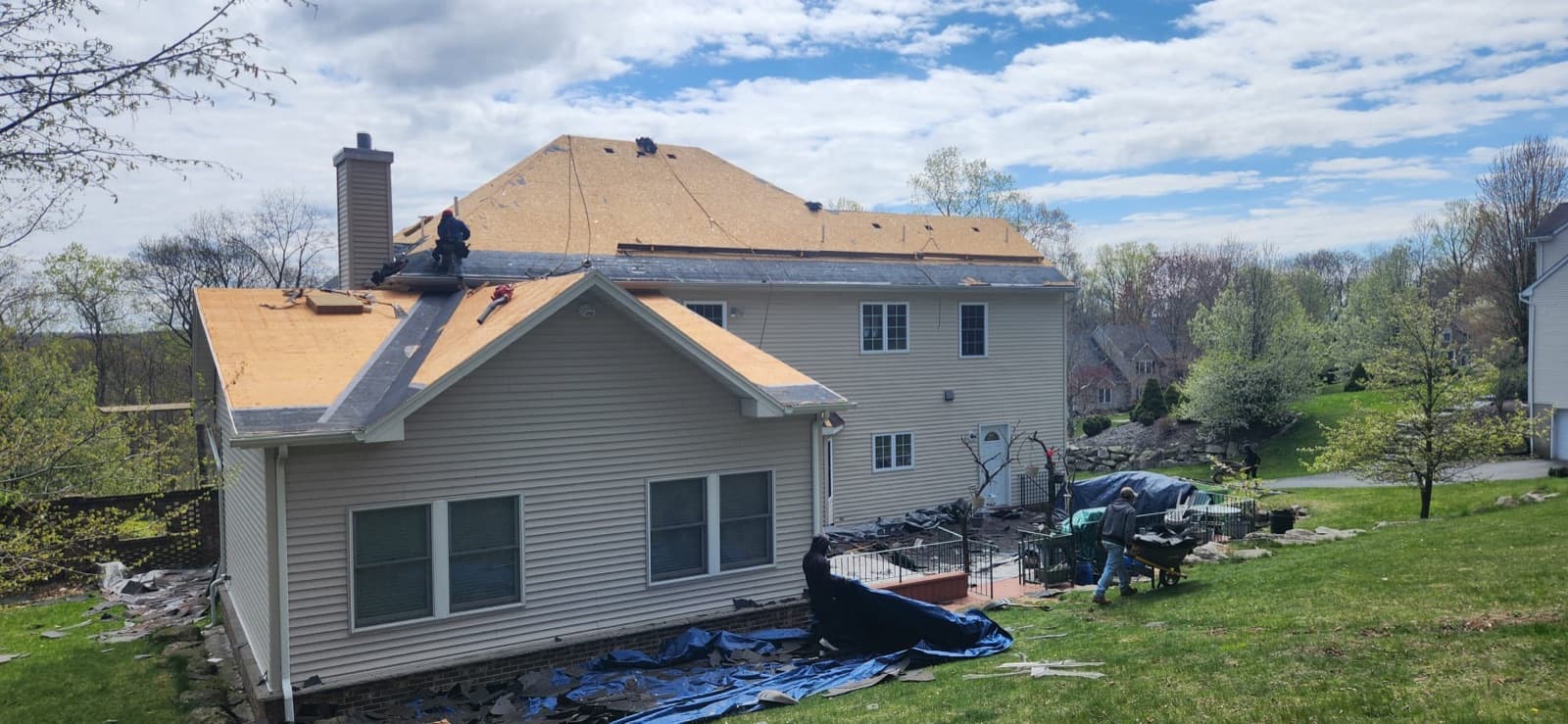
Roof Repair in North New Jersey
Wind-lifted shingles, popped nails, a cracked vent boot, worn flashing, a soft spot in the deck. Most roofs that get quoted for a tear-off need a repair instead. This page is the map to every repair we do — and the honest math on when repairing stops being the smart spend. Same-day service is standard in Bergen County; elsewhere it depends on the job and how booked we are that day.
Most roofing companies in North Jersey lead with a replacement quote — the five-figure ticket. We install new roofs too, but a large share of what we get called for is a repair: one failed detail on a roof with years of life left. A strip of shingles the last nor'easter peeled back, a length of step flashing that rusted through, a pipe boot cracked by the sun, a nail that backed out. Fixing the detail costs a fraction of a tear-off, and it is the honest answer far more often than the industry lets on.
This page is the map. Match what your roof is doing to the right fix below, then read the straight repair-vs-replace math for that symptom. We came to roofing from water-intrusion work on windows and glass, so leaks and flashing are where we are sharpest — we trace water to its actual entry point instead of smearing tar over the stain and hoping.
Two branches of this run deep enough to have their own pages, and it is worth knowing which one you are on. If the problem is a leak — a ceiling stain, a drip, water somewhere it should not be — the tracing and the permanent fix live on our roof leak repair page. If the roof is open right now, water is actively coming into the house, or a limb is on it, that is mitigation before repair, and our emergency roof repair page covers that around the clock. Everything else on a roof starts here. Call (201) 275-9185 and describe what you are seeing — we diagnose over the phone and quote free on-site.
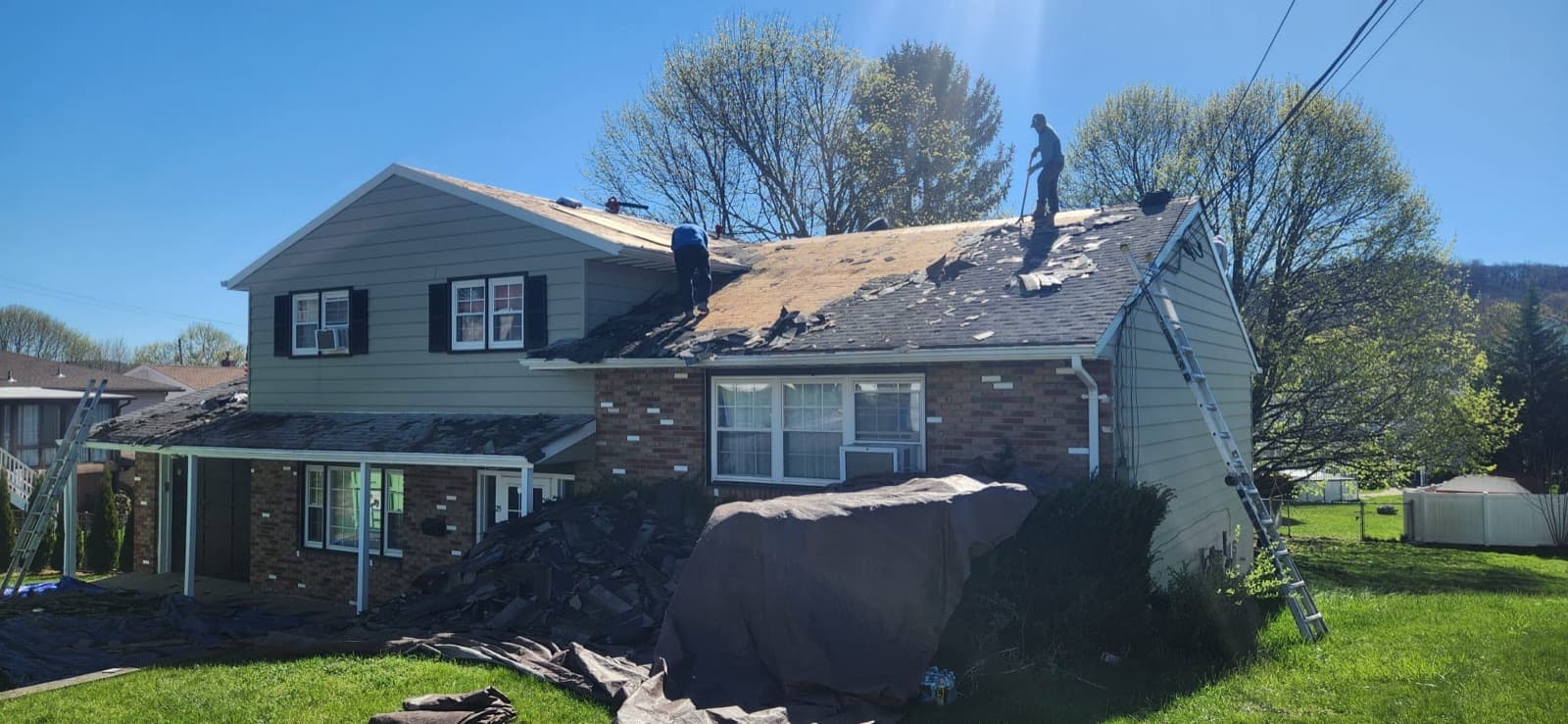
Recent work in New Jersey
What is your roof doing?
Roofs rarely fail all at once. They send signals — a dark stain, a few tabs in the yard after a storm, granules washing out of the downspout — and each one points to a specific fix. Match yours below; none of these, on its own, means you need a whole new roof.
- Missing, cracked, or curling shingles — wind lifted them or age has shrunk and dried them; usually a targeted shingle repair matched to your existing color and profile.
- A water stain on a ceiling or in the attic — a leak, and the entry point is almost never directly above the stain. Traced and sealed at the source.
- Rusted, lifted, or tar-caulked flashing at a chimney, wall, valley, or vent — the number-one leak source on North Jersey roofs; re-flashed properly, not caulked over.
- Shingles, tabs, or debris on the ground after a storm — wind or impact damage, often an insurance claim, and we document it.
- Granules filling the gutters or downspout — the asphalt layer is wearing thin; it tells us how much life is actually left.
- A sagging ridgeline or a soft, spongy deck underfoot — the one symptom that can mean structure, not surface; inspected before anything else.
- Standing water hours after rain on a flat or low-slope section — ponding from a drainage or slope problem, not just old membrane.
Flashing: the repair that fixes most leaks
The large majority of the roof leaks we open up are not 'bad shingles' — they are a flashing failure. Step flashing where the roof meets a wall, counter-flashing at the chimney, the valley metal where two planes drain together, the neoprene boot around a plumbing vent that dried and split in the sun. Water finds these seams, runs along the decking, and surfaces on a ceiling several feet from where it got in.
This is the crossover from our window and glass water-intrusion work: the discipline of finding water's real entry point instead of chasing the stain. We hose-test, pull back shingles, and read the underlayment to locate where it is actually coming in — then repair that detail properly. A leak caught early is a boot or a length of flashing; the same leak ignored for a season rots the decking and the framing beneath it and turns a small fix into a structural one. If a leak is what brought you here, the full diagnostic method and the permanent-repair options are on our roof leak repair page.
Roof leaking right now? We answer 24/7.
Wind and impact — and which page you need
North Jersey takes nor'easters, summer downbursts, and the tail end of tropical systems — Ida in 2021 is still fresh — and wind is what lifts and strips asphalt shingles. Once the weather has passed and nothing is actively coming in, storm damage is an ordinary repair: replace what blew off, re-secure what lifted, and check the flashing the wind worked on. That is the job this page covers. While the roof is still open with weather on the way, it is mitigation first, and that whole sequence — covering, containing, documenting — is on our emergency roof repair page.
When damage looks like a covered event, we photograph and document it the way an adjuster needs to see it — dated overview and close-up shots, a measured diagram, and a written scope. We cannot promise a carrier will approve a claim, and we will never tell you we will 'make insurance pay' — that is not how it works. What we can do is document the damage honestly and thoroughly so your claim is built on evidence, and meet the adjuster on the roof if that helps.
Repair vs. replace, without the upsell
The real question is not whether a roof can be repaired — almost any single failure can. It is whether repairing is the smart spend. A roof with one wind-damaged slope and ten good years left is an easy repair. A roof on its third layer, shedding granules everywhere, with brittle shingles that crack when you walk them, is throwing good money after bad — a patch there just buys a few months.
We tell you which one you have, on-site, with the honest math for both: what the repair costs and buys you, and what a replacement costs and buys you, so you decide with real numbers instead of a scare tactic. If a small flashing fix gets you five more years, we will say so — even though the tear-off is the bigger ticket for us.
Roof leaking right now? We answer 24/7.
Ice-and-water shield, drip edge, and ventilation
North Jersey roofs are governed by the NJ Uniform Construction Code, which adopts the 2024 IRC — and that is not paperwork, it is why leaks happen and how they get fixed right. The eave ice barrier is a case in point. New Jersey applies it only where the average daily temperature in January is 25°F or less, and DCA Bulletin 07-3 identifies that area of the state as Sussex County, so a Bergen or Passaic roof can be built exactly to code with nothing but felt over the eave — which is precisely what we find when we open up a winter ceiling stain. We repair to the membrane, because once a dam forms it is the only thing standing between backed-up meltwater and your sheathing.
Drip edge is required at both eaves and rakes, and the sequence matters — underlayment over the drip edge at the eave, drip edge over the underlayment at the rake (R905.2.8.5). Reverse it, as plenty of rushed jobs do, and you have built a path for water instead of a barrier. And under-ventilated attics — below the code minimum of roughly one square foot of net free vent area per 150 of attic (R806.2) — cook shingles from below and feed ice dams. When we repair, we repair to these details, not just to stop today's drip.
Everything in writing, itemized
In New Jersey, any home-improvement job over $500 legally has to be a written contract naming the contractor, the registration number, the start and finish dates, the full scope, and the total price (N.J.A.C. 13:45A-16.2(a)12, the Division of Consumer Affairs' Home Improvement Practices regulations, and N.J.S.A. 56:8-151 of the Contractors' Registration Act). We go past the minimum: every quote is line-itemed — materials, labor, flashing, disposal, and any permit — so you can see exactly what you are paying for and compare it against the next guy.
This is not just good manners. In NJ, a violation of the Home Improvement Practices regulations (N.J.A.C. 13:45A-16) is automatically a Consumer Fraud Act violation, which carries treble (triple) damages plus attorney's fees. A vague verbal handshake is not just a red flag — it is a contractor exposing you, and himself, to real statutory liability. We are registered with the NJ Division of Consumer Affairs as HIC reg.# 13VH13970900, and we put it all on paper because that is the only way you can trust the number.
Roof leaking right now? We answer 24/7.
Statewide · 24/7 Emergency
We dispatch from Garfield, which puts most of Bergen and Passaic County within a short drive and Essex and Hudson close behind, so a roof-repair call near you gets looked at quickly — and a genuine emergency gets dispatched around the clock. For non-emergency repairs we run scheduled routes across the rest of New Jersey.
A note on permits: since 2018 replacing just the covering on a detached one- or two-family home has needed no construction permit anywhere in New Jersey, and small shingle or flashing patches generally do not either. But the moment work touches the decking, the framing, or adds a penetration, a permit is required — and in older Passaic cities like Paterson, Passaic, and Clifton, where much of the pre-1965 stock still has original board decking, that comes up more often. We pull the permit under our registration when the job needs one and tell you up front when it does.
What affects the cost
| Extent of the damage | A single wind-lifted section versus multiple slopes or a whole leaking valley are very different-sized jobs. |
|---|---|
| Roof pitch and height | Steep and multi-story roofs need more staging and fall protection than a walkable ranch or Cape. |
| Shingle type and match | Matching an older or discontinued shingle color and profile can add sourcing time to a repair. |
| Decking condition | If the sheathing under a leak is rotted, replacing it adds material and labor — and can trigger a permit. |
| Flashing and penetrations | Re-flashing a chimney, skylight, or sidewall properly is more involved than swapping a single pipe boot. |
| Rush vs. scheduled | A repair squeezed into the week ahead of the next system carries a premium over one booked on a scheduled route. Emergency mitigation is a separate scope, quoted on its own. |
We don't bundle a mystery number — you get a firm, free on-site quote, approved before any work starts.
Monthly payment options
We work with Hearth, which shops several lenders on a single application. See your personalized options in minutes — checking does not affect your credit score, and there is no commitment.
- Loan amounts up to $250,000
- Funding in as little as 1–3 days
- No prepayment penalties
- No home equity required
Financing is provided by Hearth's lending partners, not by Precision Windows & Roofing. Rates and terms depend on your credit and the lender making the offer, and all financing is subject to credit approval.
Common questions
How much does roof repair cost in NJ?
It depends entirely on what failed — a cracked pipe boot, a few wind-lifted shingles, a run of chimney flashing, a leaking valley, and a decking repair are very different jobs. Most repairs are a part or a detail plus a service visit, a fraction of what a replacement costs. We diagnose and give you a firm, free, itemized quote on-site before any work starts, and batch multiple repairs into one trip to keep the price down.
Do you actually repair roofs, or just sell replacements?
We repair them — it is a real service line, not a bait-and-switch. Shingles, flashing, pipe boots, valleys, ridge caps, small decking sections, and storm damage are all fixable, usually for a fraction of a tear-off. We only recommend replacement when a roof is genuinely at the end — multiple layers, widespread granule loss, brittle shingles — and we show you the honest math for both paths on-site.
How fast can you get to a roof repair near me?
Quickly, and anywhere in the state — we dispatch same-day in Bergen County, and elsewhere depending on the job and how booked we are that day, from our Garfield shop. Ordinary repairs get booked for weather that lets the job be done properly, which is usually within a few days. A roof that is open with water coming in is a different call and gets dispatched around the clock; that process is on our emergency roof repair page.
My ceiling is stained but I see nothing wrong on the roof — can you still find the leak?
Yes — that is our specialty, and it has a page of its own. Roof leaks almost never enter directly above the stain; water gets in at a flashing seam or a failed boot and travels along the decking before it drops. We came to roofing from window and glass water-intrusion work, so we trace the leak to its real entry point — hose-testing and pulling back material as needed — instead of tarring over the drywall stain and hoping. Our roof leak repair page walks through the whole tracing method and what the permanent fixes look like.
Should I repair or replace my roof?
That is the question we answer honestly on-site. If your roof has years of life left and one localized failure, repair is almost always the smart spend. If it is on its second or third layer, shedding granules, and cracking when walked, a repair just buys a few months and replacement is the better value. We give you the real cost and lifespan of each path so you decide with numbers, not pressure.
Do I need a permit for a roof repair in NJ?
Usually not for a small patch. Since 2018 NJ treats repairing or replacing the covering on a detached one- or two-family home as ordinary maintenance, so localized shingle or flashing repairs there need no permit. A permit is required once the work touches decking, structural framing, or adds a penetration like a new vent or skylight — common on older Passaic County homes with original board decking. When your job needs one, we pull it under HIC reg.# 13VH13970900.
Can you help with a storm-damage insurance claim?
We help with the documentation, honestly — we do not promise approvals. When damage looks like a covered event, we photograph and measure it the way an adjuster needs, write a clear scope, and can meet your adjuster on the roof. What we will not do is tell you we will 'get insurance to pay' or inflate a claim; we document the real damage thoroughly so your claim stands on evidence.
Explore
Roof Repair by town
Bergen County
- Carlstadt Roof Repair
- East Rutherford Roof Repair
- Elmwood Park Roof Repair
- Emerson Roof Repair
- Fair Lawn Roof Repair
- Garfield Roof Repair
- Hackensack Roof Repair
- Hasbrouck Heights Roof Repair
- Little Ferry Roof Repair
- Lodi Roof Repair
- Lyndhurst Roof Repair
- Maywood Roof Repair
- Ridgefield Park Roof Repair
- Ridgewood Roof Repair
- Rochelle Park Roof Repair
- Rutherford Roof Repair
- Saddle Brook Roof Repair
- Saddle River Roof Repair
- South Hackensack Roof Repair
- Teaneck Roof Repair
- Wallington Roof Repair
- Wood-Ridge Roof Repair
Essex County
Hudson County
Middlesex County
Monmouth County
Get your free roofing quote
Free, no-obligation on-site assessment anywhere in New Jersey — and we answer the phone 24/7.