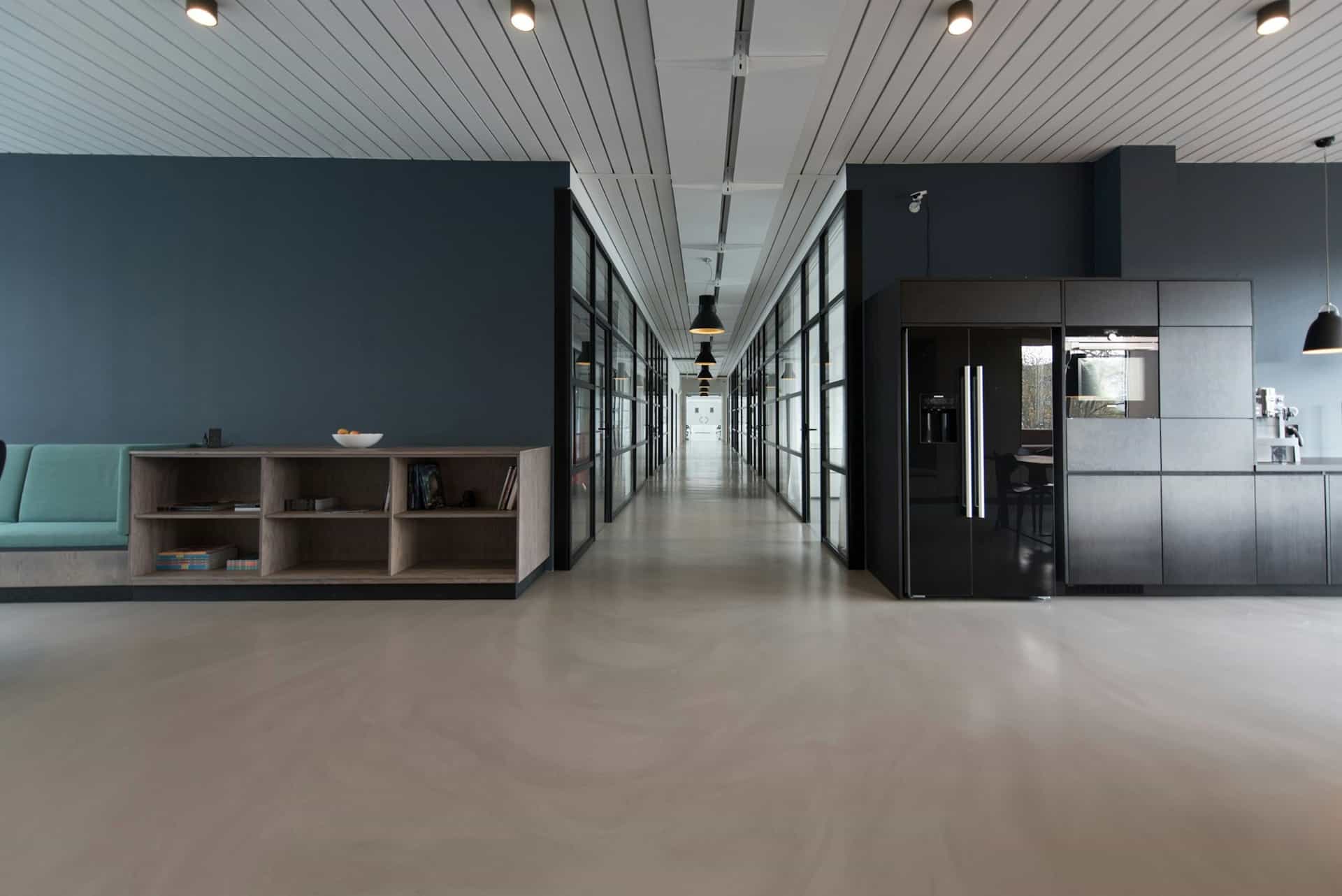
Glass Partitions
Glass partition walls for offices — fixed, demountable and operable systems.
Glass Partitions
Glass partition walls that subdivide an office floor without killing the daylight: conventional fixed systems framed at the floor, head and jambs; demountable systems that come apart and reconfigure without demolition; and operable systems that split a large room on demand. We install by the linear foot, and we spec the perimeter sealing as carefully as the glass, because that is what decides whether a wall rated for speech privacy actually delivers it in the field. A door in the wall is part of the system and we hang and adjust it with the rest; a standalone glass door going into an opening you already have is its own job, and that is on our interior and office glass doors page.
Office glass partitions had a renaissance starting in 2023. The post-COVID return-to-office push made it clear that the 2010s open-plan office trend had gone too far — workers wanted privacy for focused work, conference rooms for video calls without bothering neighbors, and walls between teams to manage noise. But nobody wanted to go back to 1990s cubicle farms or solid drywall partitions that killed natural light. The answer that landed: frameless glass partitions, often demountable (DIRTT, Modernfold, Hufcor), with acoustic-rated glass and integrated doors. We've installed thousands of linear feet of these systems across NJ Class A office buildings since the 2023 return-to-office curve hit.
Our typical commercial glass partition project: 800-3,000 linear feet of partition wall installed during a tenant improvement, often on accelerated nights-and-weekends schedule to coordinate with the rest of the buildout. We work with the major NJ tenant improvement GCs (Structure Tone, Turner, JLL Project & Development, Cushman & Wakefield) and directly with the corporate facility teams at larger tenants. The product mix is roughly 60% conventional fixed glass partitions, 30% demountable (DIRTT and competitors), 10% movable wall systems (Hufcor and Modernfold operable partitions for large rooms).
Conventional fixed glass partitions
Fixed glass partitions are built site-installed: aluminum or steel framing at the floor, head, and side jambs, with tempered or laminated glass set into the framing. Once installed, they're permanent — disassembly requires demolition. Best fit: tenants on long lease (5+ years) where the floor plan is stable, build-outs where cost per linear foot matters more than future reconfigurability, and any application where the wall needs full structural integration (acoustic, fire-rated, or load-bearing).
Framing options: thin profile aluminum (CRL 487 Series, Acurit 7700) for clean sightlines, structural steel for high-load or fire-rated assemblies, and frameless silicone-bonded (vertical joints between panels are silicone only, no aluminum mullion) for the most architectural minimal look.
Glass spec varies with acoustic and security needs. Single-pane 3/8 inch tempered for visual separation only (STC 28-31). Single-pane 1/2 inch laminated for slight acoustic upgrade and security (STC 34-36). Dual-pane laminated IGU with acoustic interlayer for conference room privacy (STC 42-45). For privacy in C-suite or HR/legal applications, we step up to staggered-thickness laminated IGUs reaching STC 47-50.
Doors integrated with the partition system: framed or frameless glass doors with hinges, pivots, or sliders. Sliders (top-track barn-style doors) are increasingly popular because they don't intrude into the room when open — useful in tight conference rooms.
Demountable partition systems: DIRTT, Modernfold, Steelcase V.I.A.
Demountable systems are pre-engineered partition kits that ship to the site, install in 1/4 to 1/3 the time of conventional partitions, and — critically — disassemble and reconfigure without demolition. It costs more per linear foot at first install than conventional partitions, but the lifecycle cost is dramatically lower for tenants that reconfigure space every 2-5 years.
DIRTT (Calgary, Canada — Doing It Right This Time) is the dominant system in the NJ market. Floor and head channels anchored at install, glass and solid panels snap into the channels with integrated power, data, and lighting prewired in the panels. Reconfigurable in 24-48 hours per major change. Integrated doors, integrated cabinetry, even integrated technology (monitors flush-mounted into solid panels). Premium-priced and premium-quality.
Modernfold and Hufcor — operable partition systems. Tracks run across the ceiling, panels stack at one end or split-stack at both ends. Used to divide large rooms (boardrooms, training rooms, banquet halls) on demand. STC ratings up to 56 on premium acoustically-engineered systems. We install and service Modernfold Acousti-Seal and Hufcor 600 Series in Class A NJ office space.
Steelcase V.I.A. and Haworth Enclose — competitor demountable systems, generally less premium than DIRTT but at lower cost. We install both when the tenant specifies. Less common in NJ than DIRTT, which has aggressive sales presence in the NYC/NJ metro.
Capital classification matters: demountable systems can often be depreciated as 7-year MACRS personal property rather than 39-year leasehold improvement, which significantly improves the tax treatment. We work with the tenant's CFO or accountant on classification questions — the integrated power/data prewiring is what gets you the personal property treatment.
STC ratings and what they mean in real offices
STC (Sound Transmission Class) is a single-number rating for how well an assembly attenuates airborne sound. Higher = better. Real-world translation: STC 25 (speech easily understood through wall), STC 30 (loud speech understood), STC 35 (loud speech audible but not clearly intelligible), STC 40 (loud speech faintly audible), STC 45 (loud speech barely audible), STC 50 (loud speech not audible), STC 55+ (recording studio territory).
Conventional drywall partition with 3-5/8 inch metal stud, single layer 5/8 gypsum each side, insulated: STC 36-39. Same construction with double layer gyp: STC 44-48. Same construction with isolation clip system: STC 52-58.
Glass partitions face inherent acoustic disadvantage — glass is dense but rigid, and resonance frequencies can amplify certain speech frequencies. Single-pane 1/2 inch tempered: STC 31. Single-pane 1/2 inch laminated with acoustic PVB: STC 36. Dual-pane laminated IGU (5/16 + 5/16 acoustic PVB): STC 42-44. Premium dual-pane staggered-thickness laminated: STC 47-50.
Critical: STC ratings assume the wall is sealed at perimeter. A great STC 45 partition with poor head and base sealing will perform at STC 30 in the field. We always specify perimeter acoustic gaskets, sealed power/data penetrations, and acoustic batts in the head and base channels. We've measured 12-15 STC field improvement just by properly sealing a partition that was specced and installed at STC 42 but performing at STC 28.
Office types and what we install where
Open-plan floor with glass-enclosed huddle rooms and phone booths: single-pane 3/8 tempered with frameless silicone joints. Doors are either swing or sliding barn-style. STC 30-33 in field. Common throughout NJ tech and finance tenants in Newport, Hoboken, Princeton.
Conference rooms and team rooms: single-pane laminated 1/2 inch with acoustic PVB. STC 35-37 in field with proper sealing. Doors with drop seals at the bottom. Standard spec for general conference rooms.
Executive offices and C-suite: dual-pane laminated IGU with acoustic spacer. STC 42-45. Acoustic-rated doors with full perimeter gasket and drop seal. We install these in law firms, financial services, and any tenant where the executive needs guaranteed speech privacy.
HR/legal interview rooms: STC 45+ required for confidentiality. Often paired with sound-masking systems (Cambridge Sound Management, Logison) to provide acoustic ambient cover. We coordinate with the AV consultant on these installs.
Training rooms and divisible boardrooms: operable partition systems (Modernfold, Hufcor). STC 50-56 panels with floor-to-ceiling seals. Stack at one end when open, deploy across the room when closed. Significant upfront cost but enables the room to serve double duty.
Where we work in NJ commercial
Newark CBD — Class A office towers around Penn Station, Broad Street, and the Ironbound. Multi-tenant office buildouts and corporate HQ tenant improvements. After-hours work standard.
Jersey City Newport, Exchange Place, Journal Square — financial services and tech tenant heavy. Goldman Sachs, JPMorgan, and other major tenants. Strict base-building specs we follow.
Hoboken — Maxwell Place, Hudson Tea, and converted industrial space. Tech and creative tenants. Older buildings often have structural quirks (existing columns, irregular floor slabs) that complicate partition layout.
Princeton, Route 1, Edison — corporate campuses (Bristol-Myers Squibb, Bloomberg, JNJ adjacent supplier offices). Conference room and executive suite installs are the dominant scope.
Cherry Hill, Mt. Laurel, Marlton — south Jersey office market. Less density but consistent demand for office partition systems in mid-rise office buildings.
Our Process
- 1Site survey and design coordinationWe measure existing conditions, evaluate ceiling height, floor flatness, and existing structural elements. For tenant improvements we coordinate with the GC, architect, and AV/IT trades on rough-in locations and ceiling grid integration.
- 2Shop drawings and submittalsDetailed shop drawings showing partition layout, panel sizes, hardware schedule, glass spec, and acoustic ratings. Submitted for architect and GC approval. Standard turnaround: 7-10 business days.
- 3Fabrication and lead timeConventional fixed partitions with stock framing and glass: 3-5 weeks. Custom acoustic IGU partitions: 6-8 weeks. DIRTT demountable systems: 8-12 weeks (factory-built in Calgary with integrated electrical and data). Hufcor/Modernfold operable partitions: 10-14 weeks.
- 4Site preparation and rough-inFloor and ceiling tracks installed. Electrical and data rough-in coordinated with the GC's MEP trades. Existing ceiling grid adjusted if required to receive partition heads.
- 5Glass installGlass panels lifted into framing, hardware fastened, alignment verified, doors hung and adjusted. Conventional installs typically run 50-100 linear feet per day per crew. DIRTT installs faster — 100-200 linear feet per day once tracks are set.
- 6Acoustic sealing and finishPerimeter acoustic gaskets installed. Power/data penetrations sealed with acoustic putty pads. Final cleaning of glass surfaces. Door hardware adjusted to ADA opening force on commercial swing doors.
- 7Acoustic testing and walkthroughWhere the tenant requires verification of STC performance, we coordinate field STC testing (ASTM E336) with an acoustical consultant. Walkthrough with tenant and GC, hand-off documentation, warranty registration.
Materials We Use
The Precision Difference
About Glass Partitions in NJ
What's the difference between demountable and conventional glass partitions?+
How sound-private can glass partitions actually be?+
Can demountable partitions be reconfigured by my facility team?+
Are glass partitions fire-rated?+
What's the lead time on a commercial glass partition project?+
Do you do after-hours and weekend installs?+
Will glass partitions meet ADA requirements?+
Glass Partitions by City
Serving All 21 New Jersey Counties
We service Atlantic County, Bergen County, Burlington County, Camden County, Cape May County, Cumberland County, Essex County, Gloucester County, Hudson County, Hunterdon County, Mercer County, Middlesex County, Monmouth County, Morris County, Ocean County, Passaic County, Salem County, Somerset County, Sussex County, Union County, Warren County. From our Garfield, NJ shop we cover the entire state, same-day in Bergen County, and elsewhere depending on the job and how booked we are that day.
Explore More
INTERIOR & OFFICE GLASS DOORS
Interior and office glass doors built for non-standard openings.
DetailsCOMMERCIAL WINDOW LEAK REPAIR
Forensic water-intrusion diagnosis and permanent leak repair for commercial windows, storefronts, and curtain-wall systems across NJ. We find the actual source — sealant, flashing, or framing — and fix it once.
DetailsSTANDARD WINDOW INSTALLATION
Professional installation of double-hung, single-hung, and slider windows.
Details