Roof Repair & Replacement in Saddle River, NJ
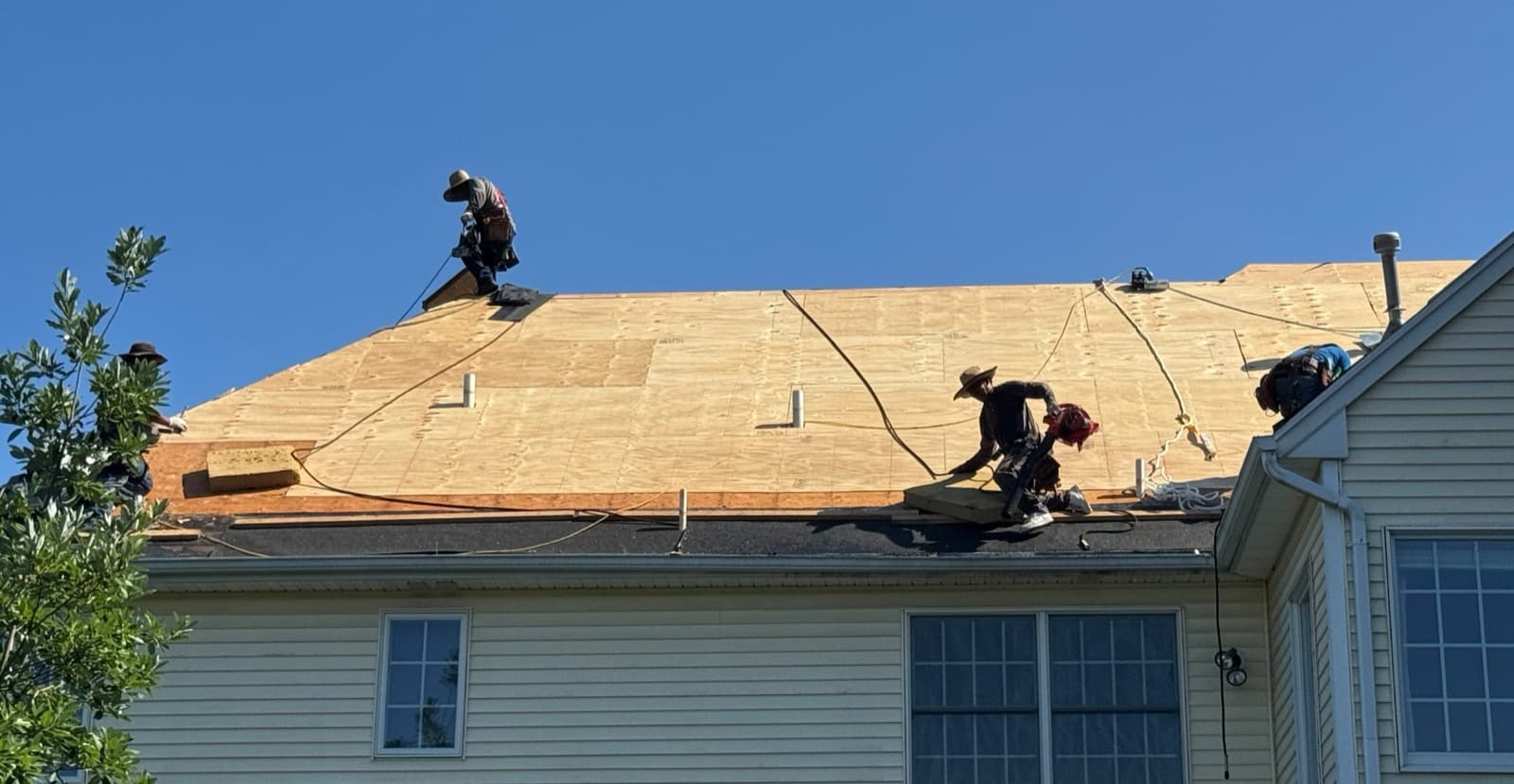
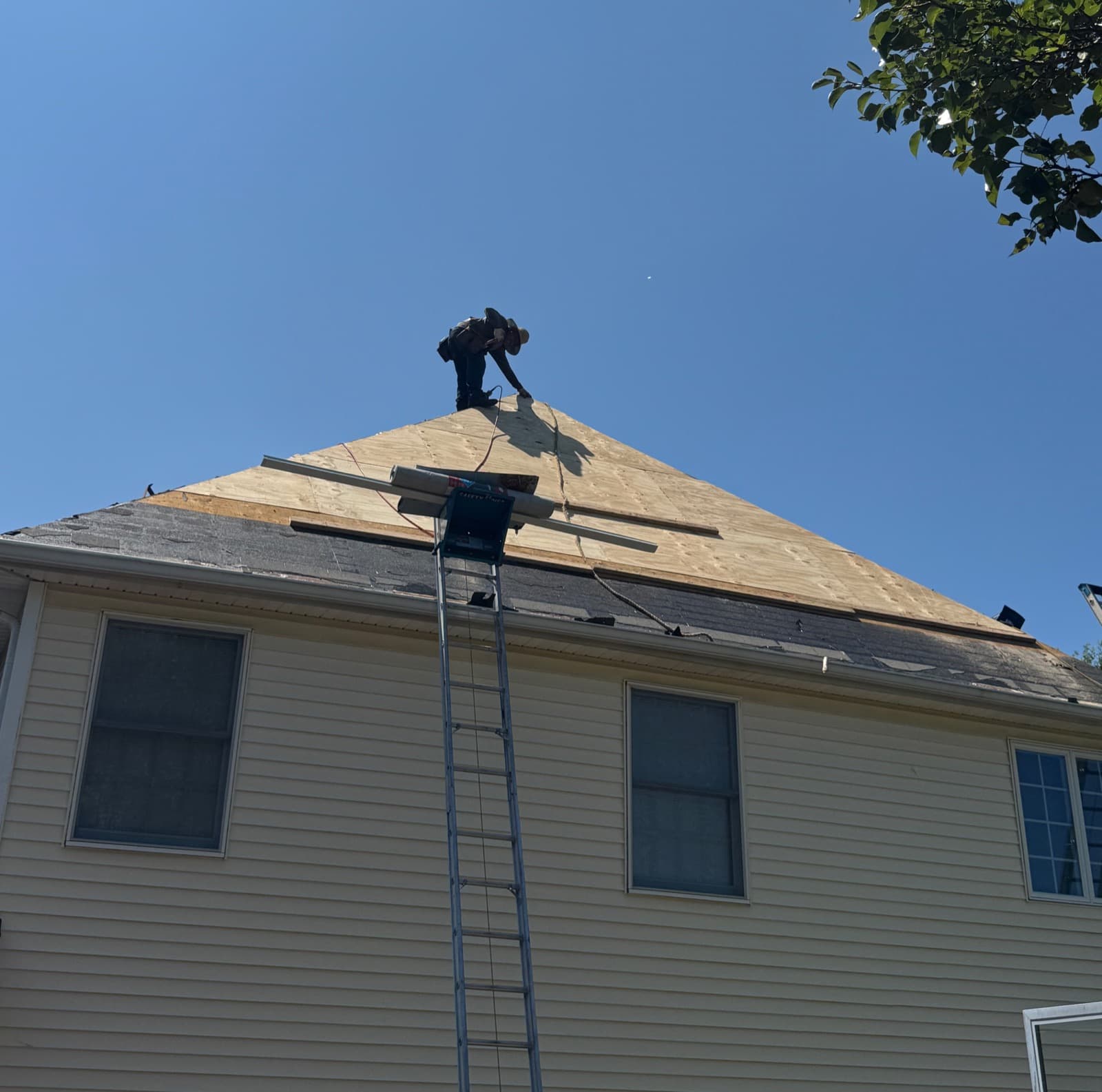
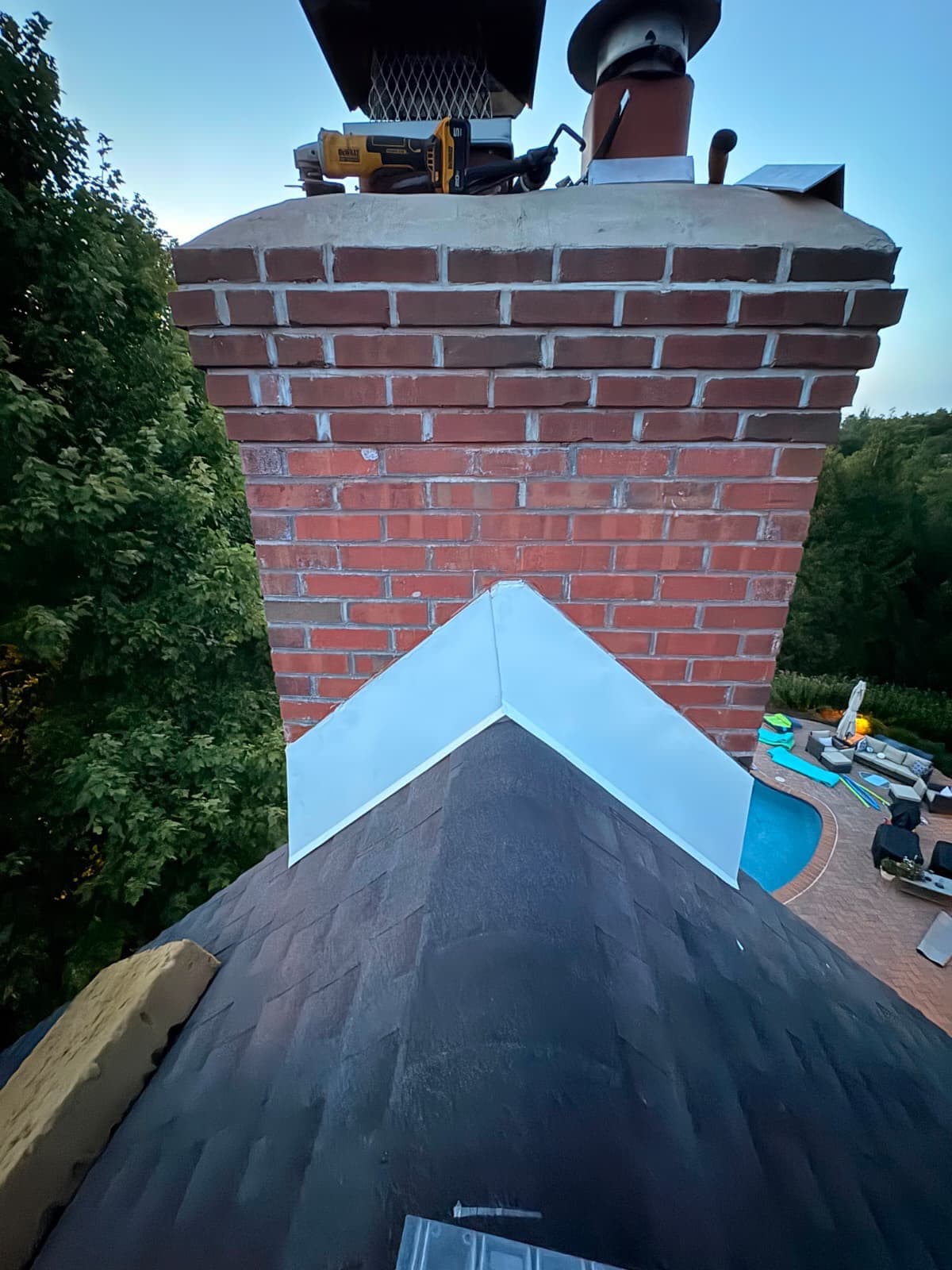
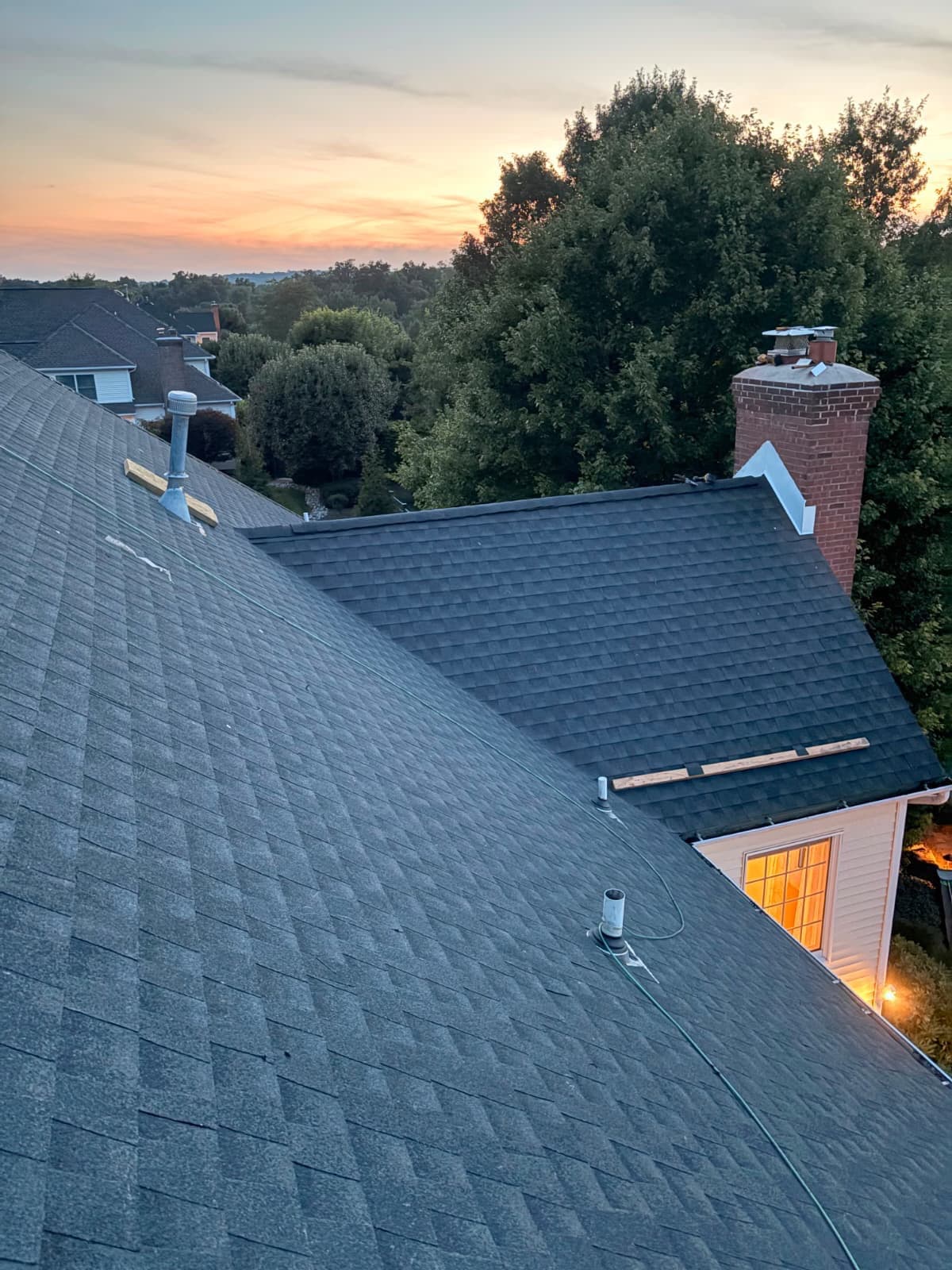
A half-hour up the road from our Garfield shop, Saddle River is the borough behind most of our roofing photography — the shot at the top of this page is a Saddle River deck mid re-sheathing, one of six jobs here in our gallery alongside a hoist at the eave, a formed chimney cricket and a finished shingle field at dusk. NJHIC #13VH13970900.
Since 1951 Saddle River has zoned a two-acre minimum lot, and the borough's own Master Plan describes the result plainly: large-lot single-family residential areas on lots of two acres or more, with homes ranging from four- or five-bedroom houses in the 2,500-to-3,000-square-foot range up to substantially larger. With no lot pressure, houses grew outward instead of upward — wings, attached garages, additions, a dormered second story over one section and not another. Every junction is a roof detail. Per square of shingle laid, a Saddle River roof carries far more valley and flashing than a same-sized roof in a tight Bergen town.
The second thing is chimneys, which is why we photograph them so often here. A house that size usually has a masonry chimney for the main fireplace and often a second elsewhere, and estate-scale chimneys are wide. The code puts a hard number on that width — past it, a formed peak above the chimney stops being an upgrade and becomes a requirement. On a modest ranch that threshold is an edge case. In Saddle River it is closer to the default, and a re-roof that skips it is where the next chimney leak comes from.
Saddle River is inside Bergen County, our home county, which is what makes the response time real rather than a marketing line. Storm damage, a roof left open, water already through the ceiling — those go out same-day, whatever time the phone rings. A leak that can wait is diagnosed quickly and then booked for workable weather. Call (201) 275-9185.
- Slate, cedar shake & copper roofing — The National Register versus local ordinance rule this page applies to Saddle River, set out in full — plus the materials the argument usually turns out to be about.
- Roof leak repair — On a roof carrying four to eight planes the entry point is routinely two planes away from the ceiling stain. Tracing it beats chasing it down the slope.
- Emergency roof repair — A limb through the roof. With the canopy this borough protects by ordinance, that is the emergency Saddle River generates more than any other.
- Roof flashing repair — Sidewall step flashing, valley metal, and the eave diverter IRC R903.2.1 requires. Per square of shingle, a house on two acres carries far more of this than a village gable does.
- Chimney flashing & leak repair — The chimney that has been flashed twice and still leaks: a missing cricket above 30 inches of width, or counter-flashing sealed onto brick instead of cut back into the joint.
- Roofing in Bergen County — The rest of our Bergen work — and how a two-acre estate job stages against a job on a 40-foot lot twenty minutes south.
Recent work in New Jersey
What the borough's zoning did to the roofline
The 1951 two-acre minimum was a deliberate brake on postwar subdivision, and it worked. The borough's greatest period of growth ran 1950 to 1970, when population more than doubled from 1,003 to 2,437, then leveled off. What it left is roughly 1,500 housing units, 83.8% of them single-family detached, on parcels most Bergen towns would call a small park.
That geometry is where the money and the risk both live. A plain gable has two planes and almost no flashing outside the penetrations; the roofs here routinely carry four to eight — a main hip, a garage wing at a lower ridge, an addition dying into a two-story wall, a portico with its own little roof. Valleys concentrate water, everything landing on two planes running down one line. And every point where a sloped eave meets a vertical wall needs a diverter. IRC R903.2.1 puts it in as many words: a flashing shall be installed to divert the water away from where the eave of a sloped roof intersects a vertical sidewall. On houses this shape, a missing one is the most common thing we find behind rotted trim.
Access here is the inverse of a dense town: no shortage of room, just a shortage of room you are allowed to ruin. Specimen plantings and hardscape near the house mean the staging point is chosen before the first bundle moves, and material goes up by hoist rather than across two acres of lawn.
The 30-inch rule, and why the same chimney leaks twice
Water running down a slope stalls against the up-slope face of a chimney. On a narrow stack it parts and runs around; on a wide one it pools, backs up under the courses and finds the deck. That is why IRC R903.2.2 draws its line at a chimney more than 30 inches wide, measured perpendicular to the slope — past that width a cricket is required, not optional. We form ours in metal on site so it fits the actual masonry instead of approximating it with sealant.
The other half is counter-flashing, and it is where most already-fixed chimneys were never fixed. Step flashing weaves up the sides course by course; counter-flashing is cut into a mortar joint and laps over it. When the last crew tarred the joint instead of re-letting metal into it, the repair buys a season. If the crown or top brick courses have gone, we call it masonry work rather than flash over a chimney that needs rebuilding.
Roof leaking right now? We answer 24/7.
Decking — and the permit that comes with it
The photos from this borough people ask about most have no shingles in them at all — a slope stripped to the framing with new plywood going down. That is not an upsell; it is what a fastener needs. A nail driven into delaminated sheathing does not hold its design withdrawal strength, whatever the shingle above it is.
It also decides your permit. Under N.J.A.C. 5:23-2.7 a straight re-cover on a detached one- or two-family dwelling is ordinary maintenance: the enforcing agency neither permits it nor inspects it nor needs telling about it. In a borough that is 83.8% detached single-family, that reaches nearly every house here — but it reaches the covering and nothing else. The moment we replace decking or touch framing a construction permit is required, which we file under NJHIC #13VH13970900. Saddle River runs its own construction office at Borough Hall, 100 E. Allendale Road, weekdays 8:30 a.m. to 4:00 p.m., issuing no permits after 2:00 p.m., and takes inspection requests in writing with the property address, permit number and three requested dates. We file in the morning window and book inspections when the job is scheduled.
Elevation, freeze-thaw, and the ice barrier question answered correctly
Saddle River is not flat. The Master Plan describes ridges and valleys running north to south, elevations from roughly 100 feet above sea level in the valley along the Saddle River to about 410 feet in the northeasterly corner, and approximately 12% of the borough — 365 acres — classified as steeply sloping. A ridge address sees more wind, snow that lingers longer and a colder eave than the valley floor two miles away.
Which raises the detail nearly every North Jersey roofer states wrong. New Jersey pins its eave ice-barrier rule to a single number — a mean January temperature of 25°F — and Bulletin 07-3 from the Department of Community Affairs names the one county cold enough to trip it: Sussex. Bergen is not covered, so a contractor telling you the code obliges you here has it backwards. We still spec the membrane on the roofs that earn it — higher, wooded, north-facing slopes where meltwater refreezes at a cold eave — paired with real eave-to-ridge ventilation, because a membrane stops water while airflow stops the ice forming at all. On a borough this varied that decision gets made by address, not by county.
Roof leaking right now? We answer 24/7.
The trees are regulated, which changes the maintenance plan
The borough's planning documents treat tree cover as a defining feature, down to a recommendation that the County roads through town — East Allendale, Woodcliff Lake, Chestnut Ridge and East and West Saddle River Roads — be designated scenic corridors specifically to protect the natural vegetation and old-growth trees along them. Chapter 210 backs that up: under § 210-56 no one may cut or remove a deciduous tree eight inches or more in diameter, or an evergreen fifteen feet or taller, except under the article's own rules.
For a roof that cuts both ways. Mature canopy over a wide, multi-valley roof means valleys packing with leaf litter, north slopes damp enough to grow moss and algae, gutters filling faster than anyone plans for, and the occasional limb strike. But the reflex fix — take the tree down — is a permit application here, not a Saturday, and even with the permit § 210-57 allows five such removals in a twelve-month period on a parcel of two acres or more, three on anything smaller. That same section exempts routine maintenance such as trimming that will not adversely affect the lifespan of the tree — which is exactly the work a roof actually needs. So the plan here is maintenance rather than removal: prune limbs off the roof plane, keep valleys and gutters clear, and fabricate the gutter to the load that canopy genuinely delivers. That last one matters because the borough documents recurring localized flooding, streambank erosion, overtopping of the Saddle River and culvert flow capacity problems, with floodplain reaching parts of Lower Cross Road, West and East Saddle River Roads and East Allendale Road.
Where the Landmarks Commission applies — and where it doesn't
Two things get confused here, and the difference decides whether anyone has to approve your shingle. The Saddle River Center Historic District was listed on the National Register on August 29, 1986 — an honor and a planning tool that by itself does not control what goes on your roof. The borough's own ordinance does. Chapter 125 created the Landmarks Commission, and 2011 amendments let the Mayor and Council designate the Saddle River Crossing Historic District by Ordinance No. 12-867-C on May 21, 2012. The borough's 2012 Master Plan Reexamination prints the boundary rather than leaving it to guesswork: all lots fronting the south side of East Allendale Road between West Saddle River Road and East Saddle River Road, plus named lots on the north side. That is the crossroads hamlet — a few blocks, where the two districts overlap — not the estate lots where most of our work is.
Inside it the rule has a trap in it. Under § 125-5A a certificate of appropriateness is required before a permit is issued and, in the ordinance's own words, in the event that no other type of permit is otherwise required, before the work can commence. Read that against the state rule above: a re-roof needs no construction permit, so "no permit" is precisely the case § 125-5A anticipates. No permit does not mean no review.
What the review looks at is roofing specifically. The visual-compatibility factors at § 125-7H name the materials, texture and color of the facade and roof at (7), and roof shapes at (8). Section 125-5B then exempts repainting, repair or exact replacement — so a genuinely like-for-like re-roof ordinarily clears. But if the color or exterior surface material changes as a result, that exemption holds only where the new one has already been approved by the Commission's own regulations for that district; otherwise the certificate is required. Applications begin with a pre-application form filed at least 10 days before a meeting, and the Commission meets the second Monday of the month. We check your block against the district before anything is ordered.
Monthly payment options
We work with Hearth, which shops several lenders on a single application. See your personalized options in minutes — checking does not affect your credit score, and there is no commitment.
- Loan amounts up to $250,000
- Funding in as little as 1–3 days
- No prepayment penalties
- No home equity required
Financing is provided by Hearth's lending partners, not by Precision Windows & Roofing. Rates and terms depend on your credit and the lender making the offer, and all financing is subject to credit approval.
Common questions
Is a Saddle River re-roof permitted work?
For a straight tear-off and re-shingle on a detached house, no. N.J.A.C. 5:23-2.7 puts that in the ordinary-maintenance bucket — nothing to permit, nothing to inspect, nothing to tell the enforcing agency. But it reaches the covering alone, and only detached dwellings; the borough's attached townhouse units are a different question we settle with the construction office first. If we replace decking or touch framing, a construction permit is required, and it gets filed under NJHIC #13VH13970900 with the borough office at 100 E. Allendale Road.
Does the Landmarks Commission have to approve my new roof?
Only if you are inside the locally designated Saddle River Crossing Historic District — the lots fronting East Allendale Road between the two Saddle River Roads, adopted by Ordinance 12-867-C in May 2012 — which is the crossroads hamlet rather than the estate blocks. If you are, § 125-5A requires a certificate of appropriateness for a change in exterior appearance by alteration or replacement, and it applies before the work commences even when no construction permit is otherwise required, which is the usual case for a re-roof. Section 125-5B exempts repair or exact replacement, so like-for-like normally clears; a change of color or surface material only clears if the Commission has already approved that material for the district. National Register listing on the Saddle River Center district does not by itself regulate your roof.
My chimney has been flashed twice and still leaks — what is being missed?
Two things, almost always. First, a missing cricket: past the 30-inch width IRC R903.2.2 sets, one is required above the chimney, and estate-scale chimneys here are usually well clear of that line. Without it water stalls behind the masonry and backs up under the courses. Second, counter-flashing caulked onto brick instead of cut into a mortar joint and lapped over the step flashing — sealant on masonry is a one-season repair by nature.
Does the code require ice-and-water shield on a Saddle River roof?
Not in Bergen County, and be careful with anyone who says it does. The mandate reaches only the corner of the state where January averages 25°F, and Bulletin 07-3 puts that corner in Sussex. Here it is best practice rather than a mandate — genuinely worth it on the higher ridge addresses toward the north-east of the borough and on shaded slopes where meltwater refreezes at the eave, and often unnecessary down in the valley. We pair it with balanced eave-to-ridge ventilation, which prevents ice dams rather than merely surviving them.
Can you take down the oak that drops branches on my roof while you are here?
Removal, no — pruning, usually yes. Saddle River's § 210-56 requires a permit to remove any deciduous tree eight inches or more in diameter or any evergreen fifteen feet or taller, and § 210-57 caps removals at five in a twelve-month period on a two-acre-or-larger parcel. But that same section exempts routine maintenance such as trimming that will not adversely affect the tree's lifespan — and pruning limbs off the roof plane is what solves this anyway. Add clearing valleys and gutters, sizing the gutter to the load that canopy actually delivers, and algae-resistant shingles on the slopes that stay damp.
Why is so much of your roofing photography from this borough?
Because a lot of our roofing work is. Six of the crew photographs in our gallery were shot on Saddle River jobs — a deck mid re-sheathing, a hoist working at the eave, a formed chimney cricket, a finished shingle field at dusk. We caption our own photos honestly and we don't run stock, which is worth checking on any roofer's site: if every picture is a suburban colonial that could be anywhere, it probably is.
Explore
Get your free roofing quote
Free, no-obligation on-site assessment anywhere in New Jersey — and we answer the phone 24/7.