Take a tape measure to your chimney and measure it across the slope, not up and down it. If it is more than 30 inches wide and the roofing bid in your hand shows no cricket or saddle, that bid is missing work the code requires — R903.2.2 of the 2024 IRC, which New Jersey adopted as its one- and two-family dwelling subcode at N.J.A.C. 5:23-3.21. It is not a judgment call. One measurement, one missing line, and you already know something real about the person who wrote the bid.
Roofing bids are hard to compare because nearly everything expensive about a roof is invisible from the driveway once the job is done. This is the roofing companion to our window-quote guide, taken line by line — including the New Jersey rules that get repeated wrong on nearly every contractor blog in this market, quoted here the way the code, the statute and the regulation actually read.
Want a price range for your own house? The Instant Roof Estimate can price many 1–2 family homes in all 21 New Jersey counties from New Jersey's aerial photo.
Get my Instant Roof EstimateTear-off or layover, and what a second layer costs you later
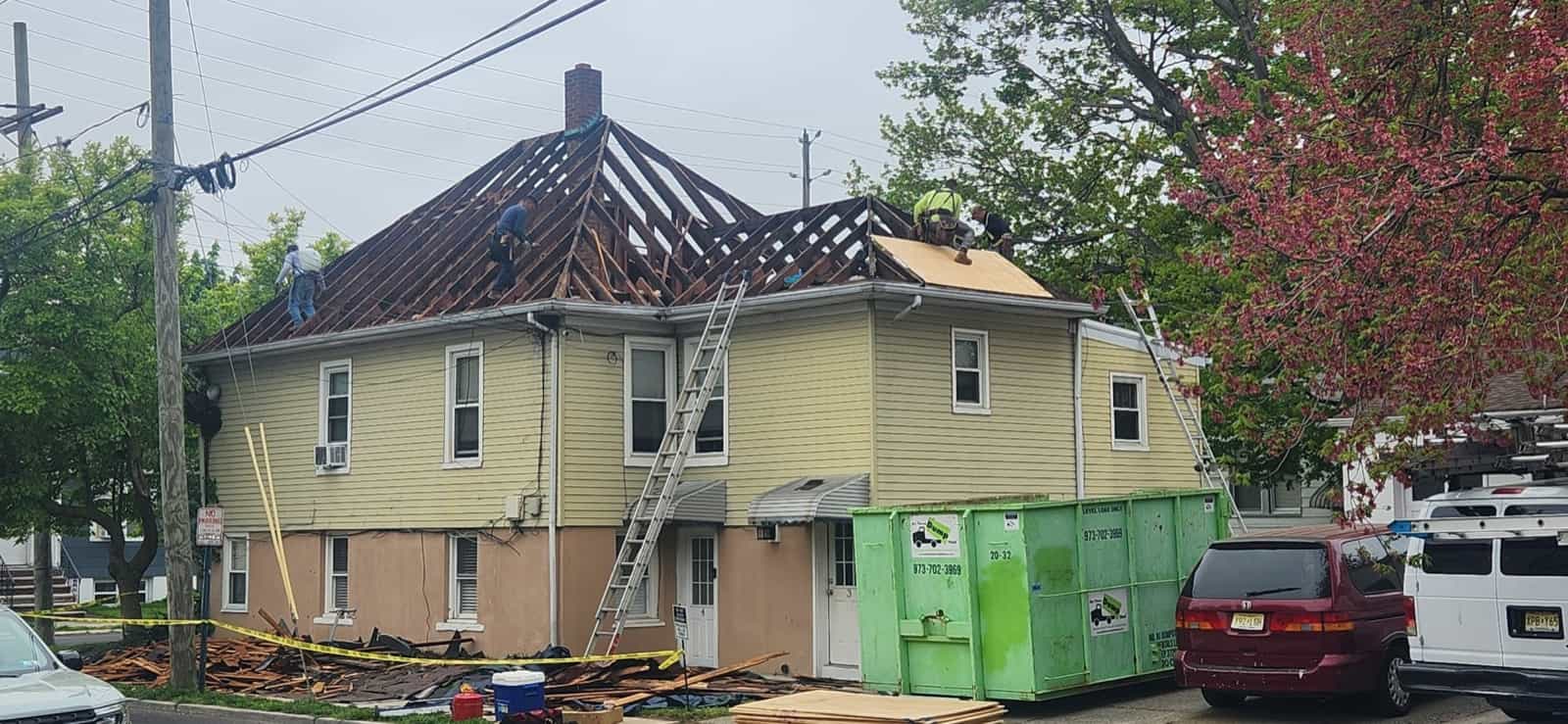
The first fork in a bid is whether the old roof comes off. A layover — new shingles over the existing ones — is the cheapest line a contractor can write, and on plenty of houses in this market it isn't a legal line to write. On an existing New Jersey house the governing rule is not the model code but the rehabilitation subcode, and it is stricter: N.J.A.C. 5:23-6.4(e)7 requires the existing roof covering to be removed before new covering goes on where the existing roof or covering is water soaked or has deteriorated to the point that it is not adequate as a base for additional roofing; where the existing covering is wood shake, slate, clay, cement or asbestos-cement tile; or where the roof already carries two or more applications of any type of covering. Wood shake is the one North Jersey homeowners get told wrong — the model code's exceptions at IRC R908.4 leave it out, and New Jersey's rule does not. Two is the hard ceiling, and on housing stock this old, plenty of roofs are there already.
Where an overlay is legal, here is the trade. The deck cannot be inspected — the sheathing is the one surface nobody looks at again for twenty years, and it is what every fastener holds into. Fastener length stops being a detail: R905.2.5 sets the nail by what it has to reach, through the roofing material and a minimum of 3/4 inch into the sheathing. Add a layer and the nail has to grow to reach the same wood; keep the same nails and the new shingles are hanging on the old roof. And the weight lands on framing sized for one roof — a second layer roughly doubles the dead load of the covering, thousands of pounds on an ordinary house, while the trapped layer runs hotter and shortens the life of the shingles you just bought. The rest of the bill arrives at the next replacement, when somebody strips two layers instead of one.
'Decking as needed' is the one line that honestly cannot be priced
Every legitimate roofing bid contains a line that is not a price, and this is it. Sheathing condition is invisible until the roof is off. The soft sheets show up in predictable places: around the chimney, down the valleys, at the eaves where meltwater backed up, and over whatever leak a previous owner patched from the outside.
So the honest handling is a written rate, not an estimate: a price per 4x8 sheet installed, in the contract, before anyone climbs a ladder. (For planning before a bid, our roof replacement cost guide gives 2026 North Jersey ranges for localized decking repair and a full re-deck.) Three ways the line gets abused:
- No rate at all. 'Decking as needed' with no per-sheet price is a blank check written for a day when you will have no leverage.
- A bundled allowance that evaporates. 'Includes up to X sheets' is fine — if the contract also says what sheets beyond X cost and what happens when fewer are used.
- A count you cannot verify. Ask for bad sheets to be photographed in place before they come out, and for the count to be called to you before the new deck is covered. Once underlayment is down, nobody can audit anything.
The line items a cheap bid quietly leaves off
These separate two bids on the same house. None is exotic, and every one of them disappears from view the moment the roof is finished — which is why they go first.
- Drip edge. R905.2.8.5 requires it at eaves *and* rakes: adjacent segments lapped not less than 2 inches, extending not less than 1/4 inch below the sheathing and back onto the deck not less than 2 inches, fastened at not more than 12 inches on center — with underlayment installed over the drip edge along the eaves and under it along the rakes. That last clause gets reversed on rushed jobs, and it is one of the few items you can check from the ground: stand at the gable end and look for the metal.
- Ice-and-water membrane at the eaves and in the valleys — see the next section.
- New pipe boots. The neoprene collar around a plumbing vent degrades under UV and dies long before the shingles around it. Cracked collar, ceiling stain, small part. A bid reading 'reuse existing flashing' is quoting a new roof with the old failure points left in it.
- Starter strip. The IRC does not name it; the manufacturer's instructions do, and R905.1 makes those instructions part of how a roof covering is legally applied. It also decides warranty math. GAF's Roofing System Limited Warranty covers its Lifetime shingles for wind to 110 mph as normally installed, and to 130 mph only under what it calls Special Installation — six nails per shingle, four on its LayerLock-labeled Timberline, plus GAF Starter Strip Products at the eaves *and* the rakes. Improvising a starter course out of cut-down field shingles forfeits that 130.
- Ridge cap. Purpose-made ridge cap, installed to its own printed instructions. GAF covers ridge cap shingles to the listed wind speed only if they were installed in strict accordance with the 'Maximum Wind Speed Coverage Under Limited Warranty' section of that product's application instructions, and its economy ridge caps are rated well below its premium ones. Cut-up 3-tab on an architectural roof is a tell.
- Step flashing at walls and dormers, replaced rather than reused, with counter-flashing cut into the masonry at chimneys. Reused step flashing arrives with old nail holes in it.
- A chimney cricket where code requires one. R903.2.2 draws the line at 30 inches of width, measured across the slope rather than up it: past that, a cricket or saddle belongs on the uphill side, finished in sheet metal or in the roof covering itself. Unit skylights flashed to their manufacturer's instructions are the section's one exception. Chimneys aren't.
Ice-and-water shield: what New Jersey actually requires
Nearly every roofer in this market will tell you an ice barrier is required by code here. Across almost all of North Jersey it is not, and the citation chain matters because it changes how you read a bid.
Start with the model code, which sets no temperature at all. R905.1.2 requires an ice barrier where there has been a history of ice forming along the eaves causing a backup of water, as designated in Table R301.2 — a determination each state makes when it adopts the code. New Jersey made it in two documents. The adopting rule, N.J.A.C. 5:23-3.21, strikes that trigger out of R905.1.2 and inserts 'In areas where the average daily temperature in January is 25°F (-4°C) or less.' DCA Bulletin 07-3 — issued May 2007, revised June 2015 — then does the arithmetic and names exactly one county: Sussex. One exemption runs statewide alongside it: a detached accessory structure enclosing no conditioned floor area never needs the barrier, wherever it stands.
So across almost everywhere we work — every New Jersey county except Sussex — the membrane is best practice rather than a mandate, which is why it is the first thing cut from a low bid. Leaving it off still meets the code here, and no town can add the requirement back. We install it anyway, and the reason is narrow and physical: the eave is where backed-up water goes, and felt has no answer to water that is sitting still. The membrane does.
Two numbers to hold a bid against. The barrier runs from the lowest edges of all roof surfaces to a point not less than 24 inches inside the exterior wall line — on deep eaves, far more membrane than the token strip along the edge — and on slopes of 8:12 or steeper it must also run not less than 36 inches measured along the slope from the eave edge. If a bid says 'ice and water shield' with no dimension, ask where it stops.
Underlayment: felt, synthetic, and what 'code minimum' buys
R905.1.1 does not say felt or synthetic. It requires underlayment to conform to the standards the chapter lists, and where a product is required to comply with ASTM D226, D1970, D2626, D4869, D6380 Class M, D6757 or D8257, to bear a label showing that standard designation and, where applicable, its type. D8257 is new in the 2024 edition and covers the synthetic sheets most crews actually carry, which is worth knowing if a bid still lists only felt. A self-adhering polymer-modified bitumen underlayment labeled to ASTM D1970 is written in as an explicit alternative. So the useful question on a bid is the product name — the label is the compliance, and 'synthetic underlayment' is not a product name.
Asphalt-saturated felt is the cheap answer, and its failure mode is specific: it wrinkles if it gets wet before the shingles go on and tears at the fasteners when a slope sits exposed in wind — which matters most on the day the roof is open and the weather is moving in. Synthetics do not absorb water, hold fasteners better, and are safer to walk.
Two pitch rules get missed on porches and additions. Asphalt shingles are not permitted below 2:12 at all (R905.2.2), so a low-slope section needs a different covering and its own line on the bid; from 2:12 up to 4:12, double underlayment is required. Everywhere else 'code minimum' means one labeled layer — legal, and also the least an assembly meant to last twenty-five or thirty years can have.
Two warranties, and only one is about your roof being installed right
Homeowners hear one word — lifetime — and assume one thing is covered. Two separate documents are in play, and the split is the most useful thing to understand before signing.
The manufacturer's material warranty covers manufacturing defects in the products. GAF's is unusually blunt about its limits. Even where the products were not installed according to GAF's instructions or to standard good roofing practices, it says, the limited warranty remains in effect — but GAF is not liable for damage caused by improper fastening or application, by settlement, movement or structural defects, or by inadequate ventilation. Labor drops out after the non-prorated Smart Choice Protection Period, ten years on its Lifetime shingles; tear-off, disposal, and costs related to metal work and flashings are excluded outright. So is ice damming, except for leaks in the area of deck covered by GAF's own leak barrier and caused by a manufacturing defect in that barrier. Read that one twice if your eaves freeze: the shingle warranty is not your ice-dam protection. The membrane is.
'Lifetime' is a defined term, not a promise. In that document it means as long as the original owner — or a second owner, if coverage was properly transferred during the Smart Choice Protection Period — owns the property, and the Lifetime term applies only to systems on single-family detached residences owned by individuals. For any other owner or building type, including condominium and homeowner associations and apartment buildings, the term is 40 years. In a market this full of two- and three-families, that is worth reading before anyone buys a roof for its warranty. Coverage transfers once, on written notice to GAF within a year of the sale, and a transfer after the non-prorated period cuts the remaining term to two years.
The stronger coverage is bought with the system, not the shingle. That Roofing System warranty applies only if you install GAF Lifetime shingles plus at least three qualifying GAF accessories — deck protection, starter strip, ridge cap, leak barrier, attic ventilation. Fall short and a thinner document governs instead: the GAF Shingle & Accessory Limited Warranty. So the question to put to a bid is not 'is it lifetime' but which of the two this roof will qualify under, with the accessories that decide it named in the written scope.
The contractor's workmanship warranty covers the installation — flashing, fasteners, transitions — precisely what the material warranty excludes. Ask its length, what it covers, whether it transfers, and check that it lives in the contract rather than on a website. Ours: we carry a ten-year transferable workmanship warranty on the installation, and we are GAF Certified — GAF's entry tier. That tier is not the same as no tier. GAF's enhanced warranties are available only through certified contractors, and the System Plus Limited Warranty is available at ours: it extends the non-prorated Smart Choice Protection Period from ten years to fifty and adds tear-off. What our tier does not reach is the Silver Pledge, which adds workmanship coverage and needs Certified Plus, and the Golden Pledge, which needs Master Elite. If a bidder promises you one, ask which tier they hold and check GAF's contractor directory, where the tier is printed on the listing — ours included.
The New Jersey legal facts, stated correctly
This is the part of the internet that is wrong most reliably. Each claim with the source it comes from:
- Registration has no dollar threshold. Under N.J.S.A. 56:8-138, no contractor business may offer to perform, or engage in, the business of making or selling home improvements unless registered with the Division of Consumer Affairs. At the permit counter the rule now sits in N.J.S.A. 45:5AAA-14, in force since 1 February 2026 in place of the repealed 56:8-147. Its text bars a town from issuing a construction permit for a home improvement if any part of it is to be done by a contractor who is neither licensed under nor exempt from the new licensing act described below, and it makes the contractor liable for any fines or penalties when a required permit was never obtained. The licenses and exemptions that bar refers to only start when that act's licensing requirement does, so how construction offices apply it in the meantime is unsettled. The number to ask for today is still the registration.
- Since 2024 the registration itself demands more. P.L. 2023, c. 237, signed 8 January 2024, amended the Contractors' Registration Act, renaming it the Contractors' Business Registration Act and renaming home improvement contractors as Home Improvement Contractor Businesses, and created the Home Improvement and Home Elevation Contractor Licensing Act at N.J.S.A. 45:5AAA-1 et seq. The Division of Consumer Affairs' notice to registrants states that to obtain, renew or reinstate a registration a business must now have workers' compensation insurance unless exempt, commercial general liability of at least $500,000 per occurrence, and an 'additional security' under N.J.S.A. 56:8-142 — a compliance bond, irrevocable letter of credit or other security of $10,000, $25,000 or $50,000 depending on contract value. A separate individual license is coming but is not live: it takes effect on the first day of the sixth month after the new State Board adopts its rules, and we found no adopted rules when this was last updated. So the thing to ask for today is still the registration number — and, if you want a sharper question, proof of the workers' compensation coverage and the additional security behind it.
- More than $500 must be in writing, with required contents. N.J.S.A. 56:8-151(a) requires every home improvement contract for a purchase price in excess of $500 — and every change in its terms — to be in writing and signed by all parties, setting out the contractor's legal name, business address and registration number, a copy of the commercial general liability certificate with the telephone number of the insurer, and the total price including finance charges. (That certificate is not decorative: 56:8-142 sets a minimum of $500,000 per occurrence.) N.J.A.C. 13:45A-16.2(a)(12) adds a description of the work and the dates or time period within which the work is to begin and be completed.
- Three days to cancel, and the contract has to say so in print. N.J.S.A. 56:8-151(b) lets a consumer cancel for any reason before midnight of the third business day after receiving a copy of the contract, and requires a conspicuous 'NOTICE TO CONSUMER' block in at least 10-point bold-faced type saying so. To cancel you notify the contractor in writing — registered or certified mail, return receipt requested, or personal delivery to the address in the contract — and all money paid comes back within 30 days. If that block is missing from your paperwork, the paperwork is not compliant.
- There is no deposit cap in the regulation. N.J.A.C. 13:45A-16.2 does not limit a deposit to any percentage of the contract price. The 'one-third maximum' repeated across contractor blogs and AI-written answers as New Jersey law is not in the New Jersey rule. We cap our own deposit at 30% — a limit we hold ourselves to, not one the State handed us.
- What the law does prohibit is paying for the end before the end. N.J.A.C. 13:45A-16.2(a)(6)(v) makes it an unlawful practice to request the buyer to sign a certificate of completion, or make final payment on the contract, before the home improvement is completed in accordance with the terms of the contract. The Division's consumer brief says the same in plainer words and adds that final inspections must be completed before final payment is made — on a job that has them, since a covering-only re-roof on a detached house is not inspected.
- More than a third up front is a warning sign, not a violation. The Division's brief 'Hiring Home Improvement Contractors' lists, under WARNING SIGNS, being wary if a contractor asks for more than a third of the total payment before work can begin. That is guidance, not a statute. A roofer who wants half up front is not breaking a law, so 'that's illegal' gets you nowhere — but a documented state warning sign is still a good reason to renegotiate the schedule.
When the honest answer is that you do not need a new roof
A fair number of the roofs we get called out to look at are not replacements. One layer, shingles still lying flat with their granules largely intact, water showing up in one place under one penetration — that is a flashing or boot failure, and the fix is a repair. Leaks concentrate at penetrations and transitions far more than out in the open shingle field, which is why a single stain on a bedroom ceiling is usually a small job in a frightening costume.
So the most useful signal in a bid is what the roofer did before writing it. Someone who went into the attic with a flashlight, checked the underside of the deck for staining and daylight, and came back with a repair scope is reading your roof. A replacement quote written from the driveway in answer to one ceiling stain is reading you.