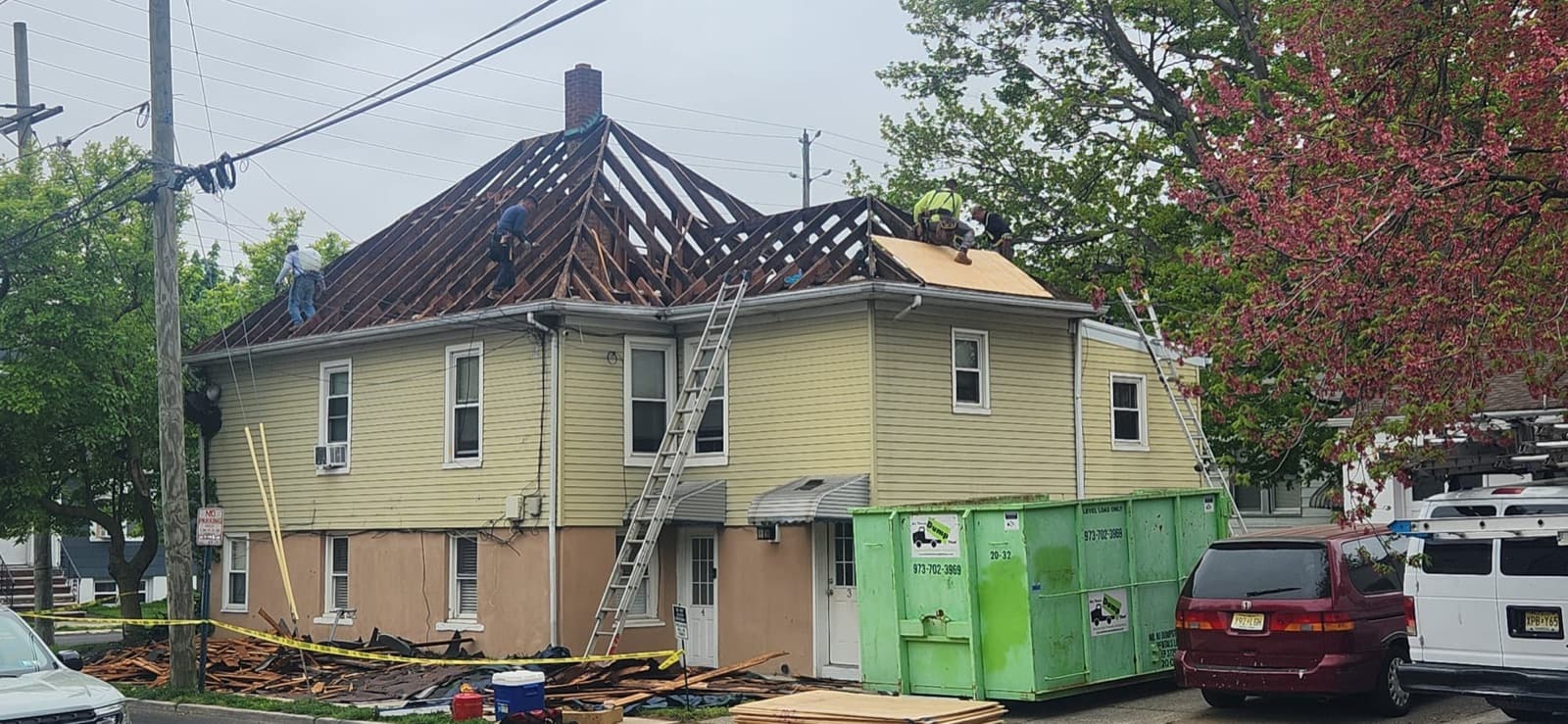
Roof Repair in Ridgefield Park, NJ
The roll-off is the scheduling problem here — off the public roadway overnight for four winter months, and off any parade route around the Fourth. We settle the container plan with the Building Department before we settle a start date. NJHIC #13VH13970900.
In Ridgefield Park the ordinance most likely to move your roofing date is not about roofs. Chapter 333, Streets and Sidewalks, holds a standalone Article IV, “Construction Trailers and Refuse Containers,” whose reach § 333-19A fixes: “No person shall park or allow to be parked any construction trailer or refuse container on any public property, be it a street or sidewalk area, except in conformance with this article and except after obtaining a permit therefor from the Building Department.” That permit runs 30 days under § 333-19C. Then § 333-20B: “No refuse container shall be placed in the public roadway overnight during the months of December, January, February or March.” Roofing does not stop in winter: for four straight months the roadway is a daylight option — same-day set and pull, or the box takes the driveway the crew needs.
Early summer closes differently. Section 333-20C: “For the five days preceding and including the Fourth of July, any other date on which a civic parade is scheduled and any parade rain date, no construction trailer or refuse container shall be parked in a public roadway along a parade route, a baby parade route, a Fire Department inspection area and a staging area for these events and within one block on either side of such areas.” The rain date is what catches a crew: it is not knowable when a job is booked. Beside it, § 333-20A: “No trailer or refuse container shall be parked within 50 feet of a driveway, intersection or fire hydrant.” Both are roadway rules; neither reaches a container on your own driveway. The article defines neither route, so we ask the Building Department rather than guess.
- roof replacement — Full tear-off, decking and re-roof — the scope that puts a container at the curb for days rather than hours.
- emergency roof repair — 24/7 dispatch to close an opened roof in, including the winter calls the roadway rule complicates.
- flat roof work — EPDM, TPO and modified-bitumen work on low-slope surfaces that already exist — seams, drains, parapets and ponding.
- commercial roofing — Re-roofing an occupied building — sequencing, the permit path, insurance paperwork and written scopes an owner or board can act on.
- roof repair in Hackensack — The county seat next door, where fewer than a quarter of the homes are single-family houses and the roofs are mostly low-slope and the roofs are mostly low-slope.
- roof repair in Little Ferry — Neighbour down the river, where the flood datum is the general height definition for every building — not, as here, a subsection that applies once a house has been raised.
What the container has to arrive wearing
Section 333-21, Lighting, is a specification rather than an instruction to be careful: “All trailers or refuse containers in the public roadway must be equipped with and display markers at the front and at the rear consisting of all-yellow reflective diamond-shaped panels having a minimum size of 18 inches by 18 inches. These panels shall be mounted at the edge of the dumpster or container at both ends nearest the path of passing vehicles and facing the direction of oncoming traffic. These markers shall have a minimum mounting height of three feet from the bottom of the panels to the surface of the roadway.” Subsection B adds a floodlight where a trailer abuts a public sidewalk; § 333-22 supplies the penalty.
Reflective tape and two cones is not what that describes, and we found no relief clause in the article. The panels are equipment the box arrives with — a question for whoever drops it.
- Driveway or roadway, and what that choice does to crew access on a narrow lot
- December through March: same-day set and pull, or private property
- Parade dates and rain dates confirmed before a start date is agreed
- Yellow diamond panels at both ends, on the supplier’s checklist
Flat roofs are prohibited, and height is measured to the peak
Article V of Chapter 96 is headed “Residential, Lot, Height and Yard Regulations,” so it governs the residential zones rather than the whole Village. Subsection F of § 96-5.8: “All measurements for purposes of height shall be to the peak of the proposed roof. All roofs shall have a minimum pitch of four inches vertical distance for each 12 inches of horizontal distance. Flat roofs are prohibited.” Subsection E supplies the figure being measured against for single- and two-family homes, and § 96-5.8G immediately after it qualifies how that figure applies — so treat 32 feet as the starting point and read G before assuming ite four-in-twelve minimum. Subsection C carves out spires, chimneys, mechanical appurtenances and parapet walls.
That last sentence changes a conversation. A flat-roofed rear addition, a porch roof reframed lower, a low-slope tie-in someone wants to build in kind — in a residential zone that is a zoning question before it is a roofing question, and the Village’s to answer rather than ours. Where a job changes roof geometry instead of replacing a covering, we get that answer in writing first.
Monthly payment options
We work with Hearth, which shops several lenders on a single application. See your personalized options in minutes — checking does not affect your credit score, and there is no commitment.
- Loan amounts up to $250,000
- Funding in as little as 1–3 days
- No prepayment penalties
- No home equity required
Financing is provided by Hearth's lending partners, not by Precision Windows & Roofing. Rates and terms depend on your credit and the lender making the offer, and all financing is subject to credit approval.
Common questions
Does a re-roof in Ridgefield Park need a construction permit?
It depends how deep the work goes. N.J.A.C. 5:23-2.7(c)1x treats roof covering replacement as ordinary maintenance under two limits: the covering only, and detached one- and two-family dwellings only. Under N.J.A.C. 5:23-2.7(b)4, structural work is never ordinary maintenance, so once a rafter or rotted decking is replaced the job is permitted work.
We own a storefront downtown. Is exterior work reviewed?
If the building has a commercial use and sits in the C-1(H) Zone, § 23-47I reaches it: “All applications for building permits involving the exteriors of buildings with commercial uses in the C-1(H) Zone visible from a public street and, even where not requiring a building permit, exterior alterations, including painting and signs, shall be referred by the Construction Official to the Historic Preservation Commission for a written report, which shall be made within 45 days. The Chairman of the Historic Preservation Commission may act in the place of the full Commission for purposes of this section.” Article VIII was adopted 12-12-2023; § 23-47J gives the report teeth, and § 23-47K keeps the design guidelines in the Construction Code Official’s office — ask for them before ordering material.
Does the Historic Preservation Commission review my house?
The referral clause is written to buildings with commercial uses in the C-1(H) Zone; it does not reach a one- or two-family house. Section 23-47N separately preserves “ordinary maintenance or repair of an exterior architectural feature ... which involves no change in design, material, color or outward appearance.” The C-1(H) district is designated by § 23-47A, so its boundary is mapped.
A storm opened our roof in January. Where does the debris go?
Not the roadway overnight — § 333-20B does not bend for weather. Article IV governs public property, so a container on your own driveway or yard sits outside it, which on a narrow lot means staging the box where the crew would otherwise park. We answer emergencies 24 hours a day.
Does the Village set a shingle standard?
We searched the Village Code for “shingle” and the search returns no results; we found no municipal standard governing roofing material, colour, profile, weight or manufacturer on a residential re-roof. We also searched “contractor” and found no municipal licensing chapter. Licensing here is the State’s, and it takes the form of a registration: NJHIC #13VH13970900, insured. We install GAF, Owens Corning and CertainTeed, are GAF certified, and carry a 10-year transferable workmanship warranty.
Explore
Get your free roofing quote
Free, no-obligation on-site assessment anywhere in New Jersey — and we answer the phone 24/7.