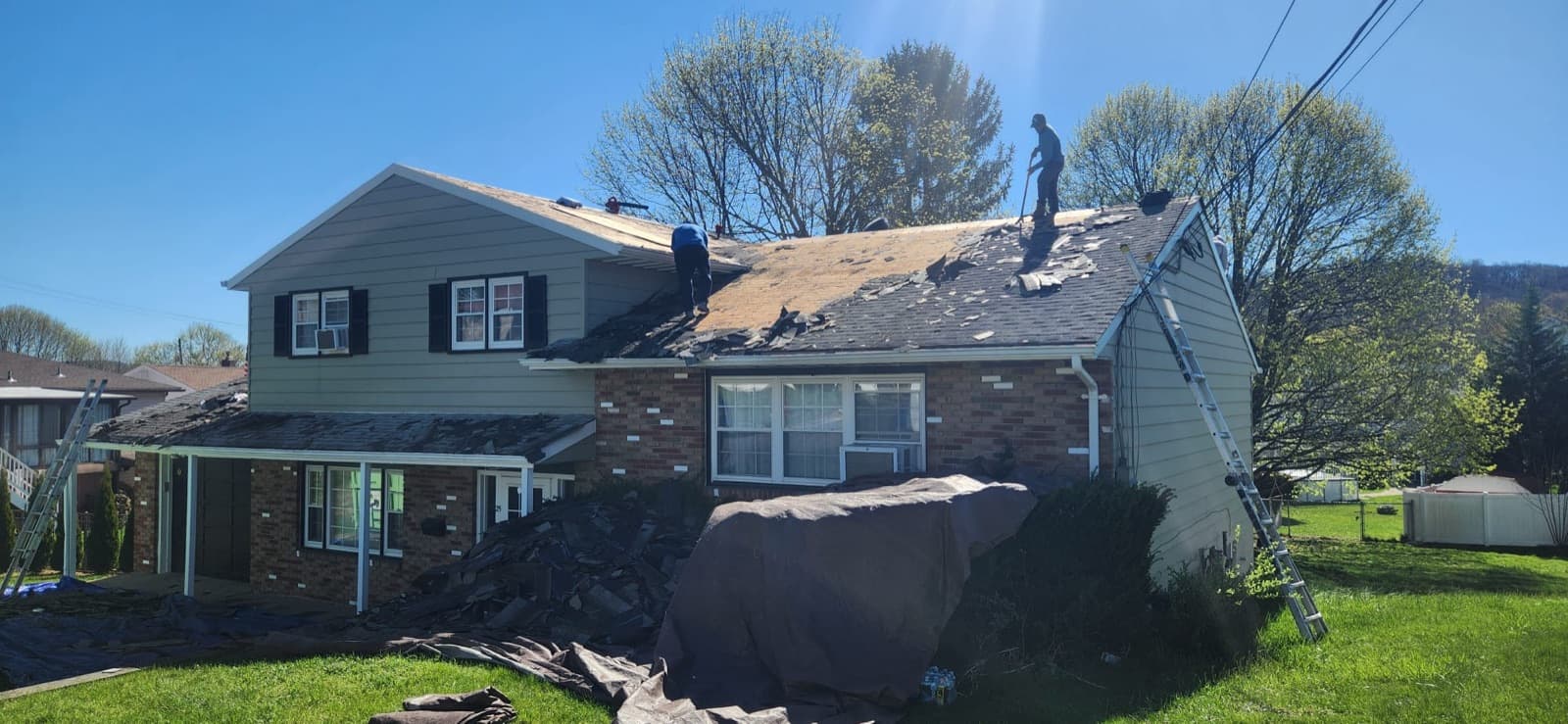
Roof Repair & Replacement in Maywood, NJ
Where a Maywood roof sits inside permitted construction, § 247-6 gives the work thirty days of suspension and no more — so the calendar is part of the scope. Tear-off, deck, flashing, gutters. GAF certified. NJHIC #13VH13970900.
In the spring of 2020 Maywood did two things seven weeks apart. On 2-25-2020, Ord. No. 2-20 swapped the borough's property maintenance standard for the 2018 International Property Maintenance Code. On 4-14-2020, Ord. No. 5-20 added § 247-6, "Completion of construction; property maintenance during construction." Subsection A leaves overall timing to the Uniform Construction Code; subsection C carves the exterior back out of it: "Notwithstanding the provisions of the Uniform Construction Code, exterior construction must be substantially complete within one year of the issuance of construction permits." The shorter number is the one that matters to a roof: construction "may not be suspended for a period of more than 30 days throughout construction," and § 247-6F(11) makes construction suspended that long a listed violation. It binds "the property owner and contractor" jointly, and § 247-6H(6) lets the Construction Official revoke open permits.
We schedule Maywood tear-offs to open and close inside one stretch of dry weather — the only version of this ordinance that is a roofer's problem rather than a lawyer's. Ten-year transferable workmanship warranty on every roof we install. (201) 275-9185; the after-hours line is the same number.
- How a full replacement runs — Tear-off, decking, underlayment, flashing and ventilation — the whole sequence, written out once instead of on every town page.
- What an inspection covers — A hands-on read of shingles, flashing, valleys and decking — the step that tells you whether this is a repair or a job with a schedule.
- Emergency roof repair — Open roof after hours — how the 24/7 call goes, from the first tarp to the permanent fix.
- Flashing, in detail — Sidewall, step, counter and chimney flashing — what "sound, tight and not admitting rain" actually takes at the joints.
- Choosing a shingle — We install GAF, Owens Corning and CertainTeed. Here is what actually separates the lines.
- Roof repair in Hackensack — The city next door, where most roofs are flat and the permit question comes out the other way.
Two ordinances, seven weeks apart, and roofing is first in the list
§ 247-6C is the outer boundary, and its definition of substantial completion puts roofing first: "the completion of major elements of the exterior ... including roofing, siding, masonry, windows and doors." § 247-6B then tells the Construction Official to give written notice to every owner whose permits have been open a year or more.
§ 247-6F is the inner boundary. Owner and contractor both must "proceed as expeditiously as possible to completion," and the violations listed underneath read like a stalled roof: F(2) reaches "unsafe exterior portions of buildings or structures, including ... overhangs, roofs," F(10) loose "shingles, shutters and awnings," F(11) exposed exterior surfaces "remaining in a state of disrepair" past thirty days, or exterior construction suspended that long. The four exemptions at § 247-6G include one that reaches a roof inside a bigger job: § 247-6G(4) exempts "construction done under multiple permits with different start dates." Unrepaid correction costs "shall constitute a lien upon the subject premises," and fines escalate by the day.
The other half is older. § 247-1D — last amended in 2002 — reaches one-family homes and owner-occupied two-family homes only in part: as to those houses, it says, "only the provisions of Chapters 1 (Administration) and 2 (Definitions), and Section PM-507 ... and § 247-4 of this chapter shall apply." § 247-4D(7), "Roofs and drainage," is what lands on them: "The roof and flashing shall be sound, tight and not have defects that admit rain." And enforcement is not only the code official's: § 247-3B rewrites the adopted IPMC so that wherever "code official" appears — Chapter 1, Administration, being one of the parts § 247-1D leaves in force here — the Maywood Police Department's members and the employees and officers of the Maywood Board of Health "are authorized to assist the code official in the enforcement of this Code."
The permit question decides which clock you are under
Start with whether a permit exists, because that decides which rule you are arguing about. N.J.A.C. 5:23-2.7(c)1x makes "the repair or replacement of existing roof covering on detached one- and two-family dwellings" ordinary maintenance, and both halves of that phrase are load-bearing. Detached is one. Roof covering is the other — under 5:23-2.7(b)4 nothing "affecting structural or fire safety" is ordinary maintenance, so the moment we open the deck and replace sheathing the exemption is gone and a construction permit is required.
Of Maywood's 3,908 housing units (2019–2023 ACS), 2,705 sit in one-unit detached structures and another 513 in two-unit structures — and a detached two-family is inside the exemption exactly as a detached single is. Clearly outside it is the other 690, about 18%: 66 units in attached single-family structures, 372 in three- and four-unit buildings, and 252 in buildings of five units or more, before you count a single attached two-family. On those the covering is permitted work too, and § 247-6 has a permit to run from.
On the detached owner-occupied house, the honest answer is that we do not know. § 247-1D limits the chapter to § 247-4 for those homes and was never updated when § 247-6 arrived; § 247-6's exemption list does not name them either. Cutting the other way, § 247-6F ties its duty to conduct to "issuance of permits" — an argument that it never reaches a house that needed no permit at all. Nothing in Chapter 247 resolves it, and we found no borough interpretation. So if a permit is already open on your house, call the Maywood Construction Official before you plan the sequence, not after the tear-off.
Monthly payment options
We work with Hearth, which shops several lenders on a single application. See your personalized options in minutes — checking does not affect your credit score, and there is no commitment.
- Loan amounts up to $250,000
- Funding in as little as 1–3 days
- No prepayment penalties
- No home equity required
Financing is provided by Hearth's lending partners, not by Precision Windows & Roofing. Rates and terms depend on your credit and the lender making the offer, and all financing is subject to credit approval.
Common questions
We are a two-family and we live in one of the units — which rules do we get?
Both halves. If the structure is detached, replacing the covering is ordinary maintenance under N.J.A.C. 5:23-2.7(c)1x — no permit, no notice — but only the covering; replace decking and you are back under a permit. Attached, even the covering is permitted work. Separately, § 247-1D puts owner-occupied one- and two-family homes under § 247-4 regardless.
Do the gutters and leaders fall under the same standard as the roof?
Yes. § 247-4D(7) also requires roof drainage "adequate to prevent dampness or deterioration in the walls or interior portion of the structure," gutters and downspouts "maintained in good repair and free from obstructions," and roof water not discharged "in a manner that creates a public nuisance." § 247-4D(12) adds chimneys.
Is there anything that kicks in before the one-year mark?
Yes. § 247-6E starts six months after the first construction permit issues: no construction equipment, vehicles, materials, tools or machinery may be stored or maintained in the front yard while not in use. It is the earliest date in the ordinance and the one a stalled roof trips first.
Do I need ice-and-water shield on a Maywood roof?
Not as a code requirement. The ice barrier is a Sussex County requirement under NJ DCA Bulletin 07-3, and Maywood is in Bergen County. We install it at eaves and in valleys anyway, as best practice rather than compliance.
Our roof is one piece of a renovation already past a year. Anything else?
§ 247-6D adds rules past the initial permit year: construction materials covered and out of sight of the street, debris containers removed within 24 hours of placement, and no equipment or vehicles on site overnight or on Sundays.
Explore
Get your free roofing quote
Free, no-obligation on-site assessment anywhere in New Jersey — and we answer the phone 24/7.