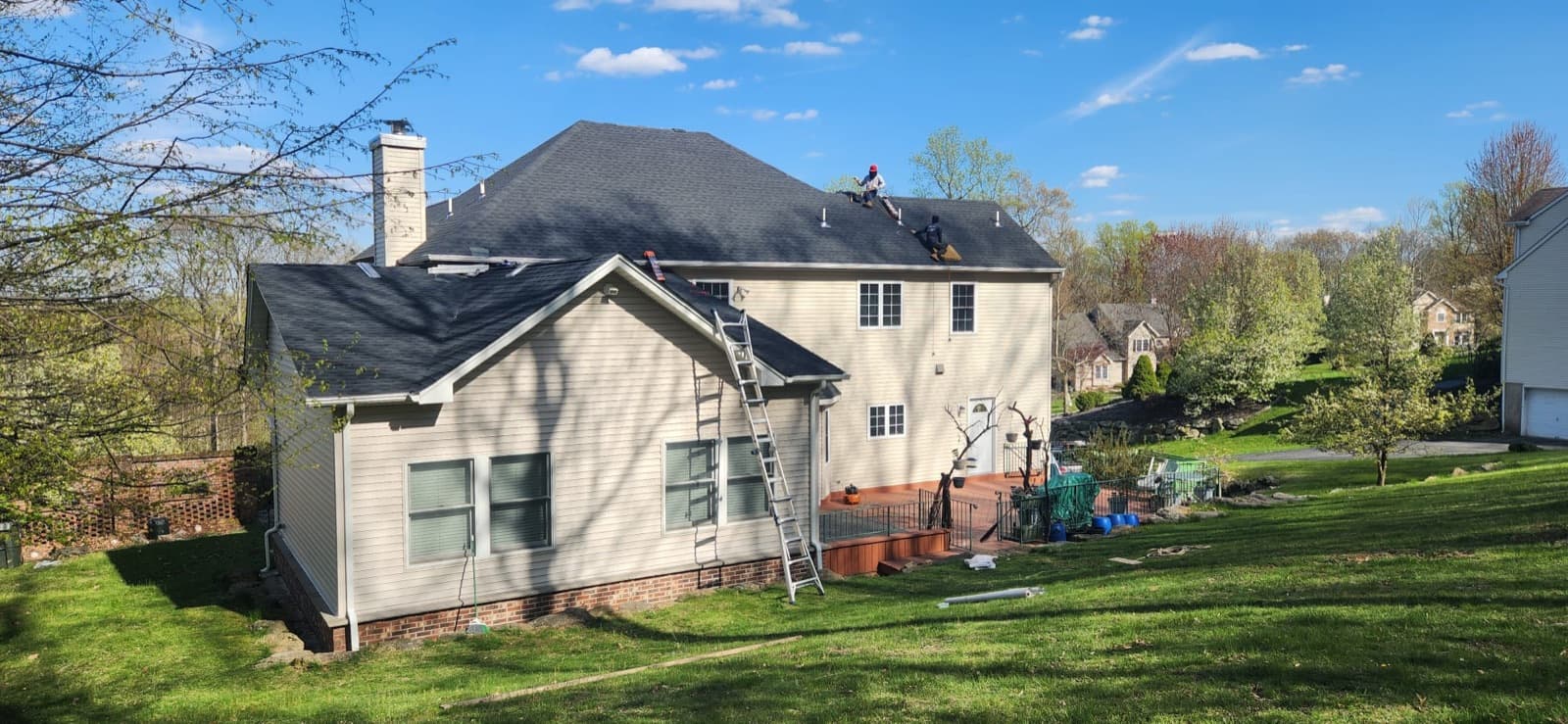
Skylight Installation & Leak Repair in North NJ
A skylight is a pane of glass set into a hole in your roof — glass and flashing, the two things we have stopped leaks at for years. New installs, leaking-skylight diagnosis, flashing reseals, and full replacements across New Jersey. Free on-site diagnosis from our Garfield shop, NJ-registered.
A skylight is the one spot on a North Jersey roof where our two trades meet in a single detail: a sealed pane of glass — our original business — set into a hole cut through the roof and held watertight by flashing, the part of roofing we are sharpest at. Nothing else on a house sits closer to our exact expertise. We install new skylights, diagnose and repair leaking ones, reseal and re-flash tired units, and replace failed ones across New Jersey from our Garfield shop.
That crossover matters because of how skylights actually fail. The glass rarely just goes bad — what fails is the flashing around it or the seal at its edge. Coming at it from years of stopping water at window seals and glazing lines, we read a leaking skylight the way we read a leaking window: find where water is truly getting in, and whether it is even a leak at all, since condensation fools a lot of homeowners. Then we fix that, instead of tearing out a skylight that was never the problem.
This page covers deck-mount versus curb-mount installs, why skylights leak, telling condensation from a real leak, when a reseal is enough versus a replacement, glass versus the old plastic domes, and why the smart time to touch a skylight is when the roof is already off. Just a cracked or fogged pane with sound flashing? That can be a glass-only job — squarely the original glass work Precision was built on. For anything involving the roof, the flashing, or an active leak, call (201) 275-9185 and we will diagnose it on-site, free.
Deck-mount vs. curb-mount — and the flashing that ties it in
A skylight sits on a roof one of two ways, and the difference decides how it gets flashed. A deck-mounted skylight sits directly on the roof deck with no separate curb, low and close to the shingles, sealed with an integrated flashing kit — the clean, low-profile choice for the asphalt-shingle roofs on most North Jersey homes. A curb-mounted skylight sits on a site-built wooden curb fastened to the deck and wrapped in a waterproof membrane, then flashed to the roof; raising the unit above the roof plane is the right move on a low-slope or flat roof — common on the flat-roofed rear additions all over Bergen and Passaic — where a deck-mount would let water pond against it. On a shingle roof, aluminum step flashing interlocks with the courses so water runs off the skylight onto the shingles below, never behind them.
Whichever mount your roof calls for, the flashing is what actually keeps the skylight dry — so we install a manufacturer-matched kit, not a bucket of caulk. Systems like VELUX No Leak skylights layer a pre-attached deck seal, an adhesive underlayment, and engineered step flashing, and earn a 10-year installation warranty only when the unit is paired with its matching factory kit — EDL for shingle roofs, EDW for tile. Caulk-and-hope flashing carries no such backing, and it is what we get called back to fix.
A proper skylight flashing system is a coordinated set of parts, and shortcutting any one is where leaks start:
- Step flashing along both sides, woven into the courses one piece at a time so each hands water to the shingle below
- Sill or apron flashing at the bottom edge, where the most water concentrates
- Head flashing above the skylight, to split water around it
- An adhesive underlayment beneath the whole assembly for a layered second line of defense
- A kit matched to the roof covering — low-profile for asphalt shingles, high-profile for tile
It is almost always the flashing or the seal — not the glass
Failed or improperly installed flashing is the number-one cause of skylight leaks. A skylight interrupts the field of shingles that is engineered to shed water, so it concentrates runoff at its perimeter — and if the flashing is corroded, reused from an old roof, face-nailed, or caulked instead of woven, water gets under it. Then it travels along the underside of the roofing for several feet before it drips through the ceiling, which is why the wet spot so often appears away from the skylight and homeowners chase the stain instead of the source.
The second failure is the seal. The weather seals and sealant around the glass harden, crack, and pull away over years of UV and temperature cycling. One version is terminal: if you see water or fogging trapped between the panes, the insulated-glass seal has failed and the unit has to be replaced — you cannot reseal a blown insulated-glass unit from the outside. The short list of what we find behind a leaking skylight:
- Flashing failure — corroded, reused, face-nailed, or caulked-over; the leading cause, and the drip usually surfaces feet away
- Cracked perimeter seal or sealant — UV and freeze-thaw dry it out and pull it loose
- A blown insulated-glass seal — fog between the panes means the glass gets replaced, not resealed
- Old plastic domes — brittle acrylic that has cracked, crazed, or split with age
- Condensation mistaken for a leak — common enough to get its own section next
Roof leaking right now? We answer 24/7.
Condensation, weep holes, and the leak that isn't one
Before anyone reflashes a roof, the first question is whether it is even a leak — because a lot of skylight water is not. Condensation forms when warm, humid indoor air from a bathroom, kitchen, or laundry below hits the cold underside of the glass and drips. The diagnostic tell is timing and pattern: condensation shows up in cold weather regardless of rain and spreads evenly across the glass, while a true leak coincides with rain or snowmelt and runs from one point.
There is a second impostor. Many skylights have internal condensation gutters — weep channels that drain minor condensation out through weep holes at the bottom of the frame. When those weep holes clog — dust, roof grit, or drywall dust tracked in after an interior remodel is the classic culprit — the water backs up and drips from the interior frame corners onto the drywall, mimicking a flashing leak exactly. Clearing the weep holes often resolves it outright. We check for both before we ever talk about opening the roof, because reflashing a skylight that is actually condensing or weeping is money spent on the wrong problem.
When a reseal is enough, and when it is throwing good money after bad
Not every leaking skylight needs replacing. If the unit is young and sound and the failure is a run of flashing or a tired bead of perimeter sealant, a proper re-flash or reseal is the right, smaller fix — done with woven step flashing and lapped underlayment, not a smear of roof cement that lasts a season. A reseal is the cheaper short-term move, and when it fits, we do it and say so.
Age tips the decision the other way. Skylights perform their best for about 15 to 20 years, the window in which the seals dry out and crack. The rule of thumb — ours and the industry's — is that once a skylight is roughly 15 years or older and starts to leak, replacement usually beats repeated reseals: the seals are wearing out everywhere at once, so a reflash just buys a little time before you are back on the roof. Over the life of the roof, replacement is usually the more cost-effective and watertight answer — especially, as the next section covers, when the roof is already being worked on. We give you the honest trade-off on-site rather than defaulting to the bigger job.
Roof leaking right now? We answer 24/7.
Why an old plastic dome is usually a replacement — and glass isn't
If your skylight is a yellowed, hazy plastic bubble, the material is the problem. Acrylic and plastic domes yellow, haze, and grow brittle with age and UV — a 20-year-old dome looks nothing like the day it went in, and brittle plastic is a prime candidate to crack and leak. Aged acrylic domes are one of the most common skylights we replace outright.
Glass does not do that. A glass skylight looks essentially the same in 20 years — true color, real clarity, no milky haze. Modern skylight glass is built for a climate like ours: double-glazed with a Low-E coating, often a gas fill and a thermal break, so it insulates and cuts outside noise far better than a single-layer acrylic dome. Where it matters, the glass is laminated — it holds together if it is ever cracked, and its PVB interlayer blocks roughly 99% of UV, protecting the floors, furniture, and artwork beneath it without the haze plastic develops.
This is squarely our lane, because glass is the original business. If your skylight's frame and flashing are sound and only the glass has cracked or fogged, that is often a glass-only job — the original glass work Precision was built on. When the flashing or the whole unit is in play, it belongs on this one.
The smart time to touch a skylight is when the roof is off
If you are replacing your roof, deal with the skylights in the same job — it is the single best-timed decision on the project. During a tear-off the old skylight flashing gets disturbed and weakened whether anyone intends it or not, and the only way to flash a skylight correctly is to interweave new flashing with the new shingle courses as they go on. Lapping new shingles around old, in-place flashing is exactly the shortcut that leaks a year later.
That is why so many roofers will re-flash an old skylight but explicitly will not warranty one kept in place through a re-roof — the seals may be near the end even when the flashing is brand new, and no one wants to own a leak that starts inside a 15-year-old unit they were told not to replace. We give you the straight call. If a skylight is young and sound, we re-flash it into the new roof and stand behind that flashing; if it is aging, replacing it while the roof is open is far cheaper and cleaner than doing it later as its own project — and it is the only way we can warranty the entire detail, glass, seal, and flashing together.
Roof leaking right now? We answer 24/7.
Safety glazing, crickets, ice barrier, and the permit question
Skylights carry their own rules in New Jersey's adopted IRC, and they are not trivia — they are what keeps a skylight safe and dry. Skylight glazing is governed by IRC R324.6, which requires safety glazing: either laminated glass (within a dwelling, a 0.015-inch PVB interlayer is allowed when each pane is 16 square feet or less and sits no more than 12 feet above the walking surface; otherwise a thicker 0.030-inch interlayer), or fully tempered glass that breaks into small granular pieces instead of dangerous shards. It is the same safety-glass logic we work with on the window side.
Two water-management rules matter here. IRC R903.2.2 requires a cricket or saddle on the up-slope side of any roof penetration wider than 30 inches, with an exception for unit skylights installed per R324.6 and flashed per the manufacturer's instructions — one more reason we install to the flashing-kit spec. The second rule is the one people cite wrongly at us. New Jersey's ice-barrier requirement (IRC R905.1.2, adopted at N.J.A.C. 5:23-3.21) is worth knowing mostly for what it doesn't cover. It governs the eaves — not a skylight opening partway up the roof — and even at the eaves DCA Bulletin 07-3 confines it to areas averaging 25°F or less in January, which in New Jersey means Sussex County alone. So nothing in the code puts membrane around your skylight, and in Bergen or Passaic nothing puts it at your eaves either. We run membrane at both: a skylight perimeter is one of the highest water-concentration zones on a roof.
On permits: cutting a brand-new skylight opening alters the roof framing — adding headers and trimmers and penetrating the weatherproof envelope — so New Jersey generally requires a building permit for a new opening, with plan review and inspection. A same-size replacement into an existing opening is treated more leniently. We confirm up front whether your scope needs a permit and pull it under our registration (HIC reg.# 13VH13970900) whenever the job calls for one.
What a skylight job actually costs to fix
A leaking skylight is not an automatic replacement, and it is rarely the emergency a high-pressure quote makes it sound like. Most of the time it is a targeted repair — clearing weep holes, resealing a perimeter, or re-flashing one unit — and that is what we diagnose and quote on-site, free, before any work starts, so you see exactly what failed and what you are paying to fix. When a unit needs replacing, or you are adding a brand-new skylight, we line-item the parts and labor so you can compare our number against anyone else's. Because this is a service page and not our cost guide, we do not post dollar figures here — the only honest price is the one measured on your roof and your skylight. Here is what actually moves that number:
What affects the cost
| Repair vs. replace vs. new install | Clearing weep holes or resealing a perimeter is a fraction of swapping a whole unit — and cutting a brand-new opening, with framing and a permit, is more than either. |
|---|---|
| Deck-mount vs. curb-mount | A curb-mounted unit on a flat or low-slope roof needs a built, membraned curb; a deck-mount on shingles uses a matched factory flashing kit. |
| Glass vs. acrylic and unit type | A laminated Low-E glass unit is a different part than a basic acrylic dome, and a venting (operable) skylight costs more than a fixed one. |
| Flashing kit and roof covering | Low-profile kits for asphalt shingle and high-profile kits for tile differ in price, and existing flashing usually should be replaced, not reused. |
| Roof pitch, height, and access | A steep or multi-story roof needs more staging and fall protection for the same skylight than a walkable ranch or Cape. |
| Interior and decking damage | If an old leak has already rotted the sheathing or stained the ceiling around the skylight, that repair is scope beyond the unit itself. |
| Paired with a re-roof or standalone | Doing the skylight while the roof is already open is far cheaper than a separate trip staged just for it. |
| New-opening permit and framing | A new hole means framing the opening and pulling a NJ permit; a same-size replacement into an existing opening usually avoids both. |
We don't bundle a mystery number — you get a firm, free on-site quote, approved before any work starts.
Monthly payment options
We work with Hearth, which shops several lenders on a single application. See your personalized options in minutes — checking does not affect your credit score, and there is no commitment.
- Loan amounts up to $250,000
- Funding in as little as 1–3 days
- No prepayment penalties
- No home equity required
Financing is provided by Hearth's lending partners, not by Precision Windows & Roofing. Rates and terms depend on your credit and the lender making the offer, and all financing is subject to credit approval.
Common questions
Why is my skylight leaking when the glass itself looks fine?
Because the glass is rarely the problem. Failed or improperly installed flashing is the number-one cause of skylight leaks, and cracked perimeter sealant is second — both let water in at the edge, not through the glass. Roof water also travels along the decking for several feet before it drips, so the stain often shows up away from the skylight. We trace it to the real entry point and rebuild that detail rather than tarring over the stain.
Is the water on my skylight a leak, or just condensation?
Timing and pattern tell you. Condensation forms when warm, humid indoor air hits the cold glass, so it appears in cold weather regardless of rain and spreads evenly across the pane; a true leak tracks with rain or snowmelt and runs from one spot. There is also a middle case: skylights with internal weep channels can back up and drip from the frame corners when the weep holes clog with dust or debris — that mimics a flashing leak exactly, and clearing the weep holes often fixes it. We check for condensation and clogged weeps before we ever talk about opening the roof.
Can a leaking skylight be repaired, or does it have to be replaced?
Most leaks are a repair, not a replacement. If the unit is relatively young and the failure is a run of flashing or a tired bead of perimeter sealant, we re-flash or reseal it properly — woven step flashing and lapped underlayment, not roof cement. The exception is a blown insulated-glass seal (fog between the panes) or an old unit around 15-plus years that is leaking: at that point the seals are wearing out everywhere at once and replacement usually beats repeated reseals. We give you the honest repair-versus-replace math on-site.
Should I replace my skylight when I have the roof replaced?
If the skylight is aging, yes — doing it while the roof is open is the best-timed and cheapest moment. A tear-off disturbs and weakens the old flashing no matter what, and the only correct way to flash a skylight is to weave new flashing into the new shingle courses. A young, sound skylight we can re-flash into the new roof and stand behind; an aging one is far cheaper to replace now than to stage as its own project later, and it lets us warranty the whole detail — glass, seal, and flashing — together.
Do I need a permit to add a skylight in New Jersey?
For a brand-new skylight, usually yes. Cutting a new opening alters the roof framing — headers and trimmers — and penetrates the weatherproof envelope, so New Jersey generally requires a building permit with plan review and inspection. A same-size replacement into an existing opening is treated more leniently and often does not. We confirm up front whether your scope needs a permit and pull it under our registration (HIC reg.# 13VH13970900) whenever the job calls for one.
My skylight is a cloudy yellow plastic dome — can it just be cleaned up?
No — once an acrylic or plastic dome has yellowed, hazed, and gone brittle, the material itself is spent and it is a prime candidate to crack and leak. There is no cleaning that back to clear. Aged plastic domes are one of the most common skylights we replace outright, and the upgrade to a laminated Low-E glass unit is a real one: glass looks the same in 20 years, insulates far better, and its PVB interlayer blocks roughly 99% of UV without the haze plastic develops.
Explore
Get your free roofing quote
Free, no-obligation on-site assessment anywhere in New Jersey — and we answer the phone 24/7.