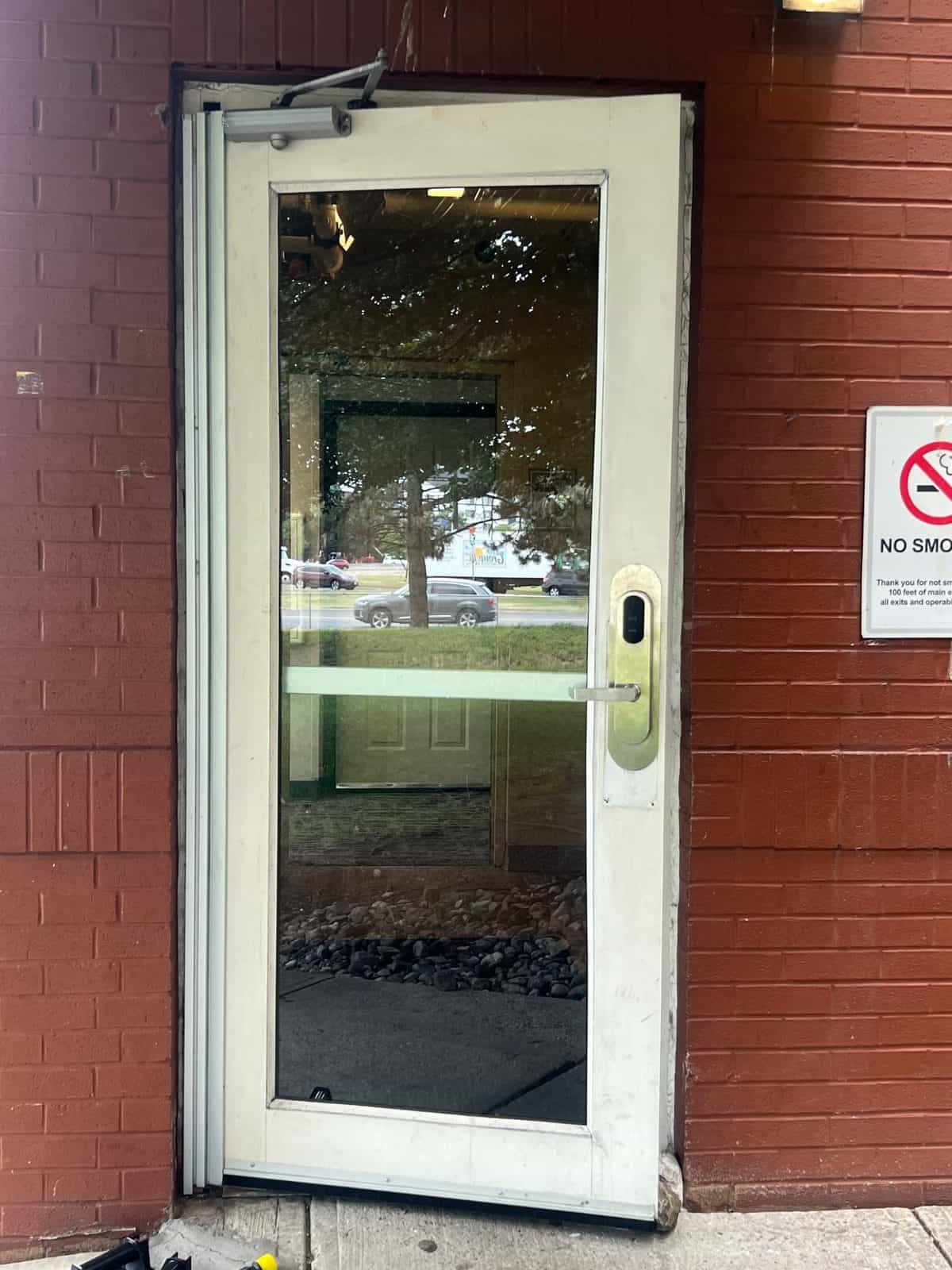
Commercial Storefront Glass
Storefront glazing, emergency replacement, and door repairs.
Commercial Storefront Glass
Complete storefront glazing services including new installation, emergency replacement, and door repairs for retail and office buildings.
Storefront glass is the most visible — and most abused — glazing on any commercial building. A retail storefront on Main Street in Madison sees 20+ years of UV cycling, freeze-thaw stress, weekly cleaning, occasional shopping-cart impact, and the inevitable break-in or vandalism event. The frames bend, the sealants harden, the weeps clog, the doors sag — and at some point the whole assembly stops being a glass system and starts being a series of overlapping failures. We install, repair, and reglaze storefront and curtain wall systems across NJ — Newark, Jersey City, Hoboken, Princeton, Edison, the Route 1 corridor, the shore towns — for retail, restaurants, banks, medical offices, and Class B/C office buildings.
Three manufacturers dominate the NJ commercial storefront market: Kawneer, YKK AP, and EFCO. Each has its quirks, its parts pipeline, and its installation specs. We carry stocking inventory for the most common Kawneer Trifab and YKK YES Series profiles, and we maintain reciprocal accounts with EFCO and US Aluminum for less common systems. A storefront repair done with wrong-system gaskets, glazing tape, or fasteners will fail within 18 months — using OEM parts on OEM frames is non-negotiable.
Kawneer vs YKK vs EFCO: what's the difference
Kawneer Trifab 451 and 451T are the most common storefront systems in NJ commercial buildings built since 1990. 1-3/4" or 2" frame depth, center-set or front-set glazing pocket, multiple thermal break options. Parts pipeline is mature — we get gaskets, glazing tape, sweeps, and weep covers from local Kawneer distributors within 1-2 days. We default to Kawneer 451 for new commercial storefront work because the system's flexibility, the local parts availability, and the proven 30+ year service life justify the slight cost premium over YKK or EFCO equivalents.
YKK AP YES 45 and YES 60 are the value-tier and mid-tier alternatives. Slightly less expensive than Kawneer at install, comparable thermal performance, parts pipeline through YKK distributors in central NJ. We see a lot of YES Series on 1990s-2010s strip retail and second-generation office buildings. Repair-friendly system but the glazing pocket gaskets are not interchangeable with Kawneer — wrong gaskets cause leaks within a season.
EFCO 433 and 451 are the workhorse mid-Atlantic storefront systems for high-rise and Class A office buildings. Heavier frame profiles, better wind-load ratings, more thermal break options. Common in Newark, Jersey City, and Hoboken Class A buildings from the 1980s-90s. Parts pipeline is less convenient than Kawneer or YKK in NJ — we order through EFCO direct with 3-5 day lead time on gaskets and trim.
US Aluminum (now part of CRL) — Series 451, 351 — is the budget option common in 1980s strip retail. System is functional but parts availability is hit-or-miss for older configurations. We often replace US Aluminum frames rather than repair them when the original system is more than 25 years old.
ADA storefront door requirements
Storefront doors in NJ commercial buildings must comply with ADA Title III as enforced by the U.S. Department of Justice and adopted in IBC Chapter 11. Key requirements: 32" minimum clear width when door is open 90° (typically requires a 36" nominal door); maximum 5 lbf opening force for interior doors and exterior doors are limited to whatever the closer manufacturer can demonstrate (typically 8-10 lbf for exterior storefronts, which is allowable under ADA's exception for exterior doors); door closer adjusted so the door takes minimum 5 seconds to close from 90° to 12°; thresholds maximum 1/2" with beveled transition.
Storefront door hardware: ADA requires lever handles, push bars, or push plates — no round knobs. Operating height 34-48" off the floor. We replace non-compliant hardware as part of any storefront door reglaze or replacement to bring the assembly to current compliance at the same time as the glass work.
Automatic door operators (low-energy or full-power) are required on entrances to many public-accommodation buildings under ADA, and required by local ordinance in some NJ jurisdictions for new commercial construction. We install and service Stanley Magic-Door, Horton, Besam, and Record operators in coordination with our storefront door work.
After-hours reglaze and tenant coordination
Retail and restaurant tenants can't operate with a boarded storefront — every hour the board-up stays up is revenue lost. We do roughly 40% of our storefront reglaze work outside business hours: nights, weekends, holidays. Coordination starts with the property manager (who owns the building envelope and contracts the work), the tenant (who owns the operating schedule), and where applicable the landlord's insurance carrier (who's paying for the work after a covered claim).
Typical after-hours storefront reglaze: 6 PM Friday close, board-up removed by 7 PM, new glass installed by 11 PM, sealants curing overnight, weep verification and final cleanup by 6 AM Saturday, ready for opening at 10 AM. After-hours pricing applies and is built into the quote before the night starts, not discovered afterwards.
Mall and shopping-center tenants have additional layers: mall security badging, freight elevator scheduling, common-area floor protection, mall management notification. We carry the OCIP coverage and the W-9 documentation that mall property managers (Westfield, Simon, Brookfield) require, and we maintain pre-approved contractor status with several NJ mall operators.
Common storefront failures we repair
Glazing gasket failure — the EPDM gaskets that seal the glass to the frame harden and lose compression. Water finds the path past them and ends up in the building. Repair: pull old gaskets, clean glazing pocket, install new gaskets matched to the frame system. 30-60 minutes per opening if access is straightforward.
Weep system blockage — drainage holes at the sill clog with paint, sealant overspray, or debris. Water that's supposed to drain back out pools in the sill track and migrates into the building. Repair: clear weeps with compressed air and pipe cleaners, verify drainage with a water test, re-install weep covers.
Door operator failure — closers leak fluid, lose pressure, fail to close the door. Door alignment goes out, latch doesn't engage, sweep no longer seals. Repair: rebuild or replace closer (LCN, Sargent, Norton — we carry the common models), re-align door, replace sweep and weatherstrip.
Frame corrosion — anodized aluminum frames in coastal locations or in regularly wet conditions develop pitting corrosion that eventually compromises the structural integrity of the frame. Repair: depends on extent. Minor pitting can be cleaned and sealed; deep corrosion requires frame member replacement.
Broken or chipped tempered glass — typically from shopping cart impact, vandalism, or stress from poorly seated gaskets. Reglaze with matching tempered glass, typically same-day or next-day for stocked sizes.
Our Process
- 1Site assessmentOn-site evaluation of the storefront system: frame type identification, gasket condition, weep patency, door operation, sealant condition, glass condition. Photos and measurements captured for the quote.
- 2Written scope and quoteWithin 48 hours: identified frame system (Kawneer, YKK, EFCO, etc.), scope of repair or reglaze, parts list with OEM gaskets and tape, labor estimate, after-hours premium if applicable, lead time. Insurance-claim coordination noted if relevant.
- 3Parts and glass procurementOEM gaskets and trim ordered from manufacturer distributor (1-3 days for Kawneer/YKK, 3-5 days for EFCO). Tempered glass to size from stock or fabrication (1-3 days stocked, 5-10 days custom). Door hardware from stock or order.
- 4SchedulingCoordinated with property manager and tenant. Daytime install for non-customer-facing repairs, after-hours for retail/restaurant storefronts. Mall and shopping-center work coordinated with mall management for badging, freight access, and common-area protection.
- 5InstallationCrew size 2-4 depending on opening size and complexity. Old glass and gaskets removed, glazing pocket cleaned, new gaskets installed, glass set with proper setting blocks, perimeter sealant applied, weeps verified clear. Door work coordinated as separate scope if needed.
- 6Verification and closeoutFinal water test on critical reglaze jobs. Operating test on door work. Photos of completed work for the property manager file. Insurance billing if direct-billed. Warranty: 5 years on sealant and gasket work, 1 year on tempered glass against fabrication defects, lifetime on workmanship.
Materials We Use
The Precision Difference
About Commercial Storefront Glass in NJ
Can you reglaze a broken storefront overnight?+
Do you work with all the major storefront systems?+
Is my storefront door ADA compliant?+
Why does my storefront leak only during heavy rain?+
How long does a complete storefront reglaze take?+
Can you document and bill insurance for vandalism or vehicle damage?+
Can you upgrade my storefront for energy efficiency or sound attenuation?+
Can you make my storefront more resistant to smash-and-grab break-ins?+
Commercial Storefront Glass by City
Serving All 21 New Jersey Counties
We service Atlantic County, Bergen County, Burlington County, Camden County, Cape May County, Cumberland County, Essex County, Gloucester County, Hudson County, Hunterdon County, Mercer County, Middlesex County, Monmouth County, Morris County, Ocean County, Passaic County, Salem County, Somerset County, Sussex County, Union County, Warren County. From our Garfield, NJ shop we cover the entire state, same-day in Bergen County, and elsewhere depending on the job and how booked we are that day.
Explore More
BROKEN WINDOW & DOOR GLASS REPLACEMENT
Broken window or door glass replaced — stocked sizes cut the same night, custom units fabricated.
DetailsCOMMERCIAL WINDOW LEAK REPAIR
Forensic water-intrusion diagnosis and permanent leak repair for commercial windows, storefronts, and curtain-wall systems across NJ. We find the actual source — sealant, flashing, or framing — and fix it once.
DetailsINTERIOR & OFFICE GLASS DOORS
Interior and office glass doors built for non-standard openings.
Details