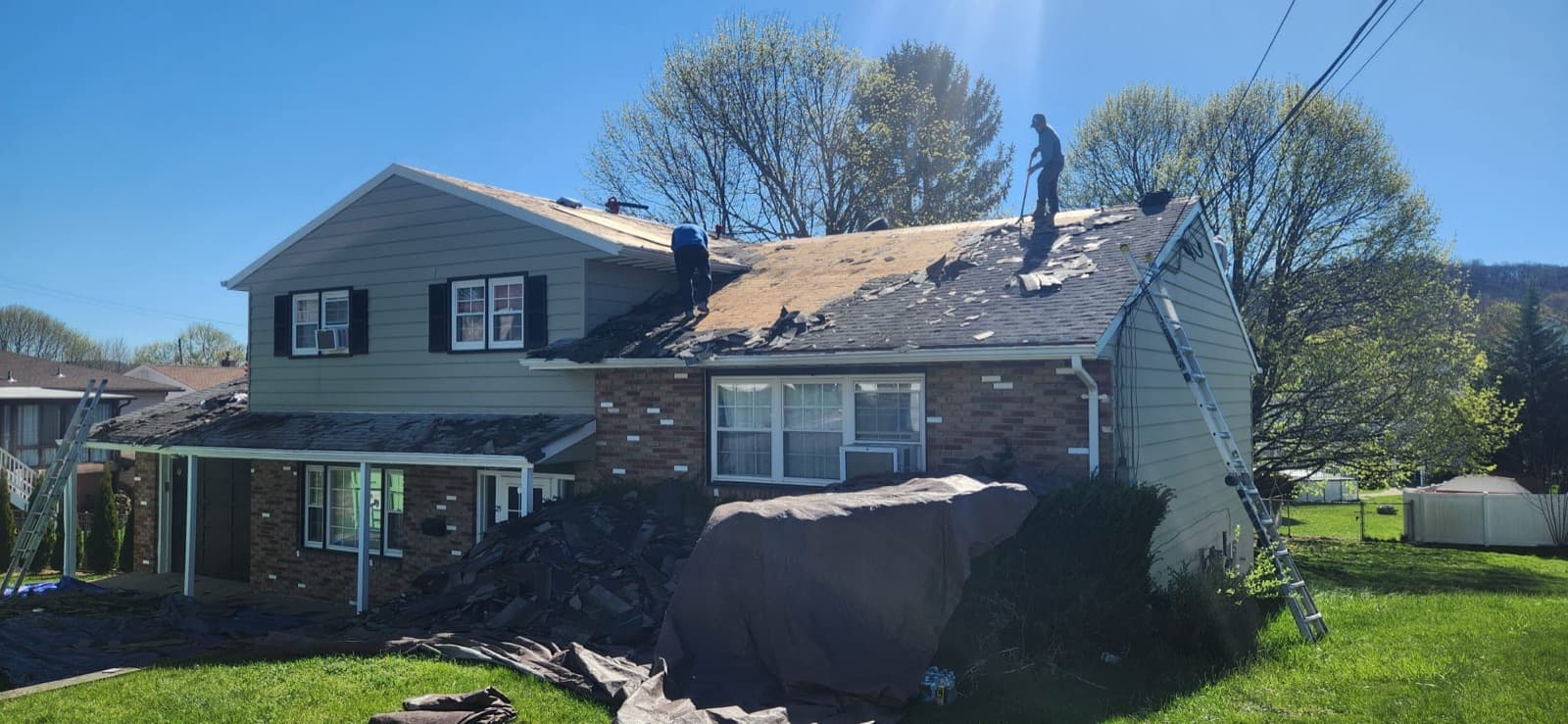
Emergency Roof Repair in North New Jersey
Shingles stripped off a slope, a limb through the deck, water running down a ceiling at two in the morning — the first job isn't the repair, it's stopping the loss. Emergency tarping and dry-in around the clock, documented before the next band of weather arrives.
Not every roof problem is an emergency, and treating them all the same is how homeowners end up paying after-hours rates for something that could have waited until Tuesday. A few tabs missing in July is an appointment. A roof that is open to the sky with another band of rain coming, a limb resting on the rafters, or water tracking down a light fixture is a different category — the house is losing more with every hour it stays that way, and the correct first move isn't to fix the roof. It's to stop the loss.
That distinction — mitigation now, repair later — organizes everything on this page. Emergency work means getting the opening covered, the water contained, and the damage documented before conditions get worse. The permanent fix is a separate job with separate requirements: a dry deck, workable temperatures, daylight, and material that can actually be matched. Force a permanent repair at eleven at night in driving rain and you get a repair that fails in the spring, which means paying for it twice.
So an emergency call is triage in a specific order — make the situation safe, photograph it, secure the opening properly, deal with the water that's already inside, then set the real repair for the first workable window. If your roof is open right now, call (201) 275-9185 and describe what you're seeing. A fair amount gets settled on the phone: we can usually tell from a description whether this is a tonight problem, a first-light problem, or something that can safely wait for a dry day. If it lands in that last category — a leak that is a real problem but not an urgent one — the tracing and the permanent fix are on our roof leak repair page, and the rest of the repair line is mapped on our roof repair page.
What to do before anyone gets there
An emergency roof call has an order of operations, and the roof is not first on the list. People come first, then electricity, then evidence, then water. Most of the expensive mistakes we see after a North Jersey storm come from reversing that order — someone climbs a wet roof in the dark, or mops up and tears out the soaked drywall before a single photo is taken.
Everything useful in the first hour can be done from inside the house and from the ground. A roof that has just been damaged is not a roof anyone should be standing on: the decking may be cracked where you can't see it, wet shingles are slick, and in winter the whole surface is a ramp. Do the items below, then call and describe it.
- Get everyone out from under a sagging or dripping ceiling — and out of the house entirely if you hear cracking, see the ceiling bowing, or smell gas.
- Kill the circuit. If water is anywhere near a light fixture, a ceiling fan, an outlet, or a switch, shut that circuit off at the panel before you touch anything in the room.
- Treat every downed wire as live. PSE&G, the utility over most of this area, says to stay at least 30 feet back from a downed line and from anything touching it, report it at 1-800-436-PSEG, and call 911 if there's an immediate hazard. If your power comes from a different utility, use their emergency number.
- Photograph before you clean. Dated wide shots and close-ups from the ground, plus the interior, taken before anything is moved, mopped, or covered up.
- Contain rather than chase. Buckets, plastic over furniture, towels at the perimeter — keep water off the floor and out of the wall cavities until the source is stopped.
- Stay off the roof and off the ladder. Nothing you can accomplish up there in the dark or the wind is worth what a fall costs.
The bulging ceiling, and why the right move is to put a hole in it
A ceiling that has gone soft and started to sag is holding standing water behind a skin of paint — sometimes a lot of it. Left alone it doesn't drain, it fails, all at once, dropping the water and the drywall into the room below. The counterintuitive but standard move is to relieve it deliberately. Shut off the circuit for that room first if water is near any fixture, set a bucket directly under the lowest point of the sag, and pierce the center of the bulge with a screwdriver or an awl — a hole about the width of a pencil is plenty. The water leaves where you're ready for it instead of where gravity picks. That patch of drywall is already lost; the hole is not what damaged it.
Then get ahead of the drying, because that quietly decides how large this job becomes. Water-restoration practice sorts water by how clean it is, and clean rainwater does not stay clean — sitting in contact with building materials it degrades into a dirtier category, and once it does, the work shifts from drying things out to removing and replacing them. That downgrade is driven mostly by dwell time, along with temperature and what the water is touching, and the published windows for it are measured in a couple of days, not weeks. Which is why the interior work starts the same night the water is stopped rather than the week the roof finally gets fixed: drying the wet cavity now, saturated material out now, and an honest look inside the ceiling instead of a coat of stain-blocking primer over the top of it.
Roof leaking right now? We answer 24/7.
How a tarp is actually anchored — and why most of them fail
A tarp thrown over a hole and weighted with cinder blocks isn't mitigation, it's a sail. The first real gust lifts an edge, water runs underneath, and by morning you have the same open roof plus a shredded tarp wrapped around the gutter. Emergency covering that holds is a small piece of carpentry, and the part doing the work is the wood, not the plastic.
The method that survives weather is the batten sandwich. The edge of the tarp gets wrapped two or more full turns around a length of furring strip or 2x4, and that whole assembly is fastened through the wrapped wood into solid decking or a rafter. The batten spreads the load along the entire edge instead of concentrating it at individual fasteners — which is exactly why grommets and bungee cords tear out and a battened edge doesn't. Every edge gets the same treatment, and where the damage runs to the top of a slope the covering is carried up and over the ridge so wind hitting the far face can't get a lip under it. It's the same construction the Army Corps uses on the federal Blue Roof program after major disasters: crews wrap fiber-reinforced sheeting around furring strips and fasten those strips down to the roof. The wood carries the load. Nothing is held on by weight.
- Wrap, don't puncture the field — fasteners should pass through wood and several wrapped layers, never through open sheeting in the middle of a tarp.
- Fasten into something structural. A batten screwed to punched or rotted sheathing has nothing to hold when the wind comes back.
- Carry it over the ridge when damage reaches the top of the slope, so the upper edge can't be lifted.
- Lap it with the water, downhill, so the covering sheds onto shingles instead of dumping underneath them.
- Leave it drum-tight. Slack collects water, and a pocket of ponded water will pull a tarp off a roof all by itself.
- Count the fasteners. Every one is a new hole in your roof that has to be dealt with at the permanent repair.
What a tarp buys you — and what it can't cover
Even a perfectly installed tarp is a consumable. Polyethylene sheeting is a short-term material: sunlight works on it continuously, and the fabric and the fastenings both loosen with every wind cycle. Published service lives swing wide enough between products, exposures, and installers that any single number deserves suspicion — the one hard reference point is the federal program, where Blue Roof coverings are designed to last about 30 days. Plan in weeks. Get eyes on it after every significant blow, and treat anything past a couple of months as borrowed time rather than a covering you can stop thinking about.
There are also situations a tarp simply can't solve, and pretending otherwise wastes a night. The federal program's own eligibility rules make the point twice over: Blue Roofs go on standard shingled roofs, while flat roofs — along with metal, clay, slate, and asbestos tile — don't qualify at all, and any roof with greater than 50 percent structural damage is excluded, for the plain reason that there's nothing sound left to anchor to. Low-slope and flat sections don't shed, so draped sheeting ponds there and eventually leaks worse than the roof did; those want a temporary membrane or a patch bonded to the surface instead. And exposed underlayment is not a substitute for a covering. Synthetic underlayment carries a manufacturer-stated exposure limit that varies a great deal by product, and felt's is far shorter; neither is a roof, and neither should be asked to face a nor'easter.
When the permanent repair genuinely can't happen for months — a large insurance scope landing in midwinter, a structural rebuild waiting on an engineer — heat-shrink film is the better temporary envelope. It's a heavier polyethylene heat-welded tight to the roof's contours, and it holds for months rather than weeks because there's no slack for wind to grab. It costs more to install than a tarp and it's overkill for a two-week wait, but across a long gap it's what actually works.
Roof leaking right now? We answer 24/7.
When it isn't a leak — limbs, punctures, and the order the work goes in
A tree on the house is a different call from a leak, and the common mistake is treating it as a roofing problem first. Everyone comes out, and stays out if there's cracking, visible sag, or any smell of gas. Call 911 if wires are down or the structure looks unstable. Load paths through a house aren't intuitive — the room that looks untouched can be the one carrying the damage — so a structural assessment, often an engineer's, is worth having before anything gets rebuilt, and your carrier may want one on the file regardless.
Sequencing matters as much as the work itself. A limb resting across several rafters is often doing something structural at that moment: its weight is part of what's holding the opening in the shape it's currently in. Cutting it free in the wrong order, or pulling from the wrong side, can drop the section it was bridging, so it is not a Saturday chainsaw project, and nobody should attempt it from the roof. Hiring someone to take a tree or a large limb off a house is licensed work in New Jersey: it means hiring a tree care company registered with the NJ Board of Tree Experts, which you can check at nj.gov/njbte, and a registered company's ads and trucks carry its NJTC registration number. Our roof work starts as soon as the tree is off: we tarp and secure the opening, photograph the damage for your adjuster, dry in over sound framing, and give you a clear read on what's puncture damage to the deck versus a broken rafter that needs to be sistered or replaced, with the repair quoted in writing. It also matters for paperwork — New Jersey treats replacing a roof covering on a detached one- or two-family home as ordinary maintenance, but work that touches structure falls outside that, and we'll tell you which side of the line yours lands on before anything gets rebuilt.
Nor'easter season is emergency season
The Office of the New Jersey State Climatologist puts coastal storms most frequently between October and April, and notes that while a winter rarely passes without at least one significant one, some seasons run upwards of five to ten. That's why our emergency calls cluster in the cold half of the year rather than the thunderstorm half — and why the damage profile is different. A summer downburst is a violent few minutes. A nor'easter is a day and a half of sustained wind and rain arriving from the same quarter, and that duration is the roofing problem. Wind that would never strip a shingle in a brief gust will, over a long night, drive water sideways up under courses that are still nailed down and still look perfect from the driveway. The National Weather Service issues a High Wind Warning for sustained winds of 40 mph or more lasting an hour or longer, or winds of 58 mph or more for any duration — and a nor'easter can sit in that band for the better part of a day.
Cold also changes what can honestly be finished that night. Asphalt shingles bond to each other with a factory-applied sealant strip that's activated by the sun's heat, and at or below roughly 40°F the manufacturers' own cold-weather bulletins stop trusting it to bond on its own. Their instruction is to hand-seal — dabs of ASTM D4586 Type I or Type II asphalt roof cement under each shingle, typically four of them — so the course stays put until the weather warms enough for the strip to take. Cold shingles are brittle enough that careless footing cracks them, too. So a January emergency is properly two visits: secure and dry-in tonight, permanent repair when the roof is dry and workable. And if what's driving water inside is ice built up at the eaves rather than an opening in the roof, that's a different job with different tools — steam, not a tarp.
Roof leaking right now? We answer 24/7.
Photograph it before we cover it — and don't sign the big contract tonight
A tarp hides the evidence. Once the covering goes on, the torn shingles, the exposed deck, and the bent flashing are all underneath it, so documentation has to happen in the gap between the damage and the fix. We shoot the opening and the interior before we secure anything, again after, and we keep the emergency work on its own paperwork. New Jersey's Department of Banking and Insurance tells homeowners directly to make the temporary repairs necessary to protect the property from further loss, to photograph the damage before those repairs start, and to save the receipts — most policies cover reasonable emergency mitigation on a covered loss, but only if you can show what was done and what it cost. How the claim itself unfolds from there — the notice deadlines, the adjuster visit, why the check arrives in two pieces — is a longer subject covered on our storm-damage and insurance-claim page.
Keep the two decisions separate. The emergency scope is small, immediate, and has to happen now. The permanent scope — a repair, a slope, or a whole roof — deserves daylight, a measured estimate, and something to compare it against. New Jersey requires a home-improvement contract over $500 to be in writing and to carry a stated three-business-day right to cancel, which tells you something about how the state expects these agreements to be entered into: with time to read them. Nobody should be sliding a full re-roof agreement across the kitchen table while the water is still running. Secure the house first; the real work gets quoted when you can actually read it.
What affects the cost
| How the opening has to be covered | A battened tarp across one slope, a bonded patch on a low-slope section, and heat-shrink film for a months-long gap are very different amounts of material and crew time. |
|---|---|
| Whether there's sound wood to fasten to | Battens have to land in solid decking or rafters. Punched, cracked, or rotted sheathing means new decking goes down before anything can be anchored at all. |
| Conditions at the time of the call | Darkness, active wind, ice, and snow load all mean slower work, more staging, and more hands than the identical covering installed in daylight. |
| The water already inside | Containment, relieving a loaded ceiling, and opening and drying saturated material is scope on top of whatever happens on the roof itself. |
| The permanent repair, quoted separately | An emergency visit buys the roof time; the actual repair or replacement is measured and quoted on its own once the deck is dry and you can see what's under it. |
We don't bundle a mystery number — you get a firm, free on-site quote, approved before any work starts.
Monthly payment options
We work with Hearth, which shops several lenders on a single application. See your personalized options in minutes — checking does not affect your credit score, and there is no commitment.
- Loan amounts up to $250,000
- Funding in as little as 1–3 days
- No prepayment penalties
- No home equity required
Financing is provided by Hearth's lending partners, not by Precision Windows & Roofing. Rates and terms depend on your credit and the lender making the offer, and all financing is subject to credit approval.
Common questions
It's the middle of the night and water is coming in. Is this actually an emergency, or can it wait until morning?
Three things make it a tonight call: the roof is physically open with more weather coming, water is reaching electrical fixtures or a ceiling is sagging, or something structural is involved — a limb, a visible sag, cracking sounds. Most everything else keeps until first light, and we'll say so rather than roll a truck at overnight rates for a job that doesn't need one. Describe what you're seeing on the phone and we'll sort it out with you before anyone commits to anything.
Can you tarp a roof while the storm is still going?
Sometimes — and it's a genuine sometimes. Nobody should be on a roof during lightning, sustained high wind, or on a sheet of ice; the covering wouldn't stay on in those conditions anyway. What can be done mid-storm is the interior side: contain and divert the water, relieve a loaded ceiling, shut down the affected circuits, and protect what's below. Then we take the covering window the moment the weather offers one, which in a long nor'easter usually means a lull rather than the end of the storm.
How long will an emergency tarp actually hold?
Plan on weeks, not seasons. Polyethylene sheeting is a short-term material and the numbers people quote for it vary wildly depending on the product, the exposure, and how well it was fastened — the one firm reference point is the federal Blue Roof program, where the coverings are designed to last about 30 days. Look at yours after every significant wind event, treat anything past a couple of months as borrowed time, and if the permanent repair is genuinely months away, heat-shrink film is the right covering for that gap instead.
My ceiling is bulging and full of water. Bucket underneath, or do I actually make a hole in it?
Relieve it, carefully. If water is anywhere near a fixture, shut that room's circuit off at the panel first. Then set a bucket under the lowest point of the sag and pierce the center of the bulge with a screwdriver or an awl — a pencil-width hole is enough. The water drains where you're ready for it instead of bringing the whole section down at once, drywall and all. That patch is already lost; the hole doesn't add to the loss.
The wind took shingles off but nothing is leaking inside. Do I need someone out tonight?
Usually not tonight — but don't let it sit either. Whatever is showing under the missing shingles, underlayment or bare deck, was never designed to be the outer layer. Synthetic underlayment carries a manufacturer's exposure limit that varies a lot by product and felt's is far shorter, and neither sheds wind-driven rain the way a lapped shingle course does. The real risk is the next system, not this hour. Get photos now while the damage is fresh and clearly tied to the storm that caused it, and get it covered or repaired before the following one arrives.
There's a tree on my roof — do I call a roofer or a tree service first?
Safety first, then a registered tree care company for the tree, then us for the roof. Get everyone out, call 911 if wires are down or the structure looks unstable, and don't try to cut the tree off yourself: a limb spanning several rafters is often carrying load at that point, and taking the weight off in the wrong order can drop the section it was bridging. Hiring someone to take it off is licensed work in New Jersey, so hire a tree care company registered with the NJ Board of Tree Experts; you can check one at nj.gov/njbte. As soon as the tree is off, we tarp and secure the opening, photograph the damage for your adjuster, read what's puncture damage to the decking versus framing that has to be replaced, and quote the repair in writing. Get a structural assessment before anything gets rebuilt — load paths aren't intuitive, and your carrier may want an engineer's read on the file anyway.
Explore
Get your free roofing quote
Roof open right now? We take emergency calls around the clock anywhere in New Jersey — call and we'll tell you on the phone whether this is a tonight job.