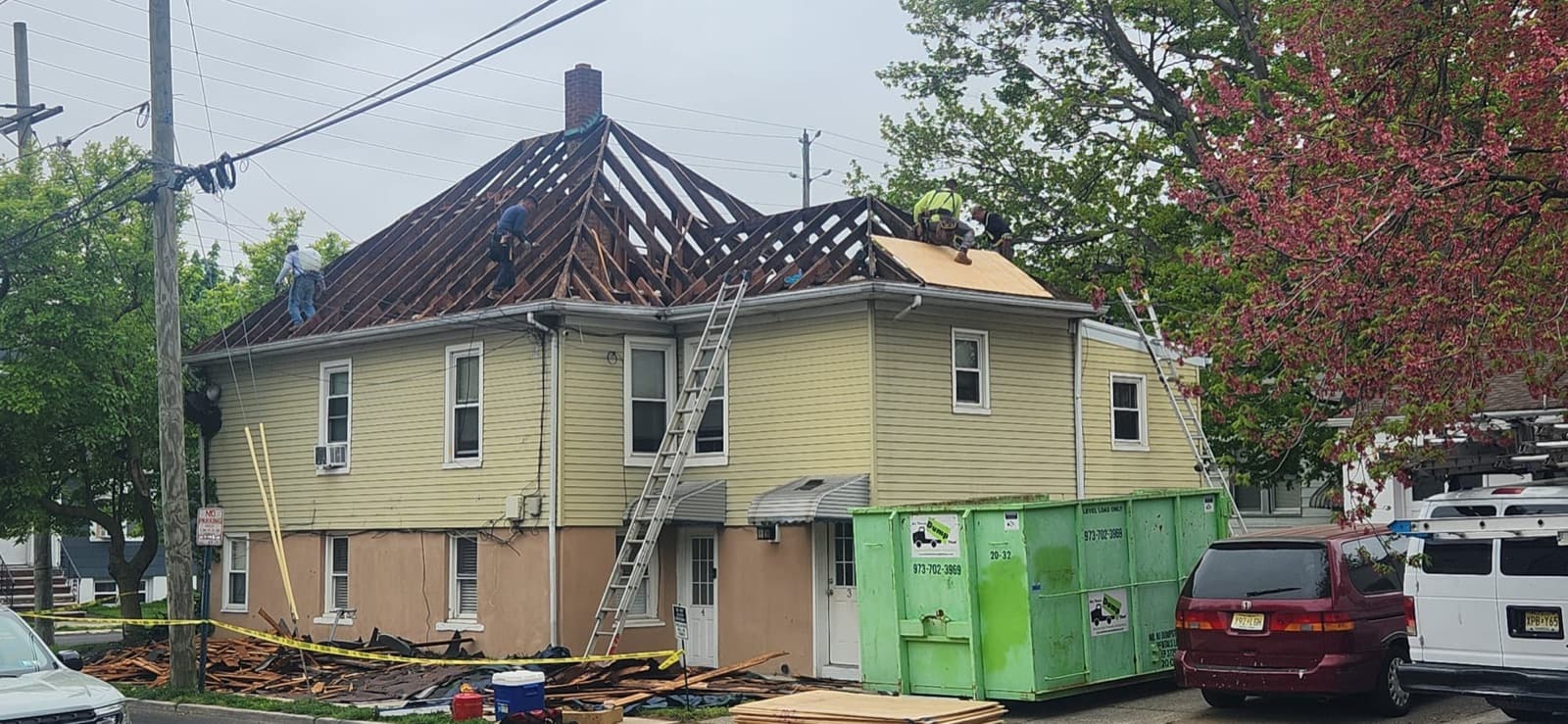
Roof Repair in Lyndhurst, NJ
Lyndhurst licenses contractors itself, and the code makes every license application a public document — carrier, policy number, workers' comp expiry, revocations in other towns. You can read your roofer's file before you pay a deposit. We write ours to be read.
Most of hiring a roofer is taking somebody's word for it — the insurance, the workers' comp, whether the last town he worked in threw him out. In Lyndhurst you do not have to. Section 4-15.8 sets out the construction code official's duties, and two of them are written for homeowners rather than for the township. He is to ensure "That the applications for local contractor's license are public documents and made available for inspection and copying by any interested person." And: "He shall notify the owner of the property on which work is to be done by the contractor if the contractor does not carry public liability insurance." Not may. Shall.
What puts a roofer in that filing cabinet is § 4-15.1, drafted wide: work for a fee that adds or removes rooms, dormers or other structures, improves, modernizes or modifies existing rooms or structures, or amounts to any improvement for which a building permit is required, on a structure where persons reside or will reside once the work is finished. The form lists a roofing and siding contractor as a classification an applicant checks off. One complication we will not pretend to settle: the subsection closes with a proviso exempting firms otherwise licensed by the State of New Jersey, and New Jersey home improvement contractors have been registered rather than licensed since 2005, under a statute that arrived long after Ordinance #1872. Whether that proviso lets a state-registered roofer out of § 4-15 is a question for the Lyndhurst construction office.
- roof inspection — A written condition report is the other half of the file you can read at the construction office — one covers the contractor, this one covers the roof.
- roof leak repair — Tracing the leak first: flashing, valleys, penetrations and the details that fail long before a shingle field does.
- roof replacement — Tear-off method, decking, underlayment and the eave membrane — how a full re-roof is actually built, in one place rather than repeated on every town page.
- emergency roof repair — An open roof gets a truck at any hour. Lyndhurst is a short run from our Garfield shop.
- roof repair in Rutherford — Next door, where the zoning ordinance is also what decides how much say you have over your own roof — a different clause, reached a different way, from the pitch rule Lyndhurst keeps in § 21-5.14.
- roofing in Bergen County — The rest of our Bergen County work — coverage, crews and how a job in the south end of the county gets scheduled.
What that file tells you — and what it can't
The form asks what a homeowner would not think to ask. The public liability carrier and the policy number. The workers' compensation underwriter and when its policy expires. Years in business. Every partner, or anyone holding ten percent or more of a corporation. And whether another New Jersey municipality has revoked the applicant's license — if so, which town, and why. Clause a of § 4-15.8 obliges the official to keep that information current.
Two of the stated grounds for revocation are worth reading in the township's own words. Section 4-15.6c4: "One owner/resident complaint against the contractor for unworkmanlike or unsafe services, which complaint has been personally verified by the construction code official or his deputy." One complaint, not a pattern — provided the official verifies it himself. And § 4-15.6d: "Licensee or applicant has had any local contractor's license revoked by any municipality in the State of New Jersey for any cause other than failure to pay licensing fees." Discipline earned somewhere else does not wash off at the town line.
What the file cannot do is grade workmanship; paperwork has never kept water off a ceiling — so read the file, then judge the crew. Every line of the form has a plain answer from us: NJHIC #13VH13970900, insured, GAF certified at the entry tier, a ten-year workmanship warranty that transfers with the house. The complaint clause reads like a threat to a bad contractor and like an argument for walking the finished roof with you.
- The license application — liability carrier, policy number, workers' comp underwriter and expiration
- Any revocation disclosed from another New Jersey municipality, and the reason given
- Whether your job sits inside § 4-15 at all, given the state-licensure proviso
The container sits where the fire official allows, and the street permit comes from the police
Most crews assume the container lives beside the house. Section 7-20.4a: "Dumpsters, roll-off dumpsters, roll-off containers and PODs shall not be located within 15 feet of any building or structure. Relief from this requirement shall be obtained by application to the fire official in writing." Any building or structure counts the detached garage and the shed, not only the dwelling, which on a typical lot here rules out the apron beside the house. Relief is a written application, not a word at the curb, and § 7-20.4b caps a container on private residential property at 30 days.
The alternative is the roadway, and that permit does not come from the building department. Under § 7-20.1a it comes from the police department, valid for not more than 72 hours and renewable; under § 7-20.5 the traffic division inspects and can have a nonconforming container moved. Section 7-20.3b3 disposes of the trade's favorite shortcut in two sentences: "The exclusive use of reflective tape is prohibited. Reflective tape may be used to augment or supplement lights and/or reflectors." Lights or approved reflectors are the real standard. Which is why staging gets settled before a date is agreed, not on tear-off morning.
Monthly payment options
We work with Hearth, which shops several lenders on a single application. See your personalized options in minutes — checking does not affect your credit score, and there is no commitment.
- Loan amounts up to $250,000
- Funding in as little as 1–3 days
- No prepayment penalties
- No home equity required
Financing is provided by Hearth's lending partners, not by Precision Windows & Roofing. Rates and terms depend on your credit and the lender making the offer, and all financing is subject to credit approval.
Common questions
Does a re-roof in Lyndhurst need a construction permit?
The state exemption is narrow twice over: N.J.A.C. 5:23-2.7(c)1x reaches the roof covering only, and detached one- and two-family dwellings only. Take out rotted decking or a rafter and N.J.A.C. 5:23-2.7(b)4 puts the job back under permit as work affecting structural safety. What is particular to Lyndhurst is what travels alongside that permit: under § 2-22.10 an application for a permit on a historic site, or on a property in a historic district, is referred to the Historic Preservation Commission for a written report to the construction official, who has 45 days. Ask the construction office whether your parcel is designated before the schedule is set.
Does anyone in Lyndhurst decide what my roof is made of?
On material, color and manufacturer, nothing. Shingle returns exactly one hit in the whole Lyndhurst code — loose shingles, in a general-maintenance list at § 13-6.10 — and no municipal standard names a product. Profile is a different answer, and it sits in zoning. Section 21-5.14a3: “Flat roofs shall not be permitted in the R-A or R-B Zones. All roofs in the R-A and R-B Zones shall have a minimum 4 1/2 inch on twelve-inch pitch.” A like-for-like re-roof does not trigger it — § 21-10.3 lets a nonconforming one- or two-family house be maintained and repaired so long as no nonconformity is increased — but a change of roof form is a zoning question before it is a roofing one.
Solar panels: is a detach-and-reset finished when they go back on?
Maybe not, and it is worth asking before the panels go back. Under § 11-5.3 the fire official identifies buildings with PV systems and notifies the owner; on that notice the owner must permanently affix an approved twelve-inch by eighteen-inch reflective PV identification logo where the fire official specifies, within 10 days. The section's own applicability sentence at § 11-5.1 confusingly speaks of truss-type construction, so whether your house is in scope is a fire-official question rather than ours. If it is, that step belongs in the schedule rather than surfacing after the crew has gone.
It is a small repair, not a whole roof. Does § 4-15 still reach it?
Possibly, so ask rather than assume: the applicability clause is not confined to permitted work. Where a given repair falls is a construction-office question. The Chapter 7 container rules do not care about scope — a roll-off is a roll-off whether it fills from one slope or five.
Explore
Get your free roofing quote
Free, no-obligation on-site assessment anywhere in New Jersey — and we answer the phone 24/7.