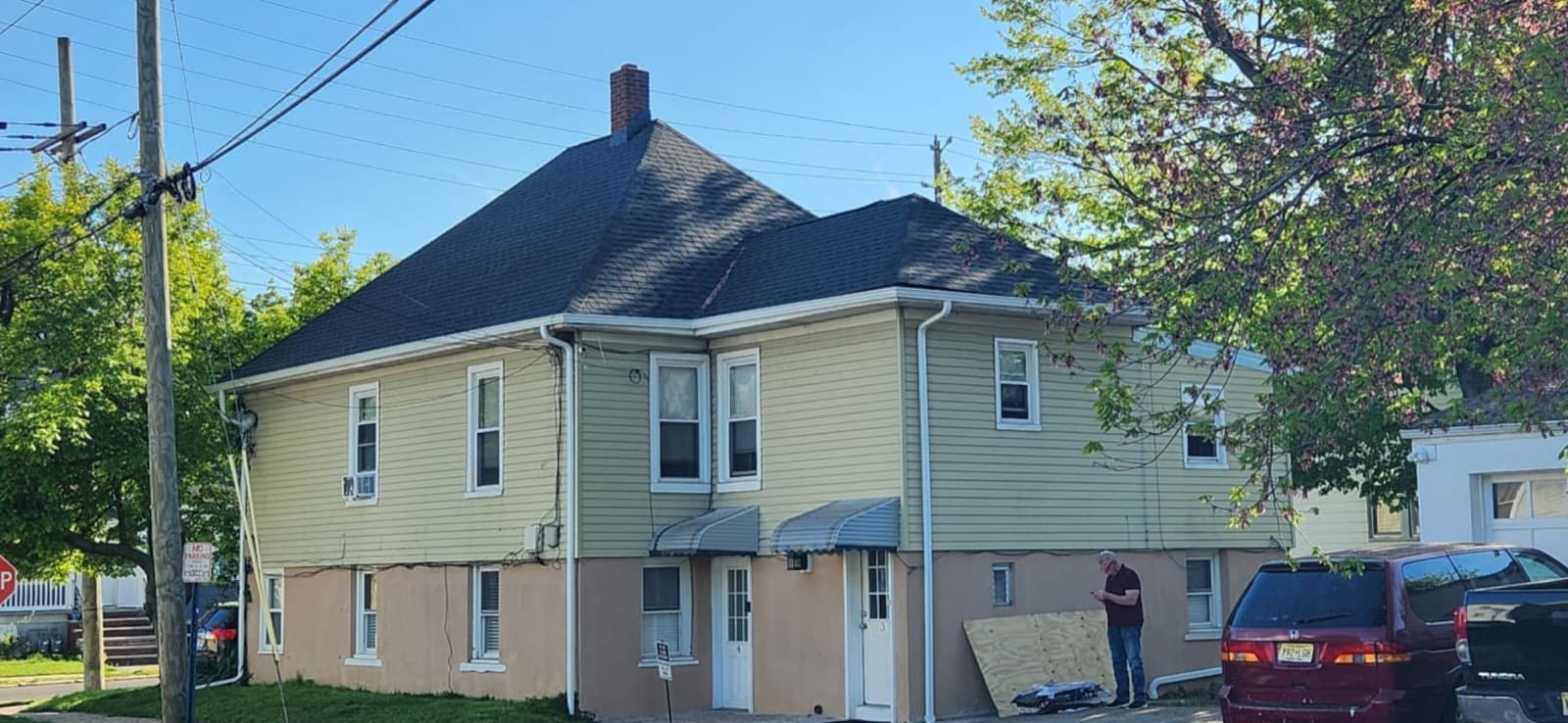
Roof Repair & Replacement in Carlstadt, NJ
Whether your Carlstadt re-roof needs a permit turns on one word in the state rule — detached — and on whether the work stops at the covering. 563 housing units here are outside that exemption from the start. Meadowlands-side commercial roofs run a second review. NJHIC #13VH13970900.
Most Carlstadt roofs are decided by one word in the state rule — detached — and 563 housing units here fall on the wrong side of it. Section 21-24 of the borough code says that inside Carlstadt's Hackensack Meadowlands District portion, “the requirements of Municipal Land Use Law, N.J.S.A. 40:55D-1 et seq., are not applicable.” Applications there are filed first with the NJSEA, which forwards them to the Borough within three business days; Carlstadt adopted the NJSEA's own master plan and codes in order to keep the approval, so the Borough still decides, out of a different rulebook. Use variances and special exceptions stay with the NJSEA. Almost no housing is on that side — the 2020 Census counted 2,563 units borough-wide, and fewer than a dozen fall inside the district, which here is industrial land rather than residential grid.
We are Precision Windows & Roofing, out of Garfield — NJ HIC #13VH13970900, GAF certified, installing GAF, Owens Corning and CertainTeed. Every roof carries a ten-year transferable workmanship warranty. Call (201) 275-9185 at any hour; an open roof does not keep business hours.
- Flat and low-slope roofing — The assembly on most district warehouse roofs, where drain and scupper placement is a design decision.
- Warehouse and commercial roofing — Carlstadt's Meadowlands side is industrial land — different permitting path, different membrane, different logistics.
- Gutters and roof leaders — How we size and hang the leaders the district's drainage rules speak to.
- Roof inspection — The dated, photographed condition report — the same record that becomes your "before" photographs.
- Roofing in Rutherford — Next door, and governed by something else: a zoning ordinance that turns on how the building is used.
- Roofing across Bergen County — Where Carlstadt sits among the county's housing worlds, and what each tends to fail on first.
The one chapter on our map that measures your roof
Chapter XXV stands up a stormwater utility under Borough of Carlstadt Public Works, and its definitions do something unusual. § 25-3: “Impervious surfaces include, but are not limited to: sidewalks… parking areas, driveways and private roads, pavements… and roofs.” The billing unit, the Equivalent Residential Unit, “has been determined to be 2,500 square feet”; a Developed Property is “a parcel in the Meadowlands portion of the municipality” carrying 300 square feet or more of impervious surface.
§ 25-5.1 takes that footage “as listed in the State Assessment Roll.” § 25-5.5 lists the practices that earn credit, “Green roofs” among them; § 25-8.6a caps the award at 35%; and the application at § 25-8.7 asks for a site plan, a maintenance plan, and “before and after photos of the installation.” Six places in the chapter confine the fee to the district portion, including the definition that carries it: § 25-5 imposes the fee on “each developed property,” and § 25-3 defines a Developed Property as “a parcel in the Meadowlands portion of the municipality.” If your parcel is not in the district, the chapter never reaches it.
The district rulebook reaches your roof, just not through a roofing standard. The Meadowlands Building Code, N.J.A.C. 19:6, is General Provisions and Foundations — Subchapter 3 is Reserved, so there is no Meadowlands shingle spec. What 19:6-1.2 does instead is make the Meadowlands Commission — whose functions the NJSEA absorbed in 2015, though the rule text still says NJMC — “acting as agent for the NJ DCA,” responsible “for the approval of all plans, for ensuring compliance with the New Jersey Uniform Construction Code,” and 19:6-1.6(b) has the municipal construction official tell applicants that plans requiring review go to NJMC before a construction permit issues. District-side roof work whose application requires plan review gets approved twice, against the ordinary state standard. What the district's own rules add is water: N.J.A.C. 19:4-8.6(b)4ix requires roof runoff “conveyed via roof leaders to a stormwater collection system, where feasible.”
Buying a roof on either side of the Carlstadt line
On the upland side — where effectively all the housing is — the answer is the ordinary state one, and it contains a word people drop. N.J.A.C. 5:23-2.7(c)1x makes “the repair or replacement of existing roof covering” ordinary maintenance on DETACHED one- and two-family dwellings: covering-only, so decking and sheathing are not in it, and detached-only, so a shared wall is not. ACS 2020–2024 puts Carlstadt at 1,311 detached single-unit homes and 847 units in two-unit buildings, but also 112 attached single-unit homes and 451 units in buildings of three units or more. Those 563 sit outside the exemption, and their re-roof is permitted work.
On the district side the roof becomes an accounted surface. A warehouse roof is not one Equivalent Residential Unit but many, and because § 25-5.1 starts from the assessment roll, the recorded footprint and the real one can diverge. If a green roof is ever in play, notice who produces the evidence: before-and-after photographs, so the picture must exist before the tear-off.
It also changes who is at the table. N.J.A.C. 19:4-8.6 is a site-plan rule — drainage plans “signed and sealed by a New Jersey-licensed professional engineer” — so it lands on district development, not on a covering replacement. When a district re-roof rides along with anything that reopens site plan, outlet count, drain and scupper placement and the receiving line become drawn decisions.
Monthly payment options
We work with Hearth, which shops several lenders on a single application. See your personalized options in minutes — checking does not affect your credit score, and there is no commitment.
- Loan amounts up to $250,000
- Funding in as little as 1–3 days
- No prepayment penalties
- No home equity required
Financing is provided by Hearth's lending partners, not by Precision Windows & Roofing. Rates and terms depend on your credit and the lender making the offer, and all financing is subject to credit approval.
Common questions
Is Carlstadt billing me a stormwater fee on my roof right now?
We will not guess. Chapter XXV is on the books, but § 25-5.2 leaves the base rate to a later ordinance or resolution, and we found no adopted rate published anywhere. Ask the Clerk. Either way, § 25-7.1 allows an appeal within 30 days of the last bill.
How do I tell which side of the district line my building is on?
By mapping, not by feel. The state's Meadowlands boundary is a published polygon and answers address by address: the DPW yard on Kero Road falls inside it, the library on Hackensack Street does not.
I own a two-family here. Do I need a permit to re-roof it?
Only if it is freestanding, and only for the covering. The exemption reaches detached one- and two-family dwellings, so a shared wall — 112 of Carlstadt's single-unit homes have one — puts you in permit territory before we start, and so does a three-family. Even on a detached two-family it ends at the covering: N.J.A.C. 5:23-2.7(b) pulls anything “affecting structural or fire safety” out of ordinary maintenance, so the moment the deck comes off, it is permitted work.
My downspouts tie into an old buried line. Does that matter?
It can, but not because of anything Carlstadt wrote for houses. The borough's prohibition on “water from roof or cellar drains” lives at § 16-4.7h, inside a chapter § 16-4 titles “Disposal of Industrial Waste” and enforces by pulling a discharger's permit — it is aimed at the industrial side, not at your downspout. What reaches a house is the plumbing subcode, which keeps storm drainage off the sanitary line. On the district side, N.J.A.C. 19:4-8.6(b)4ix wants leaders in a stormwater collection system, or failing that discharging first to “stable, vegetated areas.”
Explore
Get your free roofing quote
Free, no-obligation on-site assessment anywhere in New Jersey — and we answer the phone 24/7.