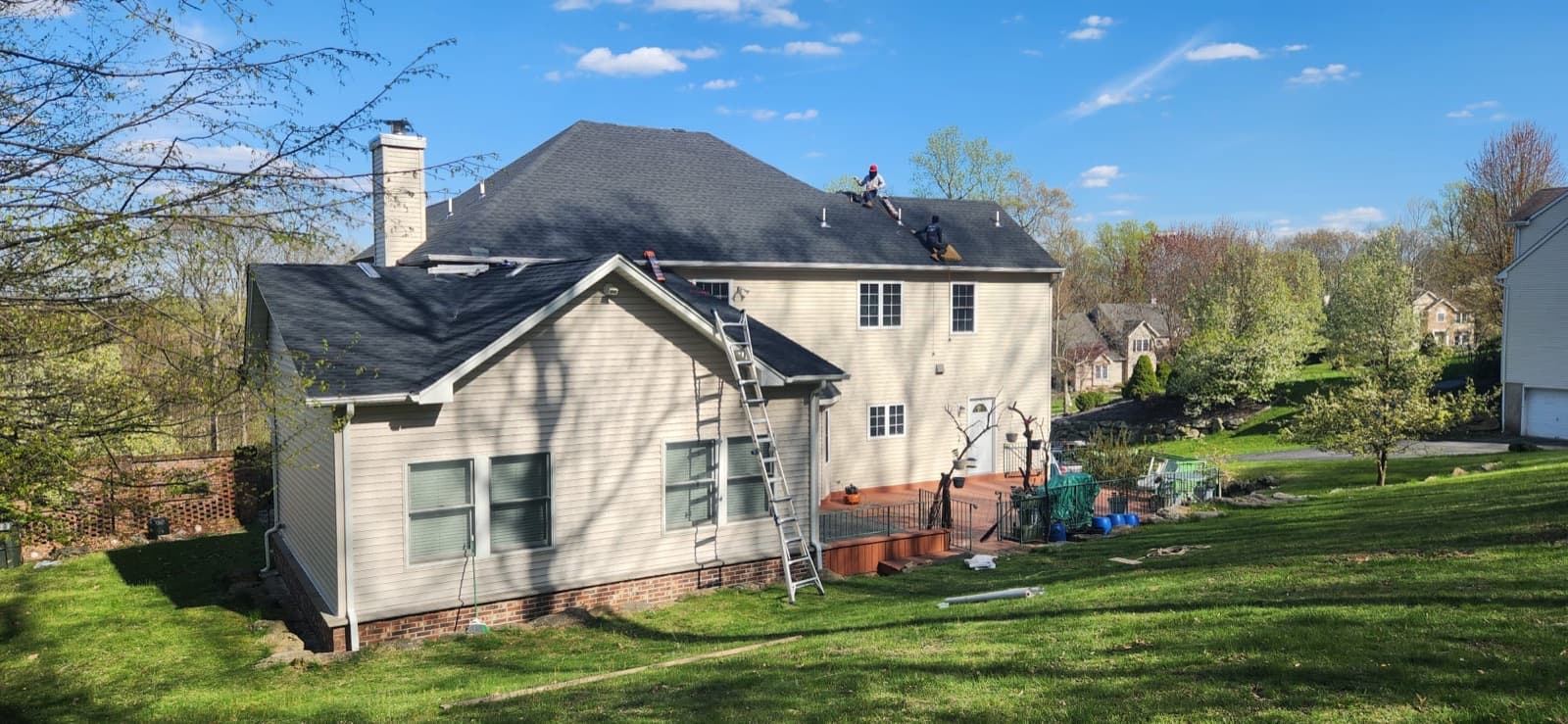
Commercial Roofing in North New Jersey
Re-roofed and repaired while the doors stay open — with the sequencing, the permit path, the insurance paperwork and the written scopes a manager, an owner or a board can act on. Across New Jersey, out of our Garfield shop.
A homeowner buying a roof is buying a material decision. An owner, tenant or property manager buying a roof is buying a schedule, a paperwork trail and a plan for the people underneath. The membrane matters, but it is rarely what goes wrong. What goes wrong is that the truck could not reach the loading door, that nobody warned the upstairs tenant about the odor, or that the roof was ordered by someone whose lease does not let them order it.
So this page is not about membranes. EPDM against TPO against PVC against modified bitumen, how the seams are made, what ponding does to a low-slope assembly — that lives on our flat and low-slope roofing page. What follows is the part of a commercial roof that a homeowner is never asked to solve: sequencing, authority, procurement, permits, and money that has to come out of a budget year.
We work out of Garfield across New Jersey. The buildings we take, and the ones we will tell you to call somebody else about, are at the bottom of this page. On credentials, be precise about what applies: New Jersey does not issue a separate commercial roofing license, so what governs your building is the permit, the insurance and the contractor's standing. Ours is NJ Home Improvement Contractor #13VH13970900 — a registration written for residential and noncommercial property, so it is not the credential that governs a building with no residence in it. The line is not where most people put it, though: the Act reaches any structure used in whole or in part as a place of residence, so a store with apartments above it sits inside that definition and the consumer-contract rules come with it. On a building that does not, what governs is the permit, the insurance and the contractor's standing — and holding the registration requires commercial general liability coverage, which is one of them. Workers' compensation on our crews. GAF Certified, which is the entry tier of GAF's residential shingle-contractor program — not its separate commercial contractor certification, and not approved-applicator status with a low-slope membrane manufacturer. Call (201) 275-9185.
- flat & low-slope roofing — The material half of the decision — EPDM, TPO, PVC and modified bitumen, seams, ponding, drains, insulation, and tear-off versus recover.
- emergency roof repair — Active leak with the building occupied — containment tonight, permanent repair scheduled properly. Reachable around the clock.
- roof leak repair — Finding the actual entry point when the stain inside is nowhere near the failure outside.
- free roof inspection — The free on-site evaluation and written summary — the documented condition report a manager, owner or board needs before anyone can approve a number.
- roof maintenance — Seasonal service on the pitched and shingled parts of a mixed building — boots, flashing, fasteners, gutters — on a spring-and-fall rhythm.
- storm damage insurance claims — How we document wind and storm damage for a carrier and stand on the roof with the adjuster. Written for a homeowners policy — the documentation method is the same on a commercial building, the policy mechanics are not.
The hard part of a commercial roof is that you cannot close
The rule governing an occupied re-roof is short and not negotiable: every shift ends with the building watertight. You open only what you can dry in and close before the crew leaves — a smaller area than the same crew would open on an empty building, which is why an occupied job takes longer than the square footage suggests. A bidder quoting your roof at the production rate of a vacant one has not thought about your building.
Odor is the constraint people forget until it becomes a complaint. Torch and hot-asphalt work push smell into a building through the same rooftop intakes your air handler uses for fresh air, so the intakes get located first, then shut down or scheduled around. Over a dental suite or a dining room, cold-applied and self-adhered systems are often the right answer even where a torched system installs cheaper.
- Access and staging — a drive-up container, a boom pick from a closed lane, and a hatch-and-stairwell carry through occupied space are three different jobs at three different labor costs, and a container or lift usually needs municipal sign-off.
- Deliveries — the one thing a business with inventory cannot have interrupted. We build the day around your delivery window rather than ask you to move it.
- Notice to tenants — a tenant who learns about the noise when it starts calls the landlord, not the roofer. Dates in writing a few days out prevents most of those calls.
The person who calls us often cannot authorize the work
Commercial calls regularly come from someone who does not own the roof — a store manager with a dripping ceiling tile, a tenant whose landlord reads the lease differently, a manager who needs three comparable bids before anything reaches an owner, a trustee who needs a vote at a monthly meeting. So the first visit exists to produce a document a decision-maker who was never on the roof can act on.
The lease usually decides more than the roof does. Triple-net arrangements put maintenance on the tenant while leaving capital replacement with the owner, and most leases never define where a repair becomes a replacement — which is exactly where the argument lives. So the scope has to be honest about which side of that line the work sits on. A patch called a replacement, or a replacement soft-pedalled as a repair, creates a problem inside our customer's lease that outlives the job.
- Landlord and tenant — send the lease clause with the inquiry. Its repair-versus-replacement language usually determines who we are actually working for.
- Property manager, board or congregation — a manager needs bids comparable line by line and a trail an owner can approve from; a board decides at a meeting on a calendar, so quotes get held to survive that timeline.
- Multiple tenants, one roof — the failure is often not above the suite that is complaining, and why water travels that way is explained on our flat and low-slope page. Everyone under the affected area belongs in the schedule conversation, not just the one who called.
Roof leaking right now? We answer 24/7.
The documents that get requested before the price
Line-item scopes we already do on every job, residential included. What changes on a commercial building is the stack that arrives before anyone looks at a price: the certificate of insurance and whatever endorsement sits behind it, the W-9 and vendor onboarding, lien waivers at each draw, a scheduled bid walk. The most misunderstood item in that stack is the first one requested.
Send us the insurance clause with your inquiry and we will take it to our agent before we bid, so you get a straight yes or no on additional-insured status rather than a certificate that looks like one. Worth knowing, and it applies to every bidder you are considering: read the box at the top of an ACORD 25. The form states in its own text that it is issued as a matter of information only, that it confers no rights upon the certificate holder, and that if the holder is to be an additional insured, the policy must contain additional-insured provisions or be endorsed. A certificate does not make anyone an additional insured — an endorsement does.
- Insulation R-value, stated as a number — this is where two bids stop being comparable. Where the work is classified as a renovation, N.J.A.C. 5:23-6.5(e)11 requires that work creating or exposing the roof decking on an assembly that is part of the building thermal envelope have accessible insulation voids filled to the R-values in Table R402.1.3, Table R402.2.6, or Table 5.5-4 or 5.5-5 of the commercial energy code, as applicable — on a Group B, F, M or S building, the commercial tables. Table 5.5-4 or 5.5-5 of the commercial energy code, not to whatever was up there in 1988. Classified as a repair, the roof falls under N.J.A.C. 5:23-6.4 instead, which carries no equivalent insulation requirement — one more reason the work category is worth settling before anyone prices it. A bid priced like-for-like on insulation is a lower number for a different scope, so ask every bidder for the target R-value and the insulation and cover-board thicknesses that reach it.
- Unit rates in the bid documents, so the bids stay comparable — deck replacement and wet-insulation removal are the quantities that move once a roof is open, and a bidder who leaves them as an allowance while another prices them per square foot is not a bid you can put side by side for an owner. What drives those numbers is on our flat and low-slope page.
- Lien waivers and the vendor packet — conditional versus unconditional, partial versus final, and who signs at each draw, plus the W-9 and vendor onboarding a property manager needs before a purchase order can be cut.
- A real bid walk with roof access arranged, so every bidder sees the same defects. Anyone quoting off a satellite image is quoting a different building.
The rule that lets a house re-roof with no permit does not reach your building
The permit exemption most people have heard of is real and it is narrow: N.J.A.C. 5:23-2.7(c)1x makes the repair or replacement of existing roof covering ordinary maintenance — no permit, no notice — on detached one- and two-family dwellings only. The list says of itself that it is not all-inclusive, so the absence of a roofing clause is not the end of the argument on its own. What gives it weight is what sits two items down. Siding gets (c)1xi for one- and two-family dwellings, then (c)1xii adds a narrow provision written expressly for buildings other than one- and two-family dwellings — like material, capped at 25 percent of total exterior wall area. The drafters knew how to extend an exemption to non-residential buildings; they wrote that clause for siding and none for roofing — which is why we settle it with the construction official rather than read the omission for you.
Losing the exemption is not the same as losing the schedule, though. An attached one- or two-family dwelling drops out of ordinary maintenance — the exemption says detached — but can land in minor work at N.J.A.C. 5:23-2.17A(c)1ii: renovation or alteration work in an existing one- or two-family dwelling, provided no primary structural members are altered in any way and the work does not constitute reconstruction. That path turns on classification. (c)1ii reaches renovation and alteration, not repair, and the Group B, F, M and S provision at (c)1iv does not reach a dwelling — so the same roof classified as a repair is not minor work under either. Notice first, work second, once the category is settled.
What almost no owner has been told is that needing a permit does not always mean waiting for one. N.J.A.C. 5:23-2.17A opens by stating that the issuance of a permit is not required before minor work may proceed: notice to the enforcing agency comes first, the work may begin, and the permit application follows within five business days. The category at 2.17A(c)1iv is repair and/or renovation work in a Group B, F, M or S occupancy — offices, factories, mercantile and retail, storage and warehouse — performed in accordance with N.J.A.C. 5:23-6, and it expressly does not reach work that is already ordinary maintenance. Inspection follows within three business days of the request, or a later date inside 30 days if the enforcing agency and the owner agree to one, which is worth confirming rather than assuming. The official closes it with a certificate of approval, not a new certificate of occupancy.
The occupancies absent from that list are the ones to flag early. Group E schools and Group R apartments and hotels are not in it, so those need the permit issued before work begins. A house of worship depends on its size: IBC 303.1.1 classifies a building or tenant space used for assembly purposes with an occupant load of less than 50 persons as Group B, which is on the list, while a sanctuary at or above 50 is Group A-3, which is not. A storefront congregation and a 300-seat sanctuary can sit on opposite sides of the same rule, which is why we settle the classification rather than assume it.
The Main Street building with two apartments over a store is the case people get wrong. It is not one occupancy — the storefront and the dwelling units above it classify separately, and 2.17A(c)1iv reaches Group B, F, M and S only. Nothing on that list covers the Group R portion, so the notice-and-proceed path cannot be assumed for the roof over the apartments.
Two determinations have to land before anyone schedules, and neither is ours to make. One is the building's occupancy classification, a building-subcode question for the construction official. The other is the work category: N.J.A.C. 5:23-6.2(b)2 has the construction official, in consultation with the appropriate subcode officials, classify all work as one or more of repair, renovation, alteration, reconstruction, change of use and addition — and the minor-work path at 2.17A(c)1iv reaches repair and renovation only. Classified as an alteration or a reconstruction, the same roof loses notice-and-proceed. We settle both with your municipality before scheduling.
- Any building — work affecting structural or fire safety is outside ordinary maintenance entirely (N.J.A.C. 5:23-2.7(b)4).
- Inspections — deck and insulation get looked at while they are still visible, and N.J.A.C. 5:23-2.18(c)2 is explicit that the work shall not proceed in a manner which will preclude the inspection until it has been made. On minor work it matters more, not less: under 5:23-2.17A(d)2 the inspection shall be based upon what is visible at the time of said inspection, and the certificate of approval shall so indicate — so anything already covered is simply not in it.
Roof leaking right now? We answer 24/7.
Commercial roof repair, replacement, or a split across two budget years
Repair or replace is a different question here, because the answer has to survive a budget conversation. The technical half is usually knowable — is the insulation wet, and is the membrane failing in one place or in many at once. The business half is what you need from us: how many more years a repair honestly buys, and what that does to the year the money has to exist.
A commercial roof is often several roof areas of different ages rather than one surface, and where that is true, replacing the worst area this year and the next one next year is a legitimate plan. What it requires is a decision about the tie-in: a phase boundary set mid-field, through a drain sump, or across the low point between two slopes becomes the leak that gets blamed on the new roof. Phase lines belong at an elevation change, an expansion joint, a parapet, or a roof-area edge.
Phasing is wrong outright when the deck is compromised or wet insulation is widespread, and that is not only a mobilization argument — at that point the code may bar a recover and force a full tear-off, which reprices the whole plan. The test itself is on our flat and low-slope roofing page. Get that answer before you build a two-year budget around a recover.
- Occupied versus vacant — the same square footage takes longer when every shift has to end dry, so a production rate borrowed from an empty building is the first thing to question in a low bid.
- Capital versus expense — a repair and a replacement land differently in a budget and in a lease, and the scope has to say plainly which one it is.
- The tie-in detail — a phase boundary is a permanent termination that has to be built as one, and it belongs in the first year's scope, not the second's.
What is under the leak decides whether this is a tonight job
On a house, the loss is a ceiling. Here the loss is the hours the business is closed, and the roof is only the thing causing it. So the first question is not how big the hole is — it is what the room is worth per hour: a rack of servers, a walk-in with product in it, a sanctuary with an organ in it, or a tenant whose business stops the moment the ceiling grid comes down. That answer, not the size of the opening, decides whether we are coming tonight.
The order of operations once we are on the phone — people, then electricity, then evidence, then water — is the same on any building, and it is laid out step by step on our emergency roof repair page. What is different here is that the evidence matters more, not less: on a loss with business-interruption exposure, what the water reached has to be documented before anything is moved or tarped. Containment above a dropped ceiling frequently keeps a business open through the afternoon while the permanent repair waits for daylight.
Roof leaking right now? We answer 24/7.
The buildings we are right for, and the ones we will tell you we are not
Sort it by who is buying rather than by what the building looks like, because that is what actually changes the job: a single owner-occupant, a small landlord with tenants above the shop, a professional condominium or a board that has to vote, a congregation with a trustee committee, and a property manager carrying somebody else's building. Under those owners sit storefronts and the apartments above them, small multi-tenant offices and professional suites, houses of worship and their halls, small warehouse and flex buildings, and three- and four-family properties, which are run like commercial buildings even though the consumer-contract rules that protect a homeowner still apply to the work we do on them.
What we are not is an industrial or high-rise roofing contractor, and we are not the right bidder for a roof that requires a full-time site safety officer, a project bond, or prequalification through a contractor-vetting network. Say so at the walk and we will tell you on the spot rather than consume a bid cycle.
Monthly payment options
We work with Hearth, which shops several lenders on a single application. See your personalized options in minutes — checking does not affect your credit score, and there is no commitment.
- Loan amounts up to $250,000
- Funding in as little as 1–3 days
- No prepayment penalties
- No home equity required
Financing is provided by Hearth's lending partners, not by Precision Windows & Roofing. Rates and terms depend on your credit and the lender making the offer, and all financing is subject to credit approval.
Common questions
Do we have to close the business while you work on the roof?
Almost never the whole building. The work gets phased so the crew opens only what it can dry in and close the same shift. What can require clearing one area for a set window is a boom pick over an entrance, hot work above an air intake serving occupied space, or material moving through a stairwell.
Do you do commercial roof repair, or only full replacement?
Most commercial calls start as a repair, and plenty of them end there. On a Group B, F, M or S building a repair is also the clearest case for the minor-work path at N.J.A.C. 5:23-2.17A(c)1iv — notice first, work second — which is why the repair-or-replace answer here can change your schedule and not only your price. A full replacement depends on how the construction official classifies the work, so that is worth settling early rather than at the permit counter. Where a membrane actually fails, and the condition thresholds that end a repair conversation, are on our flat and low-slope roofing page.
Does a commercial re-roof need a permit in New Jersey?
Generally yes. The exemption people have in mind — N.J.A.C. 5:23-2.7(c)1x, which makes replacing a roof covering ordinary maintenance with no permit and no notice — is written for detached one- and two-family dwellings only. But needing a permit is not the same as waiting for one: on a Group B, F, M or S occupancy (office, factory, retail, warehouse) a repair or renovation is often minor work under N.J.A.C. 5:23-2.17A, where notice comes first, work may proceed, and the application follows within five business days. Both the occupancy group and the work category are the construction official's call, so we settle them before scheduling.
We are a small congregation in a storefront. Are we treated as an assembly building?
Not necessarily, and the difference decides your schedule — an occupant load under 50 is Group B and can often start on notice, while at or above 50 it is Group A-3 and the permit has to issue before work begins. We confirm the occupant load with your construction official rather than assume it, and the permits section above walks the code path through.
Our building is a store downstairs with two apartments above. Which rule applies?
Not one rule — the storefront and the apartments classify separately, and the minor-work list reaches Group B, F, M and S only, none of which covers the residential portion. So a storefront timeline cannot be assumed for the roof over the apartments. It is the case worth checking first, and the permits section above sets out what it does to scheduling.
Can you name our building owner as an additional insured on your certificate of insurance?
Not with a certificate alone — that is the single most common misunderstanding in the vendor packet. A certificate is informational; additional-insured status comes from an endorsement on the policy. Send us your insurance clause with the inquiry and we take it to our agent before we bid, so you get a yes or no rather than a certificate that looks like one. Ask every bidder for the endorsement, not the certificate.
Our landlord says the roof is our problem. Is it?
The lease decides, not the roof. Triple-net leases commonly put maintenance on the tenant while leaving capital replacement with the owner, and most never define where a repair becomes a replacement — which is where the argument lives. Send the clause with your inquiry and we will write the scope so it is honest about which category the work falls into.
Can we replace the roof in phases across two budget years?
Often yes, and on a building with several roof areas of different ages it is frequently the sensible plan. The condition is that the phase boundary lands where a permanent detail can live — an expansion joint, an elevation change, a parapet, a roof-area edge — not mid-field or through a drainage path. Widespread wet insulation or a failing deck ends the conversation, and not only on cost — it can also rule out a recover, which changes the number in both years.
Can you provide a manufacturer's system warranty on a commercial roof?
Ask at the walk with the specification in hand and you will get a straight answer instead of a marketing one. Be aware of what our credential does and does not cover: we are GAF Certified on the residential shingle side, which is not approved-applicator status with a low-slope membrane manufacturer. Manufacturer system warranties are issued by the membrane manufacturer, not the roofer, and approval is per-manufacturer and per-assembly. If your specification requires one on the membrane, say so and we will tell you on the spot whether we can deliver it or whether that job belongs to a contractor who holds that manufacturer's approval.
We have an active leak and we are open right now. What happens today?
Move or cover what is under it, then call — we answer around the clock. What we ask first is what the space under the leak is: inventory, equipment, a tenant's floor, a panel or an energized fixture in the water's path. That is what decides whether this is a tonight job and what gets shut off before we arrive. The full order of operations is on our emergency roof repair page. On a commercial loss, photograph before anything is moved or tarped.
Explore
Get your free roofing quote
Free, no-obligation on-site assessment anywhere in New Jersey — and we answer the phone 24/7.