Vinyl Siding Installation & Replacement in North NJ
New vinyl on additions and new construction, and full tear-off re-sides on tired walls across New Jersey — standard or insulated, with the house wrap and flashing behind it done right. Honest, itemized quotes from our Garfield shop.
Vinyl siding is the most common exterior in North Jersey for a reason: it never needs repainting, shrugs off our freeze-thaw winters, and costs a fraction of fiber-cement or cedar. But most of the failed siding we get called to across New Jersey didn't fail because the vinyl was bad. It failed because of what was, or wasn't, behind it. Siding is the visible skin of a water-management system, and when the house wrap, flashing, and fastening underneath are done wrong, the panels buckle, the sheathing rots, and the water ends up inside the wall. A new install or a re-side is the one chance you get to build that layer correctly.
That's the part we obsess over. Precision Windows & Roofing came up on window and glass work, which is really water-intrusion work: flashing an opening so a driving Nor'easter can't push rain past it. Siding is the same problem at the scale of a whole wall. This page is about putting siding on — new walls, additions, and whole-house replacement in standard or foam-backed insulated vinyl — with the wrap and the flashing behind it treated as the actual job, not an afterthought. If what you have is damage to siding you intend to keep, that's a different job and it's on our siding repair page. From our Garfield shop we cover North Jersey and the rest of the state on scheduled routes, registered under HIC reg.# 13VH13970900.
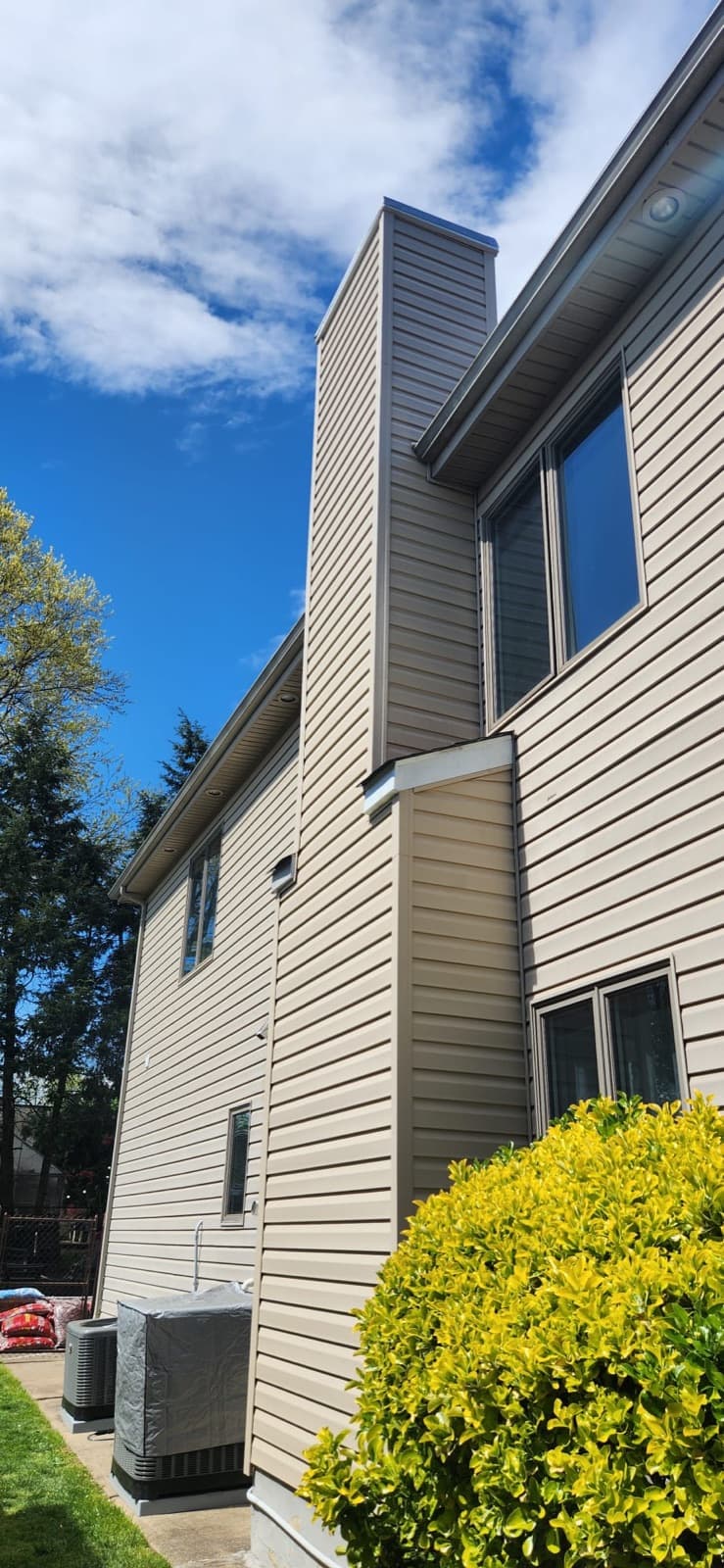
Recent work in New Jersey
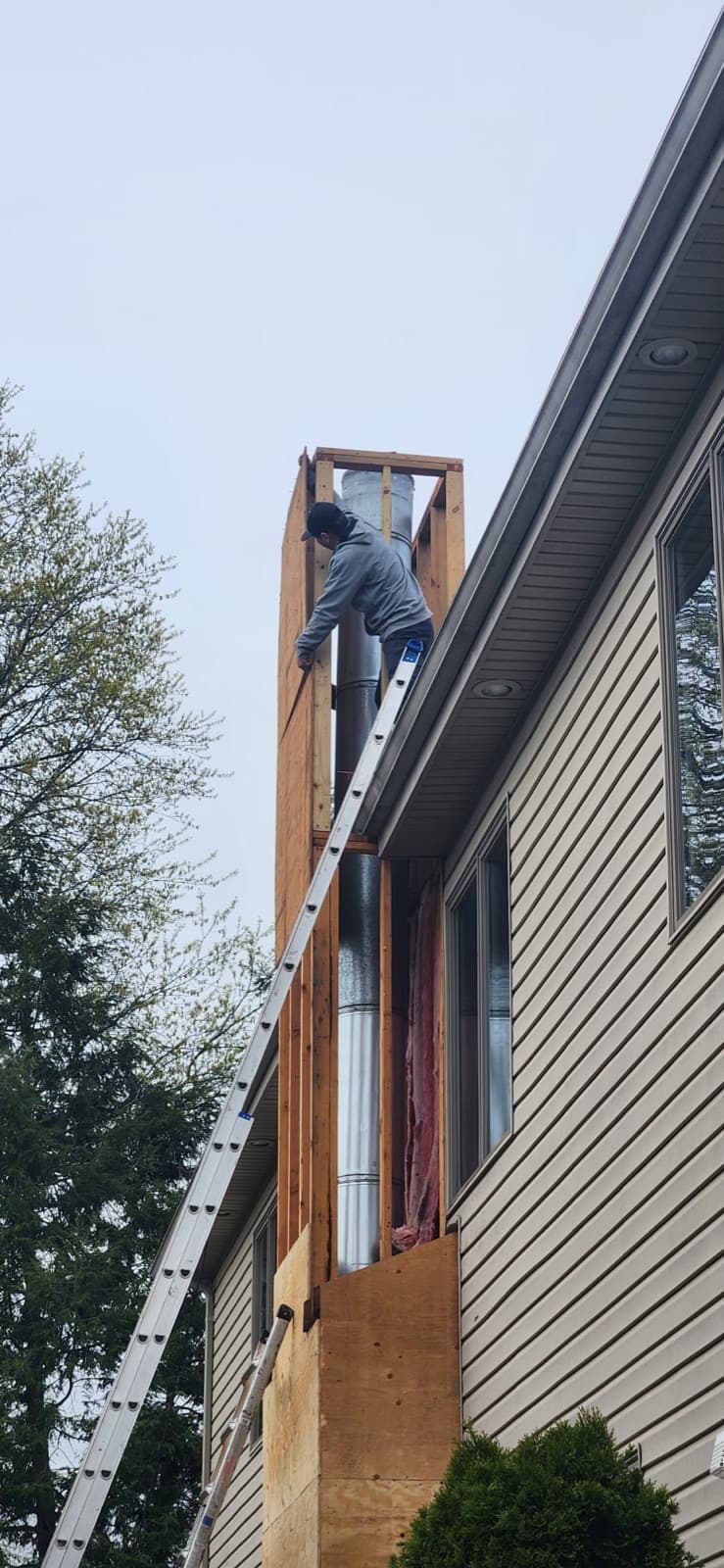
What a siding installation actually includes
The work splits two ways: fresh vinyl on a wall that has never had it — an addition, a dormer, new construction — and a complete tear-off and re-side on a tired 1960s Cape or split-level. Standard vinyl and foam-backed insulated vinyl both, plus the trim package that actually makes a job look finished. A re-side is the moment everything behind the panels is accessible, so it is also when the house wrap gets replaced properly and the window and door flashing gets renewed — the cheapest opportunity you will ever have to correct a leak-prone opening.
- New install on additions, dormers, and new construction
- Full tear-off and re-side, with sheathing and rot repair included
- New water-resistive house wrap across the whole wall, lapped in the correct order
- Insulated (foam-backed) vinyl upgrades for energy and rigidity
- Trim, corner posts, J-channel, soffit, fascia, and freeze board
- Window and door flashing renewed while the wall is open
House wrap is the real weather barrier
Here is the thing most homeowners never hear: vinyl siding is not watertight, and it was never designed to be. It sheds the bulk of the rain and lets the wall breathe, but wind-driven water gets behind it in every storm. What actually keeps that water out of your framing is the water-resistive barrier — the house wrap fastened to the sheathing underneath. New Jersey's building code requires it: vinyl has to go over a water-resistive barrier, and the wall assembly has to be built so water cannot accumulate inside it. The wrap blocks liquid water while staying vapor-permeable, so it works as a secondary drainage plane and any moisture that does get in can dry back out instead of rotting the studs. Skip it, lap it upside-down, or re-side straight over torn wrap — all things we find on failed jobs — and you have turned the wall into a sponge.
Roof leaking right now? We answer 24/7.
Flashing the openings — our window background
Nearly every water problem we trace behind siding starts at an opening or a transition, not in the open field of the wall. The code calls out exactly these spots — the perimeter of every window and door, wall penetrations, where a wall meets a roof, chimneys, and deck ledgers — because that is where water finds a path in. Flashing is what closes those paths, integrated with the house wrap in the right shingle-lap order so water is always directed out and down, never in. This is the crossover from our window work: we have spent years flashing individual openings to stop leaks, and a siding job is dozens of those same details on one house. When we re-side, we do not just cut the vinyl around your windows — we check and correct the flashing at each one first.
Vinyl has to hang loose
Vinyl moves a lot with temperature — a full-length panel can grow close to half an inch between a January morning and a July afternoon. That is why it is engineered to hang loosely on the nails, not pinned tight to the wall. The manufacturing standard, ASTM D3679, builds the room for that movement in — elongated nail slots, a specified coefficient of linear expansion, and windload requirements. Best practice on the wall is center-pinning: you fasten snug only at the middle slot so the panel expands evenly toward both ends, and you leave the nail heads a touch proud so the panel can slide. Drive the nails tight, nail off-center, or leave no gap at the trim, and the panel has nowhere to go, so it buckles and waves in the heat. Wavy siding on a sunny wall is almost always this — an install error, not a product defect. It is also why storm ratings matter here: the same standard tests windload up to 110 mph, and North Jersey's Nor'easters and tropical-storm gusts find every loose or over-driven panel.
Roof leaking right now? We answer 24/7.
The energy case for foam-backed vinyl
Plain hollow vinyl siding has almost no insulating value on its own — an R-value of roughly 0.6, essentially nothing. Insulated vinyl bonds a contoured rigid-foam backer to each panel, adding about R-2 to R-5 of continuous insulation across the whole wall. That word continuous is what matters: it lays an unbroken layer over the studs, cutting the thermal bridging where heat normally short-circuits straight through the framing. On an older North Jersey house with 2x4 walls and thin cavity insulation, that continuous layer is often the single easiest efficiency gain you can make from the outside. The foam also stiffens the panel so it lies flatter and resists impact, and it dampens sound — manufacturers cite third-party testing showing outside-noise reductions of up to around 39% from the foam backing. We will walk you through whether insulated is worth it for your specific walls and exposure rather than upselling it by default.
When a wall has actually earned a re-side
We do not push replacement, so here is the line we draw. If the damage is isolated to a panel or two, the cracks are small, the siding is not ancient, and no moisture has gotten behind it, that is a repair — we swap individual panels one course at a time and match your profile, and our siding repair page covers how that goes on vinyl, aluminum, and fiber cement. What cannot be patched is buckling. When panels are warping and pulling away from the wall, when you press on them and find soft or spongy spots, when water stains are showing up on interior walls, or when you are patching the same area over and over, the siding is telling you moisture is already trapped behind it — and a warped panel cannot be re-secured, because the warp is the symptom, not the cause. Widespread damage, or siding much past 20 to 25 years with no matching panel left in production, is where a full re-side stops being the upsell and starts being the cheaper path. Storm damage is its own case: sudden wind or impact damage from a covered event is often an insurance claim, and we document it thoroughly — dated photos, measurements, and a clear scope — so you can file honestly. We cannot promise a carrier will approve a claim, but we make sure yours reflects exactly what happened.
Roof leaking right now? We answer 24/7.
Profiles, color, and how long it lasts
Vinyl comes in more looks than people expect. The common profiles are Dutch lap (a crisp shadow line, the North Jersey default), traditional clapboard lap, vertical board-and-batten for gables and farmhouse fronts, and beaded for a more traditional face — in a wide range of colors and textures, including wood-grain embossing. Well-installed quality vinyl lasts 20 to 40 years, and premium product with a yearly wash can push past 50. It is low-maintenance, not maintenance-free: a soapy-water rinse once a year keeps it clean, and unlike wood it never needs repainting or recaulking. On color, know that darker shades absorb more UV and fade faster than light ones, though UV-stabilized panels hold their color much longer. Warranties track the grade — premium lines commonly carry 25-year to lifetime limited fade coverage, often prorated, while basic product runs closer to 10 to 15 years. No siding is warranted against all fading; the coverage is against excessive fade as the warranty defines it, and we will show you exactly what a given product's warranty does and does not promise before you choose.
What affects the cost
| Wall area, not floor area | Siding is priced by exterior wall square footage — a 2,000 sq ft two-story home typically carries roughly 2,300 to 2,600 sq ft of wall, and taller colonials have proportionally more surface to cover. |
|---|---|
| Standard vs insulated vinyl | Foam-backed insulated panels cost more per square than standard vinyl but add continuous R-value, rigidity, and sound damping. |
| Profile and grade | Board-and-batten and premium wood-grain lines run higher than a basic Dutch lap, and thicker panels with stronger fade warranties cost more. |
| Tear-off and what's behind it | Removing and disposing of old siding, plus any sheathing or house-wrap repair we uncover once the wall is open, add labor and material. |
| Trim, soffit, and fascia scope | Wrapping fascia in aluminum, replacing rotted soffit, and the corner-post and J-channel package all factor in beyond the field siding. |
| Openings and flashing | More windows and doors means more flashing and cut detail — the work that actually keeps the wall dry. |
| Height, access, and stories | Second- and third-story walls, steep grade, and tight lot access need staging and more labor than a walk-up ranch. |
| Repair vs full re-side | Swapping a few panels is a fraction of a whole-house job, though matching a discontinued color on an older wall can add sourcing time. |
We don't bundle a mystery number — you get a firm, free on-site quote, approved before any work starts.
Monthly payment options
We work with Hearth, which shops several lenders on a single application. See your personalized options in minutes — checking does not affect your credit score, and there is no commitment.
- Loan amounts up to $250,000
- Funding in as little as 1–3 days
- No prepayment penalties
- No home equity required
Financing is provided by Hearth's lending partners, not by Precision Windows & Roofing. Rates and terms depend on your credit and the lender making the offer, and all financing is subject to credit approval.
Common questions
How do I know if I need a full re-side or just a repair?
Lean toward a full re-side when panels are warping or pulling away from the wall, feel soft when pressed, are leaving water stains on interior walls, or the siding is past about 20 to 25 years with no matching panel still in production. Warped panels in particular cannot be re-secured, because the warp means moisture is already trapped behind them. A repair is the better answer when the damage is limited to a panel or two, the cracks are small, and no moisture has gotten behind it — that work is covered on our siding repair page. We give you the honest call on-site, with the cost of each path.
Does vinyl siding actually keep water out of my walls?
Not by itself — and it is not supposed to. Vinyl sheds most rain and lets the wall breathe, but wind-driven water gets behind it in every storm. The real weather barrier is the water-resistive house wrap behind the panels, which New Jersey code requires, plus proper flashing at the windows, doors, and other transitions. That layer blocks liquid water while staying breathable so the wall can dry out. When siding leaks into a house, the wrap or the flashing is almost always the failure, not the vinyl.
Is insulated vinyl siding worth the extra cost?
Often, on an older North Jersey home. Standard hollow vinyl has an R-value near 0.6, essentially none, while foam-backed insulated vinyl adds roughly R-2 to R-5 of continuous insulation across the whole wall — cutting the thermal bridging that lets heat escape straight through the studs. It also stiffens the panels so they lie flatter and resist impact, and it dampens sound. Whether the payback justifies the upgrade depends on your walls, insulation, and exposure, and we will lay that out honestly rather than default you into it.
My siding looks wavy and buckled — is that a defect?
Almost always it is an installation error, not a bad product. Vinyl expands and contracts significantly with temperature, so it has to hang loosely on the nails with a small gap at the trim and be center-pinned so it can grow evenly. If it was nailed too tight, fastened off-center, or butted hard against the trim, the panel has nowhere to expand and buckles in the heat. In many cases we can re-hang or replace the affected sections correctly so it lies flat again.
Can you match new panels to my existing siding?
Usually, yes, when the profile and color are still made — we match the profile, texture, and color so a repair blends into the wall. Vinyl does fade over time, especially darker colors under UV, so a brand-new panel can read slightly brighter than 15-year-old siding next to it. If the exact color is discontinued we source the closest current match and place repairs where the difference is least visible. We will tell you up front how close a match to expect.
Will my insurance cover storm-damaged siding?
Sudden damage from a covered event — high wind, hail, or impact — is often claimable, while gradual wear, fading, or age-related failure generally is not. We cannot promise any carrier will approve a claim, but we document the damage properly with dated photos, measurements, and a clear repair scope so your claim reflects exactly what happened. If your roof or gutters took damage in the same storm, we can assess those at the same visit.
How long does vinyl siding last, and how much upkeep does it need?
Quality vinyl that is installed correctly typically lasts 20 to 40 years, and premium product with light care can go past 50. It is low-maintenance, not maintenance-free: a rinse with soapy water once a year keeps it looking good, and unlike wood it never needs repainting or recaulking. Darker colors fade faster under sun than lighter ones, though UV-stabilized panels hold color much longer, and fade warranties run from about 10 to 15 years on basic lines up to 25-year or lifetime limited coverage on premium ones.
Explore
Get your free roofing quote
Free, no-obligation on-site assessment anywhere in New Jersey — and we answer the phone 24/7.