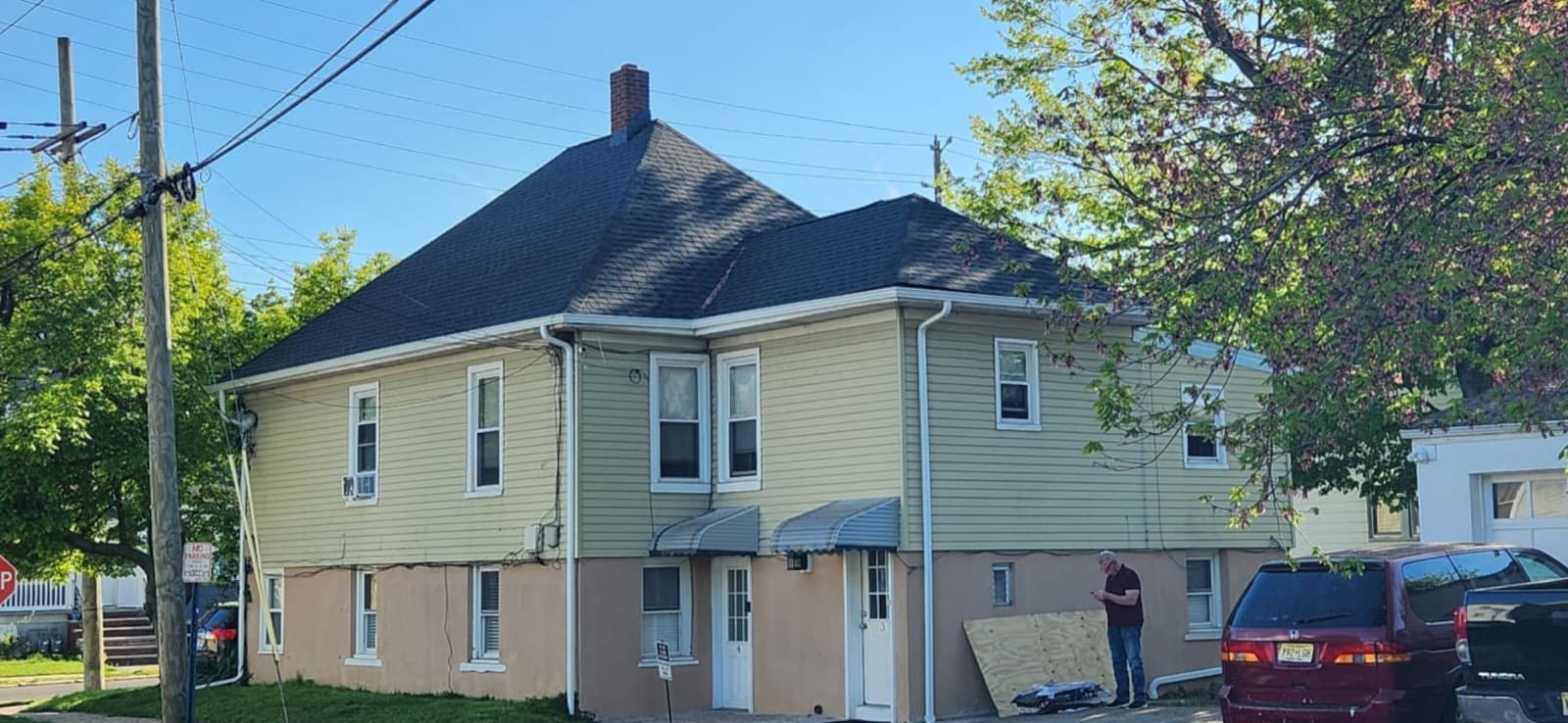
Roof Repair & Replacement in Elmwood Park, NJ
The borough orders your roof kept weather- and raintight; rent control decides how a landlord recovers the cost of a new one. Tear-offs, leaks, flashing and gutters — measured, itemized, written for whoever reads it after you. NJHIC #13VH13970900.
Two chapters of the Elmwood Park Borough Code pull against each other over your roof. Chapter 11, the Housing Code, makes keeping the roof, gutters, flashing and cornice weather- and raintight a standing duty of owner-occupants and landlords alike. Chapter 13, Rent Control, rations how a landlord gets that money back: ordinary increases are capped at 2.5% a year, and a new roof comes back, if it comes back at all, as a major capital improvement — filed with the rent board, ruled on, and disclosed to every affected tenant by certified mail. About 43% of occupied homes here are rented, and roughly 56% of those renters live in two-, three- or four-unit buildings (ACS 2019-2023 estimates). So a re-roof estimate here can end up a document other people read.
Our shop is at 163 Midland Ave in Garfield, the next town over, so an open roof here is a short run at any hour. NJHIC #13VH13970900, insured, GAF Certified — the entry tier of GAF's residential shingle-contractor program — with a ten-year transferable workmanship warranty. Call (201) 275-9185 for a free written estimate, measured on the roof rather than off a satellite picture.
- Roof inspection — The dated, written condition report that Section 11-3.23 makes worth having in a drawer - what we look at, and what comes back in writing.
- Full tear-off and re-roof — The method itself: strip to the deck, what we do when the plywood is soft, underlayment, ice-and-water, flashing and ventilation. Same work here as anywhere in Bergen County.
- What a re-roof estimate should itemize — Squares, scope lines and service life - how the estimate is built, which is the same information a capital improvement filing has to disclose.
- Gutters and leaders — Section 11-3.23 names gutters and rain conductors in the same breath as the roof. This is the page on sizing, hanging and terminating them.
- Roof maintenance — What keeping a roof "in good repair" looks like year to year - and why letting it slide is its own exposure on a building with a tenant in it.
- Emergency roof repair — Open roof, active leak, storm damage overnight. How the after-hours call works and what gets done before daylight.
One chapter orders the roof kept tight. The next one rations the money.
The Housing Code side is one sentence. Section 11-3.23: "Every roof, roof gutter, flashing, rain conductor and roof cornice shall be weather- and raintight and shall be kept in good repair." It sits inside a list introduced by Section 11-3.18, which bars anyone from occupying "as owner-occupant or let to another for occupancy any dwelling" failing those requirements - same standard either way. Section 11-3.2 names the Health Officer or Construction Official as the Public Officer, and Section 11-3.13 lets the Borough Council correct an uncorrected defect at borough expense and recover it against the premises.
The money side is Section 13-6. A landlord "may seek additional rental for major capital improvements or services", but must notify each tenant by certified mail of "the total cost of the completed capital improvement ... the number of years of useful life of the improvement as claimed by the landlord ... the total number of square feet of the dwelling ... the total square feet occupied by the tenant and the capital improvement surcharge he is seeking from each tenant." The Board determines whether an improvement is major, though Section 13-4.1 makes its powers advisory - nothing is final until the Mayor and Council act on it - and "no increase authorized by this section shall exceed 10% of the tenant's rent." Section 13-7b separately forbids reducing "service, amenities, maintenance" without the Board's prior consent.
None of it is dormant. The body Chapter 13 calls the Rent Stabilization Board sits today as the Rent Leveling Board, meeting at the Municipal Building, 182 Market Street, reachable at 201-796-1457, ext. 2018.
Write the estimate for the third reader
Read Section 13-6 as a specification and it tells you what a capital improvement filing has to contain: a completed cost, a claimed useful life for the roof, and enough measurement to split a building by square footage. A scope, a square count, a stated service life - none of it exotic, but it has to exist before the work, not after.
Who the chapter reaches is narrower than it sounds and wider than owners expect. It exempts buildings under four units only "providing the landlord rents or offers for rent no other housing space in the Borough of Elmwood Park" - the exemption turns on the landlord, not the building. Own the two-family you live in and rent nothing else in town and the exemption reads as yours; pick up a second rental in the borough and the first can come back in. No public list answers this by address; the Rent Leveling Board is the place to confirm it.
Tenant or no tenant, none of this touches the roof itself: tear-off, decking, flashing and shingle choice are the shared work the pages below cover. The borough has no historic preservation ordinance, so color and profile are yours to pick, and whether the job needs a permit is a state question rather than a borough one: N.J.A.C. 5:23-2.7(c)1x makes replacing the covering ordinary maintenance on a detached one- or two-family dwelling — narrower than it sounds in a borough this full of two-to-four-unit buildings; opening structure is not. What changes here is the record, because Section 11-3.23 is a standard the borough can enforce on its own initiative.
Monthly payment options
We work with Hearth, which shops several lenders on a single application. See your personalized options in minutes — checking does not affect your credit score, and there is no commitment.
- Loan amounts up to $250,000
- Funding in as little as 1–3 days
- No prepayment penalties
- No home equity required
Financing is provided by Hearth's lending partners, not by Precision Windows & Roofing. Rates and terms depend on your credit and the lender making the offer, and all financing is subject to credit approval.
Common questions
There is a reflective symbol on my electric meter. What is it?
Section 10-6, adopted February 4, 2010. The Construction Official decides whether a structure contains engineered lumber - "prefabricated I-joists, truss joists, truss rafters, and laminated beams and studs" - and affixes a reflective symbol to the meter, designed by the Fire Department and lettered to show where that lumber sits. Existing buildings are included. Truss rafters are roof framing, so the placard tells your roofer what is holding the roof up.
Can I put a roof over the back stairs and landing?
Yes, within a stated limit. Section 10-5 lets an existing platform or staircase attached to a dwelling be "covered by a roof or roof-like structure that is open to the outside air and not enclosed by walls, knee walls, permanent or removable windows, screens, or any combination thereof," with columns "only" for support. Cover it, do not close it in.
Where do the old shingles go, and where can the container sit?
Chapter 27 defines construction and demolition debris to include scrap asphalt and asphalt shingles, designates it recyclable, and in Section 27-1.5a makes separating designated recyclables mandatory for owners, lessees and occupants. Our crews remove the tear-off. Placement is the open question - the code does answer it: § 22-1 requires a written permit, approved by the Borough Engineer and issued by the Construction Official, before a container goes on a street or right-of-way.
Explore
Get your free roofing quote
Free, no-obligation on-site assessment anywhere in New Jersey — and we answer the phone 24/7.