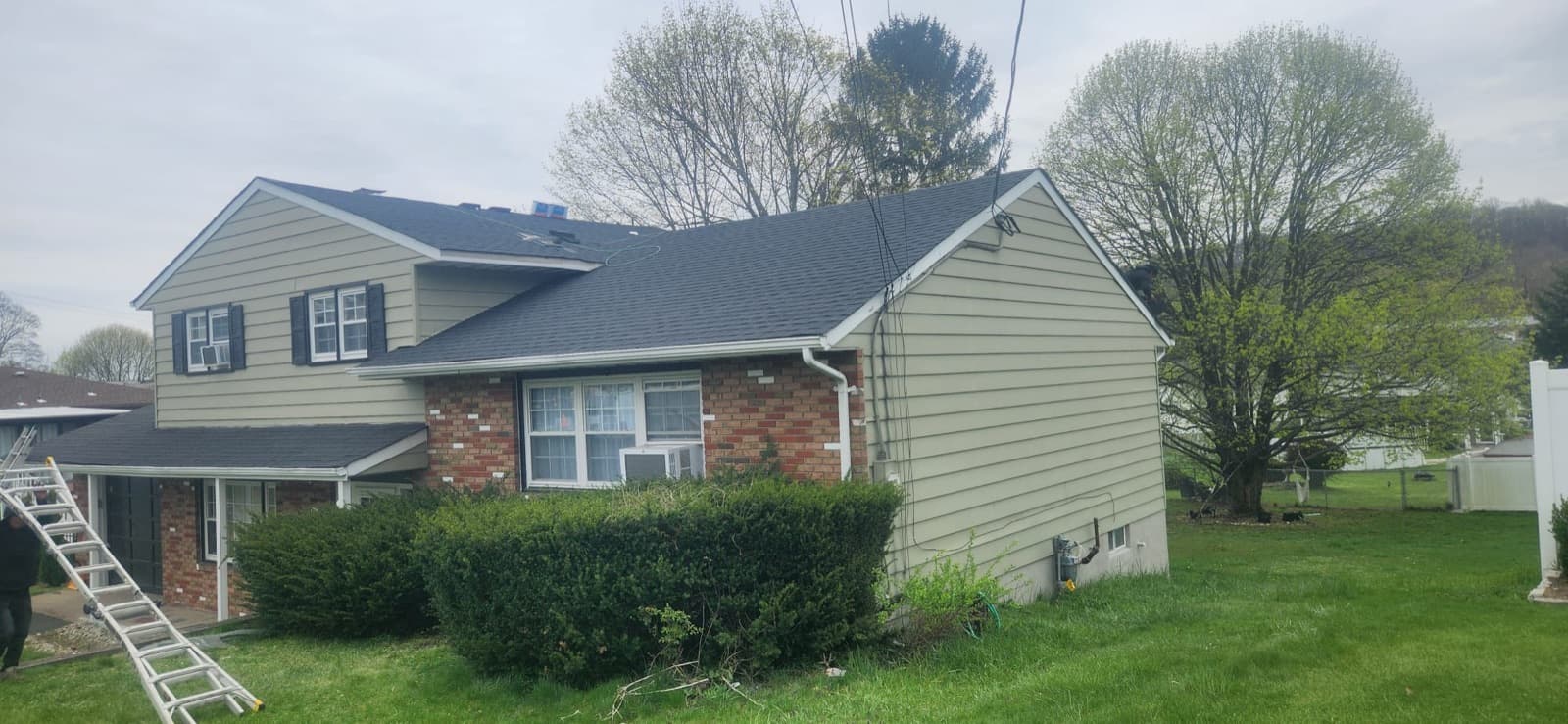
Roof Maintenance in North New Jersey
A working visit, not a walkthrough. We clear the valleys, reseal what has opened, replace split pipe boots, reset backed-out fasteners, flush the gutters, and check that the attic is still breathing — on a spring-and-fall rhythm built around what a North Jersey winter actually does to a roof.
A shingle roof gets sold as one number — 30 years, 50 years, lifetime — and that number describes the shingles. The rest of the roof runs on much shorter clocks. Asphalt roof cement at a counter-flashing skins over, shrinks, and cracks. Ridge-cap nails work their way back out as the deck moves. Neoprene at a plumbing-vent boot hardens and splits, and it does that years sooner on the sunny side of the house than on the shaded side. None of it is a defect and none of it is anyone's fault; it is ordinary wear on the consumable parts of a system, and it is why roofs that were installed perfectly still start leaking at year twelve.
Maintenance is the service call that deals with those parts on a schedule instead of waiting for a ceiling to raise the subject. We work the roof rather than survey it — debris out of the valleys and off the back of the chimney, sealant renewed where it has opened, a split boot swapped on the spot, loose tabs hand-sealed, gutters cleared and outlets flushed, and a look from inside the attic to confirm the soffits are still pulling air. You get dated photos of what we touched and a short note on anything we're watching.
In this climate that settles into a spring-and-fall rhythm, and the two visits genuinely do different work. Plenty of houses only need the once-a-year version, and that is a fine answer for them. Call (201) 275-9185 and we'll walk the roof before quoting anything — the visit gets scoped to what is actually up there, not to a package.
- Chimney flashing leak repair — Whether your chimney is one the code requires to have a cricket, and the flashing repair that lasts.
- Gutter cleaning — How often a particular North Jersey lot actually needs clearing, and why the late-fall date can't slip.
- Ice dam removal — A wall of ice at the eaves is a separate problem with a separate fix.
- Roof inspection — A different product, not a step in this one: diagnostic, written up with photos, and the right call when you are buying, selling, or fresh off a storm. Ours is free.
- Roof replacement — What a full tear-off and re-roof actually involves, for the point where maintenance stops being the smart spend.
A 30-year roof made of 12-year parts
Homeowners tend to picture roof failure as the shingle field wearing out evenly, like tread on a tire, until one day it's done. That is almost never how it goes. The field is the part engineered to shed water and it is generally the last thing to quit. What quits first is the short-clock hardware threaded through it — rubber, sealant, fasteners, and metal — most of which is designed to be serviced, and almost none of which ever is.
Knowing the individual clocks is what makes a maintenance visit worth the trip. A crew that knows a boot is due around year twelve looks at boots at year ten. A crew that doesn't waits for the stain.
- Pipe boots — a rubber part living in full sun. Roughly ten to fifteen years is a normal service life for the collar, but the identical boot ages visibly faster on a south- or west-facing slope than on the north side of the same roof. Exposure, not age alone, tells you which ones to check first.
- Sealant — asphalt roof cement and the sealant packed into a counter-flashing reglet are maintenance materials, not permanent ones. They shrink as they cure out and open a hairline that rain finds long before you do.
- Exposed fasteners — ridge caps, vent end-caps, and any face-nailed detail loosen as the deck expands and contracts through the seasons. A backed-out nail is a hole with a shingle sitting over it.
- Seal strips — architectural shingles bond course to course on a heat-activated adhesive. A tab that a February gust breaks loose will not reliably re-bond on its own, and it stays a wind target until somebody hand-seals it.
- Valleys and the back of the chimney — wherever the roof concentrates water it also concentrates debris. The uphill face of a chimney is the worst offender, and on the many older North Jersey chimneys built without a cricket behind them, that face is a debris trap by design. Whether yours is one the code requires to have a cricket is covered on our chimney flashing page.
- Flashing metal — step, counter, and valley flashing will outlive the shingles when it stays clear and drains. Buried under a wet mat of leaf litter for six months a year, it corrodes on a much shorter schedule.
What actually happens when we're up there
The difference between maintenance and a report is that we arrive with materials. Small work gets done on the visit — a boot, a fastener, a run of sealant, a lifted tab — rather than written up and quoted back to you later. Anything larger than that gets photographed, explained, and priced separately, because we'd rather you knew the difference than found a structural repair buried in a routine invoice.
A typical residential visit works front to back like this:
- Debris — valleys, the uphill side of chimneys and skylight curbs, and every roof-to-wall transition, cleared by hand rather than blown down across the shingles.
- Flashing and sealant — chimney counter-flashing, sidewall and dormer step flashing, valley metal, and skylight perimeters checked and re-sealed where the material has opened. Anything actively failing at a chimney becomes its own flashing repair, which we cover on the chimney flashing page.
- Pipe boots and vents — checked for stiffening, surface cracking, and pull-away at the collar. A split boot is replaced during the visit.
- Fasteners — backed-out nails at the ridge, hips, and exposed details reset and sealed.
- Shingles — lifted tabs hand-sealed, cracked or missing pieces replaced from matched stock where we can match it, and granule loss noted against the roof's age.
- Gutters and downspouts — cleared, hangers and seams checked, outlets flushed so the roof's drainage actually terminates somewhere useful. How often a particular lot needs clearing is its own question, and the North Jersey calendar behind it is on our gutter cleaning page.
- Attic and ventilation — a look from inside with a light: staining on the sheathing, daylight where there shouldn't be any, rust on the nail shanks poking through the deck (which says the space is holding moisture), and whether the intake path at the eaves is still open.
- Documentation — dated photos of what was serviced, plus a short written note on anything we're watching but chose not to act on yet.
Roof leaking right now? We answer 24/7.
Why spring and fall are not interchangeable visits
There is a material reason the two visits can't be swapped, and it has nothing to do with tradition. Asphalt shingles seal themselves: each course carries a strip of adhesive that softens in sun and warmth and bonds the tab above it down. That chemistry has a season. A tab lifted loose in late November sits unbonded through the entire storm half of the year, because the roof will not get warm enough to re-seal it until spring. Hand-sealing it in October takes a minute and a tube of cement. Finding it in February is a different kind of day.
So the fall visit is a deadline more than a checkup. Everything loose gets fastened and sealed while there is still warmth to seal it with, and every drainage path gets cleared once leaf drop has finished overlapping with the start of the coastal storm season. Nor'easters run from roughly September through April and are at their most frequent and most severe from December into March — that is the window the fall visit is built against.
The spring visit is the repair-heavy one, because it is cleaning up after a season of expansion and contraction. Freeze-thaw cycling works on everything that moves: sealant opens, fasteners walk back out of the deck, drip edge and gutter pitch take ice load, and winter storms leave debris packed into every valley. Spring is also when meltwater damage finally becomes visible from inside. If your eaves grew a wall of ice this year, that is a separate problem with a separate fix, and it's on our ice dam page.
The condition your warranty quietly assumes
A shingle manufacturer's limited warranty covers manufacturing defects in the shingle. It does not cover weather, it does not cover installation error, and it does not cover neglect. What surprises homeowners is how coverage actually erodes in the real world — rarely through a dramatic exclusion, and very often through ventilation. The major manufacturers, CertainTeed among them, reserve the right to shorten the warranty period and cut back the non-prorated start-up coverage on shingles installed over a deck that isn't adequately ventilated. Your own warranty document is the authority on exactly how yours is worded, and we'll read it with you rather than characterize it for you.
The code baseline behind that clause isn't complicated: IRC R806.2 sets a minimum net free ventilating area for the vented space, halved when intake and exhaust are properly balanced — soffit intake low, ridge exhaust high. Our roof replacement page walks through the arithmetic. What matters for maintenance is the part nobody plans for: ventilation is not a condition a house gets once at installation and then keeps. It drifts. A re-insulation job packs cellulose over the soffit vents with no baffles behind it. A bath fan gets dumped into the attic instead of ducted through the roof. A ridge vent's external filter mats over with dust and pollen. None of that announces itself, and a maintenance visit is the only routine occasion when anyone actually goes up there and looks.
So the accurate claim is narrow, and worth stating as such: a maintenance visit does not extend your warranty, and no contractor can make it do that. What it does is keep the conditions your warranty assumes — a deck that breathes, flashing that's intact, water that drains — from drifting out of spec without anyone noticing. It also leaves you a dated photo record, which matters on the day you actually file a claim and someone asks how the roof was cared for.
Roof leaking right now? We answer 24/7.
Maintenance versus a roof inspection
These get used interchangeably and they are two different products. A roof inspection is diagnostic. It answers how much life is left and what it would take to repair or replace, it produces a written report with photos, and it's the right call when you're buying or selling, when a storm just came through, when a home inspector flagged the roof, or when you simply don't know how old the thing is. Ours is free, and the detail is on the roof inspection page.
Maintenance is recurring service. Same eyes, same checklist in places, but the crew brings boots, sealant, ridge cap, and fasteners, and the point of the visit is that the small stuff gets fixed before we leave the driveway. The practical test is what happens next: an inspection ends in a decision, a maintenance visit ends in work. If a visit turns up something past the scope — rotted decking, a leak already inside the wall, a flashing detail that needs rebuilding rather than resealing — it stops being maintenance and becomes a repair with its own quote, which is how it should be handled.
Black streaks, moss, and the wrong way to remove either
The dark streaks running down the north-facing slope of half the houses in Bergen County are Gloeocapsa magma, a blue-green algae that feeds on the limestone filler in asphalt shingles and produces a dark UV-protective sheath — the sheath is what you're actually looking at. It takes hold on the slopes that stay damp longest. Left alone it is mostly cosmetic. Moss is the one that does structural harm: it holds moisture against the shingle mat, and as the cushion thickens it lifts shingle edges and works water backward under the courses.
The removal method matters more than most homeowners realize, because the common approach destroys the roof. The Asphalt Roofing Manufacturers Association is explicit that asphalt shingles must not be pressure-washed, and that going at them with a stiff brush or a broom is no better — the friction strips granules and drives the roof toward premature failure. ARMA's recommended treatment is a 50:50 mix of laundry-strength liquid chlorine bleach and water, applied with a sprayer, given time to work, then rinsed off with low-pressure water, with plantings below pre-wet and protected. ARMA also flags the obvious hazard, which is that a roof treated this way becomes slick — a good argument against doing it yourself off a ladder.
Prevention is cheaper than treatment. The reason the shingles directly beneath a galvanized vent or a copper flashing are always the clean ones is that rain carries trace metal ions down the slope and algae won't colonize behind it. A zinc or copper strip run near the ridge does the same thing across the whole plane, and it's a sensible add on a shaded roof we're already maintaining.
Roof leaking right now? We answer 24/7.
When maintenance is only deferral
There's a point where servicing a roof stops buying life and starts buying months, and not naming that point is how homeowners end up spending real money on a roof that needed replacing two winters ago. The tells are consistent: granule loss across the whole field rather than in the wear paths, grit in the gutters after every rain, curling or cupping over multiple slopes, shingles that crack under a knee instead of flexing, and more than one soft spot underfoot in the deck. At that stage the flashing details are usually still fine and the field is finished — which is exactly the failure maintenance cannot solve.
We also decline a claim that gets repeated a lot in this corner of the trade: that maintenance adds some specific number of years to a roof. The life-extension figures that circulate come out of commercial low-slope roofing studies rather than residential asphalt shingles, and moving them onto your house would be misleading. Nobody can tell you how many years a maintenance program adds to a particular shingle roof.
What is defensible is narrower and more useful: maintenance changes which failure you get. It doesn't stop shingles from aging out, and it won't turn a twenty-two-year roof into a thirty-year roof. It does keep the roof from failing early at a cracked boot, a dried-out reglet, a clogged valley, or a suffocated attic — the four failures that put water in a ceiling long before the shingles were done. Once the field itself is spent, the next conversation is a replacement, not another visit.
What affects the cost
| How far behind the roof already is | The first visit on a roof nobody has serviced in fifteen years is a catch-up job — years of debris, several boots at end of life, sealant to renew everywhere. The second visit a year later is a fraction of it. Maintenance cost is heavily front-loaded, which is the practical argument for starting before there is a backlog to clear. |
|---|---|
| Size, pitch, height, and access | A walkable ranch and a steep cut-up colonial with a third story are different days of work. Steep or fragile roofs need staging and fall protection, and some slopes have to be serviced from ladders and edges rather than walked at all. |
| Penetration and transition count | Every chimney, skylight, dormer, valley, and vent is its own detail to clear, check, and seal. A simple gable roof with two plumbing vents takes a small share of the time a cut-up roof with six penetrations and three valleys does. |
| Materials actually consumed on the visit | A visit where nothing needs replacing costs less than one where three pipe boots, a length of ridge cap, and a full re-seal of the chimney counter-flashing go in. We break out what was used, so you can see what was labor and what was material. |
| Tree cover and whether the gutters ride along | A roof under heavy canopy carries a bigger debris load and takes longer to clear, and some lots want an extra pass in a bad year. Folding the gutters and downspout outlets into the same visit costs less than booking that trip separately. |
We don't bundle a mystery number — you get a firm, free on-site quote, approved before any work starts.
Monthly payment options
We work with Hearth, which shops several lenders on a single application. See your personalized options in minutes — checking does not affect your credit score, and there is no commitment.
- Loan amounts up to $250,000
- Funding in as little as 1–3 days
- No prepayment penalties
- No home equity required
Financing is provided by Hearth's lending partners, not by Precision Windows & Roofing. Rates and terms depend on your credit and the lender making the offer, and all financing is subject to credit approval.
Common questions
Your roof inspection is free — can I just take that instead?
You can, and for a lot of callers it's the right place to start. The inspection tells you what condition the roof is in and what it needs; it doesn't fix anything, because the crew isn't carrying materials for it. Maintenance is the other half — the visit where boots, sealant, ridge cap, and fasteners come up the ladder and the small work gets handled on the spot. If you don't know the roof's age or condition yet, start with the inspection. If you already know the roof is sound and you want to keep it that way, book the maintenance.
Does every house really need two visits a year?
No, and we'd rather right-size it than sell a second trip. What pushes a roof onto a twice-a-year rhythm is complexity and debris load: multiple valleys, several penetrations, a chimney or two, heavy canopy overhead, or a roof already past fifteen. A newer roof on an open lot with a simple gable and two plumbing vents is a reasonable once-a-year house — and if it's only getting one visit, take it in fall, because that's the one with a hard weather deadline behind it. We'll tell you which one you are after the first visit, once we've seen what actually accumulates up there.
Does skipping maintenance void my shingle warranty?
'Void' is usually the wrong word — coverage tends to shrink rather than vanish. Manufacturer limited warranties cover manufacturing defects in the shingle, not neglect or weather, and the reduction homeowners actually run into is ventilation-related: the major manufacturers reserve the right to shorten the warranty period and cut the non-prorated start-up coverage on shingles installed over an inadequately ventilated deck. Blocked soffit intake and unaddressed flashing failures are the two conditions that most often move a roof out of the state its warranty assumed. What yours specifically says is in your warranty document, and we'll go through it with you rather than paraphrase it.
How much of this could I do myself?
The ground-level portion, realistically. Clearing gutters where you can reach them safely, keeping branches trimmed back off the roof plane, and watching your downspout discharge for granule grit are all reasonable homeowner tasks. Where DIY tends to go badly is roof-surface work: hand-sealing tabs, resetting fasteners, and re-sealing a counter-flashing all require knowing which product goes where and how much is too much — over-caulking a reglet causes its own problems. And do not pressure-wash the roof; ARMA is direct that it strips granules and shortens the roof's life.
My roof is 22 years old. Is maintenance worth it, or am I just delaying the inevitable?
Depends entirely on which part is aged. If the field still has granule coverage, the shingles flex instead of cracking underfoot, and the deck is solid, then servicing the flashing and boots is real value — those details often outlast the shingles when they're kept up. If you've got granule loss across whole slopes, grit in the gutters, curling on more than one plane, and soft spots in the deck, maintenance is deferral, and booking you a visit would be taking your money for it. We'll walk it once and tell you which situation you're in.
Do I have to sign up for a plan, or can I book one visit?
Book one visit. There's no membership requirement and no auto-renewing anything — most people start with a single catch-up visit, see what came out of it, and decide from there whether they want us back in the spring. If you do want it recurring, we schedule it and call you; you're not locked into a term. Whatever the arrangement, New Jersey requires any home-improvement contract of $500 or more to be in writing, and we put the scope in writing regardless of the size.
Explore
Get your free roofing quote
Free, no-obligation on-site assessment anywhere in New Jersey — and we answer the phone 24/7.