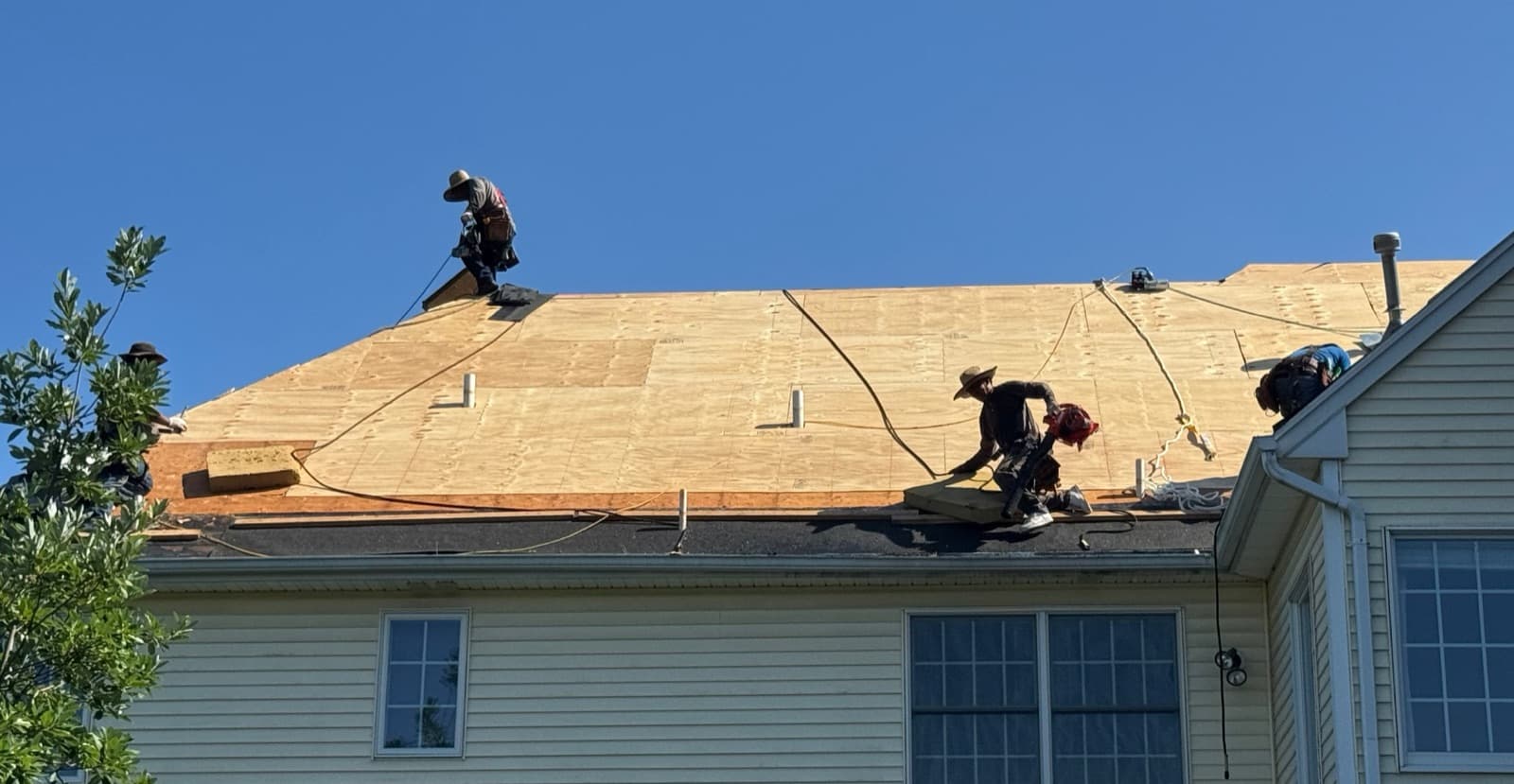
Roof Repair in Wood-Ridge, NJ
Wood-Ridge writes roof material, soffits, gutters, downspouts and leader pipes into its zoning ordinance, and the Zoning Officer inspects before a sale or a re-let. We work to that list.
In December 2021 Wood-Ridge gave the condition of your roof a second rulebook. Ordinance No. 2021-15 added a list of building defects to the special provisions of the R-1 One-Family Residential District — on top of the property maintenance chapter that already covered roofs — and it reads like a roofer's call sheet: holes in the roof, soffits or facia; missing, unsecured or disconnected roof material, gutters, downspouts or leader pipes; a structurally compromised or failing roof. A house showing any of them is, in the borough's own drafting, deemed to violate the Borough Zoning Ordinance.
Two nine-word sentences carry that standard past the single-family blocks. Section 530-7D(2): "All R-1 special provisions shall apply in the R-2 Zone." Section 530-8E(2): "All R-1 special provisions shall apply in the R-3 Zone." A clause drafted about houses therefore reaches two-family homes and apartment buildings here. And because it sits inside Chapter 530, it is also the standard the Zoning Officer certifies against before a property changes hands or a unit is re-let. One chapter, one officer, from the shingle down to the container in the driveway.
- gutter repair — Gutters, downspouts and leader pipes are named in § 530-6D(6). What re-hanging, re-strapping and replacement actually involves.
- soffit and fascia repair — The soffits and facia the ordinance lists, and what opens them up in the first place.
- roof inspection — What we look at before a certificate-of-compliance application gets filed.
- roof replacement — When the condition list points past a repair: full tear-off, decking and re-roof.
- roof repair in Rutherford — The neighboring borough that also keeps its roof standard in the zoning ordinance.
- roof repair in Hasbrouck Heights — Next door, where the zoning writes numbers onto the roof slope itself.
Your gutters are named in the zoning chapter, not the maintenance code
Section 530-6D(6) is worth reading whole: "All houses and their accessory structures and yards shall be maintained in good repair and condition. Houses and/or accessory structures and/or yards shall be deemed to violate the Borough Zoning Ordinance if they have the following conditions: broken and/or missing windows, screens, or doors; holes in the roof, soffits, facia, or siding; missing, unsecured, or disconnected roof material, siding, architectural features, gutters, downspouts, or leader pipes; structurally compromised or failing roofs, walls, foundations, architectural features, driveways, patios, decks, porches, balconies, stairs, retaining walls, fences, pools, spas, or hot tubs; fallen or dead trees or overgrown lawns, shrubs, or vegetation." The spelling of facia is the code's own.
In most towns a lifted course of shingle, an open soffit or a leader hanging off its strap is something to keep an eye on. Here each is written into the district regulations as a zoning violation, and it is the same list the Zoning Officer carries to the compliance inspection described below.
- Missing, unsecured or disconnected roof material, re-set or replaced across the affected slope
- Soffit and fascia opened up by water, animals or a failed drip edge
- Gutters, downspouts and leader pipes re-hung, re-strapped or replaced
- Holes in the roof plane, and the decking underneath them
The certificate before closing, and the container in the driveway
Article XV of the same chapter is where that list gets read out loud. Section 530-105A bars anyone from selling or transferring title to a structure or a unit in one, and from re-letting or leasing it, until they have first obtained a certificate of land use compliance certifying that the structure or unit complies with the provisions of the chapter. That chapter is Chapter 530. The trigger fires on re-letting as well as on sale, so landlords meet it far more often than owner-occupants.
Section 530-108 names the inspector, and it is not the building department. The Zoning Officer or a designee inspects the premises first, and the next sentence leaves no discretion: "The certificate will only be issued if the property so complies." A Tax Assessor or designee may walk along for assessment purposes. Which puts the roof work before the application, not after it — a defect the Zoning Officer writes down stops the certificate, and the certificate is what the closing or the new lease is waiting on. Our 10-year workmanship warranty is transferable, which matters on a house about to sell.
The container falls under the same chapter. Section 530-113: "Portable storage units and/or dumpsters may be temporarily located in single-family, multiple-family and/or commercial zoning districts, so long as they shall be placed only in the driveway, allotted parking spaces on property, are not located in the right-of-way and do not obstruct the sidewalk." Street placement is not on the table. On a narrow lot that settles the staging plan before a price is written, and you lose the driveway for the duration — it belongs in the estimate, not in a phone call the morning of the tear-off.
Monthly payment options
We work with Hearth, which shops several lenders on a single application. See your personalized options in minutes — checking does not affect your credit score, and there is no commitment.
- Loan amounts up to $250,000
- Funding in as little as 1–3 days
- No prepayment penalties
- No home equity required
Financing is provided by Hearth's lending partners, not by Precision Windows & Roofing. Rates and terms depend on your credit and the lender making the offer, and all financing is subject to credit approval.
Common questions
Does anyone in Wood-Ridge review what my new roof will look like?
Not that the code shows. We read the Wood-Ridge Code's complete chapter list and all of Chapter 10, Boards and Commissions, which establishes a Board of Health, a Board of Recreation and a Public Events Committee and nothing else. No historic preservation commission, historic district chapter or certificate-of-appropriateness process appears in the chapter list or in Chapter 10. The condition clause speaks to repair, not to appearance.
Does a re-roof in Wood-Ridge need a construction permit?
That depends on the building and the depth of the work. N.J.A.C. 5:23-2.7(c)1x treats roof covering replacement as ordinary maintenance, and that exemption carries two limits at once: the covering only, and detached one- and two-family dwellings only. Under N.J.A.C. 5:23-2.7(b)4, structural work is never ordinary maintenance, so the moment rotted decking or a rafter is replaced the job is permitted work. An attached dwelling, or an R-3 apartment building, sits outside the exemption from the start.
My roofer has the permit — can the crew start tomorrow morning?
Not under Chapter 217. Section 217-4B: "After obtaining a building permit, the person or persons doing the work shall notify the Construction Code Official 24 hours prior to commencing any work whatsoever on any building or structure." That decides whether a Monday tear-off can be booked on a Friday. Chapter 217 also requires every firm engaged in the business of reroofing or re-siding to register with the Construction Code Official (§ 217-1A), on a registration that expires each December 31 (§ 217-3).
I own a three-family in the R-3 zone. What changes for me?
Two officials on one job. The cross-reference at § 530-8E(2) pulls the R-1 condition list onto your building, so the Zoning Officer reads your gutters and soffits against the zoning ordinance. A three-family also sits outside the state's ordinary-maintenance exemption, which reaches detached one- and two-family dwellings only, so the tear-off itself is permitted work under the Construction Official.
We only need a repair, not a whole roof. Does that matter here?
Not for the ordinance. The list at § 530-6D(6) is about condition, not scope: a hole in a soffit, a downspout off the wall, one disconnected leader pipe. Any of those is on it whether the shingle field above has ten years left or not. Small work matters here, and a targeted repair can be the whole answer rather than the opening bid on a replacement.
Explore
Get your free roofing quote
Free, no-obligation on-site assessment anywhere in New Jersey — and we answer the phone 24/7.