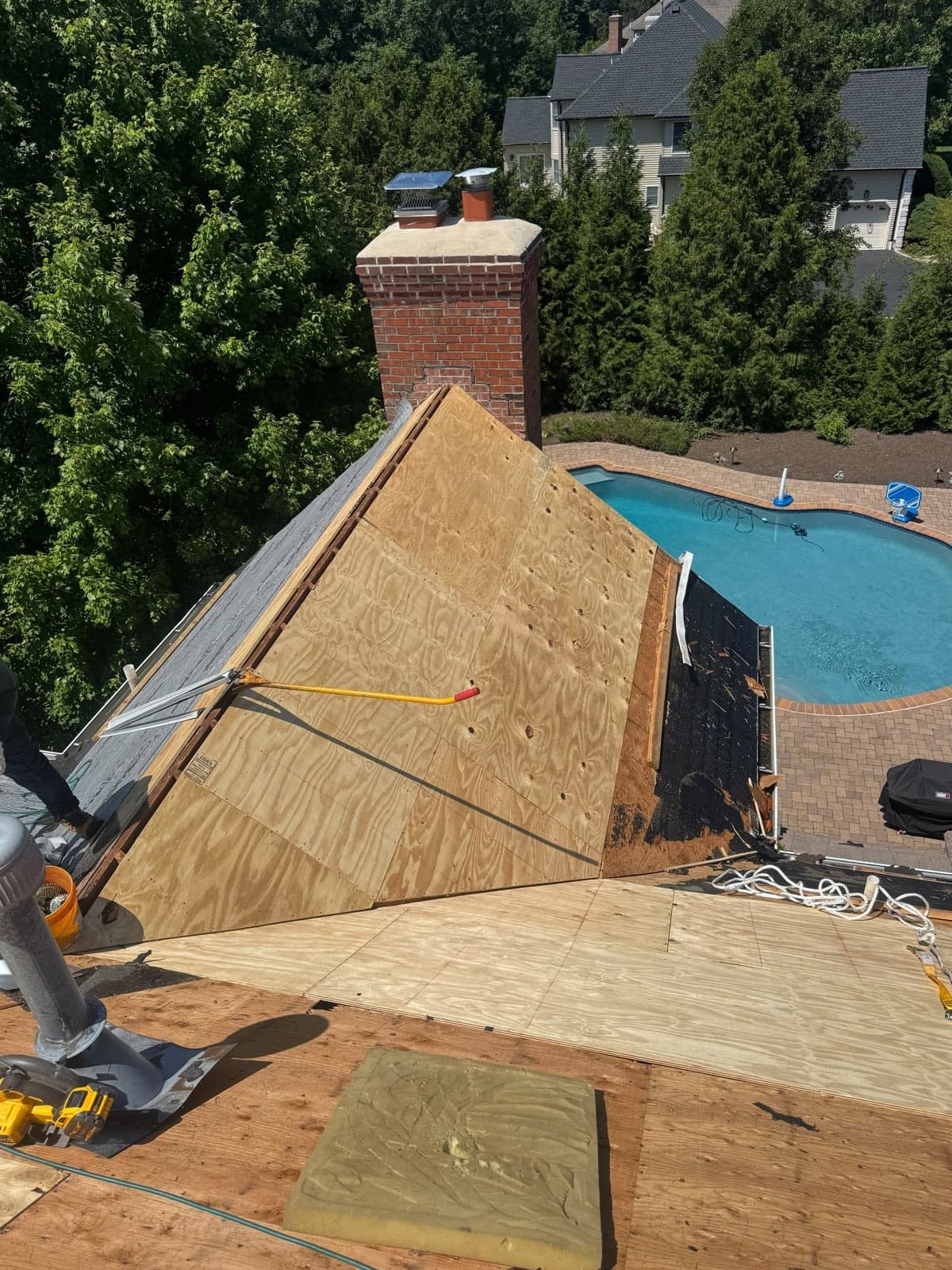
Roof Repair in Jersey City, NJ
Since 2-13-2025 Jersey City's demolition chapter names the roofline. Where a permit is required and the work alters the cornice or roofline on a front facade visible from a public right-of-way, it files as a partial demolition — Zoning Officer first, then historic review. A covering-only tear-off is not caught.
Jersey City rewrote its demolition chapter on 2-13-2025, and the word it added is the one that matters to a roofer. Jersey City Code § 105-2.1 now defines substantial deconstruction of the front facade as “any alteration to the fenestration, entranceway, porch or stoop, cornice, roofline or the material, historic or architectural components of facades which are visible from any public right-of-way.” Chapter 105 governs applications for partial demolition. So a job that alters the front cornice or roofline can file as a demolition application before it files as a roof.
Precision Windows & Roofing works out of Garfield: NJHIC #13VH13970900, GAF certified and insured, and the ten-year workmanship warranty travels with the building when it sells. (201) 275-9185 is answered at any hour. What we do differently on a Jersey City address is settle one thing before a delivery is booked — whether the work stops at the covering, or reaches the cornice and roofline on the street elevation. Those are two jobs with two calendars.
- flat & low-slope roofing — Torch-applied modified bitumen is the roof that pulls the § 131-2 Fire Safety sign-off — plus EPDM and TPO, and what a low-slope deck needs behind a street parapet.
- commercial and multi-unit roofing — B25024 puts 39,676 Jersey City housing units in structures of fifty or more. On that stock the roof is a board decision with a paper trail, and the tenants stay in place.
- 24/7 emergency roof repair — Chapter 105’s imminent-hazard route sends an opened roof straight to the Construction Official. This is the other half of that night: how a tarp is anchored so it survives the next band.
- slate, cedar & copper work — A rebuilt cornice on a Jersey City rowhouse is usually copper, slate or cedar work rather than shingle work. What those trades take, and who on our crew does them.
- roof inspection — Free, and done on the roof rather than from a photo. The line that sets a Jersey City calendar is whether your scope stops below the cornice or reaches it.
- roofing in Hudson County — The rest of the county — Hoboken, Bayonne, Union City, Weehawken — and the parapet, scupper and party-wall work that attached housing generates everywhere here.
The trigger is the front facade visible from a public right-of-way, not any cornice on the building
Read the sentence's limits before its reach. The defined term is the front facade, qualified by visibility from any public right-of-way, so a rear cornice on an interior lot is not what it names — though Chapter 105 still reaches partial demolition generally. The frame is borrowed: Hoboken's Chapter 79A carries the same sentence but stops at “cornice, or material components of the facade…” and reaches only its residential zones and Central Business District. Jersey City put in the word roofline and set no zone limit.
Chapter 105 reaches “all applications for partial demolition of a building or structure under the Rehabilitation Subcode…”, so a job generating no application never arrives here. Where it does, § 105-3.1 requires “the prior approval of the Zoning Officer…” for compliance with Chapter 345's historic preservation provisions. Section 105-3.3 gives the Historic Preservation Officer 45 days to make a finding and sets no consequence for silence. A denial goes to the Historic Preservation Commission, and it is that second 45-day clock that carries the default: “Failure to report within 45 days shall constitute a prior approval permit without conditions…”
Three details cut the owner's way. A prior approval is good for one year under § 105-3.4; an appeal from the Zoning Officer's denial lies to the Zoning Board of Adjustment under N.J.S.A. 40:55D-70(a); and § 105-3.1 sends an unsafe structure under N.J.A.C. 5:23-2.32 — whose subsection (b), Emergency measures, reaches "actual and immediate danger of failure or collapse" — straight to the Office of the Construction Official, so an open roof after a storm does not wait 45 days. One cuts the other way: Ord. No. 25-006 repealed the former § 105-4, so the written opinion on demolition eligibility is gone.
- Is the work on the front facade, and visible from a public right-of-way?
- Does it alter the cornice, roofline or visible material at the roof edge — or stop at the covering?
A property in no historic district can still draw the fifty-year question
Section 345-30.A, the ordinary certificate-of-appropriateness rule, is confined to a landmark building and to features “within a designated historic district.” Subsection E.1, added by the same February 2025 ordinance, runs the other way. It is headed “Application for Demolition Permit for Properties Not Designated as a Local Landmark or Within a Locally Designated Historic District,” and directs the Historic Preservation Officer to review those applications against criteria opening with the age of the building, “noting if the building and/or structure was constructed more than 50 years ago…”
Our Hudson County page tells readers to check whether they sit inside Van Vorst Park, Hamilton Park or Paulus Hook. That lookup still matters; E.1 means it is no longer the end of it. What decides whether any of this reaches you is whether a permit application exists at all: ACS 2020–2024 five-year table B25024, which counts housing units and not buildings, puts 135,231 units in Jersey City — 9,847 one-unit detached, 27,464 in two-unit structures — so at most 27.6% could fall inside the state exemption's word detached. Whether § 345-30 offers any hardship or waiver route is worth asking the Division of City Planning directly — the current LDO text is not published online.
The permit is the last step in Jersey City, not the first. Section 131-2, added 4-23-2025, lists nine local prior approvals — eight offices plus the plan review fee — that must be in good standing before a construction permit issues, and three are ordinary roofing items: Zoning Office approval, Traffic and Engineering for “a traffic safety plan and any street and sidewalk closures,” and Fire Safety for “combustible permits,” the desk a torch-applied modified bitumen job has to satisfy. Our East Rutherford page has one state authority reading plans before Borough Hall; this is eight desks and a fee inside a single city.
Monthly payment options
We work with Hearth, which shops several lenders on a single application. See your personalized options in minutes — checking does not affect your credit score, and there is no commitment.
- Loan amounts up to $250,000
- Funding in as little as 1–3 days
- No prepayment penalties
- No home equity required
Financing is provided by Hearth's lending partners, not by Precision Windows & Roofing. Rates and terms depend on your credit and the lender making the offer, and all financing is subject to credit approval.
Common questions
Does a re-roof in Jersey City need a permit?
Ask it as two questions. First, does the covering work pull a construction permit — N.J.A.C. 5:23-2.7(c)1x makes repair or replacement of existing roof covering ordinary maintenance only on a detached one- or two-family dwelling, and even there 5:23-2.7(b)4 pulls back out any work affecting structural or fire safety. Table B25024 caps at 27.6% the share of Jersey City units that could reach the exemption at all. Second, does the work reach the front cornice or roofline? If it does, § 105-3.1 puts the Zoning Officer's prior approval ahead of the Construction Official, and § 131-2 adds the local sign-offs.
We are outside every historic district. Can preservation review still reach us?
It can. Jersey City Code § 345-30.E.1 is written for “Properties Not Designated as a Local Landmark or Within a Locally Designated Historic District,” and routes those demolition applications to the Historic Preservation Officer, with the building's age — more than fifty years or not — the first criterion listed. It is reached only through Chapter 105, so it applies where the job is a partial demolition application; a covering-only replacement leaving the street elevation untouched is a different filing.
Our building is in RC-1. Does the code require a green roof?
The text is there, and it is blunt. § 345-45.D.5.c, a bulk standard rather than a design guideline, reads “All exposed rooftop shall provide an inaccessible true green roof.” RC-2 repeats it at § 345-45.1.D.5.c, and R-1 § 345-41.E.10.a sets a “Required performative roof ratio” once building coverage exceeds 65%. Section 345-60.A.1 reaches an existing building “moved, altered, reconstructed, added to or enlarged,” and § 345-76.A bars a permit until the alteration conforms. Whether that reaches a like-for-like membrane replacement is the Zoning Officer's call. Ask first.
Who is allowed to file our Jersey City permit?
Three questions you can check. Who is filing it; if that person is not listed on the permit application as owner, contractor, agent or New Jersey licensed professional, are they registered with the Construction Official as a permit processor under Jersey City Code § 134-3A; and has whoever retained them executed the § 134-6 disclosure and authorization form for this project? A processor “may not own, lease, sublease or otherwise hold an interest in any property or contracting company…” they were retained to work on. Registration expires yearly under § 134-5B, and § 134-9 exempts nobody from state law — it stacks on NJHIC #13VH13970900.
Explore
Get your free roofing quote
Free, no-obligation on-site assessment anywhere in New Jersey — and we answer the phone 24/7.