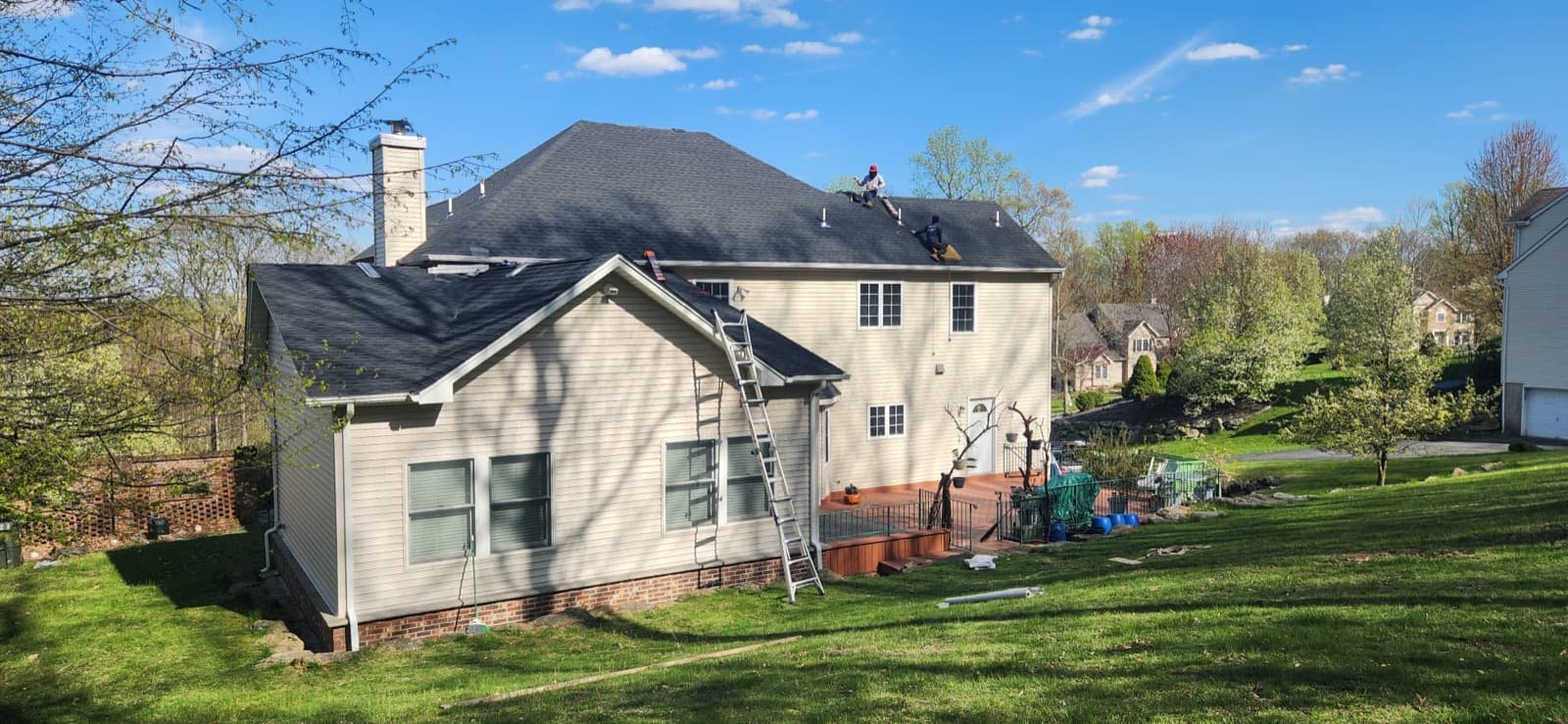
Asphalt Shingle Roofing in North New Jersey
The default North Jersey roof, done to the spec the shingle was tested at — the right grade for your roof, the nailing pattern that earns its wind rating, and the starter, cap and leak barrier that keep the warranty real. Architectural, 3-tab, designer, SBS-modified and Class 4 impact lines installed across New Jersey.
Want a range for your own house? Our Instant Roof Estimate finds your roof on New Jersey's aerial photos.
Get my Instant Roof EstimateDrive any street in Clifton, Teaneck, Nutley or Wayne and you are looking at a few hundred asphalt shingle roofs. It is the default covering on the overwhelming majority of American houses, and North Jersey is no exception. Which is exactly why the phrase "shingle roof" tells you almost nothing. It covers a flat 3-tab and a laminated designer shingle that can weigh close to twice as much or more, a roof fastened with four nails and one fastened with six, a roof with a purpose-made starter course and one with the tabs cut off a field shingle to fake it.
Those distinctions are invisible from the curb and they decide almost everything: whether the roof holds through a nor'easter, whether it streaks black in six years, whether a warranty claim is honored or denied. A shingle roof is a system — the shingle, the fasteners, the starter at the edges, the hip-and-ridge cap, the leak barrier and the ventilation working with it — and the cheap bids in this market are almost always cheap because pieces of that system were quietly swapped or skipped.
This page is about the covering itself: what the grades actually are, what the wind classes on the wrapper certify, how the roof has to be fastened to deserve them, how North Jersey weather ages asphalt, and where the manufacturer's warranty ends and ours begins. How the roof gets torn off, decked and flashed lives on our roof replacement page; the numbers live on the cost guide and the roof cost calculator. The measurement that turns any of it into a real price is free.
- Roof replacement — The full tear-off and re-roof, start to finish.
- Flat & low-slope roofing — Below 2:12 asphalt shingles are not permitted — EPDM, TPO, and modified bitumen instead.
- Roof repair — When the shingle field is sound and one detail is what failed.
- Roof replacement cost guide — Where the numbers live — 2026 North Jersey ranges by shingle grade, framed as ranges rather than a quote.
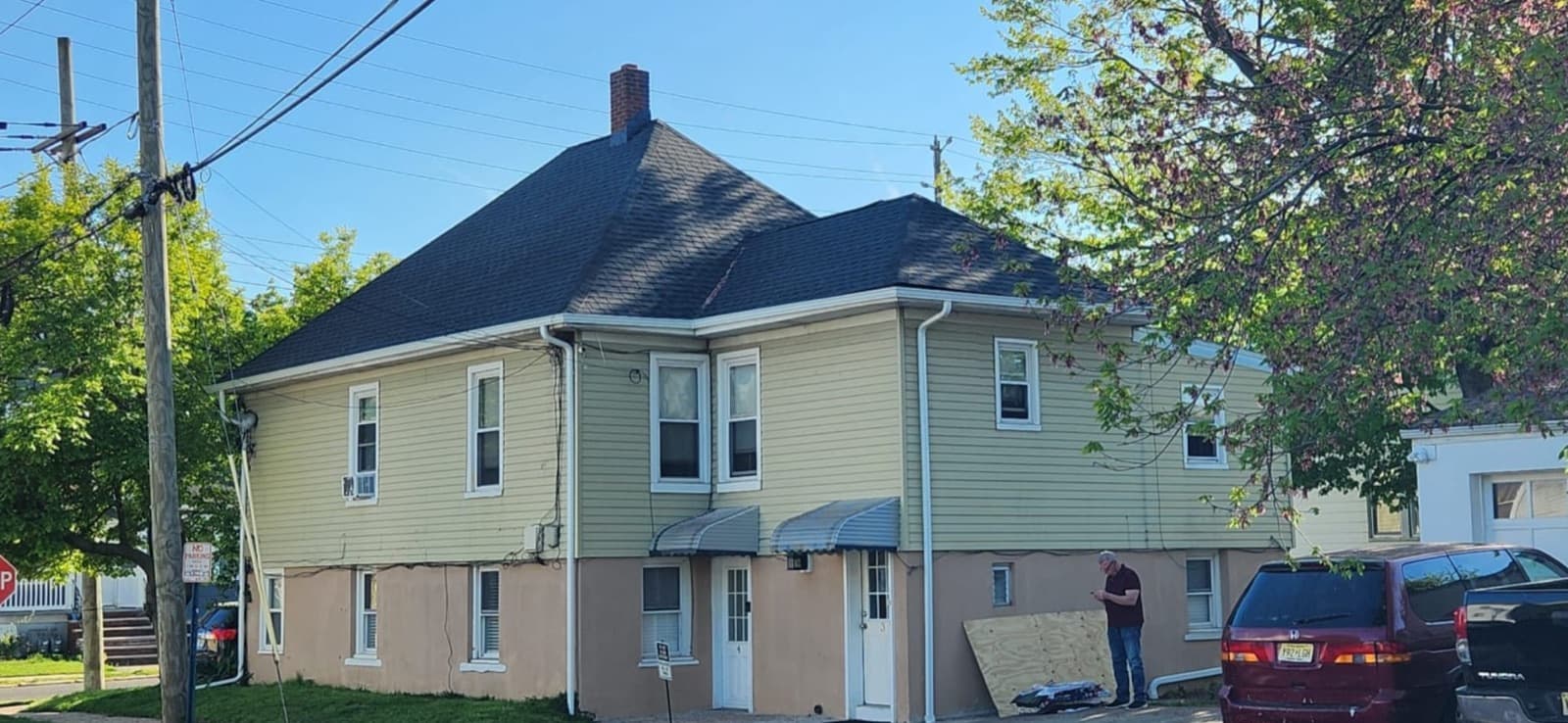
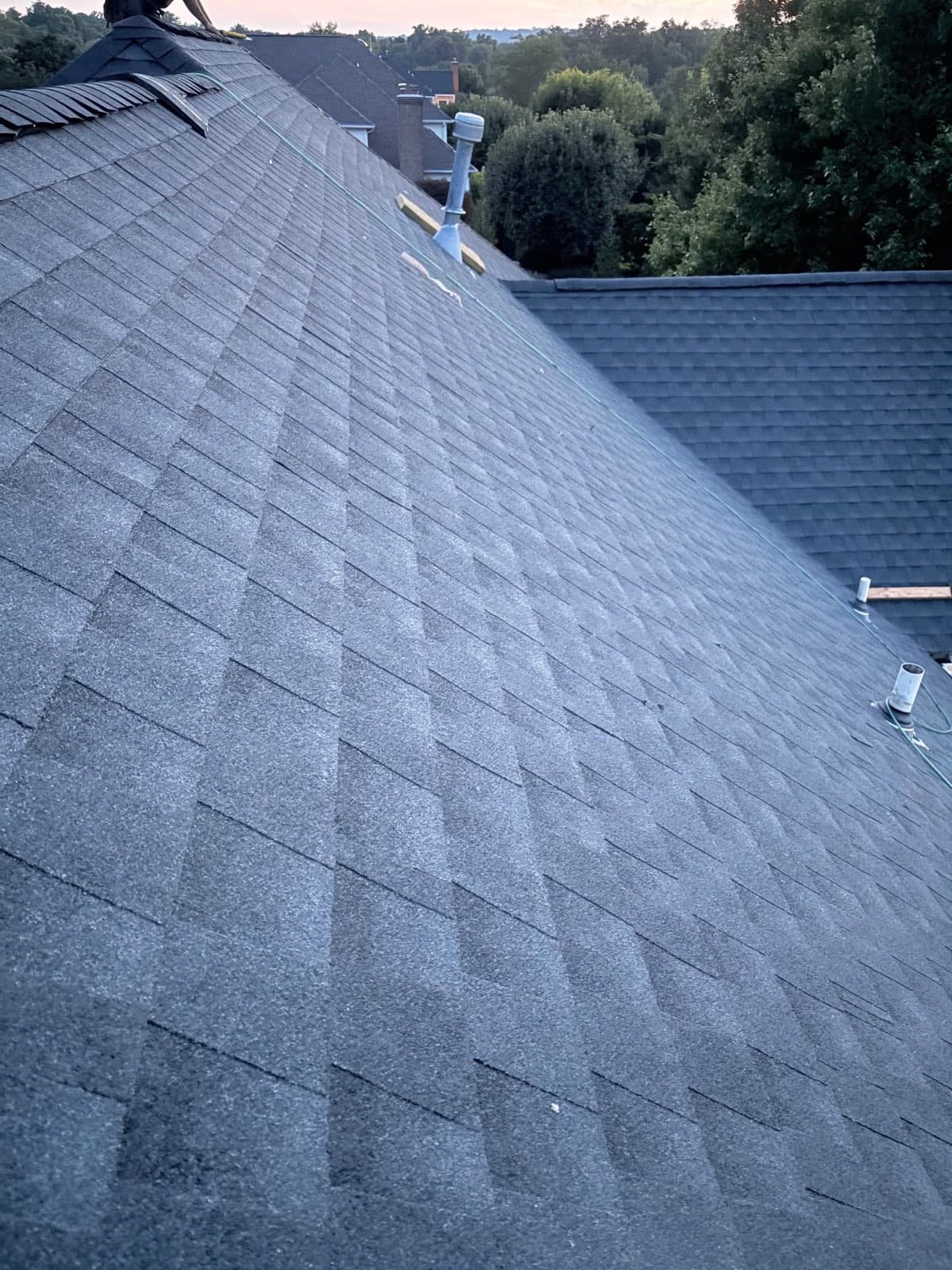
Recent work in New Jersey
Fiberglass mat, asphalt, and the granules doing the real work
A modern asphalt shingle is three things pressed together. A fiberglass mat gives it tensile strength and dimensional stability. Asphalt coats both faces and does the waterproofing. Ceramic-coated mineral granules are embedded in the top surface, and they are not decoration — they are the sunscreen. UV is what turns roofing asphalt hard and brittle, and the granule layer is the only thing standing between the sun and the asphalt. That is why granule condition, not shingle color, tells you how much life a roof actually has left: a scatter of loose granules after a fresh install is normal manufacturing debris shedding off, but bald patches and granule sludge on a roof in its second decade mean the asphalt is exposed and the clock has run out.
The residential product most homeowners buy is manufactured and sold under ASTM D3462, the specification for asphalt shingles made from a glass felt and surfaced with mineral granules, and most carry a Class A fire rating — the top classification a roof covering can hold. Underneath each shingle is a factory-applied sealant strip: a thermally activated adhesive that bonds every course to the one below it once the roof gets warm. That bond, not the nails, is what makes a shingle roof aerodynamically closed. A shingle that is nailed but never sealed is just a flap waiting for the right gust, which is why the seasonal timing of an install matters more than most people are told.
One further variable sits underneath all of it: whether the asphalt is straight or polymer-modified. SBS-modified shingles blend a synthetic rubber into the asphalt so the shingle stays pliable when it is cold and resists thermal cracking through freeze-thaw cycling. In a climate that swings from single digits in January to the mid-90s in July, that flexibility is a genuinely useful property rather than a marketing line.
3-tab, architectural, designer — and the words that mean the same thing
Start with the vocabulary, because the industry uses four words for one product. Architectural, dimensional, laminate and laminated shingle all describe the same category: two shingle layers bonded together so the roof reads with shadow and depth instead of as a flat sheet. If a salesperson tells you their "dimensional" is a step above someone else's "architectural," they are selling you a synonym.
The clearer yardstick is weight per square — a square being 100 square feet of roof. More weight means more asphalt and more mat, and more asphalt is most of what you are actually buying. Every manufacturer publishes that figure on the product data sheet, and it is the cleanest apples-to-apples comparison you can make between two proposals that both say "architectural shingle" and land thousands apart. Ask for the specific line name on any bid, then look the weight up yourself.
One hard limit applies to all three grades. Under the IRC that New Jersey enforces, asphalt shingles may only be used on slopes of 2:12 or greater, and from 2:12 up to 4:12 a doubled underlayment application is required beneath them. A low-pitch porch, dormer shed or rear addition is not a shingle problem to be solved with more sealant — below that floor it needs a different covering entirely, which our flat roof page walks through.
- 3-tab — a single flat layer with cutouts, the lightest and shortest-lived of the three. It still earns its place on a detached garage, a rental with a fixed budget, or a low-visibility outbuilding, and it is the one grade where matching the look of an existing roof is sometimes the deciding factor.
- Architectural / dimensional / laminate — the default for a North Jersey house, and the grade at which manufacturers begin offering their stronger warranty tiers and their better wind classes. Nearly every replacement we install falls here.
- Designer / luxury — heavier and thicker, cut to mimic slate or hand-split cedar shake, with oversized exposures that change the scale of the roof. It is a specific choice for a specific house: a Victorian in Ridgewood, a center-hall colonial in Montclair, a Tudor where the roofline is the architecture and a standard laminate would flatten it.
- Impact-rated (UL 2218 Class 4) and SBS-modified lines — offered within both the architectural and designer tiers rather than as a separate grade. Class 4 is the top rating in the steel-ball impact test; SBS lines are the ones formulated to stay pliable in the cold.
Roof leaking right now? We answer 24/7.
What the wind class on the bundle actually certifies
Two different test standards produce the wind classes printed on shingle packaging, and they measure different things. ASTM D3161 is the older fan-induced method: specimens sit in front of a wall of fans and the shingle earns Class A, D or F depending on the speed it survives, with F the highest. ASTM D7158 is the newer uplift-force method, which calculates the force required to break the sealant bond and sorts the result into Class D, G or H, with H the highest. The code accepts either and ties the class your roof needs to the design wind speed mapped for your address — so the useful question at the kitchen table is not what number is on the wrapper, it is what class this address requires.
Here is what those tests assume, and what homeowners are rarely told: the shingle was sealed, and it was fastened to the manufacturer's specification. Every wind class in the industry describes a correctly installed shingle. Nothing in it survives nails driven above the nailing zone, a tab that never bonded because the roof went on in February and nobody hand-sealed it, or a first course laid without a real starter strip. A top-class shingle on a sloppy install is a top-class shingle in a lab and a repair call after the first serious nor'easter.
Manufacturer wind warranties are a separate thing again — a contract, not a test class — and every one of them is conditioned on the accessory system. The pattern is the same across the major brands: the shingle carries a baseline wind warranty, and the higher tier unlocks only when that manufacturer's own starter strip and hip-and-ridge cap are used, with the nailing pattern their instructions specify. Some lines add a reinforced nailing zone to widen the target the nailer has to hit — Owens Corning's SureNail fabric strip and GAF's LayerLock are the two you will see quoted in this market — and at least one manufacturer offers an enhanced tier with no stated wind-speed cap when the full qualifying accessory package is installed. None of it is automatic. Ask any bidder which tier they are quoting, which accessories it requires, and to put both in the proposal, because the wind coverage is bought with the system rather than with the shingle.
Where the rating is won — the nail line, the starter, the cap
This is the part of a shingle roof that costs a contractor time and costs you nothing to skip, which is precisely why it gets skipped. None of it is visible from the ground once the ridge is capped.
- Nails — code sets a floor of four fasteners per strip shingle (two per individual shingle), minimum 12-gauge shank with a minimum 3/8-inch head, complying with ASTM F1667, long enough to pass through the roofing and not less than 3/4 inch into the roof sheathing. Where the design wind speed for your address crosses the code's high-wind threshold, the manufacturer's high-wind installation method applies instead, which typically means more fasteners per shingle and enhanced edge detail. We check the mapped wind speed for the town, not for the region.
- Placement — the nail has to land in the shingle's designated nailing zone so it also catches the course beneath. High nails miss that course entirely and leave the shingle hanging on its sealant. Overdriven nails cut through the mat; underdriven nails hold the next course off the deck. All three undermine wind coverage, and all three are invisible the day after the job.
- Starter course — a purpose-made starter strip runs along the eaves and up the rakes, putting factory adhesive exactly where uplift starts. Cutting the tabs off field shingles to improvise a starter is the oldest shortcut in the trade, and on most lines it forfeits the upper wind warranty outright. Rakes get starter too, not just eaves.
- Hip and ridge cap — the manufacturer's hip-and-ridge accessory is thicker and formulated to bend over a ridge without cracking. Architectural shingles cut into thirds and folded as cap will crack at the fold within a few winters, and they are not warrantied as cap on the major lines.
- A nailable deck — no fastening schedule rescues a roof nailed into delaminated OSB or gapped original board sheathing. On the older housing stock in Passaic, Paterson and Haledon this comes up constantly, and it gets priced before it gets covered.
Roof leaking right now? We answer 24/7.
Black streaks, freeze-thaw, and the winter install question
Those dark vertical streaks running down a North Jersey roof are almost never mold and almost never structural. They are colonies of Gloeocapsa magma, a blue-green algae that feeds on the limestone filler in asphalt shingles and gets carried down the slope by rain. It appears first on north-facing and shaded planes and worst under overhanging trees, and humid Northeast summers suit it perfectly. It stains; it does not rot the roof.
The manufacturing answer is algae-resistant granules: a portion of the surface granules is swapped for ceramic granules containing copper, which releases trace copper ions every time the roof gets wet. GAF brands it StainGuard, CertainTeed calls it StreakFighter, Owens Corning StreakGuard. Each carries its own limited warranty term, separate from and generally shorter than the shingle's — read it on the actual product sheet, and confirm the line you are being quoted is in fact the algae-resistant version, because the technology slows colonization rather than permanently immunizing a roof.
Thermal cycling is the other local stressor. Asphalt hardens as it ages, and a climate that runs from single digits to the mid-90s works that hardening cycle hard, which is where SBS-modified and Class 4 impact-rated lines earn their upcharge — they crack and shed granules less as they age. Hail here is occasional rather than routine, so we do not sell Class 4 as hail insurance; it is a longevity and wind-blown-debris upgrade, and some carriers offer a premium credit for it, which is worth asking your agent before you pick a line.
And the winter question, which we get every January: yes, shingle roofs go on all winter in New Jersey, and yes, the rules change. Manufacturers' cold-weather instructions generally take effect around the 40°F mark — below that the factory seal strips will not activate on their own, since they need real warmth and direct sun to soften and bond, and cold shingles get brittle enough that bending or dropping a bundle can crack them. A correct winter install means storing bundles warm, handling them carefully, and hand-sealing courses with a manufacturer-approved asphalt roofing cement rather than trusting the sun to finish the job in March. A crew that skips those steps in February has built you a roof that is not sealed, and you will find out in the first spring windstorm.
What "lifetime" covers, and what it quietly requires
A lifetime limited warranty on shingles means defects in the product for as long as you own the home — not that the roof will last a lifetime. Inside it sits a non-prorated period at the front, during which a covered defect is settled at full value; after that window the coverage prorates down against the age of the roof. Transfer rights are usually limited to a single transfer inside a set period after installation, which matters if you may sell. Both terms are printed in the warranty document and both vary by manufacturer and line, so read them before you choose rather than after.
Service life is the separate and more useful number — broadly, a 3-tab is a two-decade roof in this climate and a laminate closer to three, with the heavier designer lines running longer, and the grade-by-grade breakdown lives on our roof replacement page. The single biggest variable in whether any of them reaches its number is attic ventilation. An unvented or intake-blocked attic bakes shingles from underneath, and inadequate ventilation is one of the most common grounds a manufacturer cites when denying a claim. It is a condition of the coverage, not an upgrade.
The extended system warranties — the ones that cover labor and tear-off, run longer non-prorated, and require the full accessory package — are sold only through each manufacturer's certified-contractor programs. If a contractor offers you one, ask to see the certification, and ask them to register the warranty in your name and send you the confirmation. An unregistered warranty is a brochure.
Then there is the coverage that actually gets used. Callbacks on shingle roofs are overwhelmingly installation issues rather than defective shingles, so the workmanship warranty deserves at least as much scrutiny as the term printed on the shingle wrapper. Ask every bidder for both in writing and compare them side by side.
What affects the cost
| Shingle grade and weight | 3-tab, architectural and designer lines step up in weight per square, and that added asphalt and mat is most of the material cost difference between them. Ask for the specific product name on any bid so you can compare the published weight rather than the adjective. |
|---|---|
| SBS-modified or Class 4 upgrades | Rubberized SBS lines and UL 2218 Class 4 impact-rated shingles carry an upcharge per square. Worth pricing both ways, since some insurers credit Class 4 on the premium. |
| The accessory system | Starter strip at eaves and rakes, matching hip-and-ridge cap, leak barrier and ridge venting are the components that unlock the upper wind and system warranties. We quote them as their own lines so you can see whether a competing bid included them. |
| Nailing schedule | Six fasteners per shingle instead of four, plus enhanced edge detailing on exposed or higher-elevation sites, means more fasteners and more time on every square. |
| Roof geometry and waste | Hips, valleys, dormers and cut-up rooflines generate far more waste per square than a simple gable. Two roofs with identical square footage do not consume the same number of bundles. |
| Warranty tier | Standard manufacturer coverage comes with the shingle. Extended system warranties require the complete accessory package and registration, which adds material and paperwork to the job. |
We don't bundle a mystery number — you get a firm, free on-site quote, approved before any work starts.
Monthly payment options
We work with Hearth, which shops several lenders on a single application. See your personalized options in minutes — checking does not affect your credit score, and there is no commitment.
- Loan amounts up to $250,000
- Funding in as little as 1–3 days
- No prepayment penalties
- No home equity required
Financing is provided by Hearth's lending partners, not by Precision Windows & Roofing. Rates and terms depend on your credit and the lender making the offer, and all financing is subject to credit approval.
Common questions
Architectural, dimensional, laminate — are those three different shingles?
They are three words for one product category: two shingle layers laminated together to give the roof depth and shadow lines, as opposed to a flat single-layer 3-tab. Anyone presenting "dimensional" as a tier above "architectural" is selling you a synonym. What actually varies inside that category is the weight per square, whether the asphalt is SBS-modified, and which wind class the line was tested to — none of which you can tell from the name.
My shingles were rated for high wind. Why did tabs blow off in a nor'easter?
Because the rating describes a shingle that is sealed and fastened to spec, and one of those two usually failed. The causes we find most often are nails driven above the nailing zone so they never caught the course below, a missing or improvised starter strip at the eave or rake where uplift begins, and shingles installed in cold weather that never bonded because nobody hand-sealed them. All three are invisible from the ground. Worth knowing too: most manufacturers require their own starter and hip-and-ridge to honor the upper wind tier, so mixing brands to save a little on accessories can quietly cost you the coverage. If tabs lifted in a storm, the fix starts with pulling a few shingles to see how the roof was actually nailed — see our roof repair page.
What are the black streaks running down my roof, and can they be removed?
They are colonies of Gloeocapsa magma, an algae that feeds on the limestone filler in asphalt shingles. It is a staining problem rather than a rot problem, and it shows first on shaded and north-facing slopes and under overhanging trees. It can be cleaned, but pressure washing a shingle roof strips granules and shortens its life, so it has to be done by a low-pressure, manufacturer-approved method or not at all. On a replacement, the durable answer is specifying an algae-resistant line — copper-bearing granules that release trace copper each time the roof gets wet, sold as StainGuard, StreakFighter or StreakGuard depending on the brand.
If I buy a lifetime shingle, will the roof last a lifetime?
No, and the two are unrelated. "Lifetime limited" describes the manufacturer's coverage against product defects for as long as you own the home, with a non-prorated period at the front and prorated value after that. The roof's actual service life is a separate matter, and it depends far more on attic ventilation, nailing and flashing than on the warranty term. Ventilation in particular is a condition of the coverage rather than a bonus: a baked, unvented attic is a leading reason claims get denied. Ask for the warranty document itself, not the brochure page about it, and check the transfer terms if there is any chance you sell.
Can shingles be installed in the middle of a New Jersey winter?
Yes, with adjustments that a lot of crews skip. Manufacturers' cold-weather instructions generally start applying around 40°F: the factory sealant strips will not activate on their own below that, since they need genuine warmth and sun to bond, and cold shingles turn brittle enough to crack if they are bent or dropped. A proper winter install means keeping bundles warm before they go up, handling them accordingly, and hand-sealing courses with a manufacturer-approved asphalt roofing cement instead of hoping spring finishes the job. If your roof is actively leaking in January, that is a repair conversation, not a reason to wait until April.
Explore
Get your free roofing quote
Free, no-obligation on-site assessment anywhere in New Jersey — and we answer the phone 24/7.