Roofing, Flat Roofs & Siding in Hudson County, NJ
Hudson County roofs are their own animal — flat and low-slope EPDM, TPO, and modified-bitumen over brownstones, walk-ups, and row homes, on lots with no driveway and a shared wall on each side. That's the work we're built for: membrane repair and replacement, parapet and cornice leaks, gutters and scuppers, and siding, run out of our Garfield shop across Jersey City, Hoboken, Bayonne, and Union City with 24/7 emergency response. NJ-registered, quoted line-item.
Want a range for your own house? Our Instant Roof Estimate finds your roof on New Jersey's aerial photos.
Get my Instant Roof EstimateMost roofing pages in New Jersey are written for a pitched, asphalt-shingle roof on a detached house with a driveway to park the dumpster. That describes almost nothing in Hudson County. From Hoboken's Mile Square to the brownstone blocks of Jersey City's Van Vorst Park, Hamilton Park, and Paulus Hook, to the two- and three-family walk-ups packed into Union City — the densest city in the country over 50,000 people — the housing here is attached, older, and topped by flat or low-slope roofs, not shingle fields. The roof you can't see from the street is usually a membrane, and it fails in completely different places than a suburban shingle roof does.
That's the roofing we run out of our Garfield shop for Hudson County: EPDM, TPO, and modified-bitumen flat and low-slope roofs — repaired, re-seamed, and replaced — plus the parapet walls, cornices, internal drains, and shared party-wall flashing that make a row home leak. We also do the pitched-roof work on Bayonne's early-1900s frame houses and the waterfront's newer construction, along with gutters, siding, and chimney flashing. It's one water-tracing discipline across every roof type: find where the water actually gets in, not where the stain shows up.
This page maps the whole thing — what we cover, how a dense-urban roof job actually runs here, and the Hudson-specific permit and access realities behind it. Call (201) 275-9185 and tell us what your roof is doing; we'll read the symptom over the phone and put a free, line-item quote in your hands once we've measured it on-site, so you can compare it honestly.
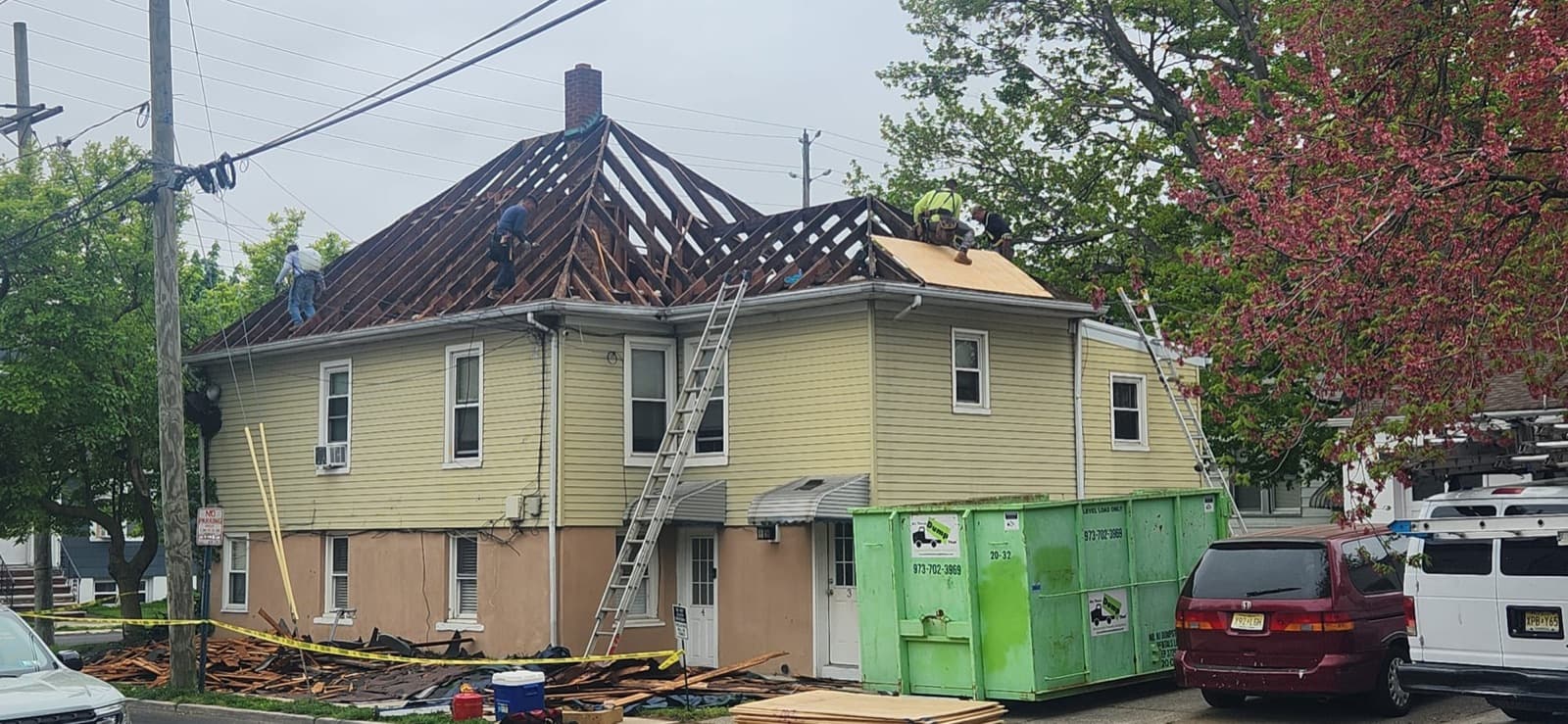
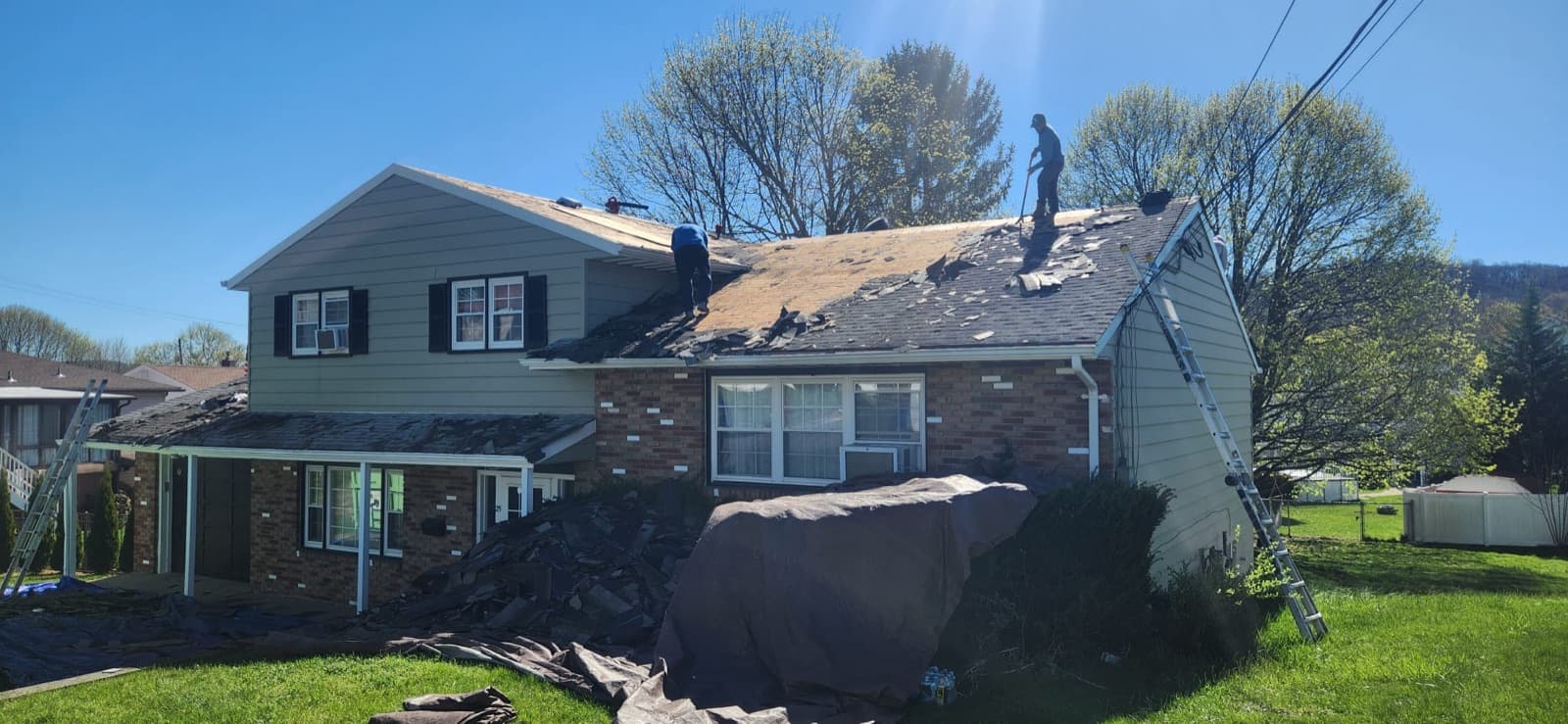
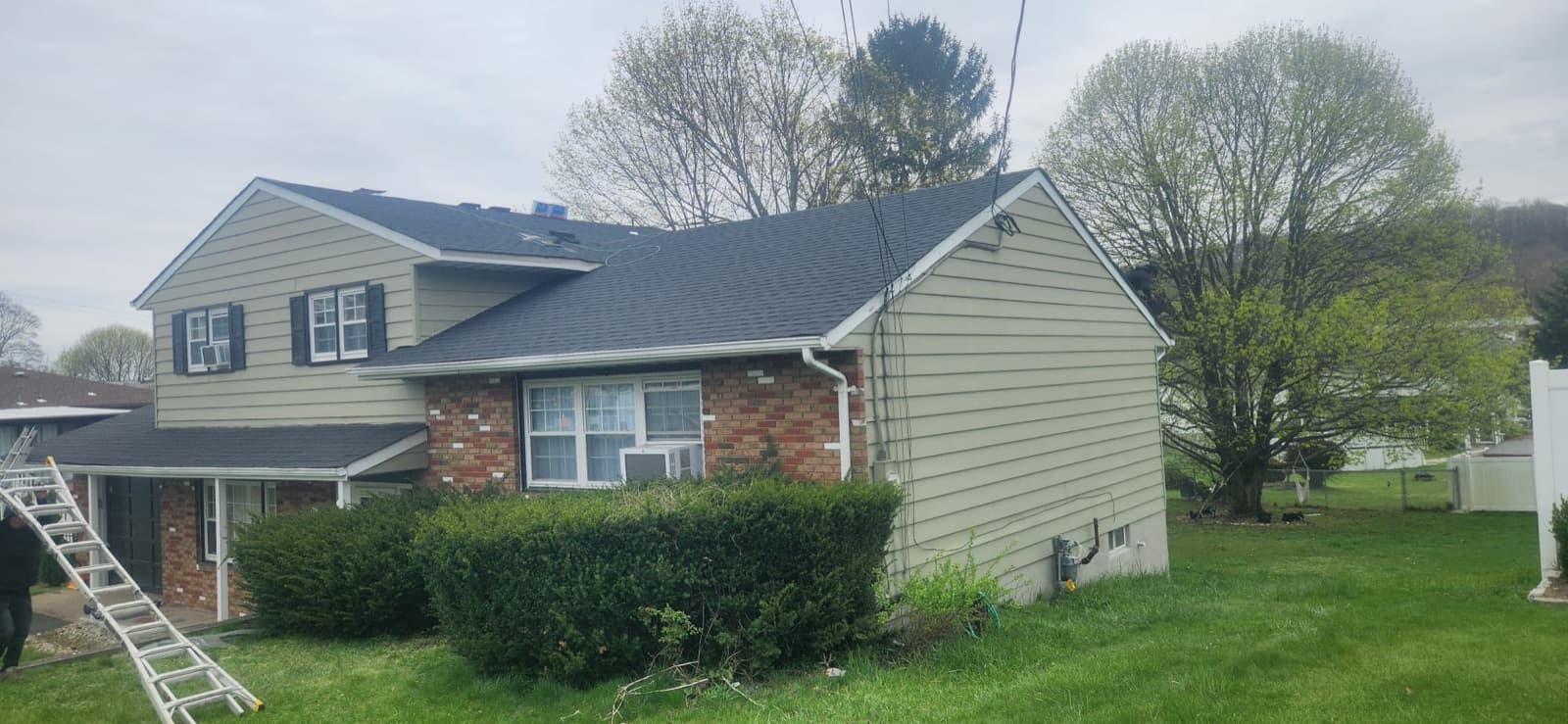
Recent work in New Jersey
Flat and low-slope roofs, fixed for how they actually fail
Across Jersey City, Hoboken, Union City, and West New York, the typical roof is flat or barely pitched and finished in a single-ply or built-up membrane — EPDM rubber, white TPO, or torch-applied modified bitumen over older tar-and-gravel. These roofs don't lose shingles in the wind; they fail at the seams, the laps, and the flashings, and they pond. Water that sits for days after rain is the tell that the slope-to-drain is gone, and standing water finds every open seam and pinhole it can.
We repair what's repairable — re-seaming a lifted lap, patching a puncture, rebuilding a failed drain or scupper detail, re-flashing where the membrane ties into a wall — because a sound membrane with one bad seam doesn't need a tear-off. When a roof is genuinely spent, we re-cover it in the system that fits the building: TPO or EPDM for most row-home and walk-up roofs, modified bitumen where torch-down makes sense, with the drainage corrected so the new roof actually sheds water instead of holding it. Every roof is measured and quoted in line items, so you see the membrane, the insulation, the flashing, and the labor as separate numbers.
Parapets, cornices, and the wall you share next door
A brownstone or row home leaks in places a suburban roof doesn't have. The parapet — the low wall around the edge of a flat roof — is the number-one culprit: its coping caps, the flashing where the membrane turns up the wall, and the masonry itself soak up water and push it inward. Decorative cornices, the internal roof drains buried in the middle of the roof, and the shared party wall between you and the attached neighbor are the others. Because water travels along the deck before it surfaces, a leak that starts at your parapet can stain a ceiling two rooms away — or in the unit next door.
This is exactly the seam-and-flashing work these buildings demand. We trace the water to its real entry, then rebuild the detail: new coping and counter-flashing at the parapet, proper membrane terminations, rebuilt drain and scupper flashing, and chimney counter-flashing let into the mortar joint rather than sealed over with caulk. On attached homes we sort out whose roof the water is actually coming from before anyone starts opening ceilings — a conversation the party wall forces and most roofers skip.
Roof leaking right now? We answer 24/7.
Gutters, scuppers, and rear leaders that keep up
Row-home and walk-up drainage isn't a front gutter and a downspout to the lawn. Flat roofs drain through internal drains or through scuppers cut in the parapet that dump into rear or side leaders, and there's often no yard for the water to go — it runs to the sidewalk, the alley, or a shared line. When a scupper clogs or a leader rusts through inside a wall, the water backs up onto the roof and over the parapet, and you get both a roof leak and a saturated facade.
- Scupper and internal-drain repair — clearing, re-flashing, and correcting the outlets that a flat roof actually drains through.
- Seamless aluminum gutters and rear leaders — sized and pitched for row-home runoff where there's no yard to absorb it.
- Downspout and leader routing — getting roof water away from the foundation and the shared wall instead of down the facade.
- Gutter guards and clearing — for the tree-lined brownstone blocks where leaves choke a rear drain by fall.
Siding, cornices, and the water that gets in sideways
On Hudson County's attached homes, the wall and the roof are one water problem. A failed cornice or a cracked parapet doesn't just leak down — it soaks the brick or the siding below and drives water in behind it. We handle the siding side of the envelope too: vinyl and insulated siding and fiber-cement on the frame walk-ups and two-families of Bayonne, North Bergen, and Secaucus, plus the wall flashing, house-wrap, and kick-out details where a pitched roof meets a taller wall.
On masonry brownstones and brick row homes, the fix is usually flashing, coping, and sealing where the roof and facade meet rather than re-cladding, and we're straight about which it is. The point is the same on every Hudson job: close the seam where two materials meet — roof to parapet, roof to party wall, wall to window — because that seam is where these buildings actually take on water.
Roof leaking right now? We answer 24/7.
Tight streets, historic districts, and post-Sandy reality
Roofing in Hudson County is as much a logistics job as a roofing job. Half these buildings have no driveway, the streets are narrow and metered, and material and debris often have to be staged from the curb or carried through the building. On the waterfront high-rises of the Jersey City and Weehawken bluffs, roof access and staging are managed and scheduled. We plan the access and the disposal up front so the job doesn't stall halfway through — and so your block isn't blocked longer than it has to be.
Two Hudson-specific realities matter before a re-roof. First, permits: New Jersey's 'ordinary maintenance' exemption that lets a detached one- or two-family home reroof without a permit does not reach attached homes (row or semi-detached) or buildings of three or more units — those need a construction permit — and several of Jersey City's local historic districts, including Van Vorst Park, Hamilton Park, and Paulus Hook, add preservation review for visible exterior work. Second, water: Hudson County's low-lying blocks flood. Hurricane Sandy's record storm tide — roughly 14 feet at the Hudson River waterfront on October 29, 2012 — put much of Hoboken underwater and pushed into Jersey City at the old Morris Canal and Long Slip low points, a reminder that on a lot of these roofs, drainage and a watertight parapet aren't cosmetic. We check which permit category your building falls in with the town, and file under our state registration whenever one is required.
What affects the cost
| Roof system and membrane | A flat EPDM, TPO, or modified-bitumen roof is priced and installed differently than pitched shingle work; the membrane and insulation drive the number. |
|---|---|
| Access and staging | No driveway, narrow metered streets, walk-up carry, or a managed high-rise all change how material and debris move — a real cost on dense Hudson lots. |
| Parapets, cornices, and penetrations | Every parapet wall, cornice, internal drain, scupper, and chimney needs its own flashing detail; row homes have more of them than a suburban roof. |
| Drainage correction | Fixing ponding — re-sloping, rebuilding internal drains or scuppers — so the new roof actually sheds water is often part of a flat-roof job. |
| Tear-off, layers, and disposal | Old tar-and-gravel or multiple modified-bitumen layers are heavy to remove, and dumpster placement and hauling are harder on a no-yard block. |
| Permit and historic review | Attached homes (row or semi-detached) and buildings of three or more units need a permit where a detached one- or two-family house wouldn't, and Jersey City historic-district properties can require added preservation review. |
We don't bundle a mystery number — you get a firm, free on-site quote, approved before any work starts.
Monthly payment options
We work with Hearth, which shops several lenders on a single application. See your personalized options in minutes — checking does not affect your credit score, and there is no commitment.
- Loan amounts up to $250,000
- Funding in as little as 1–3 days
- No prepayment penalties
- No home equity required
Financing is provided by Hearth's lending partners, not by Precision Windows & Roofing. Rates and terms depend on your credit and the lender making the offer, and all financing is subject to credit approval.
Common questions
Do you do flat and low-slope roofs, not just shingles?
Yes — flat and low-slope is the majority of what we do in Hudson County. EPDM rubber, TPO, and modified-bitumen (torch-down) roofs on brownstones, row homes, and walk-ups across Jersey City, Hoboken, Union City, and beyond, both repair and full re-cover. We fix seams, ponding, drains, and parapet flashing, and replace membranes that are genuinely spent. Pitched shingle work on Bayonne's frame houses and the waterfront too.
Do I need a permit to reroof a row home or multi-family in Hudson County?
Often — more often than in the suburbs. New Jersey's 'ordinary maintenance' rule that lets a detached one- or two-family home reroof without a permit does not reach attached homes (row or semi-detached) or buildings of three or more units; those need a construction permit, and so does replacing decking on any building. Parts of Jersey City's historic districts — Van Vorst Park, Hamilton Park, and Paulus Hook among them — add preservation review for visible exterior work on top of that. We sort out which category your building is in and file under our state registration whenever a permit is required.
My flat roof holds water after it rains — is that a problem?
Yes. Standing water hours or days after rain — ponding — means the roof's slope-to-drain is gone, and it works every seam, lap, and pinhole in the membrane until one lets go. On row homes it usually traces to a clogged internal drain or scupper, or a sagging deck. We correct the drainage as part of the repair or re-cover, not just patch over the wet spot.
Which Hudson County towns do you cover, and how fast?
All of it from our Garfield shop — Jersey City, Hoboken, Bayonne, Union City, North Bergen, Secaucus, Weehawken, West New York, Guttenberg, Kearny, and Harrison. A leak that's actively running with more weather due, or storm damage, is an emergency: dispatched the same day, around the clock, and the first job is stopping the loss. Inspections and non-emergency leak diagnosis are usually within a few days, with the permanent repair set for dry conditions; full flat-roof replacements and siding book on scheduled dates.
My building flooded in Sandy — does that affect my roof?
Hudson County's low blocks took serious water in Hurricane Sandy's October 2012 surge, which hit Hoboken and the old canal low points in Jersey City hardest. Storm surge is a wall problem, but the same weather that floods a street also finds a tired parapet or a failed drain from above. On these buildings a watertight parapet and working roof drainage genuinely matter, and we inspect and document the roof's condition either way — for your records if there's no claim, and in adjuster-ready form if there is.
The leak seems to come from next door's roof — can you sort that out?
That's common on attached row homes with a shared party wall — water crosses the wall and surfaces in your unit. We trace the leak to its real entry point before anyone opens a ceiling, and we're straight about whose roof and whose flashing detail is actually the source. It's the difference between fixing the leak and repainting the stain until it comes back.
Explore
Roof repair by town in Hudson County
Get your free roofing quote
Free, no-obligation on-site assessment anywhere in New Jersey — and we answer the phone 24/7.