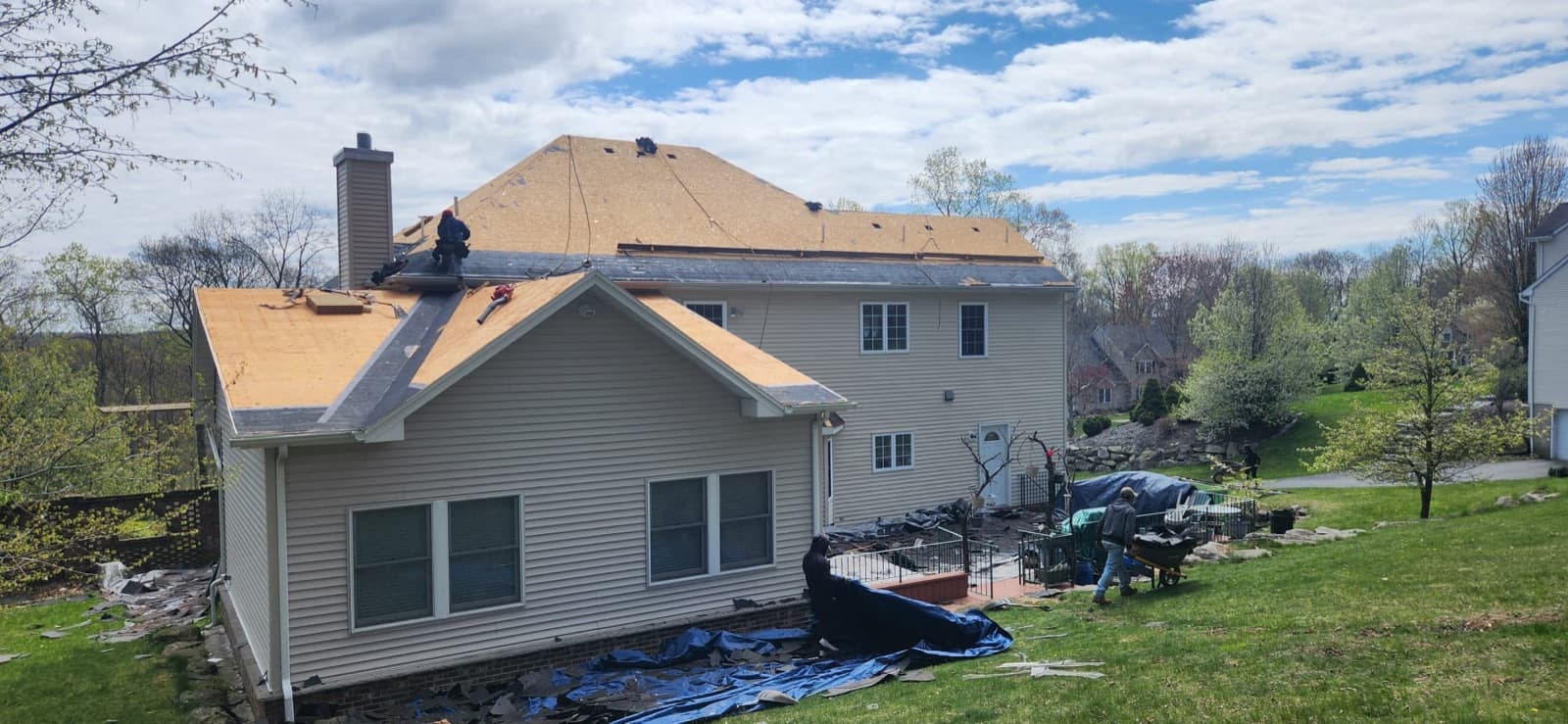
Roof Repair & Roofing in Hackensack, NJ
Hackensack is a low-slope town — fewer than a quarter of its homes are single-family houses, and more than a third of the housing stock sits in buildings of fifty units or more. Membrane, drains, parapets and coping on the apartment and co-op stock; shingles, flashing and gutters on the houses. NJHIC-licensed, with emergency dispatch same-day from Garfield.
Hackensack is the one town on our map where most homes sit under a flat roof rather than a pitched one. The city has roughly 21,400 housing units, and fewer than 5,000 of them — about 23% — are one-unit houses; more than a third of the stock, some 7,500 units, sits in buildings of fifty units or more, and better than 60% sits in buildings of ten or more (Census ACS five-year estimates, tables B25024 and B25034). Bergen County has seventy municipalities and none of the other sixty-nine is built like that. A roofing page about Hackensack that talks only about shingles is a page about a quarter of the city.
So this one leads with the other three quarters. Most of what we are called for here is a membrane roof over a managed building — a co-op board, a condominium association, a landlord with a superintendent — where the roofing is genuinely the simpler half of the job and the access, the insurance paperwork and the occupied floors underneath are the rest of it. The pitched work is real too, concentrated in the older blocks near downtown and the postwar streets on the west side, and 960 units have gone up since 2020 at the front edge of a redevelopment program the city says will add about 4,000 residential units.
Whichever one you own, start with a call: (201) 275-9185. Our Garfield shop is a short run down Route 17, so an open roof, active water entry or storm damage is a same-day dispatch, at any hour. Anything short of that is inspected quickly and then booked for weather that lets membrane and flashing go down properly.
- Roof leak repair — In a co-op or a fifty-unit building the water shows up two floors below where it got in, and in a unit nobody has keys to. We trace it before anyone opens a ceiling.
- Emergency roof repair — The county seat is minutes from our Garfield shop. A roof left open over occupied apartments gets a truck the same day, at any hour.
- Roof flashing repair — Parapet coping, drain sumps, and the wall tie-ins around bulkheads and mechanical curbs — on a low-slope building these fail years before the field does.
- Flat & low-slope roofing — Membrane, drains and parapets: with more than a third of Hackensack's housing in buildings of fifty units or more, this is where most of the city's roof area actually is.
- Roofing in Bergen County — The wider county picture — including the shingles, flashing and gutters on the under-a-quarter of Hackensack that is single-family houses.
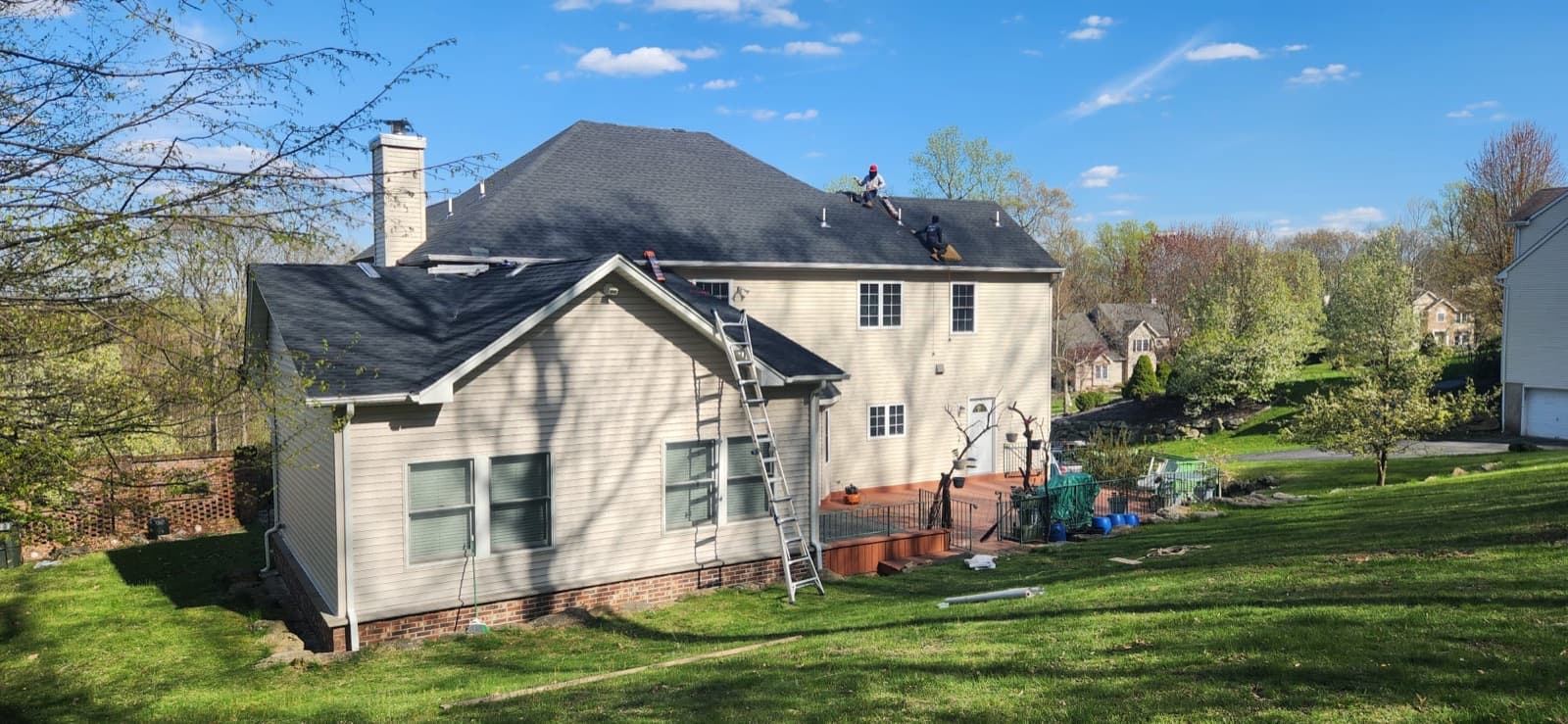
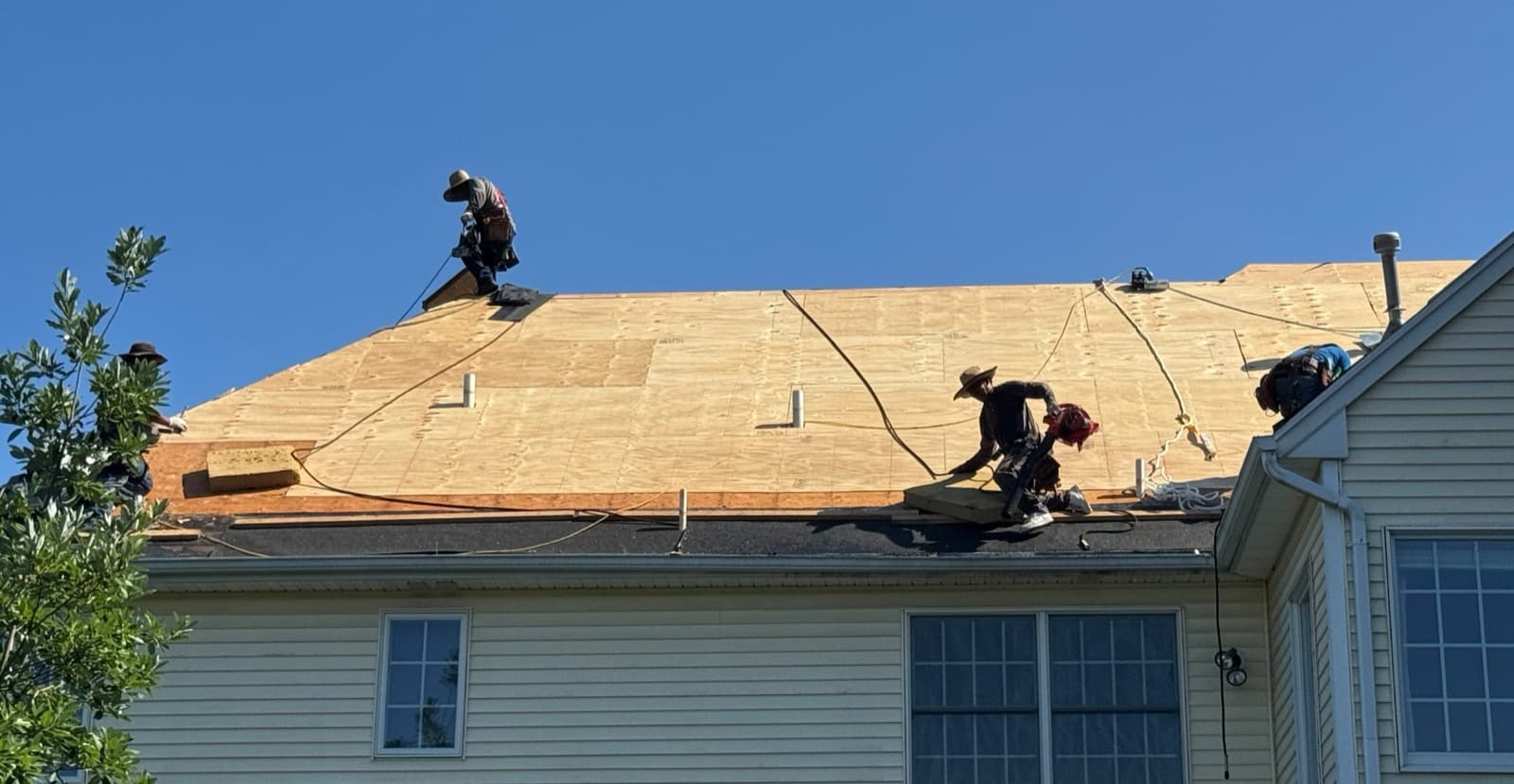
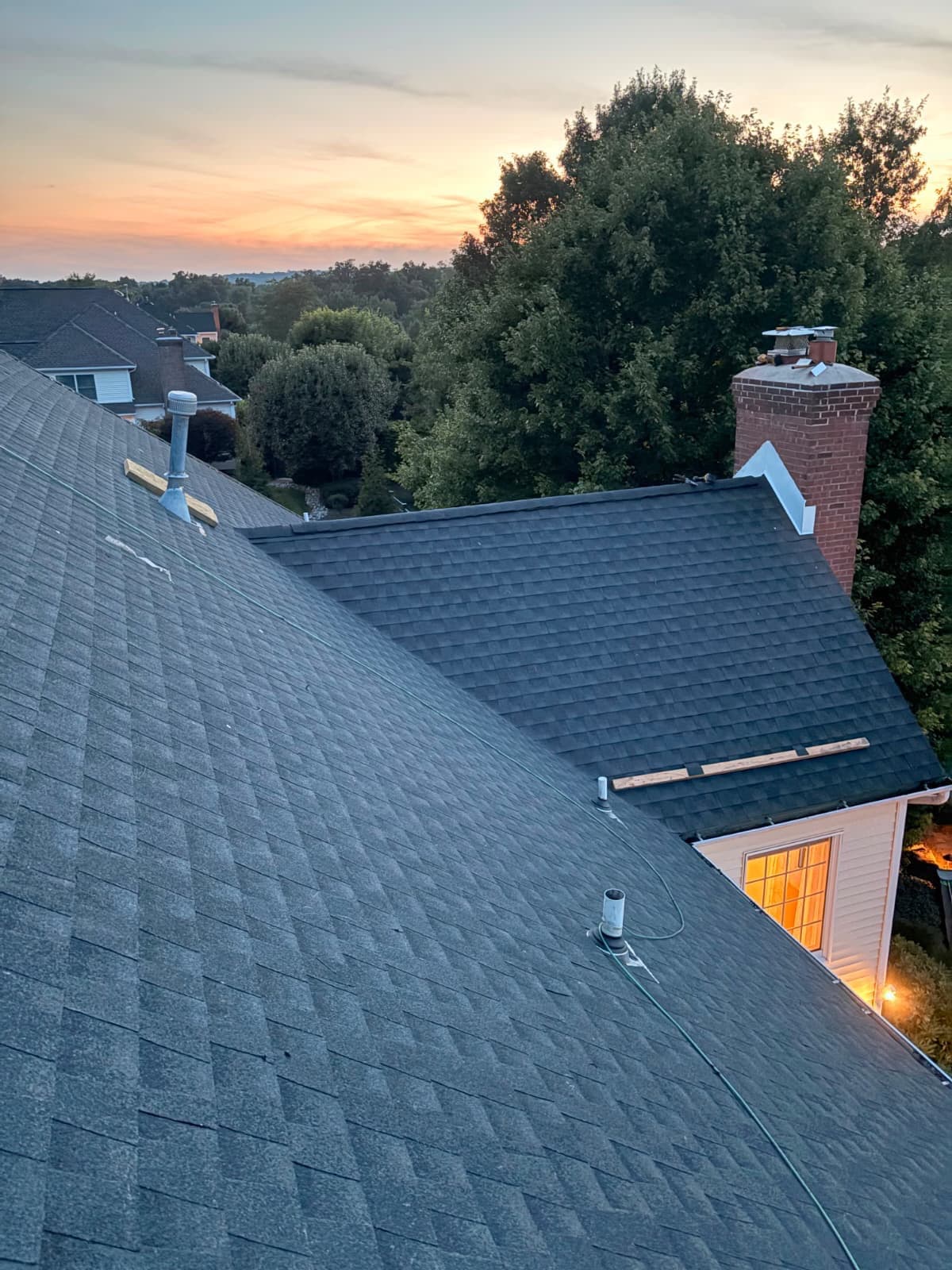
Recent work in New Jersey
Why most Hackensack roof calls are flat-roof calls
On a pitched roof gravity does the work. On the low-slope roofs covering most of Hackensack's housing nothing sheds: water sits until a drain moves it, and every failure is a seam, a termination, or a drainage problem. The faults we find here, roughly in order — a drain strainer packed with debris so the field ponds; base flashing pulled away from the parapet or missing its termination bar; a coping joint letting water into the top of the parapet and down its inside face, which reads as a wall leak two floors below; failed pitch pockets around HVAC curbs; lap seams opened by freeze-thaw. Water travels on a flat roof, so the stain is routinely twenty or thirty feet from the entry point. We probe and test rather than guess.
Ponding deserves naming separately, because it is what turns a maintenance item into a tear-off. A field still holding water a day after the rain is telling you the deck has deflected or the drainage plan never worked, and every winter that standing water freezes and works the seams a little further open. Sometimes the answer is a rebuilt drain and sump or a localized tapered patch; sometimes the whole field has to be re-sloped. We tell you which of those you are looking at before anyone starts talking about a full replacement.
Roofing a building where two hundred people live under the work
Prospect Avenue, between Beech Street and Passaic Street, is a near-continuous residential high-rise corridor roughly a mile long — the Camelot, Bristol House, the Devonshire, World Plaza and their neighbors — and the city has a Prospect–Railroad–Essex–Beech redevelopment plan adding to it. There is nothing else like that mile anywhere in Bergen County, and it changes what a roofing job actually is.
The membrane work up there is ordinary. What isn't: getting board or managing-agent sign-off on a scope they can circulate to shareholders; a certificate of insurance naming the building and the management company by their exact legal names; roof access routed through occupied floors, which means elevator scheduling, floor and lobby protection, and a crew that treats a corridor like someone's hallway because it is; and debris coming down by hoist because there is frequently no curb to give up for a container. On a managed building all of that has to be settled before a price means anything, so we work it out first and quote the whole job rather than the roofing plus a surprise.
The same applies at smaller scale across the garden-apartment and mixed-use stock — a storefront with two floors of tenants above it is the same problem with fewer stairs.
Roof leaking right now? We answer 24/7.
A combined-sewer city — and what that means for your leaders
Here is a Hackensack fact almost no roofer will raise. NJDEP lists only 21 New Jersey municipalities as having combined sewer overflow outfalls, and in all of Bergen County only Fort Lee, Hackensack and Ridgefield Park are on that list, permitted through the Bergen County Utilities Authority. A combined sewer carries storm and sanitary flow in one pipe, so the water coming off your roof is not a private matter; in a hard rain it is part of what backs up into basements.
The city has been spending against it. In May 2026 Hackensack announced $9.2 million in forgiven state infrastructure funding toward a nearly $13 million project in the Anderson Street Drainage Area west of the railroad — Clay Street, Railroad Avenue, Berdan Place, James Street, Berry Street, Stanley Place — adding over 4,000 feet of drainage culvert and 7,000 feet of wastewater piping and routing more than 22 acres of rainwater to the river through filtration units.
For a roof that means three practical things. Gutter gets cut to the area actually draining into it rather than matched to whatever was on the house. Discharge is carried well clear of the foundation, in a city sitting barely twenty feet above the tidal lower Hackensack. And a leader never gets tied into a sanitary lateral — on a combined system that is a decision about the whole street, not just your building.
Tree City USA for 29 years — what that does to a roof
The city says it has been a Tree City USA community for 29 years, and that its Shade Tree Advisory Committee, established in 1989, has planted over 500 trees. Good for Hackensack, hard on roofs: loaded gutters every fall, debris holding moisture in valleys, and shaded north-facing planes where algae and moss take hold and shingles stay wet long after the sunny side has dried.
You can't simply solve that with a chainsaw. Ordinance No. 17-2024, effective April 2024, regulates most tree removals citywide, and owners it covers may owe replacement plantings or a payment into the city's tree fund. So we manage the roof instead of assuming the tree goes: guards matched to the actual leaf load, algae-resistant shingles or a zinc strip near the ridge on the shaded plane, and an inspection that treats the north side as its own roof. If one limb is scouring granules we'll tell you which — what happens to it is between you and the ordinance.
Roof leaking right now? We answer 24/7.
Permits on a building that isn't a one- or two-family
A one- or two-family house standing on its own can be re-covered as ordinary maintenance in New Jersey, with nothing permitted and nothing inspected; go further than the covering, into decking or framing, and that stops being true. That is the answer most roofing sites give, and it is fine as far as it goes, but in a city this multifamily it is the wrong starting point. Apartment buildings, co-ops, condominiums, mixed-use and commercial roofs sit outside the exemption entirely, so the honest first step is establishing what the building legally is. We confirm with the city's Department of Building, Housing and Land Use at 65 Central Avenue and pull whatever applies under our NJHIC registration.
One line worth correcting while we are here. An eave ice-and-water barrier is not compelled by code anywhere in Bergen County; New Jersey's rule reaches only the part of the state averaging 25°F or colder in January, which DCA Bulletin 07-3 resolves to Sussex. We install one on pitched Hackensack roofs regardless, because it is cheap insurance on an assembly meant to last decades — but it is our specification, not the law, and a contractor citing the code for it in this county is quoting a model code rather than New Jersey's version of it.
Monthly payment options
We work with Hearth, which shops several lenders on a single application. See your personalized options in minutes — checking does not affect your credit score, and there is no commitment.
- Loan amounts up to $250,000
- Funding in as little as 1–3 days
- No prepayment penalties
- No home equity required
Financing is provided by Hearth's lending partners, not by Precision Windows & Roofing. Rates and terms depend on your credit and the lender making the offer, and all financing is subject to credit approval.
Common questions
Do you work on apartment, condo and co-op roofs in Hackensack?
Yes — most of Hackensack's housing is in multi-unit buildings, so this is normal work for us rather than an exception. On a co-op, condominium or managed rental we work to the board or managing agent: a scope and photo set they can circulate, a certificate of insurance naming the building and the management company, elevator scheduling with floor and lobby protection, and hoist-based debris removal where there is no curb to give up. We would rather spend a week on that groundwork than turn up and discover the freight elevator is booked.
Water is showing on a wall two floors down. Is that the roof?
Very often, and on a low-slope building it usually isn't where you'd guess. The classic Hackensack version is a failed coping joint at the top of a parapet: water gets into the wall head, runs down the parapet's inside face, and appears well below the roof line and well away from it. Base flashing that has pulled off the parapet does the same thing. Because water travels across a flat field, we probe and test to find the entry rather than working backwards from the stain.
My building is a six-unit walk-up. Is the roof permitted work?
Start by establishing what the building is. A one- or two-family house standing on its own re-covers as ordinary maintenance in New Jersey, nothing permitted and nothing inspected — but that exemption does not extend to apartment, co-op, condominium, mixed-use or commercial buildings, which is most of the housing in this city. Replacing rotted decking or touching framing needs a permit on any building. We confirm with the Department of Building, Housing and Land Use at 65 Central Avenue before quoting.
Is there a historic district in Hackensack that controls what roof I can install?
We could not find one. Unlike several Bergen towns, Hackensack does not appear to have a local historic preservation commission or a Certificate of Appropriateness process with review authority over exterior materials. What the city does have on the National Register is the Church on the Green at 42 Court Street and a handful of individual landmark houses — none of which governs the roofing material on a private home. The older houses on the west side are historic in character rather than in law. It's still worth confirming with the city for your specific address before you rely on it, and we'll ask on your behalf if you'd like.
Should my downspouts drain into the sewer line?
No, and in Hackensack that is more than a preference. The city is one of only three in Bergen County with combined sewer overflow outfalls, meaning storm and sanitary flow share a pipe, so roof water routed into a lateral adds to exactly the volume that surcharges basements in a hard rain. We run leaders to grade and carry the discharge clear of the foundation, and we size the gutter to the roof area genuinely feeding it rather than replicating whatever was there.
Explore
Get your free roofing quote
Free, no-obligation on-site assessment anywhere in New Jersey — and we answer the phone 24/7.