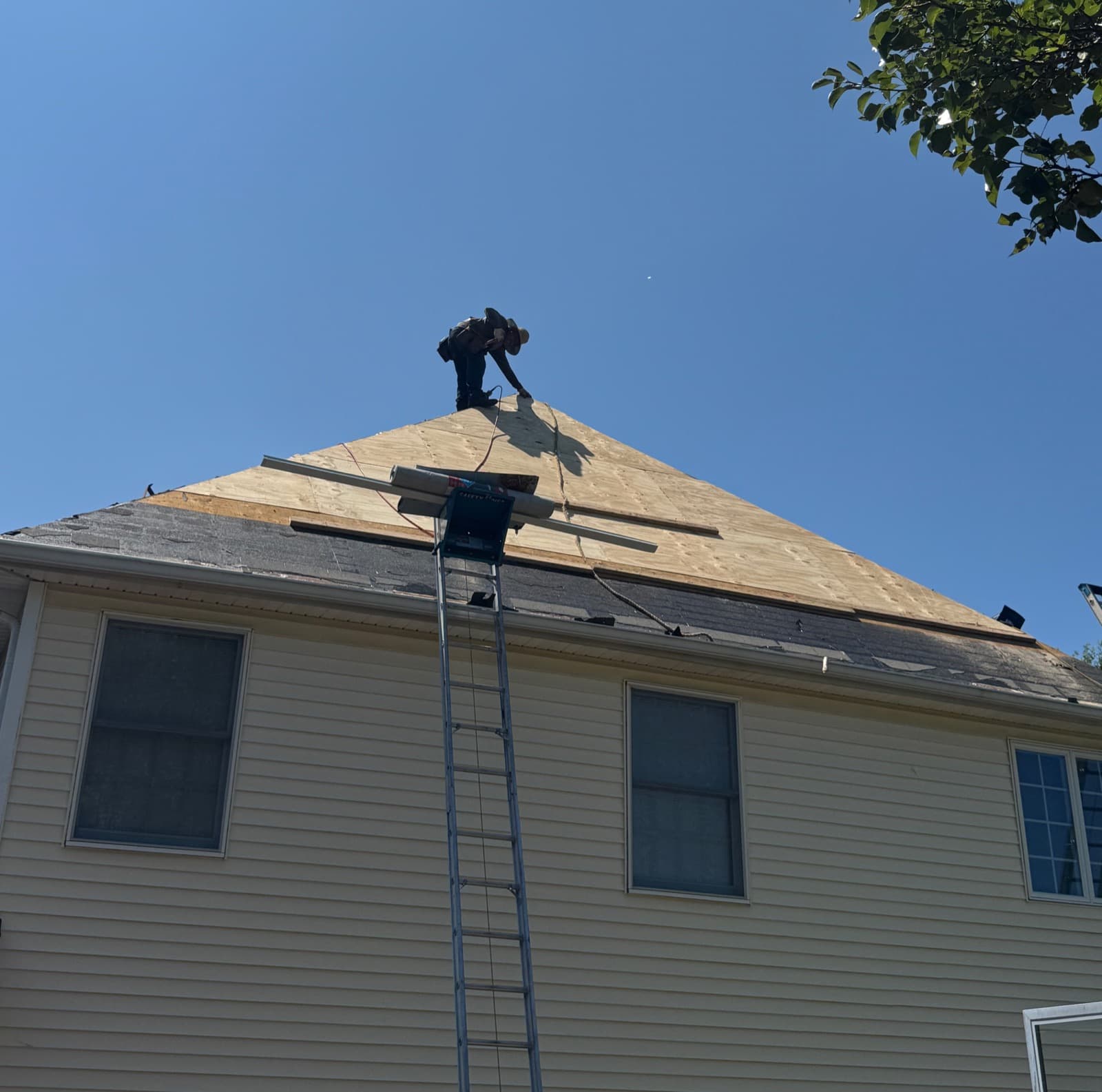
Roof Repair in Totowa, NJ
Totowa's exterior-appearance standards hang on the words "Any site plan" — and a one- or two-family house never generates one. On the buildings they do reach, the ordinance calls them a frame of reference; the ordinance calls its design standards a frame of reference, and what fixes the roof is whatever the approval on file says.
Search the Totowa code for a rule about your roof and you land on § 415-90C(2)(b)[2], the clause that mentions roof materials and demands samples. Subsection C, as amended 2-24-1998 by Ord. No. 3-98, confines its review requirement to any site plan involving a new building, an addition to an existing building, or a change in the exterior design or appearance of an existing building. And site plans come from § 415-61, which requires Planning Board approval before a building permit or certificate of occupancy for any development for which site plan approval is required, then goes on to require it for every nonresidential use. A detached one- or two-family house does not generate a site plan. So on a house, § 415-90C never reaches you — not by exemption, by scope.
Two other owners get a different answer. On a building that did go through site plan — a store, an office, an apartment building — what fixes the roof is what the Planning Board approved for that property, and the date matters: Subsection C carries a 1998 amendment, and the samples sentence was added 11-9-2004 by Ord. No. 13-2004. In two zoning districts Totowa did write roof form as a mandate. And on a commercial or institutional building the tear-off carries paperwork of its own, under the recycling chapter.
- commercial roofing — Occupied buildings — sequencing around tenants, who can authorize the work, the permit path, insurance endorsements and phasing across budget years.
- flat & low-slope roofing — EPDM, TPO and modified bitumen, and the code's quarter-inch-in-twelve drainage floor — what a low-slope roof needs when a flat section is what the building has.
- roof replacement — Tear-off method, decking, underlayment and how a full re-roof is actually built — in one place, rather than repeated on every town page.
- roof inspection — A free on-site read of shingles, flashing, valleys, decking and ventilation, with a written summary you can attach to a board or owner request.
- roof repair in Woodland Park — The borough next door, where the housing mix is the story — townhouse and association roofs, and hillside split-levels draining plane onto plane.
- roofing in Passaic County — Totowa is a Passaic County borough — the county page covers the towns around it and how we schedule crews across the county from Garfield.
A frame of reference, not a rulebook — so read the approval
Everything in the lettered list beneath it is governed by this. § 415-90C(2): "The following standards shall be utilized by the Planning Board in reviewing all site plans. These standards are intended to provide a frame of reference for the applicant in the development of site and building plans, as well as a method of review by the Board. These standards shall not be regarded as inflexible requirements nor are they intended to discourage creativity, invention and innovation. The specification of one or more particular architectural styles is not included in these standards. The standards are as follows:" A frame of reference, expressly not inflexible requirements.
The roof clause underneath, § 415-90C(2)(b)[2], amended 11-9-2004 by Ord. No. 13-2004: "The use of exterior colors, facade, texture or roof materials or the combination of colors and materials that are harmonious to the surrounding area. Samples must be submitted with site plan applications and are subject to final approval by the Planning Board and Board of Adjustment." The first sentence is the softened criterion. The second is procedural: on a property approved on or after November 2004 there may be an approved roof-material sample sitting in the Planning Board file, and that approval, not the ordinance, is what a reroof answers to. So the first question is what the resolution for that address says, and what year it carries.
- The resolution of approval on file, and the year it carries
- Whether a material sample was ever submitted — that requirement dates from 11-9-2004
- Whether the work is a change in exterior design or appearance
The one place Totowa does name materials — and it stops at the wall
Subsection C is not all frame of reference. Two clauses added 5-13-2014 by Ord. No. 06-2014 sit alongside the design standards and are written in “shall”. § 415-90C(3): “Within the B-2 Local Business District, B-4 Corporate Business District, B-5 Professional Business District, B-6 Restricted Commercial District and for all nonresidential uses along Totowa Road one or a combination of the following exterior materials shall be utilized on the front and side facades of all new buildings and additions” — natural stone, brick, glass, granite.
That is a real specification, and it is worth reading for what it leaves out: it reaches the front and side facades of new buildings and additions, and it names no roof covering at all. § 415-90C(4) does the same for ground-floor transparency. So in the districts where Totowa was willing to be prescriptive, it was prescriptive about walls. Above the wall line the only thing on file is whatever the resolution for that address approved.
- The resolution of approval for the address, and the year it carries
- Whether a material sample was ever submitted — that requirement dates from 11-9-2004
- In the R-AH and R-AH-2 districts a separate design standard fixes roof form outright; Woodland Park carries the same drafted language and that page covers it
Monthly payment options
We work with Hearth, which shops several lenders on a single application. See your personalized options in minutes — checking does not affect your credit score, and there is no commitment.
- Loan amounts up to $250,000
- Funding in as little as 1–3 days
- No prepayment penalties
- No home equity required
Financing is provided by Hearth's lending partners, not by Precision Windows & Roofing. Rates and terms depend on your credit and the lender making the offer, and all financing is subject to credit approval.
Common questions
Does a re-roof in Totowa need a construction permit?
State law, not borough law, and it cuts both ways. N.J.A.C. 5:23-2.7(c)1x treats roof covering replacement as ordinary maintenance under two limits that always travel together: the roof covering only, and detached one- and two-family dwellings only. Go past the covering — rotted decking, a cracked rafter — and N.J.A.C. 5:23-2.7(b)4 puts the job back under permit, because structural work is never ordinary maintenance. On anything that is not a detached one- or two-family dwelling, the exemption was never available.
We own a commercial building. Does the tear-off itself carry rules here?
Yes, and they sit in the solid waste chapter rather than in zoning. § 341-2C(1) requires commercial establishments and institutions to source-separate, and among the construction and demolition debris recyclable components it names asphalt-based roofing scrap. The burden lands on the building, not the hauler: "Each commercial establishment and institution shall be responsible for establishing and maintaining their own collection, transportation and marketing of designated recyclable materials, unless the municipality has agreed (individually) to provide this service or allow the use of the municipal depot for drop-off." And: "Documentation of tonnage of material recycled must be submitted in accordance with the provisions of this article." Roofing scrap is not on the residential curbside list at § 341-3A, which for one- and two-family units is aluminum, glass and newspaper.
Is there a historic commission to clear, or a Totowa roofer's license to check?
Neither turned up. A code-wide search for historic preservation returns the phrase only in the flood damage prevention chapter — the § 189-53 definitions and the § 189-43 variance provision — and no chapter regulates exterior alterations for historic character. We found no chapter licensing roofers. Ours is state and manufacturer: NJHIC #13VH13970900, insured, GAF certified at the entry tier, ten-year transferable workmanship warranty.
Our building went through site plan years ago. Does a new roof trigger review again?
Possibly — that is a borough call, not ours. § 415-90C(1) reaches a change in the exterior design or appearance of an existing building, and whether a like-for-like reroof in the same profile and colour is one is for the construction and zoning offices to say. Where the ordinance does name materials it names WALL materials: § 415-90C(3), added 5-13-2014 by Ord. No. 06-2014, requires natural stone, brick, glass or granite on the front and side facades of new buildings and additions in the B-2, B-4, B-5 and B-6 Districts and for nonresidential uses along Totowa Road. It names no roof covering. So on the roof the only specification is whatever your own approval carries. Pull the file and we will quote to it. Emergencies run on a different clock — we answer those 24/7.
Explore
Get your free roofing quote
Free, no-obligation on-site assessment anywhere in New Jersey — and we answer the phone 24/7.