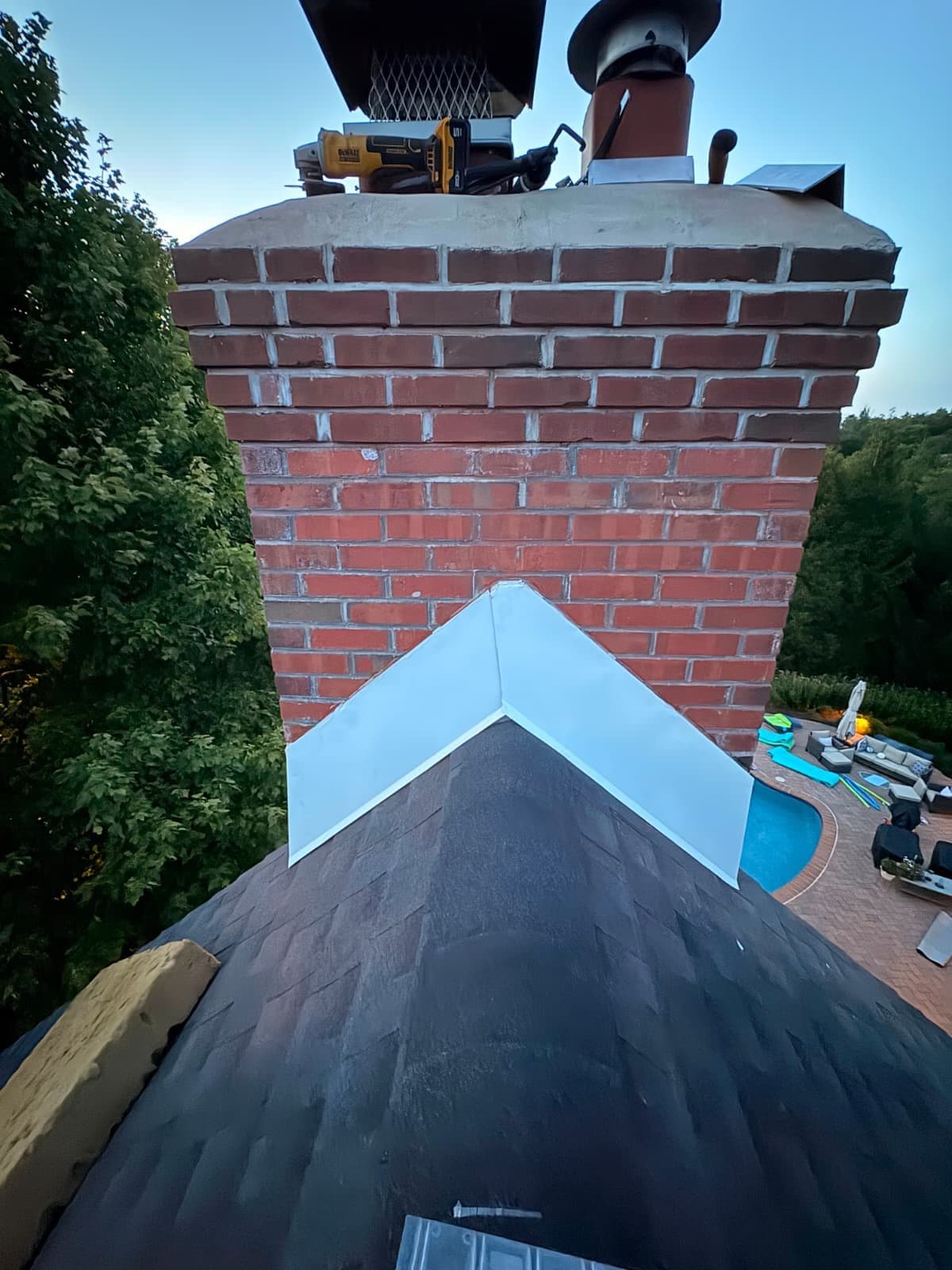
Slate, Cedar Shake & Copper Roofing in North New Jersey
The work most North Jersey roofers hand to a sub or talk you out of: slate ripped and re-hung stone by stone, cedar laid so it can dry from underneath, copper soldered rather than caulked. Across New Jersey, including the Montclair, Glen Ridge and Ridgewood housing stock where the roof is the most expensive thing on the house. NJHIC #13VH13970900.
A slate roof and an asphalt roof are not the same product at two prices. The stone on a Montclair Queen Anne or a Ridgewood Tudor was quarried, split by hand, punched for two nails and hung by a tradesman whose job title was slater, and the National Park Service puts the service life of those stones at 60 to 125 years or longer, with Vermont and New York slate around 125 years and Buckingham Virginia slate at 175 or more. That single figure reframes every bid you are about to collect. On a covering that can outlive two mortgages, the useful question is almost never what to replace it with. It is what has actually failed, and whether it is the stone at all.
This page covers the three materials our own crew works in house, and two things this market rarely puts in writing: what actually decides whether a historic house in Montclair, Glen Ridge or Ridgewood needs approval before its roof changes, which is not what most owners assume, and the code section that makes the cheap overlay bid on a slate roof illegal rather than merely unwise.
Slate, cedar and copper are quoted off a measured roof, and the market ranges in the FAQ below are for planning, not a quote. The measurement and the written scope are free either way. Call (201) 275-9185.
- Roof flashing repair — Step, apron, valley, drip edge and the kick-out — the mechanics of every flashing on a roof, whatever the covering is made of. Here we only settle which metal, at what weight, joined how.
- Roof repair in Paterson — Great Falls, Downtown Commercial, Eastside Park and Court House. Paterson runs review differently from every other town on this page, and it has its own.
- Essex County roofing — Montclair, Glen Ridge and the Watchung ridge in context, alongside the flat multi-family roofs of Newark and the Oranges — three completely different Essex roofs.
- Asphalt & designer shingles — The slate-look and shake-look designer tier, plus wind classes, the nailing zone and what a lifetime warranty actually covers.
- Flat & low-slope roofing — The other two conditions in the recover rule — layer count and a saturated deck — and how the low-slope decks next door to a mansard are diagnosed.
- Roof replacement cost guide — North Jersey ranges for an asphalt replacement, useful for reading an asphalt bid. Slate and cedar ranges are in our roof cost calculator and the FAQ below; copper is priced off a measured roof.
The National Register is an honour, not a permit — Montclair proves it
Start here, because most owners of a Victorian have this backwards. Being inside a National Register historic district, or being individually listed on it, places no restriction on a private owner's roof. The National Park Service says so in its own Register FAQs: under federal law, listing places no restrictions on what a non-federal owner may do with the property, up to and including destruction, unless the property is involved in a project receiving federal assistance. It is honorific, and it opens certain tax programmes. It is not a permit requirement.
New Jersey's side reads the same way. The State Historic Preservation Office's project review authority reaches undertakings by the State, a county, a municipality or their agencies, and its own Project Review guidance lists building and demolition permits issued to private entities among the things that are not undertakings at all.
One thing can stop you stripping a slate roof: a municipal ordinance. Under New Jersey's Municipal Land Use Law a town may create a historic preservation commission and designate local districts and local landmarks, and only that local designation carries a Certificate of Appropriateness requirement. Register district and local district are two maps drawn for two different purposes, and they frequently cover different blocks. Which makes the honest answer to "do I need approval?" never a town name. It is an address, checked against that town's own designation list before anyone writes a proposal.
Montclair is the clearest demonstration of the gap. The Township has four local historic districts and publishes them: Pine Street, a residential and mixed working-class district; Town Center; the Upper Montclair Business District; and Watchung Plaza. Three of those four are commercial. Nothing local covers the Upper Montclair and Upper Mountain Avenue Victorian belt that people picture when they picture protected Montclair. What covers that belt is the Mountain Historic District, listed on the National Register in 1988 as part of the Historic Resources of Montclair Multiple Resource Area. Register, not local.
The trap is individual designation, and it sits on the same road. Montclair separately landmarks individual properties, several of them on Upper Mountain Avenue itself: the Dittig-Walther House at 474, the George S. Porter House at 398, the Welsh House at 24, the Mountain Avenue Train Station at 451. An individually designated local landmark triggers review whichever district it does or does not sit in. Where review applies, roofing then has an express carve-out — the ordinance's list of work not requiring a Certificate of Appropriateness names maintenance and repair of existing roofing materials involving no change in the design, scale or appearance of the structure. Putting slate back as slate is generally exempt. Taking slate off and putting asphalt on is an application, and the Commission hears those once a month at 7:30 p.m. in the Council Chambers at 205 Claremont Avenue. The dates are not a fixed weekday — the Township's published 2026 schedule runs a mix of third and fourth Thursdays — so take them off the Township's own Schedule of Meetings page rather than assuming a pattern.
Glen Ridge is the inverse case, and its guidelines name slate outright
Cross the line into Glen Ridge and the picture flips. The Borough's Historic Preservation Commission, established by ordinance in 1987, oversees a historic district that encompasses over 90% of the Borough and extends nearly its entire length, and before exterior work begins on any property inside it a Certificate of Appropriateness is required. In Montclair the reviewed address is the exception. In Glen Ridge it is the default.
Glen Ridge's design guidelines are also the only ones in this market that tell you, in one sentence, what a slate roof's odds actually are. They state that roof form and materials are significant to historic character; that any alteration in roofing material visible from the street requires a COA; that in-kind replacement, asphalt to asphalt being the example given, does not require review; that applicants must provide samples of proposed roofing; and then the line that decides projects — slate roofs should be repaired and retained whenever possible, and removal is rarely approved. If the plan is to strip Glen Ridge slate for architectural shingle, that is the sentence being argued against, and it is better known before anyone has been paid to design around it.
The process is less painful than that sentence suggests, within limits. Roofing sits on the Borough's Minor Application list, so routine work is eligible for expedited review: a clear description of the existing condition and the proposed work goes to the Commission by email at any time, and an administrator either approves it or refers it to a three-member subcommittee. A substantial alteration will not clear that way. It goes to a monthly meeting, first Wednesday, 7:30 PM, with a Regular Application filed at least 20 calendar days ahead for preliminary review and 9 days ahead for final. An issued Certificate of Appropriateness is valid for two years, so an approval obtained now survives an ordinary scheduling delay.
Ridgewood surprises people in the other direction. The Village code establishes one historic district, the Village Center Historic District, plus individually designated historic sites shown on the Zoning Map. A residential Victorian that is not one of those designated sites is not inside a reviewed district, whatever its age or its street. Paterson works differently again, and strictly enough that it has its own page — start there if your address is in Great Falls, Downtown Commercial, Eastside Park or Court House.
Roof leaking right now? We answer 24/7.
There is no legal way to shingle over a slate roof
Somewhere in the bidding you may be offered the cheap option: leave the slate, shingle over it. On a slate roof that is not a judgement call about workmanship. It is prohibited.
The 2024 International Residential Code, as New Jersey adopts it for houses, sets out at R908.4 three conditions that bar a roof recover, and one of them names the material outright — slate, clay, cement or asbestos-cement tile. No exception is attached for its condition, its pitch or its age. The other two concern layer count and a saturated deck and apply to every covering; those belong to our flat-roof page. What the slate clause changes is the arithmetic: on a slate roof the cheap option does not exist, so the real comparison is between repairing the stone you have and removing it altogether.
The code has more to say about slate than most homeowners expect, and a proposal written by someone who has done this before will contain it. Slate is permitted on slopes of 4 units vertical in 12 and steeper, over solidly sheathed roofs, fastened with two nails per slate, with headlap tied to pitch: four inches from 4:12 up to 8:12, three inches from 8:12 up to 20:12, and two inches above that. That last band is why the near-vertical face of a mansard is slated differently from the main roof above it, and why the mansard is so often the one plane still wearing its original stone. Valley metal is specified as well — not less than 15 inches wide, at a minimum uncoated thickness of 0.0179 inch in zinc-coated G90. None of those are obscure numbers. They are the ones a real slate proposal is written to, and the ones a proposal written by somebody who has never done this will not contain.
It is the nails and the metal long before it is the stone
Preservation Brief 29 puts the warning third in its repair-or-replace checklist, ahead of anything about the stone: do not assume the slates are leaking. Gutters, valleys and flashings are the more likely candidates, and a false leak can be condensation in an under-ventilated attic. The Brief is direct about why. Flashings are the weakest point in any roof, and where the covering is this durable the metal around it generally reaches the end of its life first.
The failure that surprises owners most is not the stone at all. Nineteenth-century slate was very often hung on plain steel or galvanised cut nails, and those nails rust away long before the stone begins to deteriorate — the Brief calls their rusting a common cause of slate loss on historic roofs. The symptom is not cracking or crumbling. It is slates sliding out of position, several at a time, on a roof whose stone is sound. The remedy in that case is to salvage the slates and re-lay them, punching new holes where the old ones have worn. A roof failing this way looks terminal from the street and is not.
Two of the tests are worth knowing, with the caveat the Brief is emphatic about: owners should survey a slate roof from the ground with binoculars rather than climb it, so run these on slates that have already come off, or have someone do them up top. Sound the slate: a high-grade slate poised on the fingertips and struck rings with a clear, solid note, while a severely weathered one is far less sonorous and gives a dull thud. Then press hard on it by hand — a sound slate is unaffected, a deteriorated one feels brittle and cracks. What that detects is chemistry rather than wear. Impurities in the stone react through wet-dry and hot-cold cycling to form gypsum, which occupies roughly twice the volume of the calcite it replaced, and the internal stress delaminates the slate from the inside out. Because that happens as much on the hidden face as the exposed one, a weathered slate typically cannot be turned over and reused, which is worth knowing when somebody offers to do exactly that.
The threshold for the whole decision is a number. Where 20% or more of the slates on a roof, or on one slope, are broken, cracked, missing or sliding out of position, replacing that roof or that slope is usually cheaper than executing individual repairs; below 20% it should be evaluated for repair. It is legitimately a per-slope decision, because deterioration is rarely uniform, and one plane can be replaced while the others are repaired, spreading the work across years rather than one invoice. One thing is never the answer: mastic. Roofing cement over a cracked slate hardens and cracks, it makes the next repair harder, and applied to metal flashings it accelerates their corrosion. When we open a slate roof that has been maintained with tar, the first job is getting the tar off so the metal under it can be judged honestly.
Roof leaking right now? We answer 24/7.
Matching a slate that is not quarried anymore
Slate is not a colour you order out of a book. Size, shape, colour, texture, exposure and coursing all have to be documented and matched, and on a graduated roof, thickest and largest at the eaves and thinning toward the ridge, the pattern itself is part of the match.
The hard part is that several of the slates on North Jersey roofs are no longer produced. Pennsylvania Hard-Vein and Peach Bottom slate are not quarried today. Ribbon slate, common out of the Pennsylvania quarries, is no longer manufactured for roofing at all, and the accepted closest available match is mottled grey Vermont slate. If that is what is on your roof, an exact replacement does not exist, and a contractor who says otherwise has not looked. What exists is a careful match, and salvage.
Salvage is the first source and usually the best one. Where only part of a roof is coming down, the usable stone off that section goes back on the sections staying up, each piece sounded individually, because a slate that survived removal is not automatically sound. Where a roof failed at its fasteners rather than in its stone, a good share of it can usually be saved — the Brief promises only that salvage of at least some slates should be possible, and the honest answer to how much arrives once the stone is off and graded, not before.
Then the calendar, which nobody warns homeowners about. Roofing slate delivery runs 4 to 12 weeks and can reach a year on special orders, and random-width orders fill faster than fixed widths. Laying it is slow as well: an experienced slater and a helper cover roughly two to three squares a day on a clear expanse, and a complex roof of chimneys, dormers and valleys brings that below a square a day. A slate roof cannot be scheduled like a shingle roof. If the roof has to sit open in the meantime it gets stabilised properly, with roll roofing carefully stitched into the remaining roof, which buys the time to document, order and plan without leaving the house exposed.
The rough "rustic" shake sold as historic is a modern product
Preservation Brief 19 is blunt about what most cedar roofs in this market get wrong. Modern commercially available shakes are thicker than their historic handsplit counterparts and are usually left undressed, with a rough, corrugated surface — and that roughness gets promoted as suitable for preservation work precisely because it looks rustic. The Brief's verdict: it is an erroneous assumption that the more irregular the shingle, the more authentic or historic it will appear. Historic wooden shingles were thin, roughly three-eighths to three-quarters of an inch, narrow at three to eight inches, and almost always smooth — dressed with a drawknife so they lay flat and shed rainwater instead of holding it in the grain. A heavily textured shake on a 1900 Colonial Revival is a costume, and it fails faster than the thing it imitates.
The specification worth writing down is the one the National Park Service used on its own project: Number One grade, 100% clear, 100% edgegrain, 100% heartwood. Softer sapwood was historically avoided because it deteriorated quickly, and flat-grain shingles cup and curl. On lifespan the Brief is honest in both directions — historic roofs of straight edgegrain heartwood shingles have lasted over sixty years, while fifteen to thirty years is the realistic expectation for most premium modern wooden roofs.
The biggest single variable is whether the shingle can dry from underneath, and there is a documented historic practice behind the modern product. Raising shingles slightly on sleepers over the deck for under-shingle ventilation was popular in the 1920s, and the industry called it a Hollywood installation; NPS attributes cedar roofs lasting sixty years partly to it. The nylon breather mesh sold today is that detail industrialised, and on a solidly sheathed roof it earns what it costs. The corollary matters as much: heavy asphalt-saturated felt run under a cedar roof works against you, because it is absorptive and holds moisture against the underside of the shingle, and where coverage and flashing are correct it is unnecessary as a general rule. NPS's own specification does call for foil-type flashing reinforcement at hips, ridges, eaves and valleys — reinforcement at the details, not a felt blanket over the deck.
Two code points and one habit. Wood shakes want a slope of 3 units vertical in 12 or greater, and may go over solid or spaced sheathing, except on the portion of a roof requiring an ice barrier — a portion that in this state exists in Sussex County and nowhere else, so on the roofs we work that sheathing decision is ours to argue rather than the code's to settle. Shakes also have to be interlaid: an 18-inch strip of No. 30 felt shingled between each course, positioned so none of it is exposed to weather. Then the habit, which is staples. The code does permit them, in the narrow form of two 16-gauge Type 304 or Type 316 stainless staples with a crown between 7/16 and 3/4 inch. Preservation Brief 19 still says avoid them, because pneumatic staples shoot through shakes, crush the wood fibres and crack them, and we agree — corrosion-resistant nails with deformed shanks, long enough to reach about three-quarters of an inch into the decking, are what we use.
Roof leaking right now? We answer 24/7.
Copper is soldered, not caulked — and there is one roof it does not belong on
On a covering with a century of service ahead of it, the flashing metal decides when the assembly comes apart, which is why NPS calls it poor economy to use anything but the most durable metals and the best workmanship. The weights are published. Sixteen-ounce copper is the minimum recommended for flashings, because lighter sheet does not survive the erosive action of the dust and grit that rainwater carries across a roof, and 20 or 24 ounce belongs in gutters, valleys and anywhere with limited access — the places you do not want to have to reach twice.
Copper joints are soldered. A soldered seam is a continuous metal joint with the same service life as the sheet on either side of it; a caulked seam has the service life of the sealant, which on a covering measured in centuries means redoing the same joint again and again. If a proposal for copper valleys never uses the word soldered, ask what is holding the seams together.
Then the rule broken most often on mixed jobs: use one metal throughout the flashings, gutters, downspouts and any metal roofing. Mixing dissimilar metals sets up galvanic action that corrodes the more electronegative of the two, and the local version of that mistake is a copper valley draining into a galvanised gutter. Where copper is not right, lead-coated copper and terne-coated stainless are the top of the line; traditional terne is a lesser choice because it has to be repainted on a schedule.
Which brings the exception nobody selling copper mentions. Copper does not belong on a red cedar roof. NPS is explicit: copper nails should not be specified with red cedar, because a chemical reaction between the wood and the copper reduces the life of the roof, and copper flashing and gutters generally should not be used with red cedar because staining will occur. Hot-dipped zinc-coated, aluminium or stainless nails instead. There are historic exceptions where very heavy-gauge copper outlasted the shingles it served, but as a default specification, pairing cedar with copper because both are premium materials is a mistake, and a common one. Slate and copper are a matched pair. Cedar and copper are not.
We do not re-teach step, apron, valley and kick-out geometry here — the mechanics are the same whatever the covering is made of, and they live on our flashing page. What changes on these roofs is which metal, at what weight, joined how.
When the roof genuinely is finished, and what actually substitutes
Sometimes the stone really is spent, or the budget really is not there, and the alternatives deserve naming rather than avoiding.
Synthetic slate is the first thing people ask about, and the economics are less favourable than they look. The NPS assessment is that the total initial cost of an artificial slate roof is only marginally less than a natural slate roof, because everything other than the tiles — labour, flashings, tear-off — costs the same either way, and over the long run natural slate tends to be the better investment because several artificial roofs get installed during one natural one's life. NPS also does not recommend artificial mineral-fibre slate for restoration work, on the grounds that its rigid uniformity reads as manufactured rather than quarried.
The genuinely honest middle path is a designer-grade laminated asphalt shingle cut to the scale and shadow of slate or hand-split shake. It is a different material and it deserves to be chosen with open eyes rather than sold as stone. That tier — weights, wind classes, what a warranty actually covers — is our shingle page rather than this one. What belongs here is the legal half: on a Register-district house with no local designation, that choice is yours to make; on a locally landmarked one, it is an application.
Structure is the last thing to settle before anything is ordered. On a house that has carried slate for a century the framing has largely proven itself, but a roof being re-slated should have its timbers checked for deflection, cracking and twisting while it is open, and where those show, a structural engineer experienced with older buildings is the right call rather than a roofer's opinion. Old delaminating slate holds moisture and rots the wood beneath it even where nothing is visibly leaking, so sheathing gets probed rather than glanced at. Where boards have to be replaced, plywood is generally the wrong patch — nailing through it bounces enough to loosen adjacent slates — so new boards of similar width and thickness go back, shimmed flush with the old, and not pressure-treated, which shrinks.
Monthly payment options
We work with Hearth, which shops several lenders on a single application. See your personalized options in minutes — checking does not affect your credit score, and there is no commitment.
- Loan amounts up to $250,000
- Funding in as little as 1–3 days
- No prepayment penalties
- No home equity required
Financing is provided by Hearth's lending partners, not by Precision Windows & Roofing. Rates and terms depend on your credit and the lender making the offer, and all financing is subject to credit approval.
Common questions
How do I find out whether my address is actually regulated?
Ask the town for two documents and the question resolves in an afternoon: the list of locally designated historic districts and individual landmarks, and the map or zoning overlay that shows them. Register listing is not the test, so a note in the file saying the house sits in a National Register district answers nothing on its own. Montclair publishes a historic inventory viewer anyone can search, and it is worth searching by address rather than by street, because individually designated landmarks sit on blocks with no district over them. Local designation is done by ordinance and leaves a paper trail, so if nobody at the counter can find your address on a designation list, you are very probably not on one. We settle it for your address first, because the harmless version of the answer is the one everybody assumes and it is not always the true one.
Can a single broken slate be replaced without redoing the roof?
Yes, and it is the commonest job we do on slate. The nails holding a slate are hidden under the course above it, so the broken piece comes out with a slater's ripper — a thin steel blade slid up under the slate to hook and shear the old nails — and the replacement cannot then be nailed in the same place without leaving a fastener hole above the joint. It goes back nailed high instead: a single nail driven through the vertical joint between the slates in the course above, then covered by a friction-fit copper bib slid up under that joint, so the fastener is never exposed to weather. Hooks and clips that catch the bottom edge exist and get used elsewhere, but NPS specifically does not recommend a folded copper tab in a snow-and-ice climate like this one, because ice bends the tab over and the replacement slides straight back out. The bib is copper because the fastening has to last as long as the stone around it. The repair we most often find, and most often have to undo, is a slate bedded in roofing cement.
My slate roof only leaks at the chimney. Does the whole roof have to come off?
Almost never. The slates around a chimney or down a valley come off individually, get stacked in order, and go back over new metal; the field is never disturbed. That is the biggest practical difference between slate and asphalt. On an asphalt roof, rebuilding a chimney flashing means cutting into a covering that will not be the same again afterwards, which is why flashing work so often gets folded into a replacement. On slate it stays a genuinely separate scope, which also means the roof can be worked in phases — one plane or one detail a year — and that is how most of these roofs get through a bad decade without one enormous invoice.
Should anyone be walking on my slate roof?
As little as possible, and never casually. Slate is strong in the plane of the roof and breaks under a point load, so a satellite installer, an antenna crew or a painter crossing the field can cost you a dozen slates that nobody will own up to — and that applies to us as much as anyone, on the days we are up there to sweep a flue rather than to work on the roof. We work off hook ladders and staging that bear on the ridge and at the eaves rather than on the stone, and where someone has to be out on the field, they work off planks. If another trade needs roof access on a slate house, settle who is putting the broken slates back before they go up — otherwise the answer is nobody, and the breakage surfaces as a leak two winters later.
What should a written slate proposal actually itemise?
Counts, not adjectives. How many slates are coming off, how many of those are expected to go back on, and how many are being bought new — that three-way split drives both the cost and the calendar, and a vague proposal is usually vague in exactly that spot. Then linear feet of valley, ridge, hip and step flashing, each line naming the metal and its weight rather than saying flashing as required. Then access: whose staging, bearing where, and who carries the cost if a slate breaks under somebody's foot. Then what protects the salvaged stone while it is off the roof, because slate stacked carelessly in a driveway breaks before it ever goes back up. If those four are itemised you can compare two bids honestly. If they are not, you are comparing two lump sums that describe different jobs.
A roofer has already started shingling over my slate. What do I do now?
Stop the work before another course goes down. Two things are true and worth knowing in order. First, New Jersey does not require a construction permit for this — under N.J.A.C. 5:23-2.7 the repair or replacement of roof covering on a detached one- or two-family dwelling is ordinary maintenance, so the absence of a permit tells you nothing and is not the lever here. What is a lever is the code itself: ordinary maintenance still has to comply with it, and R908.4 bars a recover over slate outright, so the work is non-compliant whoever pulled or did not pull paperwork. Second, if your address is a locally designated landmark or sits in a local historic district, the approval that was skipped is a Certificate of Appropriateness, and the town's zoning officer or historic preservation staff — not the construction official — is who can act on that. Photograph the roof before anyone tidies up, because the damage is the nails driven through sound slate to hold the new shingles down, and it becomes invisible the moment those shingles are lifted off. However it resolves, the roof does not stay that way — the shingles come back off, and what is underneath gets assessed on its own terms.
My cedar roof has gone green and black on the north slope. Is it finished?
Usually not, but it is telling you something. Moss and algae grow where the shingle stays wet, which on a cedar roof means a north-facing plane under a canopy, a slope with no airflow beneath it, or debris packed into the courses holding water against the wood. The order of operations is to get the limbs off the roof plane, clear the valleys and the courses, and only then judge the wood. Nobody should pressure-wash it — the jet erodes the soft growth out of the grain and roughens a surface that was meant to be smooth, taking years off the roof in an afternoon. Shingles that have split, curled or gone soft come out one at a time. That is a maintenance visit, not a replacement.
What does slate, cedar or copper work cost?
Natural slate on a walkable 2,000 sq ft roof, with the old covering off and framing already able to carry slate, runs about $35,000 to $75,000 installed, and real cedar shake on the same roof about $22,000 to $40,000. Steep historic roofs and asphalt-to-slate conversions run higher, and copper is priced off the measured roof. On a slate repair or re-lay, the largest variable is not the material at all — it is how much of the existing stone is salvageable, which decides how much new slate has to be bought and waited for. On cedar it is the deck, and whether the shingles will be able to dry from underneath. On copper it is the weight of the sheet and the number of soldered joints. Our roof cost calculator also prices slate and cedar, and our cost guide covers asphalt replacement for reading an asphalt bid.
Do you actually do this work, or subcontract it?
In house. The ripping, the re-hanging and the soldering are done by our own crew on our own payroll, not by a specialty sub we phone when a Montclair or Ridgewood address comes in. A test you can apply to anyone, us included: ask who will be holding the soldering iron, and whether that person is on site the day the valley goes in. On subbed work nobody in the driveway can give you the name. We are NJHIC-registered, #13VH13970900, and insured, we quote line by line, and we will tell you when a repair beats a replacement even though the replacement is the bigger job.
Explore
Get your free roofing quote
Free, no-obligation on-site assessment anywhere in New Jersey — and we answer the phone 24/7.