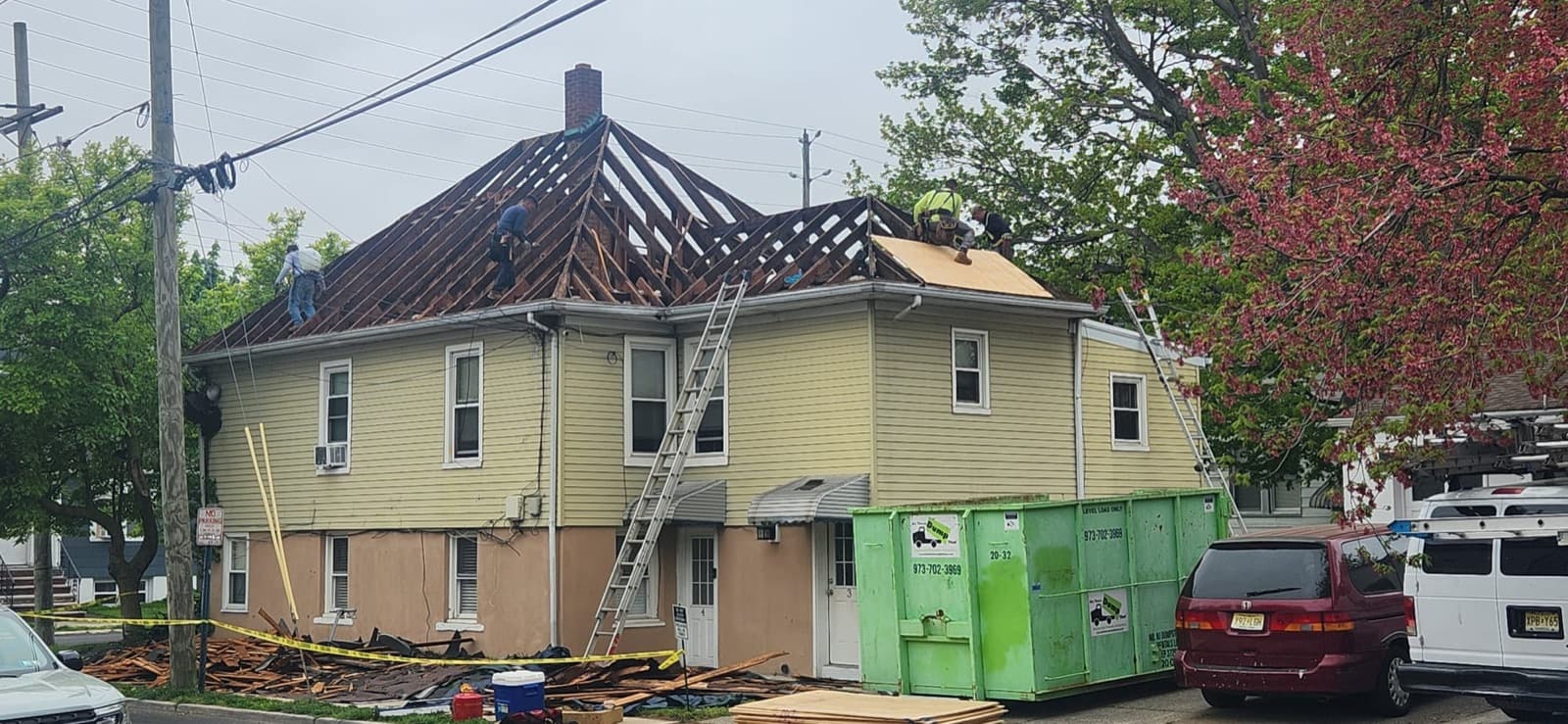
Roof Repair & Replacement in Wallington, NJ
On a rent-controlled Wallington building the roof lands in the rent record twice — once if it fails, once if you replace it. Tear-offs, leak tracing, flashing and gutters, scoped and photographed so what your attorney or accountant hands the Rent Leveling Board is a dated record and not a shoebox of receipts. NJHIC #13VH13970900.
Wallington adopted rent control in 1973 and still runs a Rent Leveling Board, and that one fact changes what a roof is on a covered building here. Chapter 283 defines a “dwelling” as anything rented to four or more tenants or family units, then exempts several categories on top of that, so coverage is the first question to settle on any Wallington building. Where the chapter does reach it, the roof lands on both sides of the rent ledger. Let it go, and § 283-10 lets a tenant or class of tenants ask the Board to set a reduced “reasonable rental value,” payable until the landlord proves the deficiency corrected. Do it, and § 283-5 is the route back — an application to treat the roof as a capital improvement, recovered across the IRS depreciation period, and not deemed complete until an ordinance-set professional-review escrow is on deposit.
We are Precision Windows & Roofing, based in Garfield, NJ HIC #13VH13970900 and GAF certified. We install GAF, Owens Corning and CertainTeed, and every roof carries a ten-year transferable workmanship warranty. Call (201) 275-9185; we answer around the clock when a roof is open.
- Full roof replacement — Tear-off to the deck, sheathing repair, underlayment, ice-and-water, flashing and ventilation — the actual scope behind the word “improvement” on a capital-improvement application.
- Roof inspection — The dated, photographed condition report that becomes your evidence when the question is whether a deficiency existed and whether it has been corrected.
- Apartment and commercial roofing — For the ten-plus-unit buildings that carry a fifth of Wallington's housing — different permitting path, different membrane, different logistics than a house.
- Roofing over occupied apartments — Written for Hackensack, but it is where we set out the phasing and tenant-notice practice we use on a building with people living under the work.
- Gutters and leaders — § 276-9B(20) names leaders, gutters and downspouts in the same breath as the roof, so here is how we size and hang them.
- Roofing across Bergen County — Where Wallington sits in the county's four distinct housing worlds, and what each one tends to fail on first.
What Wallington's code actually says about your roof
Two chapters do the work. Chapter 283 (Rent Control, reviewed annually by the Rent Leveling Board) decides what the roof does to the rent. Chapter 276 (Property Maintenance) sets the condition the building has to hold in the first place, and § 283-10 points straight at it by requiring the landlord to keep up the standards “provided or was required to do by law.”
§ 276-9B(20), Roofs: “The roof shall be structurally sound, tight and have no defects which might admit rain, and roof drainage shall be adequate to prevent rainwater from causing dampness in the walls or interior portion of the building. All leaders, gutters and downspouts shall be maintained in a state of good repair and adequate to carry off water from the building.”
§ 276-9C adds a measurable outer limit — exterior deterioration counts when it includes “loose or missing siding or roof coverings affecting 15% or more of the outside surface.”
And § 283-5B sets the recovery formula: a capital improvement is one “depreciable pursuant to the Internal Revenue Code …” and “the total amount of the cost … shall be divided by the depreciation period allowed by the Internal Revenue Service,” prorated among tenants and charged “for no period greater than the original depreciation period.” IRS Publication 527 lists a new roof among improvements to residential rental property and puts that property class on a 27.5-year recovery period.
Buying a roof on a rent-regulated Wallington building
The two clocks run at very different speeds. If the Board finds a deficiency, the § 283-10 reduction runs until you prove it corrected — open-ended, on a timetable you do not control. The § 283-5 pass-through is the opposite: sliced across a 27.5-year schedule and split among the units.
Practically, that puts weight on three things. Documentation, because § 283-10 makes proof of correction the landlord's burden — we date the scope, photograph the deck once it is open, and invoice the job as one identified improvement rather than a running tab of small repairs. Completeness, because § 276-9B(20) is a condition test with no percentage in it: a roof that admits rain fails it, and so do leaders that do not carry water off the building, which is why gutters belong in this scope and not next year's. And sequencing, because the Board's own professionals are paid out of an applicant escrow posted before the application is deemed complete.
We are roofers, not your attorney or accountant, and we do not file rent-board applications. What we can give you is a scope and a record clean enough to hand to the people who do.
Monthly payment options
We work with Hearth, which shops several lenders on a single application. See your personalized options in minutes — checking does not affect your credit score, and there is no commitment.
- Loan amounts up to $250,000
- Funding in as little as 1–3 days
- No prepayment penalties
- No home equity required
Financing is provided by Hearth's lending partners, not by Precision Windows & Roofing. Rates and terms depend on your credit and the lender making the offer, and all financing is subject to credit approval.
Common questions
I own a four-unit house in Wallington and live in one unit. Does any of this apply to me?
Chapter 283 probably does not — it exempts dwellings of five or fewer units in which the owner resides, and the Rent Leveling Board itself says it handles only buildings of four or more units. Chapter 276 is a separate question: property maintenance is not a rent-control provision, and it does not turn on your unit count or where you live.
My tenants are complaining about ceiling stains. How fast can that turn into a rent reduction?
Not instantly. § 283-10B says a deficiency “may be found and disclosed only after a duly noticed hearing.” The part worth reading twice is the end of it: tenants pay the reduced value “until the landlord proves that the deficiency has been corrected.” The exposure closes on your evidence, not on the calendar, which is a reason to get a dated inspection on paper early.
Is a patch enough to satisfy the maintenance code?
It depends which half of the code you are answering. § 276-9C's 15%-of-surface threshold describes gross deterioration, so a small patch can clear it easily. § 276-9B(20) has no threshold at all — a roof with defects that might admit rain is non-compliant at any size. A patch that stops the water can satisfy the code and still not be the improvement § 283-5 contemplates.
Does the Rent Leveling Board have to approve the roof before I do the work?
§ 283-5 governs seeking additional rental, not permission to maintain your building, and your Chapter 276 obligation does not pause while an application sits. The approval you do need is a construction permit: the state's ordinary-maintenance exemption at N.J.A.C. 5:23-2.7(c)1x reaches only detached one- and two-family dwellings, so a Chapter 283 building — four or more units by definition — sits outside it and the re-roof is permitted work. An emergency roof does not wait on any of that. Talk to the Board and your accountant about the increase; call us about the roof.
Why does Wallington have so many buildings this affects?
Census ACS 2020–2024 estimates put the borough at 4,988 housing units, of which about 1,027 sit in structures of ten or more units — far too large for the owner-occupancy exemption to reach. Roughly 62.5% of occupied units are renter-occupied, against about 34.7% countywide in Bergen.
Explore
Get your free roofing quote
Free, no-obligation on-site assessment anywhere in New Jersey — and we answer the phone 24/7.