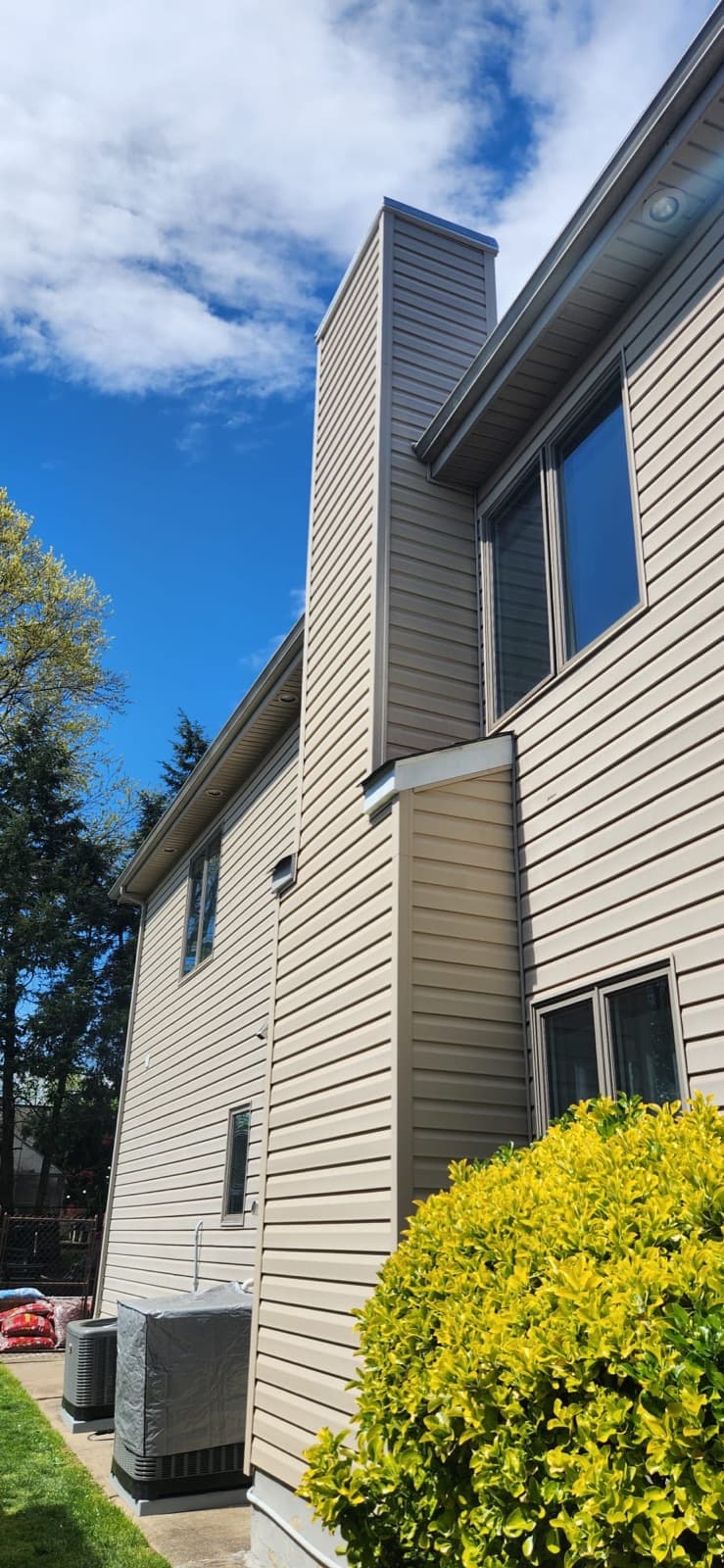
Chimney Repair in North New Jersey
Sweeping, creosote removal and relining, plus crown repair, chimney caps, tuckpointing and repointing, brick rebuilds, waterproofing and the flashing at the roof joint — both halves of your chimney, from one contractor. Free on-site diagnosis across New Jersey from our Garfield shop. NJ-registered.
A chimney is the most exposed masonry on a North Jersey house — a stack of brick and mortar standing alone above the roofline, taking sun, wind-driven rain, and a full freeze-thaw winter from all four sides at once. It is also where two of our specialties meet: masonry that has to shed water, and the flashing at the roof joint that keeps water out where the chimney punches through the roof plane. That second part is Precision's origin story. Before roofs, our trade was water intrusion at windows and glass — flashing an opening so a driving nor'easter cannot push rain past it — and a chimney is the same fight scaled up. We run chimney repair out of our Garfield shop across New Jersey, HIC reg.# 13VH13970900.
Here is the honest scope up front, because chimneys are one of the trades where a homeowner is most likely to be sold the wrong thing. We work on both halves of a chimney, which not every contractor does. Outside: flashing at the roof joint, crown repair and rebuilds, chimney caps, tuckpointing and repointing, brick rebuilds, and waterproofing. Inside: sweeping, creosote removal, and relining. That matters because the two halves cause each other — an unlined or failed flue is what condenses acidic flue gas into the mortar, and a cracked crown is what lets water into the same joints from above. Having one trade look at both means nobody gets to blame the other. Most calls that come to us as 'chimney repair' are really a leak, and if that is you, our chimney-flashing page is the place to start.
This page is the map to the masonry side of it — every service, what it covers, and the North Jersey code and climate reality behind the work. Not sure which repair your chimney needs? Call (201) 275-9185. We diagnose over the phone, and quote on-site, free, before any work starts.
- Chimney flashing leak repair — Leaks at the roof-to-chimney joint — step and counter-flashing, and the cricket a wide chimney needs.
- Chimney sweeping — The inside half: flue brushed and vacuumed, firebox, smoke chamber and damper, with written findings.
- Chimney inspection — What condition the flue is actually in — the three NFPA 211 levels, and which one a sale calls for.
- Chimney liner replacement — Cracked, missing or wrongly sized flue liners — stainless, cast-in-place or new clay tile.
Recent work in New Jersey
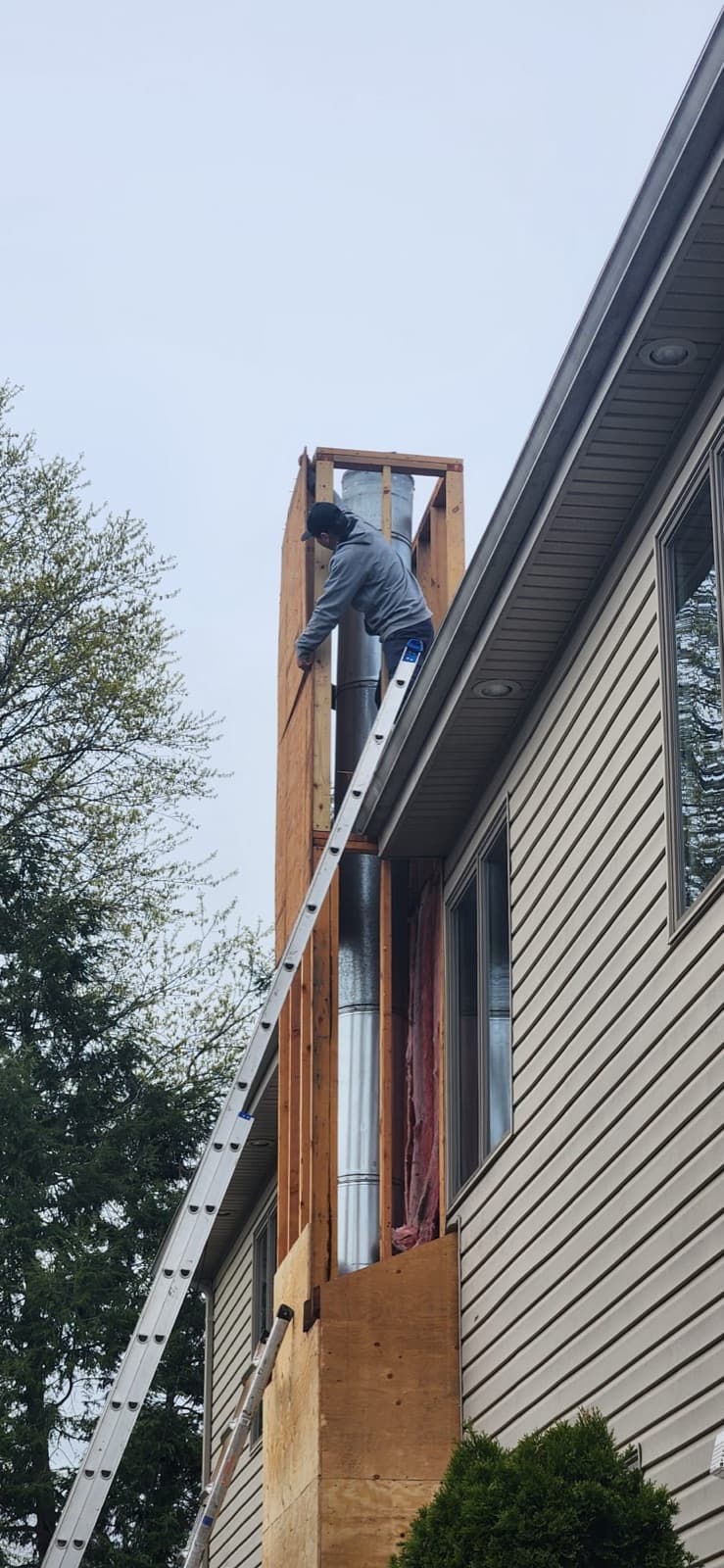
What 'chimney repair' actually covers
'My chimney needs repair' can mean six different jobs, and they rarely cost the same or fix the same problem — so the first thing we do is figure out which one you actually have. A chimney is three systems stacked together: the flue inside that carries smoke and combustion gases out, the masonry shell of brick and mortar that holds it up and takes the weather, and the crown and flashing on top that keep water from getting in. Chimney repair, the way we run it, covers all three — the flue inside, the shell, and the top and roof joint. Here is what falls under it:
- Flashing at the roof-to-chimney joint — the single most common source of a chimney leak, covered in depth on our chimney-flashing page.
- Crown repair or rebuild — the sloped masonry top that sheds water off the chimney; a cracked or missing crown lets water pour straight down inside the shell.
- Chimney cap — the metal screen-and-lid over the flue opening that keeps rain, animals, and downdrafts out of the flue.
- Tuckpointing and repointing — grinding out failed mortar joints and packing in fresh mortar so the brick sheds water instead of soaking it up.
- Brick and masonry rebuild — relaying spalled, loose, or leaning brick, usually the section standing above the roofline that takes the worst of the weather.
- Waterproofing — a breathable, vapor-permeable repellent that keeps a sound chimney from drinking up the next freeze-thaw winter.
- Sweeping and creosote removal — clearing the flue of soot, creosote and whatever else has got into it, which is a wood-burning problem far more than a gas one.
- Relining — a new flue liner where the old one is cracked, gapped or missing, or where a conversion left a flue sized for the appliance that used to be there.
Most chimney calls start as a leak
The large majority of homeowners who call us about the chimney are really calling about water — a brown ring on a bedroom ceiling, a musty attic, a dark stain running down the chase. And the honest truth is that the leak is almost never the brick simply 'being old.' It is the flashing: the metal joint where the roof meets the masonry, which is a hole cut clean through the roof plane and the first place water tries to get in. This is exactly the water-management problem we came to roofing from — the same discipline that keeps a window dry, where every upper layer laps over the one below so gravity carries water out and down, never behind.
Because chimney flashing is a deep subject on its own — step flashing woven into the shingle courses, counter-flashing cut into a reglet in the mortar, the cricket a wide chimney is required to have on its high side — we give it a full page of its own. If what you have is a leak, start there: it walks through how the flashing is supposed to work, why a tarred-over 'repair' comes back in a few years, and the fix that actually lasts. The masonry repairs on this page come into play when water has been getting in long enough to damage the brick itself, or when a cracked crown — not the flashing — is the entry point.
Roof leaking right now? We answer 24/7.
The crown and the cap are not the same part
No two chimney parts get mixed up more than the crown and the cap, and knowing which is which tells you a lot about where a leak is coming from. The crown is the solid, sloped masonry or concrete slab that forms the top of the chimney and sheds water off the brick — think of it as the chimney's own little roof. The cap is the metal screen-and-lid that sits over the flue opening in the middle of that crown, keeping rain, animals, and downdrafts out of the flue itself. Confusingly, the building code uses the opposite word: what the trade calls the crown, the IRC (R1003.9.1) calls the chimney 'cap,' and requires it to be sloped to shed water, with a drip edge and a caulked bond break around the flue liner so the masonry and the tile can expand at their own rates.
When a crown cracks — and North Jersey's freeze-thaw winters crack them constantly — water stops running off and starts running in, straight down the inside of the shell where you never see it until the brick below is saturated. A hairline-cracked crown can often be resurfaced with a proper crown sealant or overlay. A crumbling or badly under-built one — and plenty of older North Jersey crowns are just a thin skim of mortar with no overhang — has to come off and be recast as a real slab that overhangs the brick by a couple of inches with a drip kerf underneath, the way the code intends. A missing or rusted-through cap, by contrast, is a straightforward swap: cheap insurance against a flue full of leaves, squirrels, and rain.
Tuckpointing, repointing, and when brick has to come down
Mortar is sacrificial by design — it is meant to be softer than the brick and to weather first, so the joints fail long before the brick does. In our freeze-thaw climate, where the temperature crosses 32 degrees and back dozens of times a winter, water soaks into a tired joint, freezes, expands, and pries it apart a fraction of an inch at a time. Left alone, recessed joints become open channels, the brick faces start to spall — flake and break off — and you get the white, chalky efflorescence that means water is moving through the masonry and carrying salts out with it.
Repointing is the fix: the failed mortar is ground out to a sound depth and packed with fresh mortar matched to the original, so the joints shed water again instead of holding it. (Tuckpointing, strictly speaking, is the finish technique of tooling that new mortar to a clean, uniform joint line; the two words get used interchangeably in the trade, and either way the goal is sound, watertight joints.) When the brick itself is too far gone — faces spalled away, units loose, the stack leaning — repointing is not enough, and the affected courses have to come down and be relaid. That is most common on the section above the roofline, which stands alone in the weather and takes wind, sun, and freeze-thaw from all four sides at once.
A tall or leaning stack raises a code question, too. A masonry chimney has to terminate at least three feet above the roof where it exits and two feet above anything within ten feet of it — the '3-2-10' rule, IRC R1003.9 — so a rebuild has to put the height back, not just the brick. Small repointing and crown work generally proceed as ordinary maintenance, but a structural rebuild can require a construction permit; the rule is the state's, your municipal construction office applies it to your scope, and we tell you which category your job falls in before we start.
Roof leaking right now? We answer 24/7.
Waterproofing — and the flue behind it
Once the mortar and crown are sound, the cheapest chimney repair is the one you prevent. Brick is porous; it drinks water, and in winter that water freezes inside it and does the spalling damage from within. A breathable, vapor-permeable water repellent — a siloxane or silane-based product, not paint and not a glossy 'sealer' — soaks into the masonry and keeps liquid water out while still letting water vapor escape from inside. That last part is the whole game: a film-forming coating or masonry paint traps moisture behind it, and the next hard freeze pops the brick face right off. We waterproof only with the breathable kind, and only on masonry that has already been repaired — sealing water into a cracked joint just hides the problem for a season.
A chimney has an inside as well as an outside, and we work on both. We are a registered New Jersey home-improvement contractor (HIC reg.# 13VH13970900). The masonry shell, the crown, the cap, the flashing and keeping water out are one half; sweeping, creosote removal and relining are the other, and we work to NFPA 211 on that side. If your flue tiles are cracked or gapped, or you burn wood and have not had a recent camera inspection, that is a conversation to have before the masonry is scheduled rather than after, because what we find inside can change what the outside needs. Any home-improvement work of $500 or more comes with the written, itemized contract New Jersey law requires, approved before we start.
What affects the cost
| Which component failed | Swapping a cap, resurfacing a crown, repointing a few joints, and rebuilding the brick above the roofline are very different-sized jobs on the same chimney. |
|---|---|
| Extent of the masonry damage | A handful of recessed joints is quick; widespread spalling, efflorescence, and loose brick over a whole face is a much larger repoint or a partial rebuild. |
| Crown repair vs. rebuild | A hairline-cracked crown can often be sealed or overlaid; a crumbling or under-built one has to be torn off and recast with a proper overhang and drip edge. |
| Chimney height and access | A tall stack standing well above the ridge, a steep roof, and the staging and fall protection they require all add time before any masonry is touched. |
| Flashing and cricket work | If the leak is at the roof joint, rebuilding step-and-counter flashing — and adding the cricket a wide chimney is required to have — is skilled labor beyond the masonry itself. |
| Permit for a structural rebuild | Minor repointing and crown work generally proceed as ordinary maintenance, but a full rebuild can pull a construction permit under the same state rule in every Bergen and Passaic town. |
We don't bundle a mystery number — you get a firm, free on-site quote, approved before any work starts.
Monthly payment options
We work with Hearth, which shops several lenders on a single application. See your personalized options in minutes — checking does not affect your credit score, and there is no commitment.
- Loan amounts up to $250,000
- Funding in as little as 1–3 days
- No prepayment penalties
- No home equity required
Financing is provided by Hearth's lending partners, not by Precision Windows & Roofing. Rates and terms depend on your credit and the lender making the offer, and all financing is subject to credit approval.
Common questions
What's the difference between a chimney crown and a chimney cap?
They are two different parts, and people mix them up constantly. The crown is the solid, sloped masonry or concrete slab that forms the top of the chimney and sheds water off the brick — the chimney's own little roof. The cap is the metal screen-and-lid over the flue opening in the middle of the crown, which keeps rain, animals, and downdrafts out of the flue. To add to the confusion, the building code (IRC R1003.9.1) calls the masonry crown a 'cap.' Both matter, and they fail in completely different ways: a cracked crown leaks water down inside the shell, while a missing metal cap lets debris and critters into the flue.
My chimney is leaking — is that a masonry repair?
Usually not — it is usually the flashing, the metal joint where the roof meets the chimney, which is the number-one leak source by a wide margin. That is its own subject, and our chimney-flashing page covers how it is supposed to work and the fix that lasts. That said, a cracked crown or crumbling, open mortar joints can also be the entry point, so we trace the water and check the whole chimney before quoting rather than assuming. The point is to fix the actual source, not the nearest stain.
What is tuckpointing, and does my chimney need it?
Tuckpointing and repointing both mean grinding out failed mortar joints and packing in fresh mortar so the brick sheds water instead of soaking it up. Your chimney needs it when the joints are recessed, crumbling, or showing white, chalky efflorescence — signs that water is working through the masonry. If the brick faces themselves have spalled off or the units are loose, repointing alone is not enough and those courses have to be rebuilt. We tell you honestly which one your chimney is at, on-site.
Do you sweep and reline chimneys, or only do the masonry?
Both. Sweeping, creosote removal and relining are work we do, to NFPA 211, alongside the exterior masonry — crown, cap, flashing, tuckpointing, brick rebuilds and waterproofing. Most chimney companies sit on one side of that line, which is why a homeowner so often ends up coordinating two trades who each say the problem is the other one's. On a gas or oil conversion in particular the two are the same job: the flue was sized for the old appliance, the cooler wetter exhaust condenses in an oversized flue, and the acid works on the mortar from the inside out. Relining fixes the cause and the masonry repair fixes what it already did.
Should I waterproof my chimney, and is that just painting it?
It is worth doing on sound masonry, but it is emphatically not paint. Brick is porous and drinks water, which freezes and spalls it from within over a North Jersey winter. The right product is a breathable, vapor-permeable water repellent — siloxane or silane-based — that soaks in and blocks liquid water while still letting vapor escape. Paint and film-forming 'sealers' do the opposite: they trap moisture behind them, and the next hard freeze pops the brick face off. We only waterproof masonry that has already been repaired, because sealing water into a cracked joint just hides the problem.
Do I need a permit to repair my chimney in NJ?
Usually not for the small stuff. Minor repointing, crown repair, cap replacement, and flashing work generally proceed as ordinary maintenance with no construction permit. The moment the job becomes a structural rebuild — taking the stack down and relaying brick — a permit can be required under the state code, and your municipal construction office applies it to your scope. We tell you which category your chimney falls in before we start, and pull the permit under our state registration when one applies.
Explore
Get your free roofing quote
Free, no-obligation on-site assessment anywhere in New Jersey — and we answer the phone 24/7.