How to Find a Roof Leak: Signs, Causes & What to Check
A North Jersey roofer's field guide to finding a roof leak: the signs to read, where leaks really start, why the stain is never under the source, why a roof leaks with no rain, and what you can safely check before you call. Same-day service is standard in Bergen County; elsewhere it depends on the job and how booked we are that day.
The first sign of a roof leak is rarely dramatic — a faint brown ring on a ceiling, a patch of paint that has started to bubble, a musty smell in a closet that wasn't there last month. Then the questions start: where is it coming from, how long has it been happening, and will it get worse before the next storm? A roof leak is one of the most misunderstood problems in a North Jersey home, because almost nothing about it is where it appears to be.
This is the diagnostic guide, not a sales pitch. It covers the signs of a roof leak, where leaks actually originate, the one physical fact that explains why the stain is never under the source, why a roof can leak with no rain at all, and what you can safely check yourself before calling anyone. It's written from a specific angle: Precision Windows & Roofing came up on window and glass work — really water-intrusion work, tracing a leak past a flashing joint to the exact point water gets in. A roof is that same forensic problem at full scale, and you read it the same way.
If you'd rather skip to having it found and fixed, that's our roof leak repair page — tracing and permanent repair across New Jersey, (201) 275-9185. If water is coming in right now, start with emergency roof repair instead. If you want to understand what your roof is telling you first, start here.
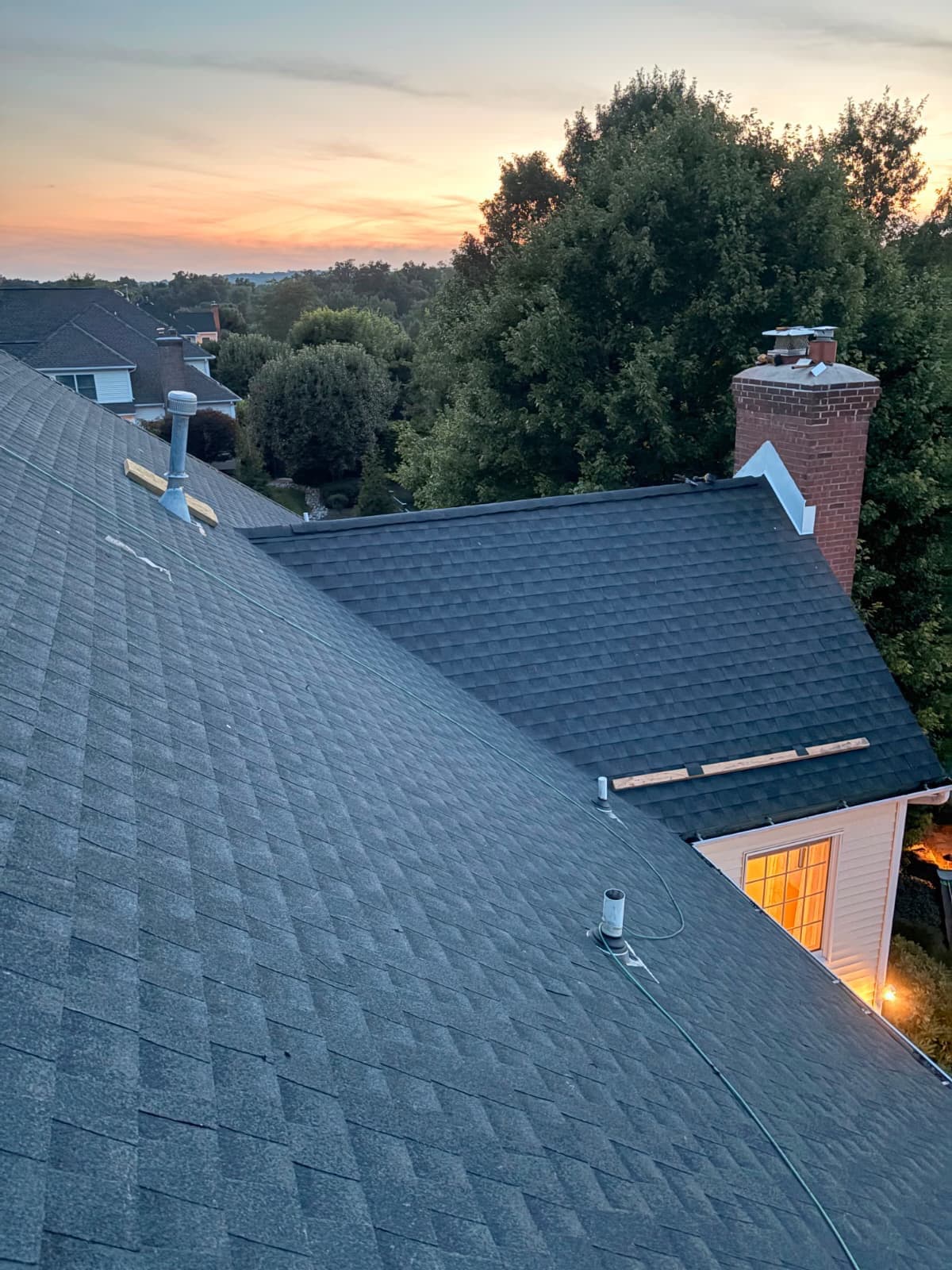
Recent work in New Jersey
The signs of a roof leak, inside and up top
Most leaks announce themselves indoors long before anything shows on the roof. The classic tell is a water stain — a yellow-brown ring on a ceiling or high wall, often with a darker edge where the wet area has dried and spread more than once. But by the time a stain appears, water has usually been getting in for a while, which is why the subtler signs matter just as much. The attic is where a leak is easiest to read, and where to look first if you can get up there safely: on a bright day, daylight showing through the deck means an actual hole, and short of that, dark water trails, damp insulation, rusted nails, and mold on the sheathing all mark where water has been traveling.
- Ceiling or wall stains — brown or yellow rings that grow after each rain; a soft, sagging spot means water is pooling above the drywall.
- Bubbling, blistering, or peeling paint and wallpaper — trapped moisture pushing the finish off the surface.
- A persistent musty or damp smell in a room, closet, or attic, even when nothing looks wet.
- Attic signs — daylight through the deck, dark trails on the rafters, damp or matted insulation, rusted nail tips, and mold on the sheathing.
- Missing, cracked, or curled shingles and a surge of granules in the gutter — visible from the ground with binoculars after a storm.
Water travels — so the stain lies about the source
Here is the single most important thing to understand about a roof leak, and the reason so many get 'fixed' two or three times: water almost never drips straight down from where it entered. Once past the roof surface, it hits the underside of the wood deck and follows gravity — running downhill along the slope, across the top of the sheathing, down a rafter or a nail shank — until it reaches a seam or a low point where it can finally drop. By then it can be six to eight feet, sometimes more, from the actual entry point.
So the interior stain is almost always downslope of the leak, never directly beneath it — the ring over your kitchen table may have started at a chimney ten feet up the roof. This is exactly why the instinct to caulk 'right above the stain' fails: you seal a spot where nothing is wrong and leave the real opening untouched. Finding a leak means reading the water backwards, from where it lands to where it came in, which is a discipline rather than a guess.
Roof leaking right now? We answer 24/7.
Where roof leaks really start — not the open shingles
The wide field of shingles in the middle of a roof rarely leaks — that surface is engineered to shed water, and it does its job. Leaks come from the interruptions: the places where the roof is cut open for something else and depends on flashing, boots, and detailing to stay watertight. Damaged, rusted, loose, or poorly lapped flashing is the single most common cause of roof leaks, which is why the same short list of spots comes up again and again. When you go looking, check these first:
- Flashing at walls, dormers, and valleys — the metal that hands water from the roof to a shingle or a wall; when it corrodes, lifts, or was caulked instead of woven in, it leaks.
- Valleys — where two roof planes meet, they carry more water than almost anywhere else on the roof, so even a small defect there leaks heavily in a downpour or snowmelt.
- Chimneys — usually the flashing, not the bricks: failed step or counter flashing, or a cracked chimney crown, are a leading source of chimney-area leaks.
- Skylights — most often the flashing kit or the seal around the glass, not a skylight that has simply gone bad.
- Vent-pipe boots — the rubber collars around plumbing vents dry out and crack after about ten to fifteen years, a small, cheap failure that leaks like a big one.
- Nail pops — a fastener that backs out lifts a shingle and lets water run down the nail, leaving a rust trail that points right at itself.
The roof that leaks when it isn't raining
One of the most confusing calls we get is the roof that drips on a clear day. If you have water coming in with no rain, the roof itself may be fine — the water is coming from somewhere else. In a North Jersey winter the usual culprit is attic condensation: warm, moist indoor air rises into a cold attic, hits the underside of the sheathing, and condenses into frost or droplets that drip back down exactly like a leak. It shows up in the coldest stretch of the year — Newark's January lows sit in the mid-20s — and it signals an air-sealing and ventilation problem, not a hole in the roof.
Two more cold-weather sources fake a leak. An ice dam forms when heat escaping into the attic melts snow up high; the meltwater runs down and refreezes at the cold eaves, building a ridge of ice that backs standing water up under the shingles — so the roof 'leaks' during a thaw with no rain falling at all. And year-round, mechanical systems drip: a clogged air-conditioner condensate line, a rusted-out drip pan on an attic air handler, a sweating duct, or a plumbing vent stack can each put water on a ceiling. The tell is timing — water after a hard freeze points to condensation or an ice dam; water on humid summer days with the AC running points to the HVAC.
Roof leaking right now? We answer 24/7.
Tracing a leak from stain to source, step by step
Because water travels downhill, you find a leak by working uphill. Start at the interior stain and, if you have attic access, get up there with a bright flashlight — ideally during or just after rain, when the water trail is live and easiest to follow. Find the wet spot on the underside of the deck, then follow the breadcrumbs upslope: the dark staining, the damp insulation, the rusted nails, and the glistening path on the wood all lead back toward the entry, which always sits higher than where the water is dropping.
Where the trail ends, look for the nearest roof penetration just above it — a vent, chimney, skylight, or valley — usually within about six feet, and very likely your source. Mark it from inside, so it can be found from on top. If the leak is intermittent and you can't reproduce it, a controlled hose test works: on a dry day, with a helper watching the stain from inside, run a garden hose over one small area of the roof at a time, starting low and moving uphill, waiting several minutes at each spot until the leak reappears. That isolates the exact entry point without guesswork — but only if it can be done safely, which is the next question.
What you can check safely — and when to call a pro
Much of leak diagnosis is genuinely DIY-friendly, and none of the safe parts involve standing on the roof. You can read the interior stains, get into the attic with a light, glass the roof from the ground with binoculars, and run a hose test from a stable ladder at the eave. Those checks alone often reveal roughly where water is getting in. What isn't worth your safety is walking the roof itself — falls from roofs are among the most common serious home-improvement injuries, and a steep, wet, mossy, or storm-damaged North Jersey roof is exactly where they happen. Never climb a roof in the rain, on ice, or right after a storm to chase a leak.
Call a professional when the trail leads somewhere a homeowner can't safely or properly fix. Flashing, chimneys, skylights, and valleys top that list — they need to be re-flashed and woven back into the shingles correctly, not sealed with a tube of caulk that fails in a season or two, and that detailing is our core specialty. Bring in a pro, too, when you can't locate the source at all, when the deck or rafters feel soft or spongy (that's rot, and it means water has been in the structure a while), when you see mold, or when a spot you already patched keeps coming back. A recurring leak almost always means the real entry point was never found.
Roof leaking right now? We answer 24/7.
In a North Jersey winter, a slow leak compounds fast
It's tempting to watch a small stain and hope it holds until spring. In our climate that's a costly bet. Every bit of water that reaches the wood deck and framing has a freeze-thaw cycle waiting for it: moisture soaks into the plywood, freezes and expands on the next cold night, and works the sheathing apart layer by layer, so a pinhole in October can be a sagging, delaminated deck by March. Trapped moisture in a warm wall or attic cavity can also grow mold in as little as a day or two, and wet insulation stops insulating the moment it's soaked.
There's a seasonal trap, too: the minor summer drip you shrug off is the same weak spot an ice dam will exploit in January, when backed-up meltwater is driven hard under the shingles and a nuisance becomes a ceiling on the floor. The stain you can see is always the smallest part of a wet area you can't. Finding the source now — before the next storm or the next hard freeze — is what keeps a flashing repair from turning into a decking-and-drywall project. If you have an active leak or a stain you can't trace, we diagnose it on-site and stop the water the day we're out: (201) 275-9185.
Monthly payment options
We work with Hearth, which shops several lenders on a single application. See your personalized options in minutes — checking does not affect your credit score, and there is no commitment.
- Loan amounts up to $250,000
- Funding in as little as 1–3 days
- No prepayment penalties
- No home equity required
Financing is provided by Hearth's lending partners, not by Precision Windows & Roofing. Rates and terms depend on your credit and the lender making the offer, and all financing is subject to credit approval.
Common questions
Where is my roof leaking if the ceiling stain isn't near a chimney or vent?
The stain is not under the leak — that's normal. Water enters up high, clings to the underside of the deck, and runs downhill along the slope, rafters, and nails, often six to eight feet, before it finds a spot to drip. So a stain in the middle of a room can start at a chimney or valley well up the roof. You find the real source by tracing the water uphill from the stain, not by looking straight up.
What are the earliest signs of a roof leak?
Before an obvious ceiling stain, watch for bubbling or peeling paint, a persistent musty smell, and the best early warning of all — attic clues: dark water trails on the rafters, damp or matted insulation, rusted nail tips, and mold on the sheathing. From the ground with binoculars, missing or curled shingles and granules piling up in the gutter after a storm are worth noting too. The earlier you catch it, the smaller the fix.
Why is my roof leaking when it hasn't rained?
A roof that 'leaks' with no rain often isn't leaking at all — the water is coming from elsewhere. In winter the common cause is attic condensation: warm indoor air hits the cold roof deck and drips. An ice dam can also release water during a thaw with no precipitation. Year-round, a clogged AC condensate line, a rusted air-handler drip pan, a sweating duct, or a plumbing vent can drop water on a ceiling. Timing is the clue — after a freeze suggests condensation or ice; humid AC-season days suggest the HVAC.
Can I find a roof leak myself?
Often, yes — from inside. Read the interior stains, get into the attic with a flashlight (ideally during rain) and follow the water trail uphill to the nearest penetration, and glass the roof from the ground with binoculars. A hose test from a ladder at the eave can pinpoint an intermittent leak. What you should not do is walk the roof — especially a steep, wet, or storm-damaged one — to chase it. If the trail leads to flashing, a chimney, a skylight, or a valley, that's the point to call a pro.
My roof only leaks during snow or in winter — what causes that?
Almost certainly an ice dam or attic condensation. An ice dam forms when heat escaping into the attic melts snow up high; the water runs down and refreezes at the cold eave, building a ridge of ice that forces meltwater back up under the shingles, so it leaks during a thaw with no rain. The lasting fixes are at the eave and in the attic — an ice-and-water membrane at the eaves and balanced attic ventilation — not a bead of sealant on the shingles.
I found the spot and caulked it, but the leak came back — why?
Two likely reasons: you sealed above the stain rather than the true entry point uphill, or the real source is failed flashing that caulk can't fix. Flashing at walls, chimneys, valleys, and skylights has to be replaced and woven back into the shingle courses to shed water properly; a bead of caulk over it lasts a season at most before it dries, cracks, and leaks again. A leak that returns after a patch is the classic sign the source was never actually found.
Explore
Get your free roofing quote
Free, no-obligation on-site assessment anywhere in New Jersey — and we answer the phone 24/7.