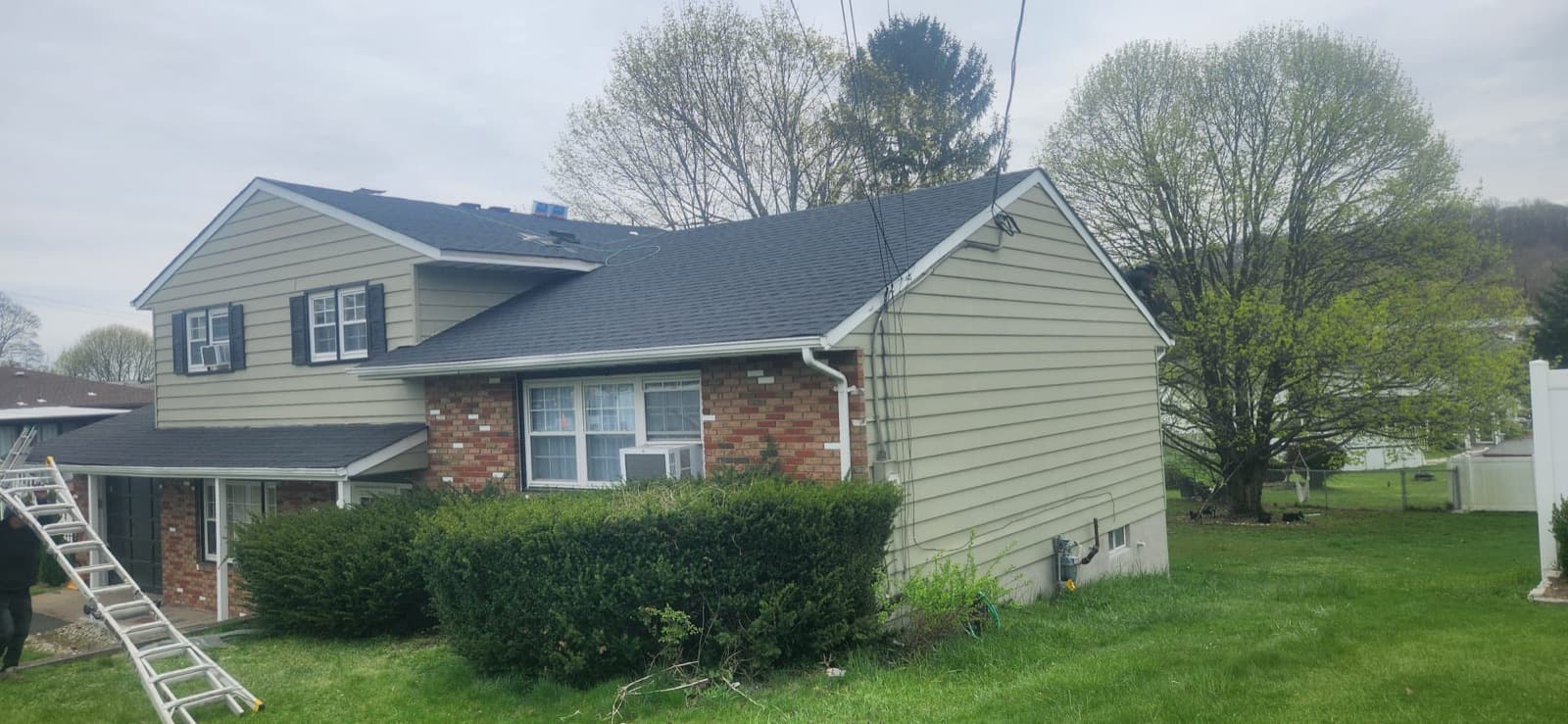
Roof Repair & Replacement in Fair Lawn, NJ
Tear-offs and re-roofs on the borough's postwar capes, ranches and splits; dormer flashing rebuilt the way it should have gone on the first time; Radburn jobs staged off the lane side because the park side has no vehicular access at all; leaks traced to their real entry point; gutters sized for the canopy. Dispatched from our shop in Garfield. NJHIC-licensed, measured on your roof, quoted line by line.
Fair Lawn went from 9,107 people in 1940 to 23,885 in 1950 — a 162% jump in a single decade — and the borough's own history puts the peak near 37,000 by 1968. That is not trivia when you are standing under a roof here. It means Fair Lawn was built out in a rush, tract by tract, and whole streets of capes, ranches and split-levels got their first roof inside the same year or two. Roofs installed together age together, which is why we often end up quoting two or three houses on one block inside the same month.
The borough is really two roofing markets. The postwar belt — Warren Point, Memorial Park, Lyncrest, Berdan Grove, Columbia Heights and the tracts around them — is simple, low-penetration geometry: a plain gable or hip, one chimney, a couple of vent boots, and very often a shed dormer cut in decades later. Then there is Radburn, the planned community whose original section went up between 1929 and 1934, where the houses sit backwards on their lots under a mature canopy and where two ordinary assumptions about a re-roof — where the truck parks, and whether you need a permit — can both stop being true.
Fair Lawn is a genuine same-day town for emergencies; our shop is in Garfield, a few miles south. If the roof is open, the storm has just come through, or water is already inside, that is a night-or-weekend call and we take it. A repair that can wait is looked at quickly and then booked for dry weather. Phone (201) 275-9185 and walk us through what you are seeing.
- Roof leak repair — On a postwar split the stain shows up on the lower ceiling and the water got in at the dormer wall above it. This is how we work backwards from one to the other.
- Emergency roof repair — A few miles from the shop. A limb through the roof or a plane peeled off in a storm gets a Fair Lawn address a truck the same day, at any hour.
- Roof flashing repair — Dormer step flashing, the diverter at the foot of a sidewall, valley metal where a wing meets the main roof — rebuilt properly rather than sealed over again.
- Seamless gutter installation — Gutter sized for what Fair Lawn's mature street trees actually drop into it, and pitched to move water — not copied off whatever length was hanging there before.
- Roofing in Bergen County — The rest of our Bergen County roofing, and how the state's ordinary-maintenance rule reads differently from one borough to the next.
Recent work in New Jersey
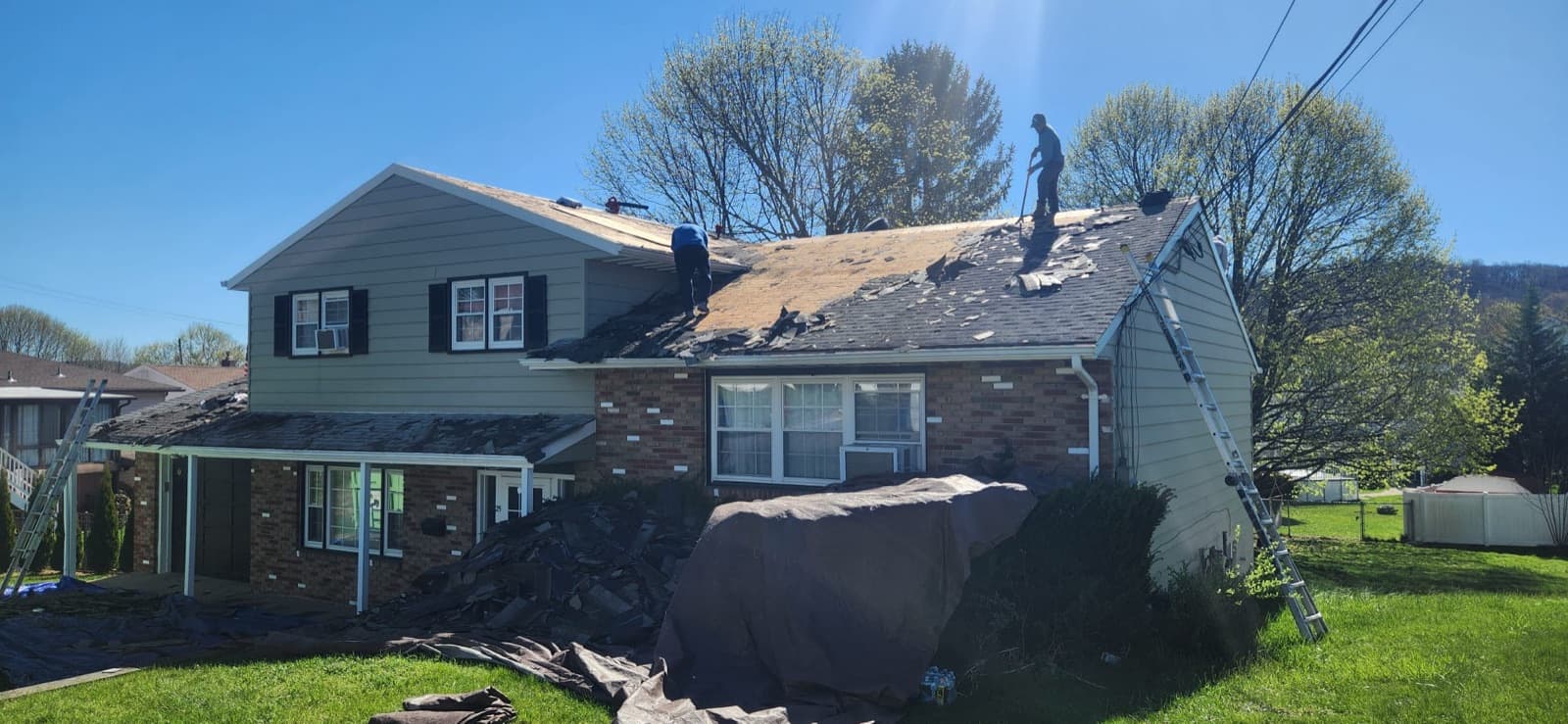
Why whole Fair Lawn blocks come due at once — and what actually leaks on them
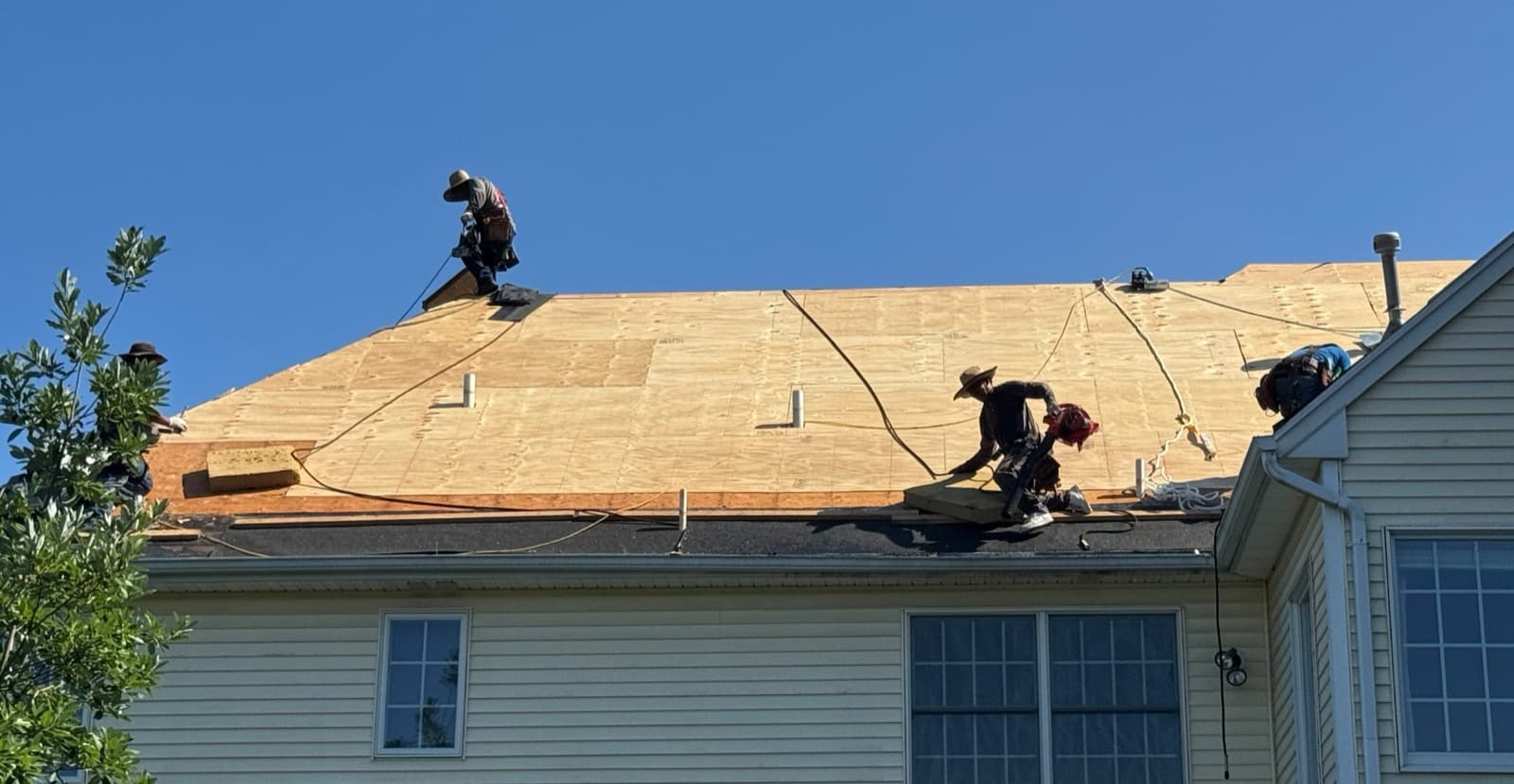
Because the borough was substantially built out by the late 1960s, most houses here are on at least their second covering — and since no more than two layers are allowed, a house already carrying two coverings has no option left but a full tear-off. What sits under those layers is the honest unknown. Pre-1950 blocks are likely on plank rather than panel, and boards that have dried, split or spread stop gripping a fastener. The early-1950s tract houses are a coin flip between plank and early plywood, and nobody can tell you which you have from the driveway. We show you the deck with the roof open and re-sheath only where the wood cannot hold a nail, priced on a line of its own.
Dormers are the other Fair Lawn signature, and they are where these roofs actually leak. A cape that got a shed dormer or a full add-a-level has a wall landing in the middle of a roof plane, and that junction needs true step flashing woven course by course plus a diverter — a kick-out — where the eave of the roof dies into the vertical wall. IRC R903.2.1 requires that flashing, and on a dormered cape it is the most-skipped detail in this county. When it is missing, the water surfaces a year later as a stain in the corner of a bedroom ceiling, well away from where it got in and usually on the wrong wall — which is why homeowners here so often replace a ceiling twice before anyone goes on the roof.
The build-out was not only houses — the borough's own account notes that the farmland was developed for single-family homes "and several large garden apartment complexes," and that the Fair Lawn Industrial Park on Route 208 went up through the 1950s with additions in the following decade. So there is real low-slope work in this town, and on any mixed roof the junction where a flat section ties into a pitched one is what we check first.
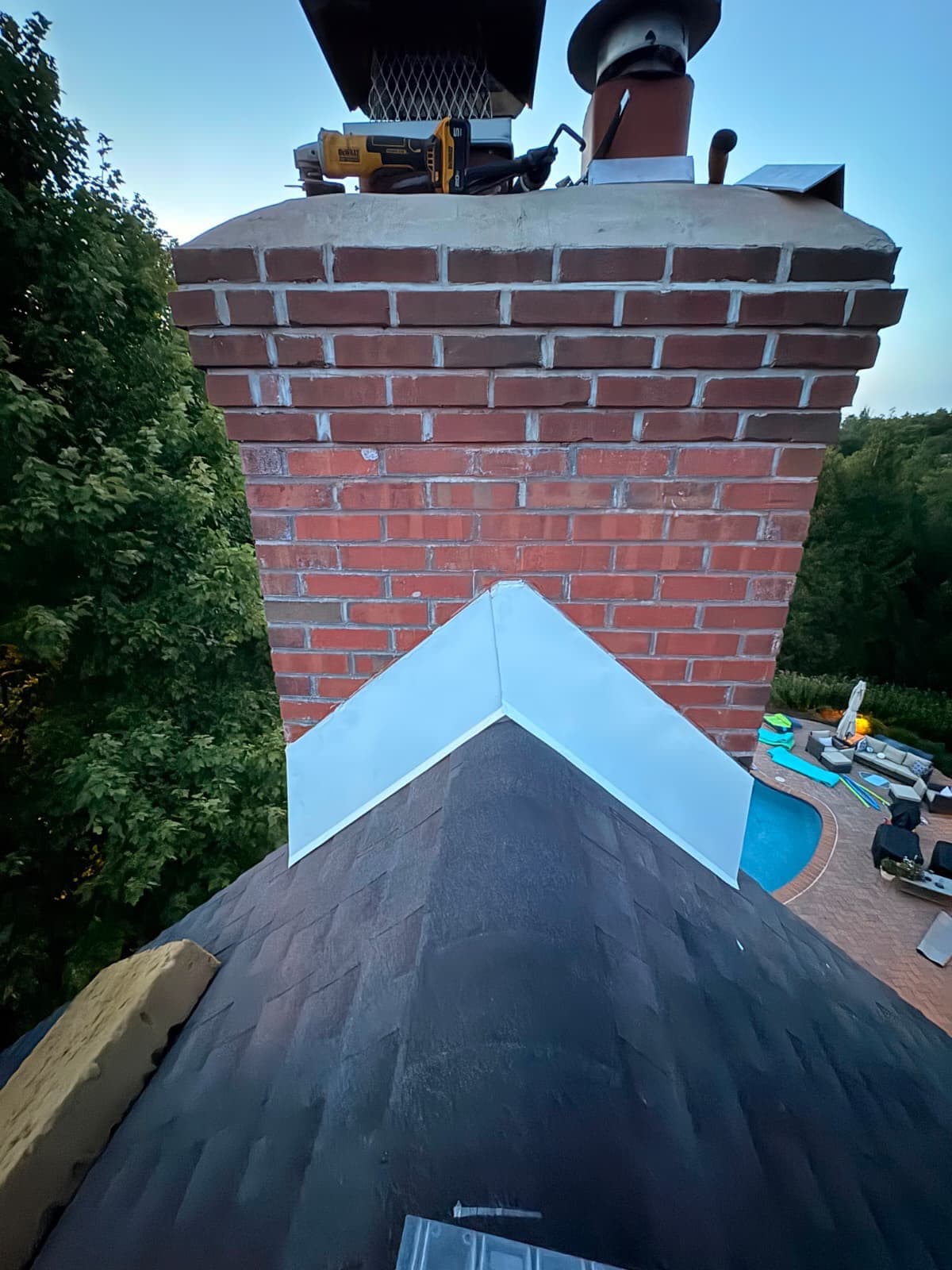
The work that follows from all of that: full tear-off and re-shingle in architectural asphalt, with fresh underlayment, drip edge and flashing throughout; dormer and roof-to-wall rebuilds with genuine step flashing and the kick-out diverter IRC R903.2.1 requires where an eave meets a wall; chimney work with new step flashing set course by course and the counter-flashing let back into a cut reglet instead of smeared over; deck inspection and CDX re-sheathing where plank boards have split or spread; and seamless gutters and leaders, with guards where the canopy demands them.
The one Fair Lawn neighborhood where the front of the roof faces a footpath
Radburn was planned by Clarence Stein and Henry Wright for the City Housing Corporation and built from 1929 until the corporation's 1934 bankruptcy stopped it, so the original section is a tight pocket of houses that all went up inside about five years. What makes it a different roofing job is the site plan: the houses are double-fronted, with the primary rooms facing the interior park and the garage side facing a short cul-de-sac lane. Every truck, dumpster and ladder hoist therefore stages on the lane side, because the park side has no vehicular access at all — it is a pedestrian path in daily use. Debris containment on that plane is handled by hand, over ground the whole community walks on.
Radburn is also the one part of town where the permit answer can flip between neighbors. New Jersey's ordinary-maintenance exemption for re-roofing reaches detached one- and two-family dwellings only. Radburn's original build included roughly 90 row houses and 54 semi-attached houses alongside its single-family homes, and an attached dwelling does not qualify — so a Radburn row house re-roof is permit work even when the identical job on the detached house at the end of the lane is not. We sort that out with the building department before the tear-off, not after.
The canopy is the third factor. Radburn Parks is an ArbNet-accredited Level I arboretum; its registry entry describes mature white, red, black and pin oaks — some of them centuries old — along with hickories, an allée of London planes and groups of conifers, over parks and open spaces designed by landscape architect Marjorie Sewell Cautley. That canopy means relentless organic litter, gutters that pack solid rather than merely clog, north-facing planes that stay damp long enough to grow moss, and limb strikes in any real wind.
The paperwork is widely misunderstood. Radburn was named a National Historic Landmark in 2005, but that designation is federal and does not by itself restrict a private owner's roof. What binds Radburn owners is a Declaration of Restrictions dated March 1929 and recorded that April in the Bergen County Clerk's office, administered by the Radburn Association and separate from any borough permit — confirm material and color with the Association before anything is ordered.
Roof leaking right now? We answer 24/7.
The Fair Lawn permit answer is not the one on most roofing websites
Statewide, since 2018, the Uniform Construction Code has treated a covering-only replacement on a stand-alone one- or two-family house as ordinary maintenance — nothing permitted, nothing inspected. Most contractors stop reading there and tell every Bergen homeowner a roof never needs one. Two things they leave out: the exemption is for detached houses only, so attached and multi-family buildings are outside it, and it covers the covering alone.
Fair Lawn's own published remodeling guidance does not read the simple way either: the borough's list of work requiring a building permit names roofing and siding outright. That list reads as a general summary, and it cannot override the state rule — N.J.A.C. 5:23-2.7(c) says ordinary-maintenance items shall be treated as such by every enforcing agency. We still call the Fair Lawn Building Department at Borough Hall, 8-01 Fair Lawn Avenue, (201) 794-5307, confirm your building type and scope, and file under our NJHIC registration when a permit applies. And one case has no ambiguity anywhere in the state: the moment decking or framing is replaced, it stops being covering work and a permit is required.
Ice barrier here is best practice, not code — and almost everyone states it backwards
Fair Lawn sits on the valley floor, around 69 feet at the municipal elevation point; there is no hill-town microclimate here. Ask three roofers whether New Jersey code obliges an ice-and-water barrier at your eaves and most will answer wrong. The rule is keyed to how cold January runs, at a threshold of 25°F, and the state has already published which county clears it — DCA Bulletin 07-3 puts the answer at Sussex, up at the top of the map. Nothing compels the membrane down here in Bergen. We spec it as standard on Fair Lawn roofs anyway, and we say plainly which of those two you are buying.
Where a Fair Lawn ice dam actually starts is the attic, and this housing stock is built to produce them. A dormered cape or a finished-upper-floor split usually has knee walls, insulation packed against the sheathing, and soffit vents blocked the first time someone added insulation — a warm deck that melts snow high on the plane and refreezes it at the cold overhang. Under the Radburn canopy, shaded north planes hold that snowpack days longer. The fix is balanced ventilation: intake at the soffit, exhaust at the ridge, and the knee-wall voids brought into the picture rather than ignored.
Roof leaking right now? We answer 24/7.
What a roof can honestly do on the Passaic and Saddle River blocks
Fair Lawn is bounded by the Passaic River along its western and southern edge and by the Saddle River on the east and northeast. During Hurricane Irene in 2011 stretches of River Road and Wagaraw Road went entirely under water, and the borough's parks supervisor told a local reporter at the time that the flooding at Memorial Park was the worst he had seen in 32 years on the job.
Be clear about the limit of what we sell: no roof and no gutter stops a river. What roofing does is manage the water that lands on the house — and a long, low postwar roofline puts a surprising volume through a short run of gutter in a hard downpour. Get the capacity wrong and it comes over the front edge onto the fascia and the beds below, which is a fascia and soffit repair a few years later rather than a flood. After wind or hail we inspect, photograph what we find, and document it accurately for a carrier, but we will never tell you we can get a claim approved.
Monthly payment options
We work with Hearth, which shops several lenders on a single application. See your personalized options in minutes — checking does not affect your credit score, and there is no commitment.
- Loan amounts up to $250,000
- Funding in as little as 1–3 days
- No prepayment penalties
- No home equity required
Financing is provided by Hearth's lending partners, not by Precision Windows & Roofing. Rates and terms depend on your credit and the lender making the offer, and all financing is subject to credit approval.
Common questions
Fair Lawn says roofing needs a building permit. Does it?
Not for the covering alone on a detached one- or two-family house — and do not accept a blanket answer either way. Statewide, New Jersey has treated a covering-only replacement on a stand-alone one- or two-family house as ordinary maintenance since 2018, and N.J.A.C. 5:23-2.7(c) says every enforcing agency shall treat it that way. Fair Lawn's published remodeling guidance lists roofing and siding among the work requiring a building permit, but that is a general summary, not a rule that overrides the state's. A Radburn row house or semi-attached house is outside the exemption, and if decking or framing is replaced, a permit is required regardless. We confirm your address and scope with the Fair Lawn Building Department, (201) 794-5307, before the tear-off.
I live in a Radburn row house. Is the permit answer different from the rest of Fair Lawn?
It can be, and this is the one place in town where it clearly is. New Jersey's ordinary-maintenance exemption applies to detached one- and two-family dwellings. Radburn's original build included roughly 90 row houses and 54 semi-attached houses, and an attached dwelling is outside that exemption — so a re-roof there is permit work even when the same job on a detached house nearby is not. We confirm the classification with the building department before we schedule anything.
My neighbors are all getting new roofs. Does that mean mine is due?
Often yes, and Fair Lawn is the town where that reasoning genuinely holds. The borough went from 9,107 residents in 1940 to 23,885 in 1950, so the housing went up in concentrated tracts and those roofs went on inside the same year or two. Same install date, same exposure, same lifespan. It still deserves an inspection rather than an assumption — two identical houses can diverge by a decade on ventilation alone.
Radburn: does anyone have to approve the shingle before I order it?
Check with the Radburn Association first. Radburn properties are subject to a Declaration of Restrictions dated March 1929 and recorded that April with the Bergen County Clerk, administered by the Association and separate from anything the borough requires. The 2005 National Historic Landmark designation is federal and does not by itself control a private owner's roof, and under the borough code the Historic Preservation Commission's own role is advisory. The Association is the binding layer, so we confirm material and color with them before ordering.
There is a stain in the corner of an upstairs ceiling but the shingles look new. Where is it coming from?
On a dormered Fair Lawn cape, nine times out of ten it is the roof-to-wall junction at the dormer rather than the shingle field. Either the step flashing was surface-nailed or caulked instead of woven into the courses, or the kick-out diverter at the bottom of that run is missing, so a slope's worth of runoff goes in behind the wall instead of turning into the gutter. It travels along the framing before it shows, which is why the stain is rarely under the entry point. We open the junction, rebuild the flashing and leave you the photos.
Explore
Get your free roofing quote
Free, no-obligation on-site assessment anywhere in New Jersey — and we answer the phone 24/7.