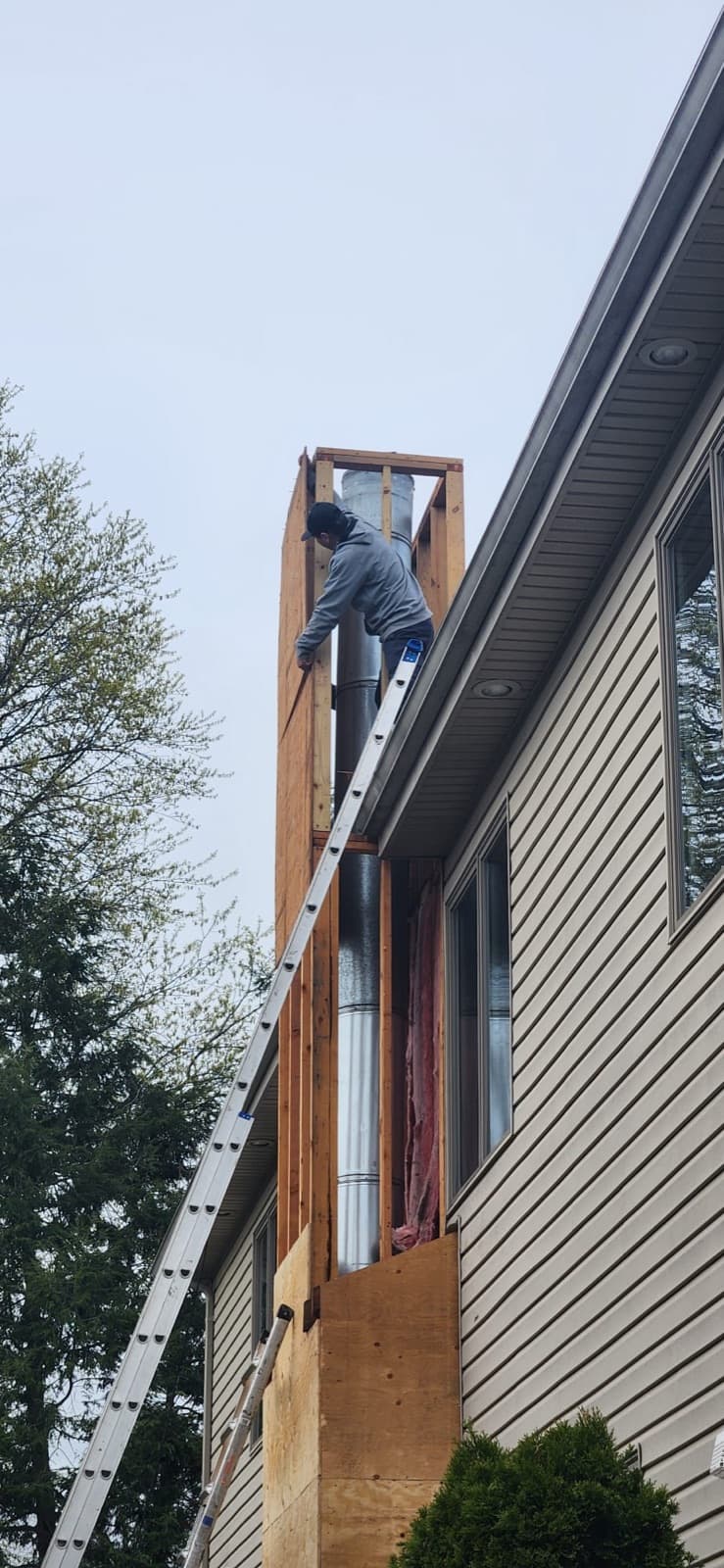
Siding Repair in North NJ — Vinyl, Aluminum & Fiber Cement
Cracked, loose, faded, or storm-damaged siding fixed across New Jersey — vinyl, aluminum, and fiber cement. We match your existing panels where we can, and we check what the water did behind them before we close the wall back up. From our Garfield shop, NJ-registered, free on-site diagnosis.
Most siding-repair calls we get across North Jersey are one of two very different jobs wearing the same clothes. One is genuinely cosmetic — a ladder knock, a stray baseball, a wind-cracked course, a run of chalky aluminum — where the fix is a clean panel swap or a repaint and the wall behind is dry and sound. The other looks identical from the curb but is a symptom: water has already found its way behind the siding, and the cracked or buckled panel is just where it finally showed. Telling those two apart, on-site, before anyone quotes a number, is the whole job. Replace the panel on the second one and you have hidden a leak, not fixed it.
Siding is only the visible skin of a wall's water defense; the real barriers are the water-resistive house wrap behind it and the flashing at every opening. So we treat every repair as a diagnosis first: we read whether the damage stops at the surface or runs into the sheathing, the house wrap, and the framing behind it. We repair all three of the sidings North Jersey actually has on its houses — vinyl on the postwar Capes and colonials, aluminum on the mid-century stock, and fiber cement on the newer and remodeled homes — and each one fails, and gets fixed, in its own way.
From our Garfield shop we cover New Jersey, same-day in Bergen County, and elsewhere depending on the job and how booked we are that day. Our registration is HIC reg.# 13VH13970900. The on-site look and the honest call — repair this, or the smarter money is a re-side — are free, and nothing gets ordered or opened until you have approved a written, itemized scope. Call (201) 275-9185.
- Storm damage & insurance claims — Sudden wind or impact damage is often a covered event — here's how we document it.
- Vinyl siding installation & replacement — When a re-side is the honest call, this is the whole scope — house wrap, flashing, and the trim package behind the panels.
- Vinyl siding cost guide — 2026 North Jersey ranges for a full re-side, and how fiber cement compares to vinyl on price.
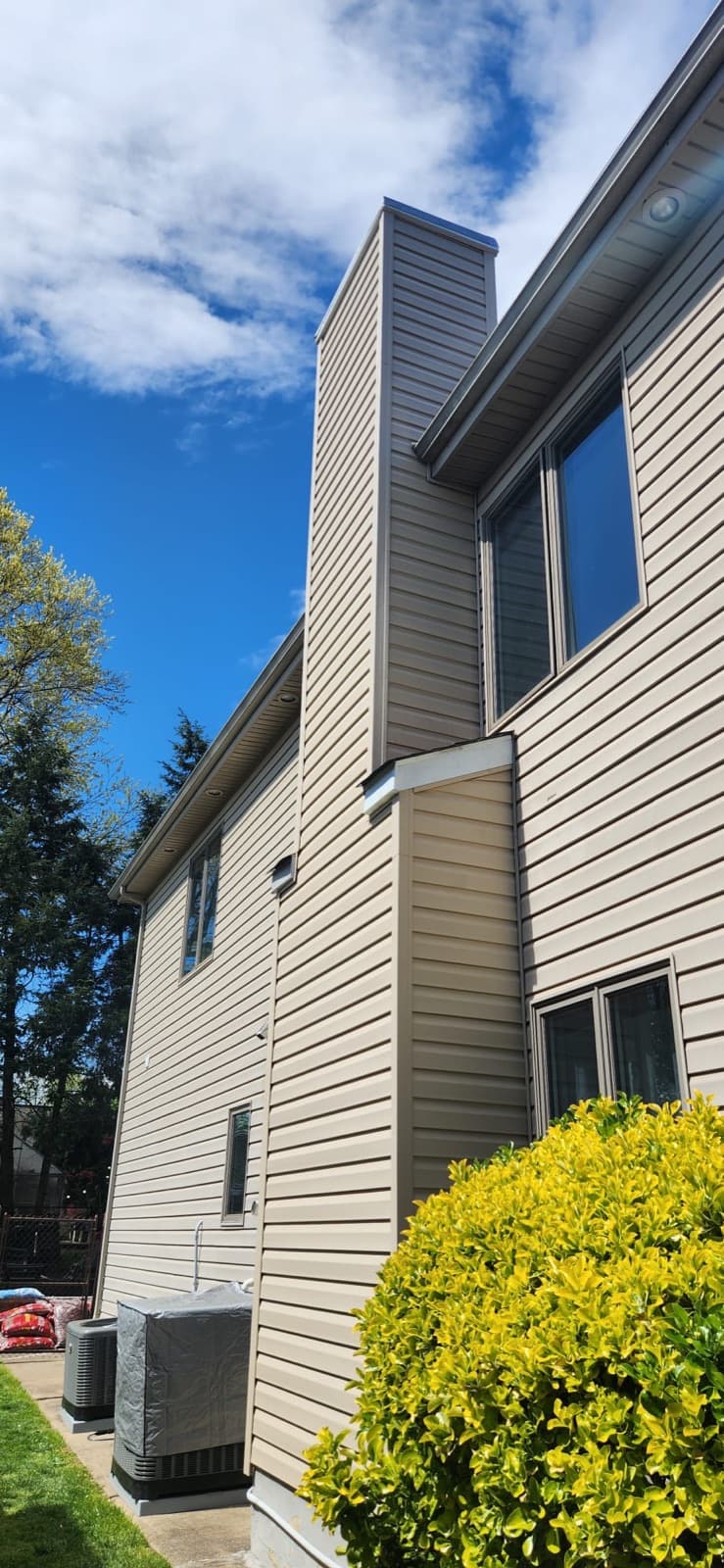
Recent work in New Jersey
Vinyl, aluminum, and fiber cement each fail differently
There is no single 'siding repair.' What broke, and how we fix it, depends entirely on what your walls are clad in — and North Jersey has all three in quantity. A vinyl repair is a matter of unlocking and re-hanging a panel; an aluminum repair is often paint and dent work, not replacement; a fiber-cement repair is a small-engine version of masonry, with sealed cuts and factory-matched finish. Diagnosing the material correctly is the first thing we do, because the wrong method on the right damage just creates a second repair later.
- Vinyl — cracked, split, or blown-off panels come out with a zip tool that unlocks the course above, and a matched panel locks back in. Because vinyl is fastened loose to move with temperature, most 'popped' or wavy panels aren't broken at all — they were nailed too tight or off-center and simply need re-hanging with the correct expansion gap. Cold makes it worse: vinyl loses flexibility below roughly 20°F, so winter impacts that would only dent a panel in July can split it clean at a seam or corner.
- Aluminum — common on North Jersey's 1950s-to-70s homes, and it rarely needs full replacement. The usual complaints are oxidation (a white, chalky film that dulls the finish and stains the brick and concrete below it) and dents. Chalking is cosmetic, not structural, and a correctly prepped repaint restores it for another 10 to 15 years — the catch is that paint must never go over active chalk or it bonds to the powder instead of the metal. Shallow dents can be pulled or filled; deep dents and tears get a patched or replaced section.
- Fiber cement (James Hardie and similar) — the toughest of the three, but it cracks and chips on hard impact and at over-driven nails. Small cracks and holes take a cementitious, fiber-cement-compatible patching compound, then prime and paint; a badly damaged board gets cut out and a new one set. Every cut end has to be sealed, because an unsealed edge is an open door for water. If the board is factory-finished ColorPlus, damage larger than a dime should be replaced with new ColorPlus stock rather than touched up, since a field patch won't hold the factory match.
Matching a faded or discontinued panel
The hardest part of most siding repairs isn't the labor — it's making the new panel disappear into a wall that has been aging in the sun for fifteen years. Every siding fades under UV, and darker colors fade fastest, so even when your exact color is still manufactured, a brand-new panel off the shelf reads noticeably brighter than the weathered siding around it. On older walls the problem compounds: the profile or the color has often been discontinued outright, and there is no exact panel left to buy.
We are honest about this up front, because a contractor who promises an invisible patch on 20-year-old siding is guessing. Our approach is to source the closest current profile and color, then place the repair where the eye is least likely to catch it. On a discontinued run, one of the best tricks is to pull good panels from an inconspicuous elevation — a rear or garage-side wall, or behind a deck — to make the visible repair a perfect match, then put the slightly-off current-production panels where nobody looks. When even that won't blend, a high-quality exterior vinyl-safe paint can bring a repair section to the faded color. For factory-finished fiber cement, manufacturer touch-up kits are formulated to match the original ColorPlus finish for nicks and nail heads. We tell you which of these your wall calls for, and how close a match to honestly expect, before we start.
Roof leaking right now? We answer 24/7.
Cracked and torn panels after wind, hail, and a cold snap
North Jersey siding takes Nor'easters, tropical-storm remnants, and the occasional hail event, and the damage is often worse than the same storm would do elsewhere because of our cold. Wind lifts, creases, and tears panels — or peels a whole course off a gable — and finds every panel that was fastened too tight to flex. Hail is the quieter threat: stones around three-quarters of an inch can crack vinyl, and in genuinely cold weather even smaller hail will split brittle panels at their seams and corners. Once a crack opens, our freeze-thaw winters do the rest, driving water in, freezing it, and widening a hairline into a gap.
Sudden damage from a covered event — high wind, hail, or impact — is frequently an insurance claim, while gradual fading, chalking, and age-related failure generally are not. If it is a claim, we document the damage properly and hand you and the adjuster an accurate picture; the coverage decision itself is theirs, not ours, and our storm-damage and insurance-claim page walks through how that process actually works. If the same storm hit your roof or gutters, we assess those in the same visit rather than sending a second truck.
When a siding repair is really a flashing repair
This is where a lot of 'siding repair' calls actually land. Siding is the visible skin of a water-management system, not the barrier itself — the real barrier is the water-resistive house wrap behind it, which New Jersey code requires, and the flashing at every opening and transition. When water shows up inside a wall, the failure is almost always the wrap or the flashing, not the panel that happened to crack. So before we swap a panel over a stain, we check what is behind it: press-test the sheathing for soft spots, look for the tell-tale rot streak, and trace where the water is really getting in.
Two spots cause most of it. The first is the roof-to-sidewall intersection, where a missing or bent kick-out flashing dumps a roof's worth of runoff straight down behind the siding — the IRC has required kick-out flashing there since 2009 for exactly this reason, and its absence is a common cause of rot in the OSB and framing behind an otherwise fine-looking wall. The second is the perimeter of a window or door, the single biggest water-intrusion point on any wall, and the detail that most often gets flashed wrong. Fixing either of these means opening the siding well past the visible damage, roughly two feet out from the opening or junction, correcting the flashing and house wrap in the right shingle-lap order so water always drains out and down, drying or replacing any wet sheathing, and only then re-siding. We tell you plainly when a repair is really this, because closing a cracked panel over a live leak just buys a much bigger bill later.
Roof leaking right now? We answer 24/7.
Repair one wall, or re-side the house
Repair is the right answer far more often than the siding industry admits, and we lead with it. If the damage is isolated to a panel or a course, the cracks are small, the material still has years in it, and the wall behind is dry, we fix exactly that and leave the rest of your siding alone. A single storm-hit elevation can often be re-clad on its own. What can't be patched back to healthy is buckling and warping — a warped panel is the symptom of trapped moisture, not a fastening you can re-secure — or siding that is chalking, cracking, and pulling loose across the whole house at once.
The line we watch for is when repairs stop being cheaper than the alternative: when you are patching the same wall repeatedly, when soft spots and interior stains say water is already in the framing, or when the siding is simply past its service life and no match exists anymore. At that point the honest math points to a full re-side, and we will say so even though the smaller repair is the easier sale. When a re-side is the call, our siding install and cost guides lay out the whole scope; when a repair will genuinely hold, that is what we quote — line-item, so you see the panel, the flashing, the carpentry, and the labor as separate, comparable lines instead of one mystery number.
What affects the cost
| Which material you have | A vinyl panel swap, an aluminum dent-and-repaint, and a fiber-cement board replacement are three different labor and material profiles — fiber cement is heavier and needs specialized cutting and sealed cut ends. |
|---|---|
| How much is damaged | A single panel or course is a fraction of a whole-wall repair, which is in turn a fraction of a full re-side; the count of affected panels and elevations drives the job. |
| Sourcing a match | Matching a current color and profile is quick; tracking down or working around a discontinued panel on older, sun-faded siding adds sourcing time and sometimes a paint or panel-relocation step. |
| What we find behind it | If the damage stops at the surface it stays a siding job; if water has reached the house wrap, sheathing, or framing, the flashing and carpentry to make it right add labor and material. |
| Openings and flashing involved | A repair around a window, door, or roof-to-wall junction means opening the wall well past the damage and correcting flashing and house wrap — the work that actually keeps the wall dry. |
| Height, story, and access | Second- and third-story walls, steep grade, and tight lot access need staging and more labor than a repair you can reach off a walk-up ranch. |
We don't bundle a mystery number — you get a firm, free on-site quote, approved before any work starts.
Monthly payment options
We work with Hearth, which shops several lenders on a single application. See your personalized options in minutes — checking does not affect your credit score, and there is no commitment.
- Loan amounts up to $250,000
- Funding in as little as 1–3 days
- No prepayment penalties
- No home equity required
Financing is provided by Hearth's lending partners, not by Precision Windows & Roofing. Rates and terms depend on your credit and the lender making the offer, and all financing is subject to credit approval.
Common questions
Can you match my faded or discontinued siding?
Usually well enough to blend, and we are honest when we can't get closer. Every siding fades under UV — darker colors fastest — so even the same color bought new reads brighter than aged siding next to it, and older profiles are often discontinued outright. We source the closest current profile and color, and on a discontinued run we can pull matching panels from an inconspicuous wall (a rear or garage side) to make the visible repair perfect, then place the newer panels where nobody looks. A vinyl-safe exterior paint or, on fiber cement, a factory-matched touch-up kit can close the last gap. We tell you how close a match to expect before we order anything.
Can a cracked vinyl panel be repaired without redoing the whole wall?
Almost always, yes. Vinyl is designed to come apart — a zip tool unlocks the course above the damage, the cracked panel slides out, and a matched panel locks back in, one course at a time. We also find that many 'broken' panels aren't cracked at all; they were nailed too tight or off-center and just need re-hanging with the correct expansion gap so they lie flat. The whole wall only comes into play when the damage is widespread, the panels are buckling, or moisture has gotten in behind them — and we will tell you plainly which situation you're in.
Can aluminum siding be repaired, or is it time to replace it?
Aluminum, common on North Jersey's mid-century homes, rarely needs full replacement. Its two usual problems are cosmetic: oxidation — that white, chalky film that dulls the finish and stains the brick below — and dents. A correctly prepped repaint restores chalked aluminum for another 10 to 15 years, though the chalk has to be washed off completely first or paint bonds to the powder instead of the metal. Shallow dents can be pulled or filled; deep dents and tears get a patched or replaced section. Replacement usually makes sense only when the panels are widely corroded or torn, not merely faded.
Can cracks in fiber cement or Hardie board be patched?
Small cracks, chips, and holes, yes — with a cementitious patching compound made for fiber cement, then primed and painted. A badly damaged board is cut out and a new one set, and every cut end gets sealed, because an unsealed edge lets water straight in behind the siding. If your boards are factory-finished ColorPlus, we replace damage larger than about a dime with new ColorPlus stock rather than field-patching it, since a hand-applied patch won't hold the factory color match. Touch-up kits handle nail heads and small nicks.
How do I know if water has gotten behind my siding?
The tells are soft or spongy sheathing when you press on the wall, a dark rot streak, paint or panels lifting in one area, musty smells, or water stains showing up on the inside walls. Two spots cause most of it: a missing or bent kick-out flashing where a roof meets a sidewall (code has required it since 2009 for this exact reason), and the perimeter of a window or door, the biggest water-intrusion point on any wall. When we find one, the fix is to open the siding well past the damage, correct the flashing and house wrap, dry or replace wet sheathing, and only then re-side — patching over a live leak just delays a bigger bill.
Is storm-damaged siding covered by insurance?
Often — when the damage is sudden and from a covered event like high wind, hail, or impact, rather than gradual fading, chalking, or age. We document what happened accurately so your claim reflects the real damage, but we can't promise a carrier will approve it — that decision is the adjuster's, and we're wary of any contractor who guarantees otherwise. Our storm-damage and insurance-claim page covers the process end to end. If your roof or gutters took the same hit, we look at those on the same visit.
Explore
Get your free roofing quote
Free, no-obligation on-site assessment anywhere in New Jersey — and we answer the phone 24/7.