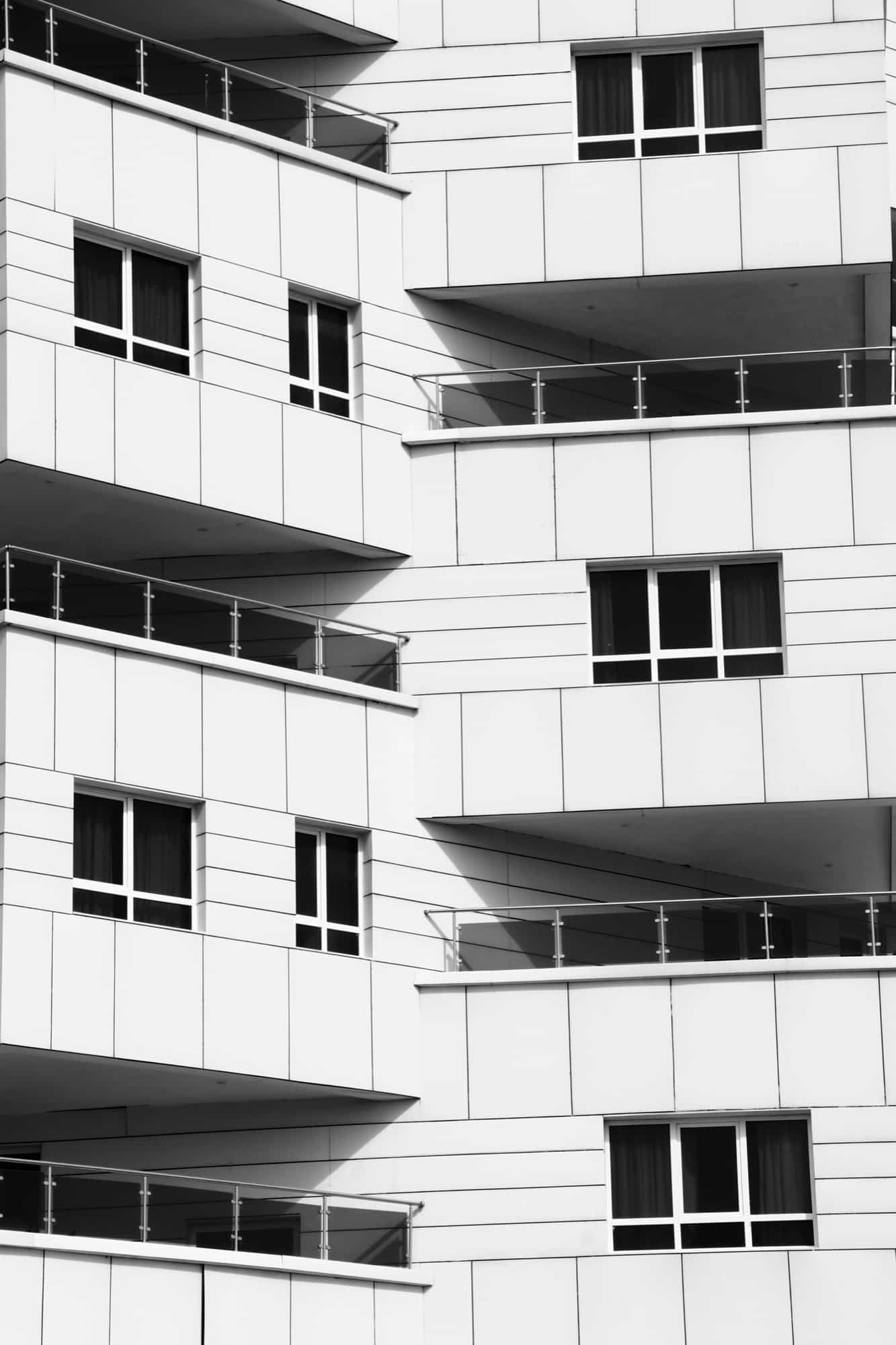
Glass Railing Systems
Modern glass railings for staircases, decks, and pool surrounds.
Glass Railing Systems
Modern safety meets unobstructed views. We install glass railing systems for staircases, decks, and pool surrounds. Elevated balcony and terrace guards are covered on the glass balconies page.
Glass railing systems are the same structural family as glass balconies — IBC 2407 governs both — but this is the grade-level and stair half of the work: deck and patio railings on single-family residential, pool barrier enclosures, porch and stoop guards, and interior and exterior stair railings. Elevated guards — balconies, roof terraces and mezzanines, where the glass is holding people back from a real drop — are engineered differently and covered on our glass balconies page. The hardware options here multiply, the code requirements shift with occupancy, and the residential market in NJ has very different cost expectations than the commercial market.
We install glass railings across all 21 NJ counties. The split: heavy residential demand for backyard deck, patio and pool railings in Bergen, Morris, Somerset, Monmouth, and Burlington counties; coastal demand for oceanfront deck and stair railings on the Shore (Atlantic, Cape May, Ocean, Monmouth); commercial demand for grade-level restaurant and cafe seating enclosures, club and community pool barriers, and stair guards in the urban centers (Newark, Jersey City, Hoboken, Asbury Park, Atlantic City). Each context has its own spec patterns that we've calibrated over hundreds of installs.
Top-rail vs frameless: the structural choice
Top-rail systems put a continuous metal or wood cap across the top of the glass panels. The top rail ties the panels together structurally and provides the IBC-required handrail for stairs. Top-rail systems can use either tempered single-lite glass or laminated glass — the top rail provides the redundancy that single-lite tempered would otherwise lack. Lower cost per linear foot, easier to repair (replace a broken panel without affecting adjacent panels), and the top rail itself can be a design feature.
Frameless systems eliminate the top rail entirely. The glass panel is the railing — no horizontal member above. Sleeker aesthetic, unobstructed view, but more expensive and structurally constrained. Frameless systems require laminated glass with structural interlayer (SentryGlas Plus is standard) for redundancy. Frameless is the choice for oceanfront views, modern architectural projects, and any install where the visual purity of glass is the design driver.
We default to top-rail for stairs (the IBC handrail requirement effectively mandates a continuous top member on any rise/run guard) and frameless for the level deck, patio and pool-surround runs where the view is the priority. Mixed installs — frameless on level runs, top-rail on stairs — are common on multi-level deck projects.
Deck-mount options: surface, fascia, and core-drill
Surface mount: base shoe or post bases are anchored to the top surface of the deck. Simplest install on existing decks. Requires that the deck surface can carry the moment load (the railing acts as a lever arm — horizontal load at the top of the glass translates to high tension/compression at the deck connection). Wood-framed decks usually require blocking under the decking to spread the load, often necessitating partial deck-board removal at install.
Fascia mount: hardware is anchored to the vertical face of the rim joist (the fascia) rather than the top surface. Preserves the full deck surface area — the railing offsets outward from the deck edge. Better load distribution into the framing. Our default on new wood-framed deck construction. Hardware: CRL Aluminum Post and Base, Wagner Companies Legato, or custom-fabricated stainless brackets.
Core-drill (concrete only): for concrete decks and patios, we core-drill 4-6 inch diameter holes at each post location, set the post in epoxy grout, and anchor the post structurally to the slab. Cleanest install on concrete, no surface penetrations of the slab waterproofing. Used on ground-level concrete patios, pool decks and courtyard seating enclosures.
We evaluate substrate carefully on every quote. Composite decking (Trex, TimberTech, AZEK) cannot be face-fastened with deck-mount hardware without engineered through-blocking to the joist — composite material doesn't have the pull-out strength of solid lumber. We've remediated dozens of railing installs where the original contractor face-fastened to composite and the railing failed pull-test within 5 years.
NJ deck and pool code: what enforcement looks at
Deck and pool railings in NJ residential fall under N.J.A.C. 5:23-3.18 (IRC adoption) and N.J.A.C. 5:23-3.14 (IBC adoption for commercial). Key dimensional requirements: 36 inches minimum guard height for residential decks under 30 inches above grade, 42 inches for higher decks and any commercial use. Pool barriers require 48 inches minimum and self-closing self-latching gates.
The 4-inch sphere rule is the most commonly missed item on existing decks: no opening in the guard may pass a 4-inch sphere. For continuous glass railings this is automatic, but for top-rail systems where the panels do not touch (1/4 inch reveal between panels is typical), the inspector will check each gap. We design panel widths and reveals to satisfy the rule with margin.
Stair handrails require continuous graspable surfaces, 1.25 to 2 inch diameter, at 34-38 inches measured from the stair nosing. Frameless glass on a stair without a top rail does NOT satisfy the handrail requirement — we always add a top rail or wall-mounted handrail on staircases.
Pool enclosure railings have stricter requirements: bottom rail no more than 4 inches above the deck (so a child cannot crawl under), pickets or solid panels no openings passing a 4-inch sphere, gate self-closing and self-latching with latch above 54 inches or guarded against child reach. Glass pool enclosures satisfy these requirements with continuous glass panels mounted in base shoe.
Hardware brands and finishes
C.R. Laurence (CRL, Los Angeles) is the dominant US glass railing hardware supplier. CRL TAPER-LOC HD for base shoe, CRL Aluminum Railing systems for full-frame, CRL standoffs for point-mounted. Wide product range and good distribution. Aluminum frames available in anodized or powder coat finishes; stainless options for marine.
Wagner Companies (Pennsylvania) — Legato glass railing system. Strong commercial product, particularly for stair handrails with continuous wood or metal top cap. Custom fabrication available.
Q-railing (Germany, US distribution) — Easy Glass Slim base shoe, Easy Glass Air frameless. European aesthetic, cleaner sightlines, more expensive than CRL. Premium residential and architectural commercial.
Viewrail (US, Indiana) — pre-engineered residential glass railing kits. Mid-market product, faster lead times than custom-fabricated. Suitable for standard residential decks where the architectural feature isn't critical.
Finishes: anodized aluminum (Class I, 0.7 mil minimum) for general use; PVDF/Kynar painted aluminum (Hylar 5000) for premium finish and coastal; 316L stainless for marine and showcase. Powder coat is acceptable for inland residential but fails at edges and chalks under UV — we don't spec it for coastal or commercial.
Pool railings — code, chemicals, and visibility
Pool barrier railings face unique stresses: high humidity, pool chemicals (chlorine, bromine), constant UV, and visibility requirements (lifeguards and parents need to see through to the pool). Glass railings are the dominant choice in luxury residential pools because they satisfy the visibility requirement without compromising barrier height.
Hardware for pool installs: 316L stainless throughout. Standard 304 will pit from chlorine exposure within 3-5 years. Aluminum extrusions need anodizing depth of at least 0.7 mil and ideally 1.0 mil for chlorine pool environments. Sealants need to be chlorine-resistant — Sika 1A SL polyurethane and Dow 795 silicone both perform well; cheaper acrylic-based sealants fail quickly.
Glass for pool: 1/2 inch laminated tempered standard. Low-iron (Starphire) often specified for the highest clarity — eliminates the green tint at the panel edges. Frameless installs are common because the unobstructed view to the pool is a design priority.
Maintenance for pool railings: rinse the entire railing assembly with fresh water weekly during pool season. Inspect sealants annually. Replace any sealant showing cracking or adhesion failure before water gets behind hardware. With proper maintenance pool railings run 20-25 year service life.
Our Process
- 1Site visit and design consultWe measure the deck, patio, stair run or pool perimeter and discuss top-rail vs frameless, panel sizing, hardware finish, and access. For new construction we coordinate with the deck builder or pool installer. For retrofit we evaluate substrate conditions.
- 2Substrate and load assessmentWe confirm that the deck framing, concrete slab, or substrate can carry the railing loads (50 plf horizontal + 200 lb concentrated). For wood-framed decks we may recommend blocking or sister joists. For composite decking we engineer through-bolting to the framing.
- 3Shop drawings and engineeringStandard residential top-rail systems use pre-engineered hardware kits — no PE stamp required. Frameless systems, commercial installs, and any coastal/oceanfront install get stamped engineering. Drawings show panel layout, hardware schedule, and anchorage details.
- 4Fabrication and lead timeStandard residential top-rail with stock glass: 3-5 weeks. Custom frameless or oversized panels: 5-8 weeks. Marine-spec hardware adds 2-3 weeks. Lead times confirmed at order; weekly status updates during fabrication.
- 5InstallSubstrate preparation, hardware mounting, glass setting, sealant work, and final tightening. Residential deck install: 1-2 days for standard run. Pool enclosure: 2-3 days. Multi-level deck or commercial patio enclosure: 3-5 days. Crew arrives with all hardware, sealants, and lifting equipment.
- 6Walkthrough and warrantyPull test verification on any anchor where required. Final operational test of any gates or openings. Maintenance schedule handed over (rinse-down frequency, sealant inspection intervals). Lifetime workmanship warranty on installation; manufacturer warranty on hardware and glass.
Materials We Use
The Precision Difference
About Glass Railing Systems in NJ
Can I install glass railings on my existing wood deck?+
Top-rail vs frameless — which should I choose?+
How high does my deck railing need to be?+
Are glass railings safe for kids and pets?+
Will glass railings work around my pool?+
How long do glass railings last in NJ?+
Do I need a permit for a glass railing install?+
Glass Railing Systems by City
Serving All 21 New Jersey Counties
We service Atlantic County, Bergen County, Burlington County, Camden County, Cape May County, Cumberland County, Essex County, Gloucester County, Hudson County, Hunterdon County, Mercer County, Middlesex County, Monmouth County, Morris County, Ocean County, Passaic County, Salem County, Somerset County, Sussex County, Union County, Warren County. From our Garfield, NJ shop we cover the entire state, same-day in Bergen County, and elsewhere depending on the job and how booked we are that day.
Explore More
GLASS INSTALLATION
Full-service glass installation across New Jersey — residential, commercial, and architectural. Cut, tempered, laminated, and insulated glass installed to NJ Uniform Construction Code.
DetailsSTANDARD WINDOW INSTALLATION
Professional installation of double-hung, single-hung, and slider windows.
Details