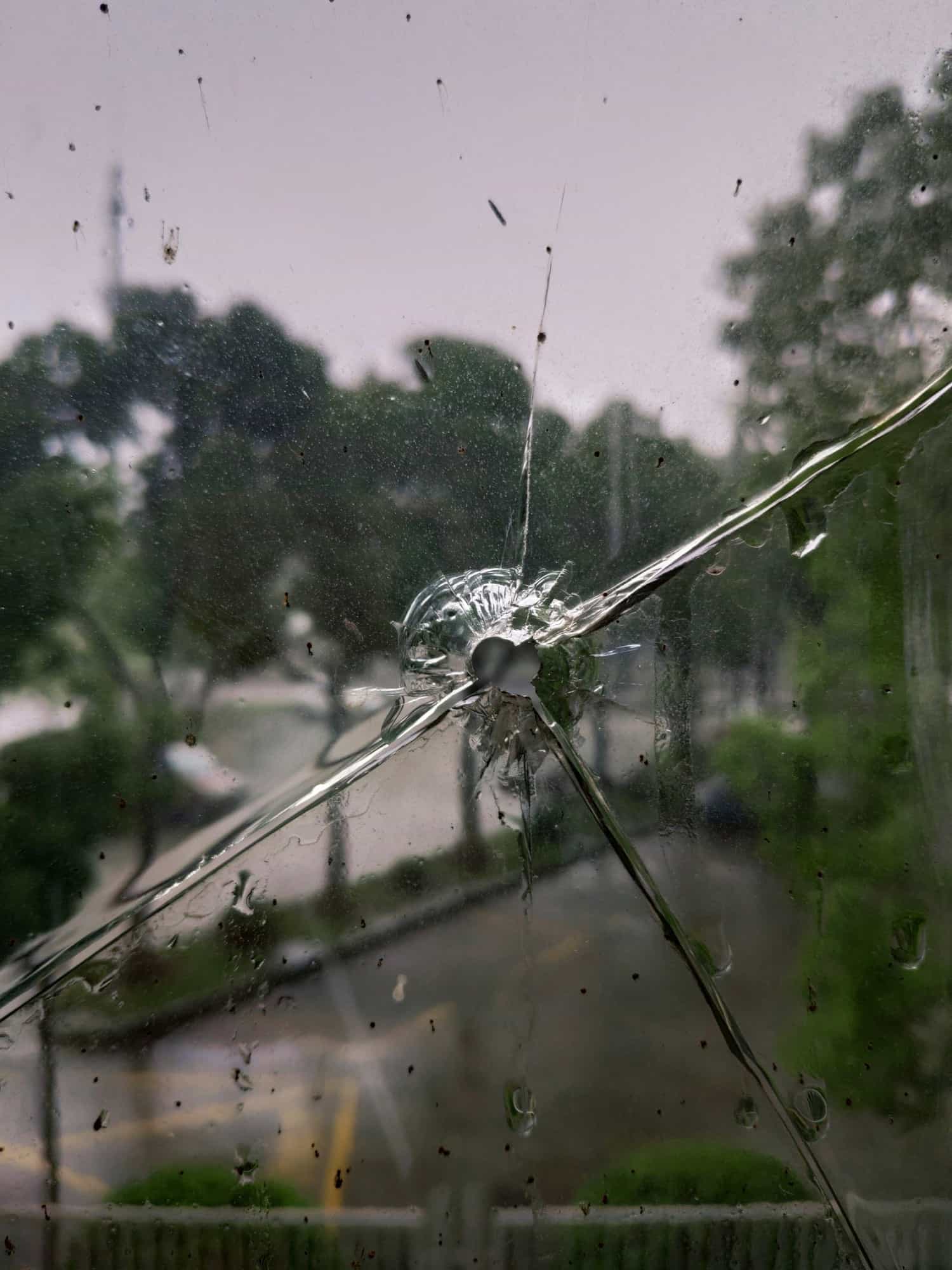
Impact Resistant Glass
Storm and intruder resistant laminated impact glass.
Impact Resistant Glass
Protect your home from storms and intruders. Our impact-resistant glass features a laminated interlayer that holds the glass together even when shattered.
Impact-resistant glass is laminated glass engineered to withstand wind-borne debris during hurricanes and severe storms. The product is two lites of glass bonded with a structural interlayer (PVB or ionoplast — SentryGlas Plus is the gold standard) that holds the glass together when struck. The flying 2x4 dent test from ASTM E1996 is the basis of impact rating: a 9-pound 2x4 launched at the glass at simulated hurricane wind speed. The glass cracks but stays in the frame, which keeps the building envelope intact during the storm.
Florida built its building code around impact glass after Hurricane Andrew (1992) made it clear that wind-driven debris breaking unprotected windows was the primary failure mode for residential structures. New Jersey hasn't gone that far — IRC and IBC as adopted in NJ don't mandate impact glass for any residential use. But Hurricane Sandy (2012) caused over $30 billion in NJ damage and revealed how exposed the Jersey Shore actually is. Discerning oceanfront homeowners and many commercial properties along the Shore now spec impact glass voluntarily.
Wind loads on the Jersey Shore
ASCE 7-16 establishes basic wind speeds for structural design across the US. For residential Risk Category II, the Atlantic coast of NJ runs 130-140 mph (3-second gust) in coastal Atlantic, Cape May, and Ocean Counties. Moving inland 5-10 miles drops to 115-125 mph. Northern NJ inland is 105-115 mph. The high-load areas line up almost exactly with the historic hurricane storm tracks that have impacted NJ — Sandy (2012), Irene (2011), Floyd (1999), Donna (1960).
Building envelope loads scale with wind speed squared, so a 140 mph design is more than 2x the load of a 100 mph design. Standard residential windows are designed and tested to specific design pressures (DP) — DP 30 to DP 50 covers most stock residential. Impact-rated windows for coastal use run DP 50 to DP 70+ to handle the design wind plus the dynamic load of debris impact.
Wind-borne debris zones are specifically called out in IBC Chapter 16 and the Florida Building Code. NJ has not adopted formal wind-borne debris zones, but many municipalities along the Shore (Mantoloking, Lavallette, Beach Haven, Avalon, Stone Harbor) have post-Sandy local ordinances or strong recommendations for impact glazing in new construction and major remodel along the oceanfront.
FBC vs IBC: missile testing and the rating standards
ASTM E1886/E1996 is the test standard. Large Missile Test (Level D): 9 lb 2x4 launched at 50 ft/s at the glass. Small Missile Test (Level B/C): smaller projectiles at higher velocity. The glass must remain in the frame with no perforation larger than 5 inches. Followed by cyclic pressure testing simulating storm wind loads.
Florida Building Code (FBC) High Velocity Hurricane Zone (HVHZ) in Miami-Dade and Broward counties has the strictest testing — TAS 201, TAS 202, TAS 203 — which exceeds ASTM E1886 in some ways. Products certified to Miami-Dade NOA (Notice of Acceptance) are the gold standard. Outside HVHZ, FBC accepts ASTM E1886 certification.
NJ adopts IBC, which accepts ASTM E1886/E1996. Products labeled for ASTM E1996 impact rating are accepted for NJ commercial wind-borne debris zones (if local code or insurance specifies). Florida Miami-Dade NOA certified products are accepted everywhere because they exceed any other standard.
Common rated products: PGT WinGuard (residential), CGI Sentinel (commercial), Andersen Stormwatch (residential impact). All of these come with rating documentation we provide for permit submittal and insurance verification.
Glass make-up and frame requirements
Impact-rated glass spec: 5/16 inch outboard tempered + 0.090 inch SentryGlas interlayer + 5/16 inch inboard tempered = 9/16 inch total laminated. Some products use 1/4 + 0.090 + 1/4 = 5/8 inch total. For IGU configuration (dual-pane impact for energy code compliance): impact laminated outboard / 1/2 inch argon airspace / standard Low-E annealed inboard = 1-3/16 inch IGU.
The interlayer matters. Standard PVB will pass some impact tests but is less stiff and tends to bulge inward after impact, sometimes pulling out of the frame. SentryGlas Plus ionoplast (Kuraray) is much stiffer and stays mechanically anchored in the frame even after multiple impacts. Most premium impact products use SentryGlas; lower-cost products may use PVB.
Frame requirements: the glass is only as good as the frame holding it. Impact-rated framing systems use deeper glazing pockets (typically 1 inch versus 1/2 inch standard), reinforced corners, structural silicone glazing in many commercial applications, and impact-rated hardware. Replacing only the glass in an existing standard frame does NOT create an impact-rated assembly — the entire window unit must be designed and tested as an impact system.
Insurance discounts
Some insurers writing New Jersey homeowners policies offer a discount for impact-rated windows or permanent storm shutters. New Jersey does not require insurers to offer one, so ask your insurer whether you qualify and what it is worth before you count it toward the cost. That is the real difference from Florida, where state law requires residential property rate filings to include discounts or credits for windstorm loss-reduction features.
Ask your insurer what documentation it needs before the install. An impact rating belongs to the whole tested assembly — frame, glass, and the specified installation — under a recognized standard (ASTM E1886/E1996 or Miami-Dade NOA), not to the glass alone, and we provide the certification the product carries (a Miami-Dade NOA, a Florida Product Approval or its ASTM E1886/E1996 rating) with every impact install.
Beyond any insurance discount you may qualify for, impact glass eliminates the need for shutter deployment before storms. Plywood, Bahama shutters, and roll-down storm shutters all require labor to deploy and disposal/storage between uses. Impact glass is permanent passive protection — the window is always storm-ready. For owners of vacation homes who aren't on-site to deploy shutters before a storm, this is a major benefit.
Where we install impact glass in NJ
Oceanfront single-family residential — Mantoloking, Lavallette, Bay Head, Loveladies, Long Beach Island, Brigantine, Margate, Ventnor, Avalon, Stone Harbor, Sea Isle City, Wildwood Crest, Cape May Point. Replacing standard windows with impact-rated units is a major scope on every recent remodel and rebuild.
Barrier-island commercial — hotels, restaurants, retail in beach towns. Many of these properties suffered significant Sandy damage and rebuilt with impact glass.
Bay-side and back-bay homes — Mantoloking, Forked River, Tuckerton, Atlantic City marinas. Still exposed to storm surge wind even when not directly oceanfront. Many homeowners spec impact glass for any window facing the bay or sound side.
Inland luxury residential — Princeton, Saddle River, Alpine, Far Hills. Some discerning clients spec impact glass on south- and east-facing elevations even far from the coast, for severe thunderstorm and hail protection. Not common but a real market.
Our Process
- 1Wind load and design assessmentWe confirm the design wind speed for the specific location per ASCE 7-16, identify wind-borne debris zones if applicable, and discuss the required DP rating. For oceanfront installs we typically target DP 50+ with Level D impact rating.
- 2Product selectionWe walk through 2-3 product options at different price/performance points. Typical residential: PGT WinGuard or Andersen Stormwatch. Commercial: CGI Sentinel or YKK AP impact-rated storefront.
- 3Documentation and permitWe pull the manufacturer NOA or ASTM E1886 certification and, when the scope needs a permit, prepare the submittal documentation and submit it to the local building department. If your insurer offers a discount, we provide the certification documents it asks for.
- 4Order and lead timeStandard residential impact products: 6-8 weeks. Custom commercial impact storefront: 10-14 weeks. Marine spec hardware adds 2-3 weeks. We track production and confirm install date once units ship.
- 5InstallImpact glass install follows standard window install procedures with additional attention to anchorage. We use the manufacturer-specified fastener pattern and depth (typically heavier than non-impact installs) and, on a permitted job, verify with the inspector at rough inspection.
- 6Verification and insurance documentationOn a permitted job, final inspection coordinated with the building department. We provide all certification documentation, NOA copies, and install photos for the insurance file.
Materials We Use
The Precision Difference
About Impact Resistant Glass in NJ
Is impact glass required by code in NJ?+
Will impact glass actually stop a hurricane projectile?+
Will impact glass lower my insurance premium?+
Can I retrofit impact glass into my existing windows?+
What's the difference between impact glass and standard laminated glass?+
Does impact glass replace storm shutters?+
Does impact glass help with security too?+
Does impact-resistant glass reduce outside noise?+
Guides on this
- Nor'easter and hurricane-season checklist
What to do to your windows before a named storm reaches the Jersey Shore, and what impact glass changes about that list.
Serving All 21 New Jersey Counties
We service Atlantic County, Bergen County, Burlington County, Camden County, Cape May County, Cumberland County, Essex County, Gloucester County, Hudson County, Hunterdon County, Mercer County, Middlesex County, Monmouth County, Morris County, Ocean County, Passaic County, Salem County, Somerset County, Sussex County, Union County, Warren County. From our Garfield, NJ shop we cover the entire state, same-day in Bergen County, and elsewhere depending on the job and how booked we are that day.