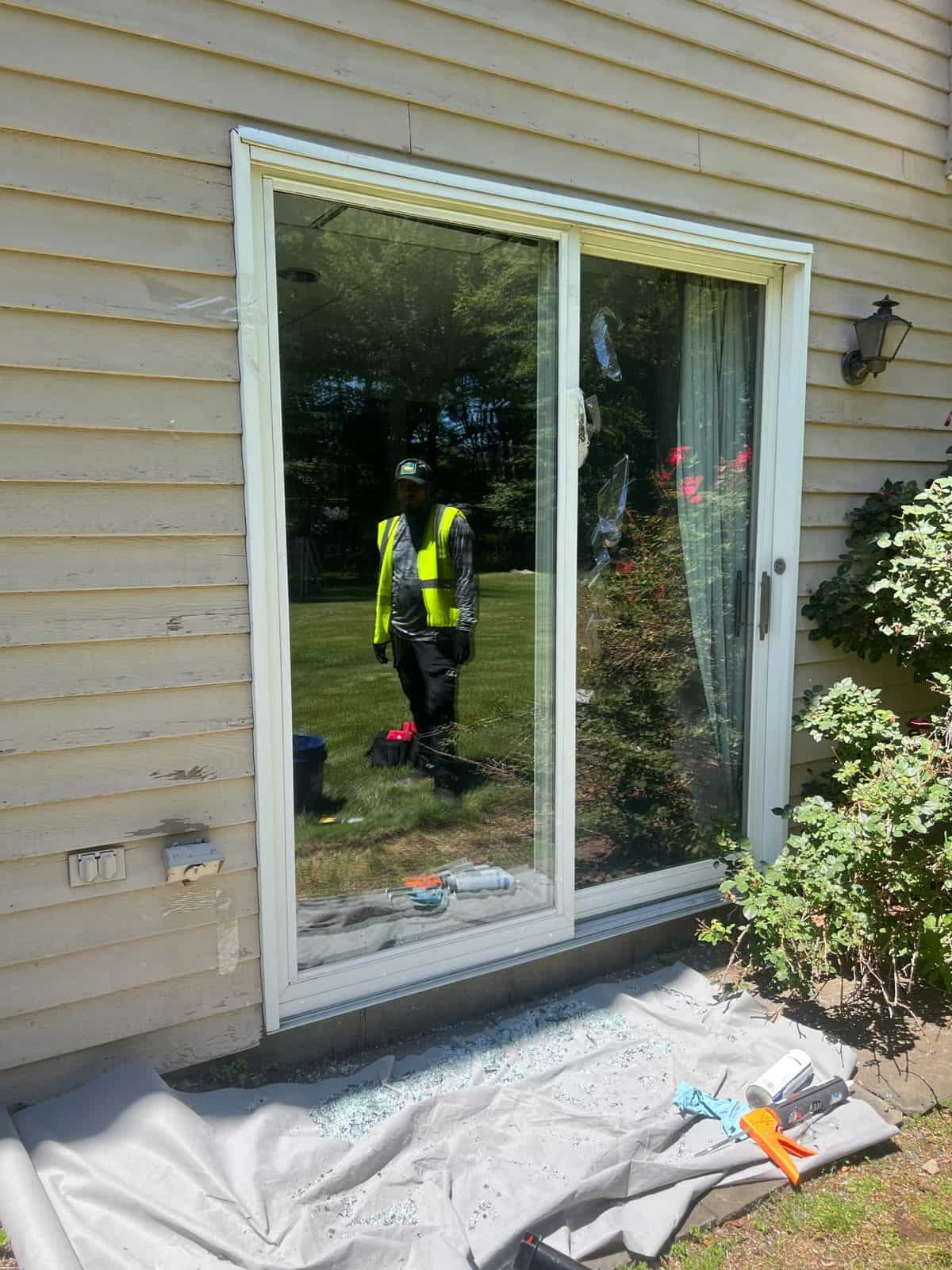
Sliding Glass Door Installation
New sliding patio door installation — XO/OX, multi-slide and pocket systems, custom sized.
Sliding Glass Door Installation
Sliding glass door installation and replacement across NJ — traditional XO/OX patio doors plus 3-, 4- and 6-panel multi-slide and pocket systems from Andersen, Pella, Marvin and PGT. Custom sized for non-standard openings, with flood-zone thresholds and shore-grade hardware spec'd where the site calls for it. If your existing door drags, sticks, or has fogged glass, that is repair work and it lives on our sliding & patio door repair hub.
This page covers new sliding door installation. Worn rollers, a panel off its track, a lock that won't engage, or a fogged insulated glass unit are repairs — and most of them cost a fraction of a new door.
Sliding & patio door repair across NJPrecision installs sliding glass doors across all 21 NJ counties — traditional XO/OX patio doors, XOX three-panel units, and the wide multi-slide and pocket systems that open a whole wall. This page is about new doors: sizing, configuration, structural header, threshold detail, glass package, and hardware. If what you have is a door that drags, sticks, jumped its track, or has fogged glass, that is repair work and our statewide sliding and patio door repair hub covers it in detail. A sliding glass door is one of the most engineered openings in a home: two large tempered panes ride on rollers carrying 100+ pounds of glass, seal against wind and rain through multiple weatherstrip layers, lock against forced entry, and meet code for safety glazing, egress, and — in coastal NJ — wind-borne debris impact. Get any of these wrong and the door won't open, won't close, leaks at every nor'easter, or fails at the worst possible time. We install Andersen, Pella, Marvin, Milgard, and PGT doors, including the heavier multi-slide configurations now standard in new-construction great rooms.
The Jersey Shore presents specific challenges: flood-zone elevation requirements that change the sill detail and the threshold height; ASCE 7 wind-borne debris zones requiring impact-rated glass; salt-air corrosion attacking standard hardware. We spec accordingly on every shore-area job — marine-grade stainless rollers, impact-rated glass packages, code-compliant thresholds. Inland we focus on smooth operation, energy performance, and security, with screen options that actually keep insects out of a back patio.
When a repair beats a new door
Before you buy a door, it is worth knowing that most sliding-door problems are repairs, not replacements — we diagnose and quote them on-site, and the full repair scope lives on our sliding and patio door repair hub. The most common call is a door that drags, sticks, or won't slide: almost always worn rollers (10-15 year typical lifespan) or a track packed with grit or dented by impact. We clean and straighten the track, replace the roller assemblies with heavy-duty units, and re-shim the door plumb so it glides through full travel again.
Off-track panels are the other frequent emergency — a heavy operating panel lifted or knocked out of the lower track, often after a forced-entry attempt. We reset the panel, replace damaged rollers and the track section if needed, and add anti-lift hardware so it can't happen again. For broken or foggy glass we replace just the insulated glass unit (IGU) in most cases — a single shattered pane or a failed, fogged seal does not require a whole new door. We carry common sizes and order tempered or laminated units to match the original.
We also repair handles and mortise latches, multi-point locks that no longer engage, weatherstrip and bottom sweeps that leak air and water, and screen doors that have jumped their track. When a door is genuinely past repair — frame rot, a bent aluminum frame, or obsolete hardware with no parts available — we say so and quote replacement instead. Security-related breaks (shattered glass, a door that won't lock) are prioritized as emergency calls, and we go anywhere in New Jersey to secure the opening, same-day in Bergen County, and elsewhere depending on the job and how booked we are that day.
NJ flood-zone and threshold requirements
Properties in FEMA Special Flood Hazard Areas (SFHA) — A, AE, V, VE zones common throughout coastal NJ — must comply with NJ Flood Hazard Area Control Act and the local floodplain ordinance. For sliding glass doors specifically: the finished floor of the door opening must be at or above the Base Flood Elevation (BFE) plus required freeboard (typically 1-2 feet of additional elevation above BFE, varying by municipality). This often means doors install at sill heights well above the patio or deck outside, requiring a step-down on the exterior.
The threshold has to be designed as a watertight detail. We use heavy-duty aluminum thresholds with integral weep channels and a continuous bulb seal at the operating panel. Standard residential thresholds (1/2" to 1" height) often fail flood-zone freeboard. We spec elevated thresholds with proper flashing — sometimes 4"-6" above the exterior deck — and coordinate with the deck contractor for a code-compliant transition.
V-zone (velocity zone, coastal high-hazard) properties have stricter requirements: doors must be designed to withstand wave action, the structure must be elevated on piles, and the door framing must transfer wind loads to the structural diaphragm. We work with the project engineer on V-zone openings and don't substitute residential-grade doors for engineered V-zone assemblies.
Multi-slide vs traditional XO/OX
Traditional sliding doors are XO or OX configurations — one operating panel (X) and one fixed panel (O) — in 6', 8', or 12' nominal widths. The operating panel slides behind or in front of the fixed. Maximum operating panel width is typically 4', constrained by what one person can move on rollers without power assist. Sealing is straightforward: standard weatherstrip and a single operating threshold.
Multi-slide doors are 3-, 4-, 5-, or 6-panel configurations where multiple panels stack to one side, opening the wall to a much wider opening (12'-24'+ on residential, larger on commercial). Two main types: stacking (panels park behind one another in a multi-track header) and pocket (panels disappear into a wall cavity for a fully unobstructed opening). Multi-slide doors are dramatically more complex: oversized headers (often requiring engineered structural beams), multi-track headers with precise alignment requirements, panel weights that often exceed 200 lbs each and require power-assist or careful manual operation.
Cost difference is substantial: a typical 8' XO sliding door installs for the price of a single panel of an equivalent multi-slide system. The multi-slide is the dramatic indoor-outdoor design feature; the XO is the functional patio access. We do both, and quote each transparently.
Manufacturers: Andersen 200/400 Series for traditional XO/OX; Andersen E-Series and A-Series for premium configurations; Pella Lifestyle and Reserve; Marvin Modern; PGT WinGuard for impact-rated; LaCantina, NanaWall, and Western Window Systems for high-end multi-slide. We install all of these and have manufacturer training certification on the major systems.
Screen options that actually work
Standard fiberglass-mesh sliding screens that come with most sliding doors are functional but limited: easy for cats and small children to push through, fragile against pet claws, and visually intrusive across the open door. We offer three upgrades.
Heavy-duty pet-resistant mesh (Phifer Pet Screen, Tuff Screen) — 7x reinforced polyester fiber. Holds up to claws and routine pushing. Drop-in replacement on existing screen frames, and the least expensive of the three upgrades.
Retractable screens (Phantom, Mirage, Genius) — screen retracts into a side cassette when not in use, invisible from the open door. Engages on demand. Excellent for sliding doors that double as primary patio access where the homeowner wants the door wide open most of the time. A clear step up from pet mesh — what you're paying for is the cassette hardware and the fit, not the screen.
Stainless steel security screens (Crimsafe, ScreenAway) — woven 316 stainless steel mesh in a heavy aluminum frame. Provides forced-entry resistance equivalent to a locked security door, plus pet and child resistance. Common on shore homes and security-conscious primary residences. The most expensive of the three, and the only one doing security work. We price all three on the same quote so you can compare them side by side.
Locks, security, and forced-entry resistance
Standard residential sliding door locks are typically a single hook or mortise latch engaging a strike on the fixed panel jamb. Functional but easily defeated — sliding door break-ins are typically not lock failures but lift-and-pry attacks where the operating panel is lifted out of its track. Two upgrades address this.
Anti-lift kits (door pins or upper-track anti-lift blocks) prevent the operating panel from being lifted out of the lower track. Cheap hardware relative to what it prevents — we include it on every sliding door we install, as standard.
Multi-point locks engage the door at three to five points along the operating panel height with deadbolts driving into the frame. Significantly increases forced-entry resistance. Standard on premium and impact-rated doors (Andersen E-Series, Marvin Modern, PGT WinGuard) and a worthwhile retrofit on existing doors — the hardware and the labor to fit it are both real, so it gets its own line on the quote.
Smart locks: most major sliding door manufacturers now offer integrated smart-lock options (Andersen Smart Lock, Pella Insynctive). We install and program these as part of the door scope when specified.
Our Process
- 1Free on-site consultation and measureNo charge and no obligation. We assess the existing opening or new rough opening, measure for door size, evaluate the structural header capacity (critical on multi-slide upgrades and on flood-zone retrofits), confirm flood-zone status if applicable, discuss configuration (XO/OX/XOX/multi-slide), and review screen, lock, and glass options.
- 2Written quote and specWithin 48 hours: door manufacturer and model, glass package (Low-E, gas fill, impact rating if applicable), configuration, hardware finish, screen type, lock type, threshold spec, total turnaround. Includes NFRC rating and manufacturer warranty terms.
- 3Permit and orderBuilding permit pulled through local Construction Official when the opening or header changes; a door replaced in the same opening needs none. Manufacturer lead time: stocked Andersen 200 Series — 2-3 weeks; custom and premium configurations — 4-8 weeks; multi-slide systems — 8-12 weeks; impact-rated for coastal — 6-10 weeks.
- 4Removal and prepOld door removed, structural opening verified or upgraded (header replacement on multi-slide upgrades), sill flashing installed (Vycor V40 or equivalent), opening verified plumb, level, and square within manufacturer tolerance (typically 1/8" over 8 feet).
- 5InstallationDoor set, leveled, and anchored per manufacturer spec. Multi-slide systems require careful track alignment and progressive panel installation. Weatherstrip, sweeps, and exterior trim installed. Operating panel adjusted on rollers for smooth operation through full travel. Typical install time: 4-6 hours for traditional XO; 8-12 hours for multi-slide; 1-2 days for pocket systems.
- 6Inspection and walkthroughOn a permitted job, the local Construction Official inspects (permit closeout). Walkthrough with homeowner: operation, locking, screens, threshold drainage. Warranty paperwork — manufacturer warranty plus lifetime workmanship from us.
Materials We Use
The Precision Difference
About Sliding Glass Door Installation in NJ
Can you replace just the glass in a sliding glass door?+
My sliding glass door came off its track — can you fix it?+
How much does sliding glass door repair cost in NJ?+
Should I repair or replace my sliding glass door?+
What's the difference between a regular sliding door and a multi-slide system?+
Do I need impact-rated glass on my Jersey Shore sliding door?+
How do I keep my sliding door secure from break-ins?+
Why does my sliding door bind or stick?+
Can I add a screen to my existing sliding door?+
How long does sliding door installation take?+
Are sliding doors energy efficient?+
Sliding patio door or French door — which should I choose?+
Guides on this
- Sliding door vs French door
Clear opening, swing space, weather sealing and cost — how the two patio-door types actually compare on a NJ house.
Sliding Glass Door Installation by City
Serving All 21 New Jersey Counties
We service Atlantic County, Bergen County, Burlington County, Camden County, Cape May County, Cumberland County, Essex County, Gloucester County, Hudson County, Hunterdon County, Mercer County, Middlesex County, Monmouth County, Morris County, Ocean County, Passaic County, Salem County, Somerset County, Sussex County, Union County, Warren County. From our Garfield, NJ shop we cover the entire state, same-day in Bergen County, and elsewhere depending on the job and how booked we are that day.
Explore More
INTERIOR & OFFICE GLASS DOORS
Interior and office glass doors built for non-standard openings.
DetailsENERGY EFFICIENT REPLACEMENTS
Low-E and argon-filled windows that lower heating and cooling bills.
DetailsSTANDARD WINDOW INSTALLATION
Professional installation of double-hung, single-hung, and slider windows.
Details