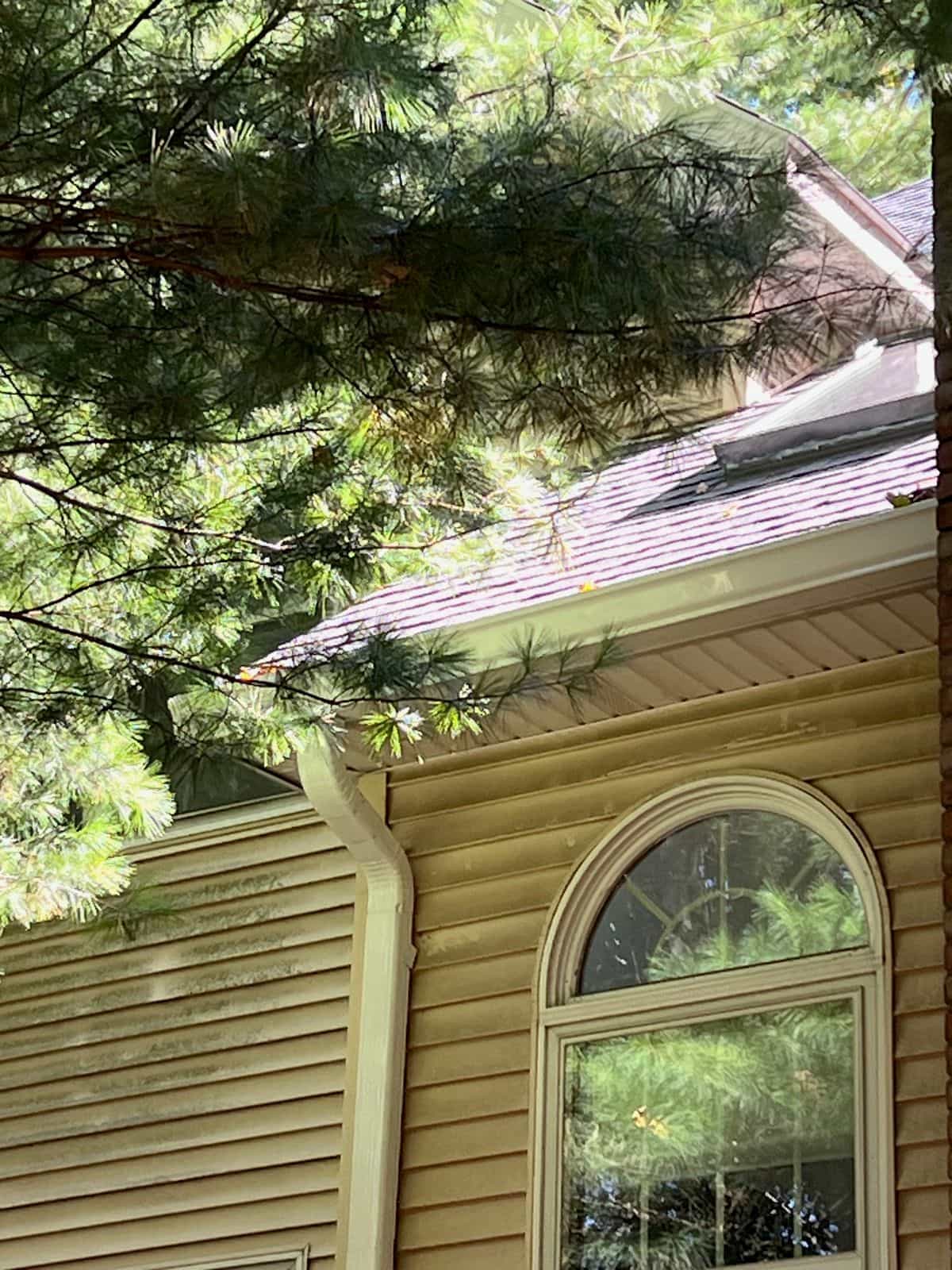
Clips that grip the gutter are the roof-safe way to hang Christmas lights on a house with shingles. A fastener driven through a shingle, the fascia or the siding is a hole, and GAF, the roofing manufacturer, warns that small holes like that can draw in moisture and lead to roof leaks and rot. Whatever goes up has to come down the same way it went up: one clip at a time, not with a yank from the ground.
We hang lights both ways, whichever the customer prefers. Clips are the roof-safe default on shingles and gutters; a fastener goes in only when a customer asks for one, and we explain the leak and rot risk first. This guide lays out the trade-off the way a roofer sees it, so you can decide for your own house, or know what to ask a crew before they climb a ladder at your eave.
Why one fastener hole matters
GAF tells homeowners not to nail or staple holiday decorations to shingles, fascia or siding, because the small holes can draw in moisture, which may lead to roof leaks and rot. It adds a second reason: nails and staples can pierce the protective insulation on an electrical cord, which can lead to sparks. Both points are why this guide exists.
A roofer's gloss on the first one: a small hole is a slow problem. A leak that starts small can take a while to show, and by the time a stain appears on a ceiling nobody connects it to a string of lights hung a couple of Decembers earlier. If a stain does show up, roof leak repair starts with finding where the water actually got in, which is often not directly above the stain.
Which clip goes where
For the gutter line, which is where most roofline lights run, use plastic gutter clips. That is the method GAF names for hanging lights from gutters and eaves: the clip grips the gutter, and nothing is driven through the gutter, the fascia or a shingle. GAF also says to keep decorations lightweight so the gutters do not sag under them.
Every season people search for clips that go under shingles. GAF's tips do not describe any method that goes under a shingle, and we are not aware of a shingle-maker source that approves one, so we do not treat it as safe by default. A shingle is meant to lie flat and shed water; lifting its edge to slip something under it is a different thing from gripping a gutter.
Gutter guards and screens change what a gutter clip can grip, and the answer depends on the product. We do not publish a one-size rule for them here. If you have gutter guards, tell us the brand when you ask about lights, or check the guard maker's instructions before clipping anything to them.
- Gutter line (the eaves): plastic gutter clips and light strings, so the gutter is not carrying more than it should.
- Door frames, porches, railings and shrubs: these do not need the roof at all. GAF suggests stringing lights around the door frame and front-lawn foliage as the alternative to roof lights, and all of it can be reached from the ground.
- Gable edges and ridgelines: there is no gutter to grip, which is why this is where fasteners tempt people and where the ladder risk is highest. It is the run worth leaving to a crew, or leaving dark.
Clips or fasteners: the honest trade-off
The case for a fastener is real, and the federal safety agency and the shingle maker weigh it differently. The U.S. Consumer Product Safety Commission, in its holiday decorating tips, says to fasten outdoor lights securely so wind cannot damage them, and that if you use staples they should be insulated staples rather than nails or tacks. It also mentions running strings through hooks sold at hardware stores. GAF's concern is the roof. A loose string can whip around in wind; a hole in the wrong place can let water in.
In practice that means a clip has to grip firmly, strings have to stay light, and the run is worth checking after a windy night. If you decide on a fastener anyway, keep it off the shingles themselves, use as few as the string needs, and use the insulated kind CPSC describes. That decision is the customer's call, and the risk is the one thing we will not skip explaining.
Keep heavy decorations off the roof
GAF says inflatables, statues and holiday scenes are better left on the ground. Securing heavy or oversized decorations to a roof can damage shingles and potentially affect roof warranties, and strong winds can rip them off, possibly tearing shingles with them. Park the sleigh on the lawn.
If your roof is still under a manufacturer's warranty, the warranty terms are the document to read before anything heavy goes up there, not an internet forum.
A ladder, not the roof
GAF's advice is to use an extension ladder rather than walking on the roof, because scrambling on shingles can cause granule loss and damage, and to use a ladder only when it is safe to do so and a buddy is present. Walking a roof is work for professionals.
The numbers say why a spotter matters. The U.S. Consumer Product Safety Commission reported in November 2024 that there are about 160 Christmas-decorating injuries a day during the holiday season, with nearly half involving falls, and that about 14,900 people were treated in emergency rooms for holiday decorating injuries in the 2023 season (November 1, 2022 to January 31, 2023).
Ladder footing is the part most people skip: soft lawn after rain, a slope, a shrub bed under the eave, or a driveway that ends where the house starts. Level, firm ground first, then the spotter, then the ladder.
Power without overloading
The electrical rules are short, and most of them come straight from the product-safety agencies and from GAF.
- Outdoor-rated lights only. CPSC says to check the label to confirm the lights are certified for outdoor use. GAF says the same in its own words: safety rated and made for outdoor use.
- LEDs run cooler. GAF recommends low-heat LED bulbs.
- Plug into a GFCI-protected outlet. CPSC says outdoor lights and decorations should be plugged into circuits protected by ground-fault circuit interrupters, and that portable outdoor GFCIs are sold where electrical supplies are sold.
- No more than three sets of incandescent lights in a run, and no overloaded outlets. That is CPSC's rule from its November 2024 release. For LED sets, follow the maximum run printed on the package.
- Check every set before it goes up. CPSC says to look for broken or cracked sockets, frayed or bare wires and loose connections, and to throw out damaged sets.
- Turn lights off or unplug them when you leave or go to bed. GAF and CPSC both say so.
What about a new outlet?
Adding an outdoor outlet is permitted electrical work in New Jersey, with a permit filing and inspection, so it goes to a licensed electrician. We plug lights into your existing outdoor outlets; we do not add outlets, circuits or wiring.
Taking lights down without tearing the roof edge
Take them down the way they went up. GAF warns that grabbing one end and yanking can tear shingles and pull down gutters; remove the clips one at a time and coil the lights as you go, which also makes next year's install easier. CPSC gives the electrical version of the same warning: never pull or tug on lights, because the stress on the connections can create a fire hazard.
Pick a dry day with no ice on the eave or at the foot of the ladder, and take the lights down when the season ends and the weather allows.
Afterward, look along the eave from the ground for a shingle edge that has lifted, a gutter hanger that has pulled loose, or a gutter that has started to sag where the clips were. A loose hanger is an easy fix now; if a gutter has pulled away from the house, gutter repair covers it.
When to hand it to a crew, and where we work
A tall roofline, several gables, mature trees pressed against the eaves, a long or gated driveway that puts the ladder a long way from the truck, or a condo or homeowners association that sets rules on what may be attached to the building: any of these turns a Saturday project into a job for a crew with extension ladders, a spotter and the time to do it without hurrying. GAF's own advice is to hire a pro if it is not safe for you to do it yourself. Christmas light installation covers how that works here, including hanging your lights or ours, taking everything down after the season and storing it until next year. Our crew is insured for ladder and roof work.
We work across Bergen, Passaic, Essex and Hudson counties, from Ridgewood, Saddle River, Franklin Lakes and Ho-Ho-Kus to Montclair and Millburn; the installation page lists the towns by county.
Sources (read October 13, 2026)
Everything above that states a rule or a statistic comes from one of these four documents.
- GAF Roof Views blog, 6 Tips for Installing Holiday Roofing Decorations, by Annie Crawford, December 14, 2021: https://www.gaf.com/en-us/blog/your-home/6-tips-for-installing-holiday-roofing-decorations-9c9140d1-aa4b-4483-aee6-c43b3f207459
- U.S. Consumer Product Safety Commission, Happy Holidays Start with Safety, release dated November 19, 2024 (decorating injuries and the three-sets rule): https://www.cpsc.gov/Newsroom/News-Releases/2025/Happy-Holidays-Start-with-Safety-CPSC-Urges-Families-to-Cook-Decorate-and-Select-Toys-with-Care-This-Season
- U.S. Consumer Product Safety Commission, CPSC Announces Holiday Season Decorating Safety Tips, release 05-068, dated December 13, 2004 (outdoor labels, GFCIs, insulated staples or hooks, removing lights): https://www.cpsc.gov/Newsroom/News-Releases/2005/CPSC-Announces-Holiday-Season-Decorating-Safety-Tips
- N.J.A.C. 5:23-2.17A, Minor work, section (c)4 (installing outlets in one- and two-family homes), text as published by Cornell Law School's Legal Information Institute: https://www.law.cornell.edu/regulations/new-jersey/N-J-A-C-5-23-2-17A