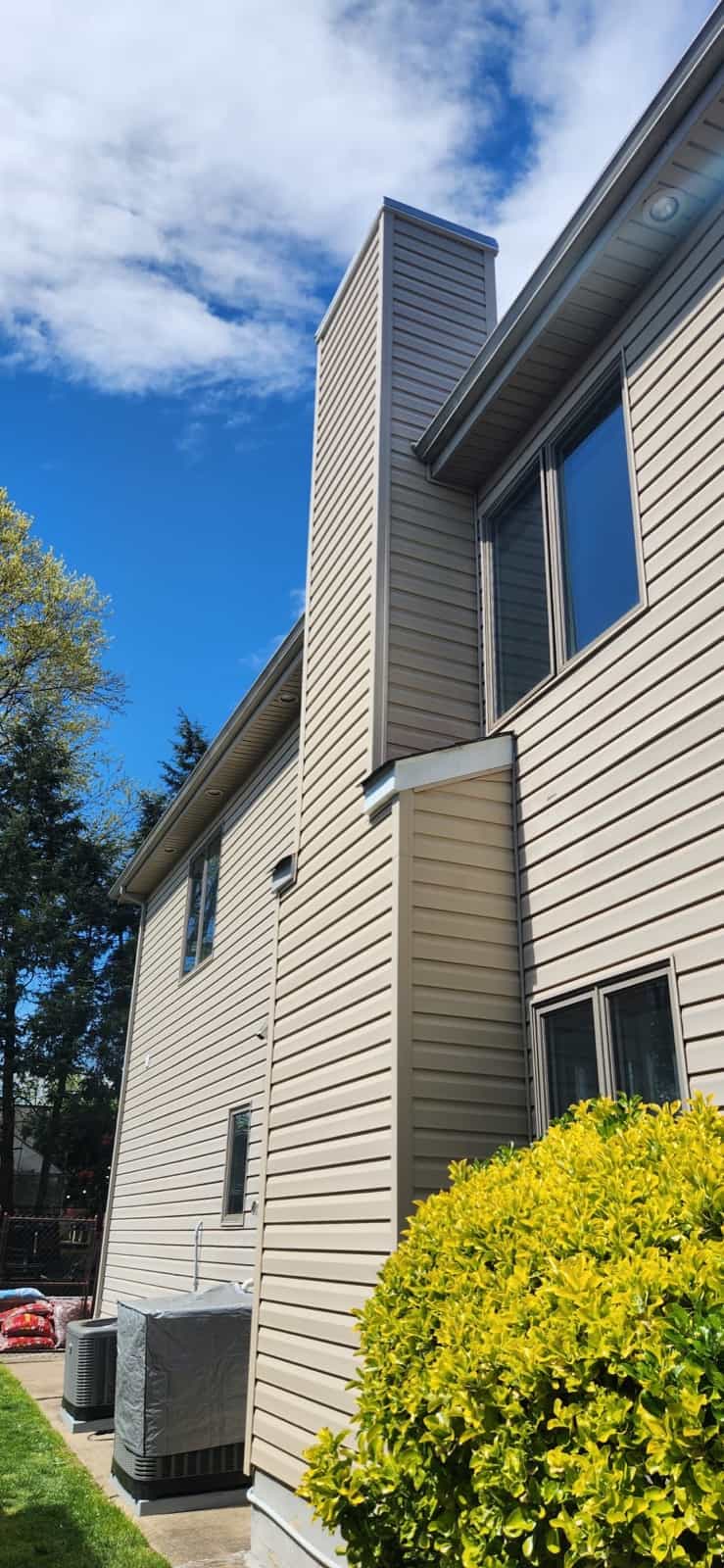
Vinyl siding chips and cracks more easily in hard cold, so a winter crack is usually a cold panel that got hit. The Vinyl Siding Institute's installation manual warns installers about exactly that when they cut siding in extreme cold. The hit tends to come from an ordinary winter chore: a snow blower throwing stones, a plow pile pushed against the bottom course, an icicle dropping off an overflowing gutter, or a ladder leaned on a panel. The other cause is a panel nailed too tight to move, which is an installation problem, not a weather one.
This guide is for North Jersey homeowners with vinyl or fiber cement siding: what hits siding in winter, what to keep off the wall, what the manual says about installing vinyl siding in the cold, the fastening that lets a panel move, and what to check once the snow melts. Matching a faded panel and repair costs belong to our siding repair page, so we only point to it here.
Why cold vinyl cracks when a warm panel would not
Vinyl siding is rigid PVC, and the industry's own manual treats cold vinyl as easier to damage. The Vinyl Siding Institute (VSI) tells installers that in extremely cold weather they should move the saw through the material slowly to prevent chipping or cracking. If a panel can chip under a trained installer's saw, it can chip when a chunk of ice hits it. The model building codes require vinyl siding to be certified to ASTM D3679, a standard whose requirements include impact strength, but we found no published figure for how a finished panel behaves at a given temperature, so we do not quote one.
The second cause is movement. VSI says vinyl siding can expand and contract 1/2 inch or more over a 12 foot 6 inch length during normal year-round temperature changes, and that tight nailing, screwing or stapling makes it buckle. Our reading, not VSI's wording, is that a pinned panel is also stressed when it shortens in the cold, so a crack that starts at a nail slot with no sign of a hit points at the fastening.
- A crack or chip with a scuff or dent at the center: an impact. Look at what was near the wall at that height: a blower chute, a shovel pile, a ladder top or a hanging gutter.
- A crack that runs from a nail slot, or ripples along a whole course: fastening. VSI says face-nailing, which means driving a nail through the face of the panel, can result in ripples.
What hits siding in a North Jersey winter
Toro's operator's manual for its CCR Powerlite snow thrower says the rotor blades can throw stones, toys and other foreign objects, and says never to run it near glass enclosures, automobiles or window wells without adjusting the discharge angle. A wall at the edge of a walk is in the same line of fire.
- Snow blower chutes. Aim the chute away from the house. Toro also tells operators to clear the area of objects first, so walk the edge of the driveway and walk for loose stones and edging before the first storm.
- Plow and shovel piles. A blade or shovel scrapes the bottom course, and then the pile sits against it. Our guide to marking a driveway before the plow comes covers the edges, and the snow removal page covers where your town lets the snow go.
- Icicles and ice sheets. A gutter that overflows or sags drops ice onto the wall and the walk. Knocking icicles down with a shovel or hammer is an easy way to crack a panel and bend the gutter. Gutter repair fixes a gutter that sags or has pulled away, and an eave that grows ice every winter is an attic heat problem explained on the ice dam page.
- Ladders. The top of a ladder resting on a cold panel puts the load on a small patch of stiff plastic. Rest it somewhere other than a panel face, or use a stand-off.
Snow piled against the wall
Pile snow away from the house where you can. VSI describes vinyl siding as a cladding, not a water-resistive barrier: a supplemental rainscreen that reduces the water reaching the barrier installed behind it. Treat this as housekeeping rather than a sign the wall will rot.
The vents are the exception. On its carbon monoxide prevention page, the U.S. Fire Administration says to make sure vents for the dryer, furnace, stove and fireplace are clear of snow and other debris. After a plow pass or a drift, find the vent terminations in your siding and clear them by hand.
The base of the wall matters too. VSI says panels and accessories must move freely, and a corner post hangs from nails at the top so its expansion and contraction happen at the bottom. Packed ice around that bottom end works against the movement the manual builds in; that is our inference, not VSI's statement. Fiber cement has firmer rules: the HardiePlank instructions send you to local code for the gap to finished grade, with a 6 inch minimum shown in the figure, and ask for 1 to 2 inches between the siding and paths, steps and driveways.
Can vinyl siding be installed in the winter?
Yes. The VSI manual has rules for cold installs rather than a ban, and we found no lowest temperature in it at which work must stop, so that limit comes from the siding maker and conditions on the day. The rules exist because of movement. A panel hung on a 20 degree day is close to its shortest, and in July it grows into whatever room was left at the ends. A panel set snug in January has no room, so it can ripple or buckle in the first hot week. That is why the gap at corner posts and J-channel should be measured on a cold install, not judged by eye.
The manual says the siding maker's own instructions should be followed in a conflict. Gentek's 2013 vinyl installation guide, for example, asks for a 1/2 inch clearance where panels fit into accessories when it is below freezing at application. Hold a crew, ours included, to the figure for the product going on your wall, and ask which gap they are using. In the cold, the VSI manual changes three things.
- Wider gaps. Leave at least 1/4 inch of clearance at openings, stops, corner posts and channels, and increase it to 3/8 inch when installing below 40 degrees Fahrenheit (4.4 degrees Celsius). For panels 20 feet or longer, the manual sends the installer to the manufacturer for how much more.
- Slower cutting. In extremely cold weather, move the saw through the material slowly to prevent chipping or cracking. A circular saw takes a fine-tooth plywood blade mounted backwards, which the manual warns could be unsafe on any other material.
- Insulated siding. The foam at the panel ends is butted together with no gap, unless the work is done in cold weather, when the manual says to consult the manufacturer.
Fastening that lets vinyl move
These VSI rules hold in every season, and breaking them shows up as buckles in July.
- Push the panel up until its lock is fully engaged with the course below, then fasten it without stretching it, and do not force it up or down while fastening.
- Fasten in the center of the nailing slot, beginning in the center of the panel and working toward the ends, so the panel can slide both ways.
- Leave about 1/32 inch between the fastener head and the panel, about the thickness of a dime. Tight nailing, screwing or stapling makes the siding buckle as the temperature changes.
- Drive each fastener straight and level, and use one long enough to penetrate the sheathing and framing a total of at least 1 1/4 inches unless the manufacturer's instructions say otherwise.
- Do not face-nail or staple through the panel; VSI allows it only in very limited applications where the nail hem has been removed and punch-lock systems cannot be used.
Fiber cement siding in the cold
In the HardiePlank instructions, the cold-weather questions sit with the caulk and the paint. Caulk is an elastomeric sealant meeting ASTM C920 Grade NS, Class 25 or higher, or a latex sealant meeting ASTM C834, applied per the sealant maker's written instructions or ASTM C1193. Painting goes by the paint maker's specifications and never onto wet boards, and repainting ColorPlus boards follows the paint maker's written instructions on coverage, method and application temperature. The temperature limit is on the caulk tube and the paint can, not in the siding instructions.
That copy is the November 2010 edition posted with a Florida product approval, so follow the current instructions for the product going on your house. Our James Hardie siding page explains the product.
What to check in spring
When the snow is gone, photograph the wall at every height a blower, shovel, ladder or plow could reach, beginning with the bottom course.
- Cracked or chipped panels, and bottom edges that hang open or have come out of their lock.
- Waves or ripples along a course, and panels that will not slide a little side to side when pressed gently, which is the sign of a panel pinned by its fasteners.
- Stains or ice marks below a gutter, which point to overflow, and gutters that sag or have pulled off the fascia.
- Dryer, furnace and fireplace vent terminations, and the bottom of every corner post.
One cracked panel or a whole wall
One cracked panel is a siding repair; that page covers matching a faded or discontinued panel. Cracks in several courses, or panels out of their locks across a whole side of the house, are the point to ask about siding replacement.
We work in Bergen, Passaic, Essex and Hudson counties. Call (201) 275-9185, HIC reg.# 13VH13970900, and if it is one panel, that is what we will quote.
Sources (read October 20, 2026)
Check the current instructions for the product on your own wall before relying on any number here.
- Vinyl Siding Institute, Vinyl Siding Installation Manual, copyright 2020 (PDF posted October 2022): https://polymericexteriors.org/wp-content/uploads/2022/10/2022-Vinyl-Siding-Installation-Manual-ENGLISH_100322_LR.pdf
- Gentek Building Products, Vinyl Products Installation Guide, 2013: https://www.gentek.ca/wp-content/uploads/sites/2/2021/01/Gentek_VINYL_PRODUCTS_INSTALLATION_GUIDE_ENGPP_050613-1.pdf
- James Hardie, HardiePlank Lap Siding installation requirements, effective November 2010, Florida Product Approval FL13192: https://www.floridabuilding.org/upload/PR_Instl_Docs/FL13192_R2_II_Install%20-%20hardieplank.pdf
- Toro, CCR Powerlite Snowthrower Operator's Manual, Form No. 3355-458 Rev B: https://www.toro.com/getpub/35183
- U.S. Fire Administration, Carbon Monoxide Poisoning Prevention, page last reviewed September 21, 2026: https://www.usfa.fema.gov/prevention/life-safety-hazards/carbon-monoxide/
- ASTM International, D3679-25 Standard Specification for Rigid PVC Siding, scope: https://store.astm.org/d3679-25.html