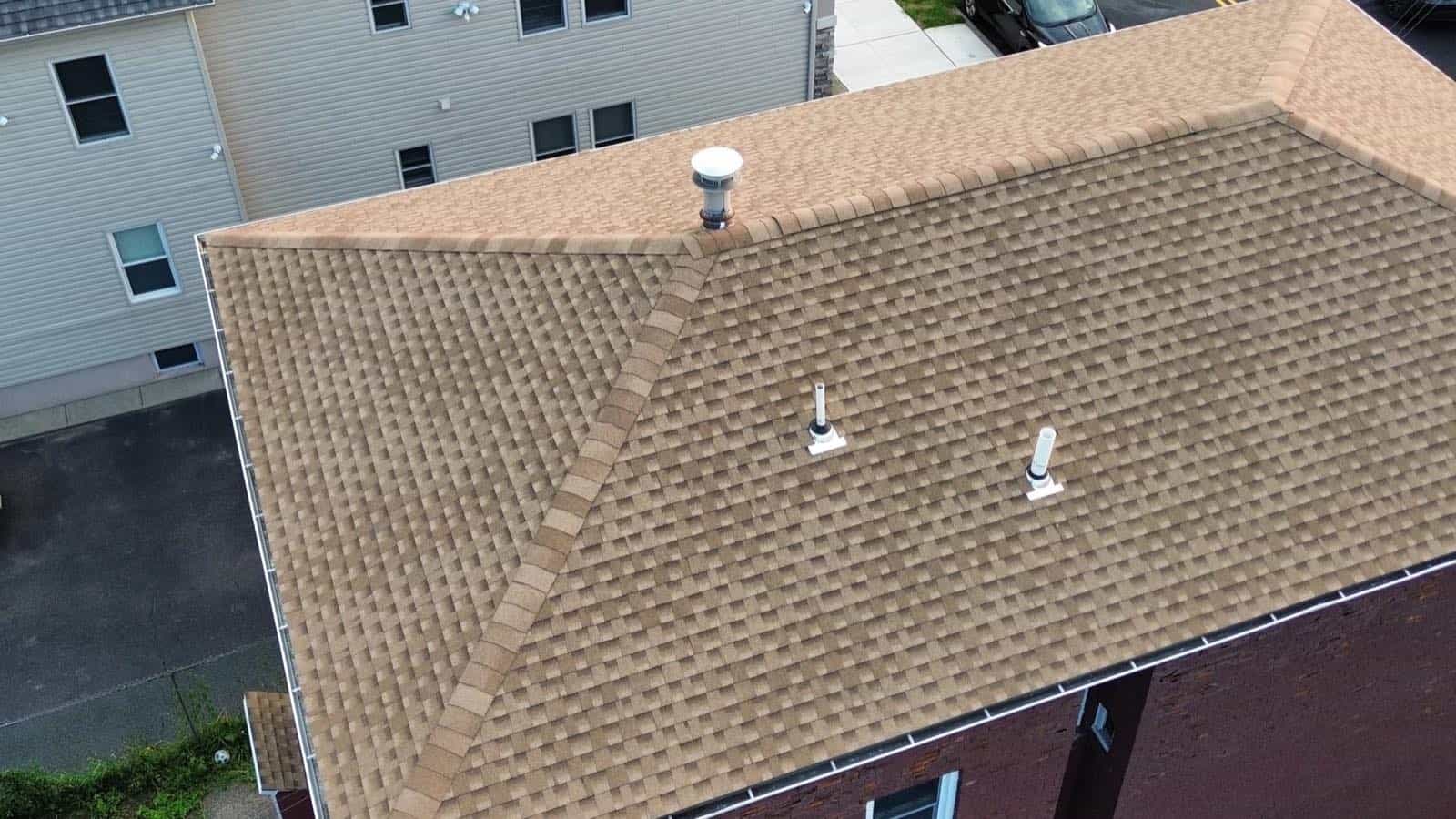
There is no single depth of snow a roof can hold. How much snow a roof can hold depends on what its framing was designed and built to carry, and on the snow itself: the same eight inches can weigh seven times more when it is wet and heavy than when it is light and dry. FEMA's Snow Load Safety Guide says most buildings are not at risk of snow-induced failure, and that trying to remove snow from a roof is more often hazardous than helpful.
Below: what fresh, wet and iced snow weigh, how a design snow load is set and where New Jersey sends designers to look it up, where the weight collects, the signs that mean you leave and call a structural engineer, and what icicles along the gutters tell you.
We are roofers, not structural engineers, and nothing here can tell you your roof's capacity. That takes someone who can see the framing. This is general information, not engineering advice.
How much snow can a roof hold? It depends on three things
No figure in pounds or inches applies to every house. The roof side of the answer is the framing, its age and condition, the pitch and where the wind puts the snow. The snow side moves just as much, because density changes with temperature, rain and time on the roof.
The risk climbs when conditions stack up: heavy wet snow, rain on the snowpack, drifts against a taller wall, and a flat roof with blocked drains. How often deep snow days arrive is covered in how much snow North Jersey gets in a typical winter; this post is about what the pile weighs.
What snow weighs: fresh, wet, packed and ice
Depth tells you little; density decides. FEMA puts a foot of fresh snow at 3 pounds per square foot when light and dry and 21 when wet and heavy, and notes East Coast snow tends to be wetter and denser than western snow. NDSU Extension gives it by volume: about 7 pounds per cubic foot for light, fluffy snow, about 15 for average snow, and 20 or more for drifted, compacted snow. The two sources agree at the heavy end and differ at the light end.
Snow does not stay the weight it fell at. FEMA notes that roof snow in sunlight can soften, become denser and then harden when the temperature drops below freezing, and that meltwater can pool and refreeze. Ice is heavier still: a little less than 5 pounds per square foot for each inch, and about 57 for a foot.
Take a 1,000 square foot section of roof. Eight inches of light, dry snow at FEMA's figure is roughly 2,000 pounds; eight inches of wet, heavy snow is about 14,000. A one-inch glaze of ice adds just under 5,000. That is our arithmetic from FEMA's figures for an even layer, not a prediction for your roof: a pitched roof sheds some, and drifts pile more in other places.
What the roof was designed for: ground load, roof load and the New Jersey lookup
Codes start from a ground snow load, the weight of snow on the ground. FEMA explains that the mapped values carry a 2 percent chance of being equaled or exceeded in any given year, so they are a design level, not a ceiling. A designer converts that to a roof snow load using wind exposure, slope, shape, obstructions, use and whether the building is heated; FEMA says wind exposure has the largest effect, and that assuming the roof carries what the ground does is incorrect.
New Jersey does not print a county-by-county number for Bergen, Essex or Hudson. The Department of Community Affairs' Bulletin 19-1 (issued September 2019, revised September 2022) sends designers to the Applied Technology Council or ASCE hazard tool, entered with a street address or coordinates, because a city or ZIP code returns the center of that area and could underestimate the load. Withdrawn 1994 values survive only for a result marked "case study" in six counties, Passaic among them at 40 pounds per square foot; every other county, Bergen, Essex and Hudson included, should generate a number. It is site-specific and can depend on elevation, so the number has to come from your own address. If the tool does not answer, the bulletin says to contact the local construction office.
A design load is not the weight at which a roof fails, and it says nothing about a 60-year-old roof with split rafters. FEMA notes that wood members can split or rot, that drifting loads first entered the BOCA code in 1975, and that an older building may not have been designed for snow loads as they are understood today.
Where the weight piles up: drifts, valleys, porch roofs and flat roofs
FEMA calls unbalanced snow, deeper in some spots than others, a greater risk to the structure than an even layer. Flat and low-slope roofs hold snow instead of shedding it, though FEMA reports that roofs pitched at only 10 degrees have been observed to shed, and that asphalt shingles hold snow more than metal panels or single-ply membranes. What turns a flat roof from fine to risky is water: meltwater that cannot reach a blocked drain pools, which FEMA calls ponding, a concentrated load. Codes allow for light rain on snow but not heavy rain, and FEMA says a short rain can saturate the snow and add significant weight.
FEMA's checklist before the season and between storms is to make sure drains, gutters and downspouts are clear. Our flat roof page covers how those roofs are built and repaired, and commercial roofing covers larger low-slope buildings. On a pitched house the load collects in predictable places:
- Against a taller wall, chimney or dormer, where wind drops snow in the wind shadow of the higher roof.
- In valleys where two slopes meet, which FEMA says accumulate greater depth than the rest of the roof.
- On porch, garage and entrance roofs below a higher roof. Snow sliding off the upper roof adds an impact force on top of its weight. FEMA notes snow guards or cleats inhibit that slide.
Warning signs, inside and out, and when to leave
FEMA says an overstressed roof deck or framing typically shows warning signs before it fails, and its instruction when you see them is to evacuate promptly and have a qualified design professional, such as a Professional Engineer, inspect the structure. If any of these appear while the snow is still up there, get everyone out first and make the calls from outside.
FEMA's list includes severe roof leaks. A drip during a snowy stretch can be an ice dam or flashing problem a roofer traces, but a leak together with any other sign below means leave first and diagnose later:
- Popping, cracking or creaking noises.
- Doors or windows that can no longer be opened or closed.
- A sagging ceiling, or sagging roof sheathing or framing.
- Cracked or split wood members, or cracks in walls or masonry.
- Severe roof leaks, or on a low-slope roof, water collecting where it does not normally drain.
Do not climb up there: what to do instead
FEMA states that removing roof snow is more often hazardous than beneficial. OSHA warns that snow-covered roofs can hide skylights people fall through, and that layers of ice form as the temperature drops. NDSU Extension says that unless an engineer or building official recommends it, the decision to shovel off a roof is an educated guess.
FEMA calls removal prudent when the load is close to what the roof can carry, or somewhat close with more snow forecast. Its method:
- Use a non-metallic snow rake, from the ground where possible; FEMA says metal rakes can damage roofing material.
- Leave at least 2 inches of snow; clearing to the surface can seriously damage the covering and lead to leaks.
- No picks or other sharp tools, no mechanical equipment, and no stockpiling removed snow on the roof.
- Stay back from the eave, outside the range where snow slides, because it can release at any moment, and watch for dislodged icicles.
- OSHA lists overhead power lines as an electrical hazard in roof snow work; keep any rake well clear of the service wire to the house.
Icicles on the gutters: a heat-loss clue and a load at the eave
Icicles come from the same meltwater that builds an ice dam. University of Minnesota Extension names the conditions: snow on the roof, a higher part of the roof surface above 32 degrees and a lower part below it. That heat primarily comes from the house, it says, and in many homes air leaking through the ceiling into the attic is the major route. Icicles alone do not prove an ice dam, but a heavy curtain along one stretch of eave, or a ridge of ice behind the gutter, is worth a closer look; the fix is on our ice dam removal page.
The structural side is the ice. FEMA says ice dams create a concentrated load at the eaves and reduce a sloped roof's ability to shed snow. Gutters that sag, pull away or bend after a freeze are a gutter repair job.
Do not knock icicles down from a ladder. FEMA warns that an icicle falling even from a short height can cause damage or injury. Keep people and pets out from under the drip line.
After the thaw: what to check on the roof, gutters and attic
FEMA recommends inspecting the roofing once snow comes off, plus a quick structural check after particularly large storms. Photograph anything you find before it is repaired, and read your policy: NDSU Extension notes that roof failure from snow is not covered by all policies. Our storm damage claim documentation page explains what to photograph, and an on-site roof inspection confirms the covering is sound. If it is a pipe boot, flashing or a lifted shingle, that is what we will quote. If it looks structural, we will say so and tell you to call an engineer: (201) 275-9185, HIC reg.# 13VH13970900.
Walk the house from the ground and check:
- Lifted, missing or cracked shingles, especially where snow slid off a higher roof.
- Bent gutters, and downspouts pulled away from the wall.
- Dents, sags or torn flashing on porch and garage roofs below a higher roof.
- New or growing ceiling stains, and doors or windows that still stick after the snow is gone.
- Damp insulation or dark, wet decking in the attic, if you can reach it safely.
Sources (read October 20, 2026)
The figures above come from these sources.
- FEMA, Snow Load Safety Guide (FEMA P-957), January 2013: https://www.wbdg.org/FFC/DHS/femap957.pdf
- NJ Department of Community Affairs, Bulletin 19-1, Design Loads for Ground Snow, Wind and Seismic, revised September 2022: https://www.nj.gov/dca/codes/publications/pdf_bulletins/b_19_1.pdf
- NDSU Extension, Roof snow removal probably not necessary, Ken Hellevang, December 28, 2022: https://www.ag.ndsu.edu/news/newsreleases/2022/december/roof-snow-removal-probably-not-necessary
- OSHA, Winter Weather: Hazards/Precautions: https://www.osha.gov/winter-weather/hazards
- University of Minnesota Extension, Dealing with and preventing ice dams, reviewed 2022: https://extension.umn.edu/protecting-home-rain-and-ice/dealing-and-preventing-ice-dams